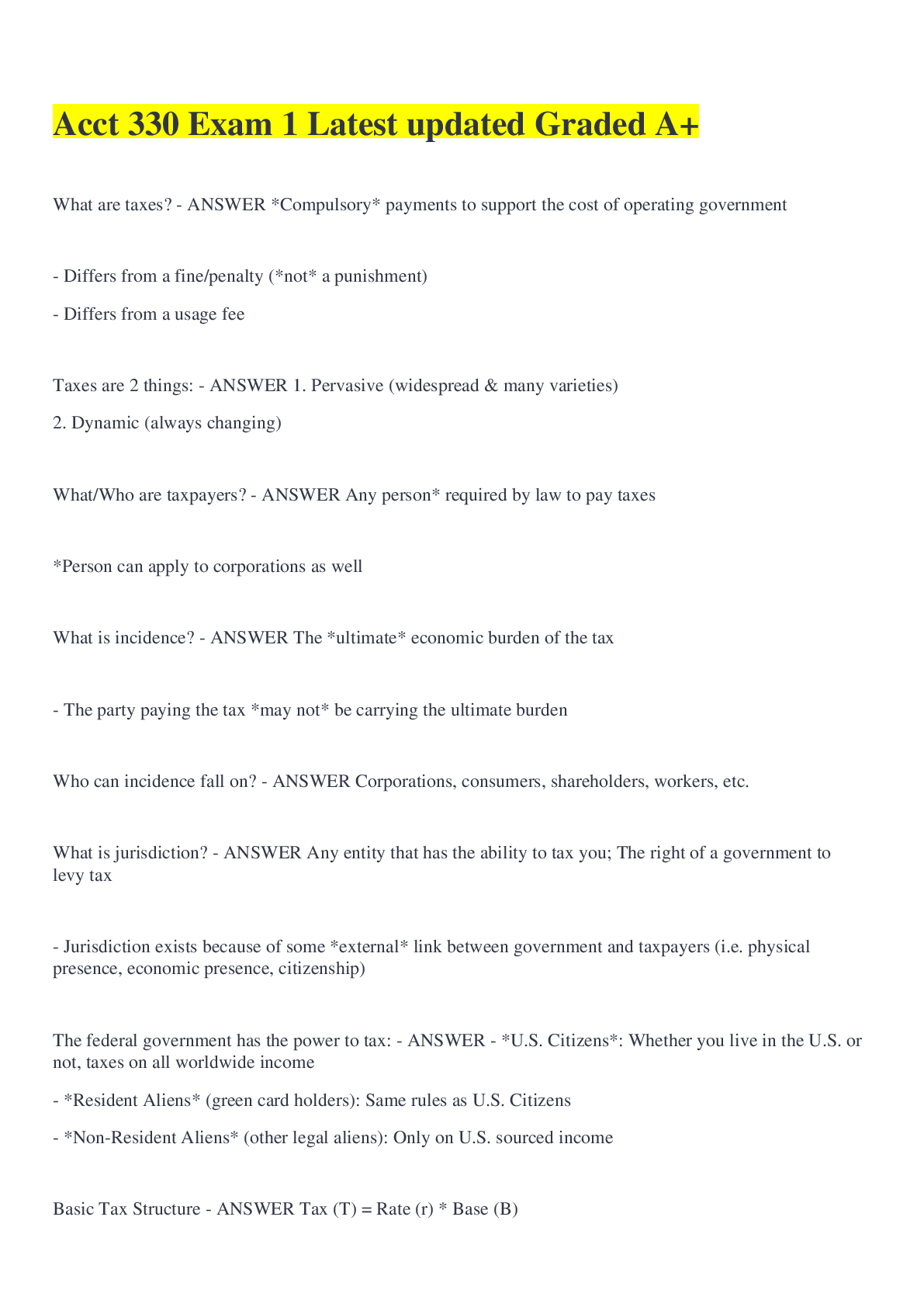
What are taxes? - ANSWER *Compulsory* payments to support the cost of operating government
- Differs from a fine/penalty (*not* a punishment)
- Differs from a usage fee
Taxes are 2 things: - ANSWER 1. Pervasive (w
...
What are taxes? - ANSWER *Compulsory* payments to support the cost of operating government
- Differs from a fine/penalty (*not* a punishment)
- Differs from a usage fee
Taxes are 2 things: - ANSWER 1. Pervasive (widespread & many varieties)
2. Dynamic (always changing)
What/Who are taxpayers? - ANSWER Any person* required by law to pay taxes
*Person can apply to corporations as well
What is incidence? - ANSWER The *ultimate* economic burden of the tax
- The party paying the tax *may not* be carrying the ultimate burden
Who can incidence fall on? - ANSWER Corporations, consumers, shareholders, workers, etc.
What is jurisdiction? - ANSWER Any entity that has the ability to tax you; The right of a government to levy tax
- Jurisdiction exists because of some *external* link between government and taxpayers (i.e. physical presence, economic presence, citizenship)
The federal government has the power to tax: - ANSWER - *U.S. Citizens*: Whether you live in the U.S. or not, taxes on all worldwide income
- *Resident Aliens* (green card holders): Same rules as U.S. Citizens
- *Non-Resident Aliens* (other legal aliens): Only on U.S. sourced income
Basic Tax Structure - ANSWER Tax (T) = Rate (r) * Base (B)
- Base = What can be taxed?
Flat rate - ANSWER A *single* percentage applicable to *all* base amounts
Graduated rate - ANSWER *Differing* percentages applied to *different* base amounts
Progressive rate structure - ANSWER *Higher* rates for *higher* bases
Proportional rate structure - ANSWER One rate for all bases (*flat rate*)
Regressive rate structure - ANSWER *Higher* rates for *lower* bases
- No tax is like this
Transaction-based tax - ANSWER Triggered by an event (ex: transactions)
Activity-based tax - ANSWER Imposed ongoing activities (ex: employment)
Earmarked taxes - ANSWER The revenues from some taxes are *directly* linked to certain government expenditures
- *Property taxes* finance public schools and emergency services
- *Payroll taxes* finance Social Security, Medicare, etc.
Which of the following is *not* a characteristic of tax?
A. A tax is compulsory
B. A tax is intended to punish unacceptable behavior
C. A tax is levied by a government
D. All of these choices are characteristics of a tax - ANSWER B. A tax is intended to punish unacceptable behavior
Which tax raises the most revenue for the federal government? - ANSWER Individual income tax
Mr. Dodd resides in a state with a 6% sales and use tax. He recently traveled to another state to buy furniture and paid that state's 4% sales tax. Which of the following statements is *true*?
A. Mr. Dodd's use tax liability to his home state equals 2% of the purchase price of the furniture
B. Mr. Dodd does not owe a use tax to his home state
C. Mr. Dodd's use tax liability to his home state equals 6% of the purchase price of the furniture
D. None of these choices are true - ANSWER A. Mr. Dodd's use tax liability to his home state equals 2% of the purchase price of the furniture
Acme Incorporated's federal income tax increased by $100,000 this year. As a result, Acme reduced the annual dividend paid on its common stock by $100,000. Who bears the incidence of the corporate tax increase? - ANSWER Acme's shareholders
Which of the following is an earmarked tax?
A. A tax that generates revenues that the government can spend only to build more National Parks
B. A tax imposed on the purchase of specific items such as liquor or cigarettes
C. A tax imposed only on individuals who earn more than $1 million annually
D. A tax that generates revenues that the government can spend for any purpose - ANSWER A. A tax that generates revenues that the government can spend only to build more National Parks
What are local taxes? - ANSWER Taxes at *city* or *county* level
- Primarily consists of: real property, personal property, sales tax, and income tax
What is real property? - ANSWER Qualifies as any land, anything on the land, and anything under the land
- Taxes are paid annually on *market value* of real property (Market value is determined by a tax assessor and can be contested by owner)
- Different types of real property are often taxed at different rates and/or subject to different appraisal techniques
Property Tax Abatement - ANSWER A temporary reduction in tax
What is personal property? - ANSWER Any assets that are *not* real property
- Taxes are paid annually based on *market value* of asset (Market value is *NOT* determined by an assessor and instead must be *self reported*)
Why are personal property taxes becoming less relevant for local tax revenue? - ANSWER No one is assessing or reporting assets because it's cumbersome
*State tax* revenues consist primarily of: - ANSWER - Consumption (sale)
- Income (personal)
What is sales tax levied on consumers based on? - ANSWER Retail price of tangible goods
What states don't impose a sales tax? - ANSWER Alaska, Delaware, Montana, New Hampshire, and Oregon
- If a state doesn't have sales tax, local can't have sales tax
What is a use tax? - ANSWER A tax on the ownership, possession, or consumption of tangible goods within a state that must be paid when the owner did not pay the state's sales tax
- Only applies to sales tax
- Use tax = *Pointless*
[Show More]