Assessment
process of observing a sample of student's behavior/performance and drawing inferences about the student's knowledge/abilities
An effective teacher continually analyzes data from multiple assessments to
...
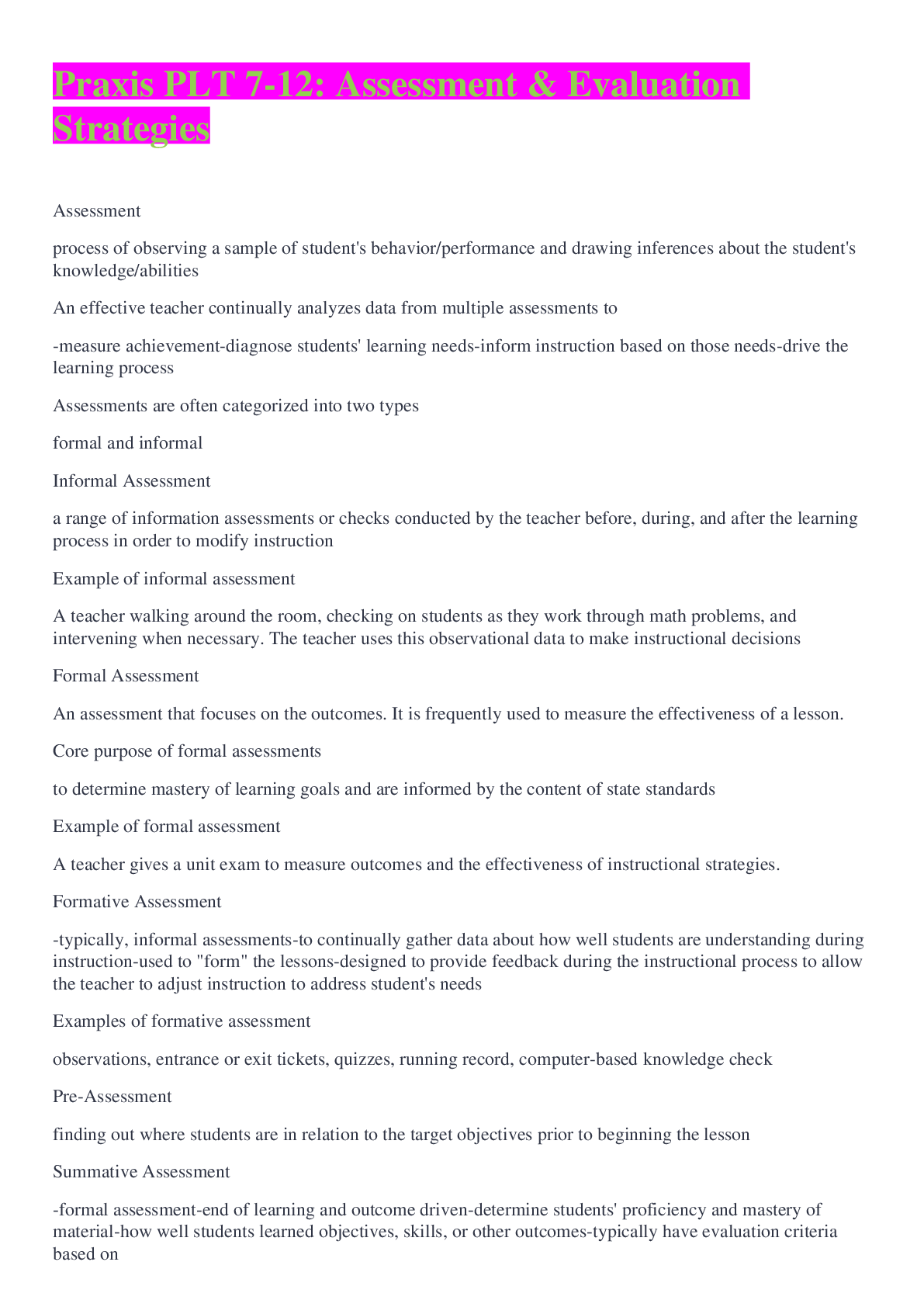
Assessment
process of observing a sample of student's behavior/performance and drawing inferences about the student's knowledge/abilities
An effective teacher continually analyzes data from multiple assessments to
-measure achievement
-diagnose students' learning needs
-inform instruction based on those needs
-drive the learning process
Assessments are often categorized into two types
formal and informal
Informal Assessment
a range of information assessments or checks conducted by the teacher before, during, and after the learning process in order to modify instruction
Example of informal assessment
A teacher walking around the room, checking on students as they work through math problems, and intervening when necessary. The teacher uses this observational data to make instructional decisions
Formal Assessment
An assessment that focuses on the outcomes. It is frequently used to measure the effectiveness of a lesson.
Core purpose of formal assessments
to determine mastery of learning goals and are informed by the content of state standards
Example of formal assessment
A teacher gives a unit exam to measure outcomes and the effectiveness of instructional strategies.
Formative Assessment
-typically informal assessments
-to continually gather data about how well students are understanding during instruction
-used to "form" the lessons
-designed to provide feedback during the instructional process to allow the teacher to adjust instruction to address student's needs
Examples of formative assessment
observations, entrance or exit tickets, quizzes, running record, computer based knowledge check
Pre-Assessment
finding out where students are in relation to the target objectives prior to beginning the lesson
Summative Assessment
-formal assessment
-end of learning and outcome driven
-determine students' proficiency and mastery of material
-how well students learned objectives, skills, or other outcomes
-typically have evaluation criteria based on standar
- "sums" up lessons/units
-assess the effectiveness of a curriculum or instructional program
Examples of Summative Assessment
-mid-term or final exam
-district benchmark tests
-state assessments
-performance assessment like a research paper, digital project, or visual presentation
-chapter tests
-science lab at the end of a unit
Diagnostic Assessment
-pre-assessment providing instructors with information about students prior knowledge, preconceptions, and misconceptions before beginning a learning activity
-considered formative assessments because they inform instruction
-can be given during a lesson
Example of a diagnostic assessment
Before starting a Science Unit, a teacher gives a quick assessment to determine students' prior knowledge of concepts in the text.
She uses this information to make instructional decisions moving forward.
performance based assessment
-an assessment that measures students' ability to apply the skills and knowledge from a unit or units of study
-the task challenges students to use their higher order, critical thinking skills to creat a product or complete a process
Example of performance based assesment
After reading text about the Civil War, students develop stories about different historical figures in the war.
Students then perform these stories in front of the class and answer questions.
Screening
-an assessment used to place students in appropriate classrooms or grade level
Example of screening
Students are typically screened throughout the year to determine what level they are reading.
Placement decisions are made based on the outcomes of the screening
Create and select appropriate assessment format to meet instructional objectives
-backward design
-test item analysis
-test per standards and objectives
-select most appropriate assessment at the appropriate time to measure the appropriate skill
-create valid and reliable assessments and test questions (check a copied test to make sure that it doesn't have questions that you didn't teach or plan to teach)
-item analysis
-assessment sequence
-testing environment
-accomodations
Item analysis
-follow-up analysis of patterns in students' responses to various items in an assessment
-process which examines student responses to individual test items to determine quality of test instructions and items
Examples of a test question quality used to determine if the question should be excluded
-if all students missed the problem
-wording was misleading or confusing
-skill taught does not align to the skill tested on the assessment
-not a correct answer choice
-question is not answerable because their is misinformation in the question
-item is too difficult or too easy
Key step in the backwards design process
assessments
Rubric
-an evaluation tool or set of guidelines used to promote the consistent application of learning expectations, learning objectives, or learning standards in the classroom
-measure students' attainment of knowledge against a set of criteria
-typically used for large projects and writing
Rubrics should be used for the following reasons
- inform students of the expectations before the assignment is started
- act as a formative self-assessment or peer-assessment tool during the task
-act as a final evaluation for the teacher
Rubrics are classified 2 ways
holistic and analytic
[Show More]