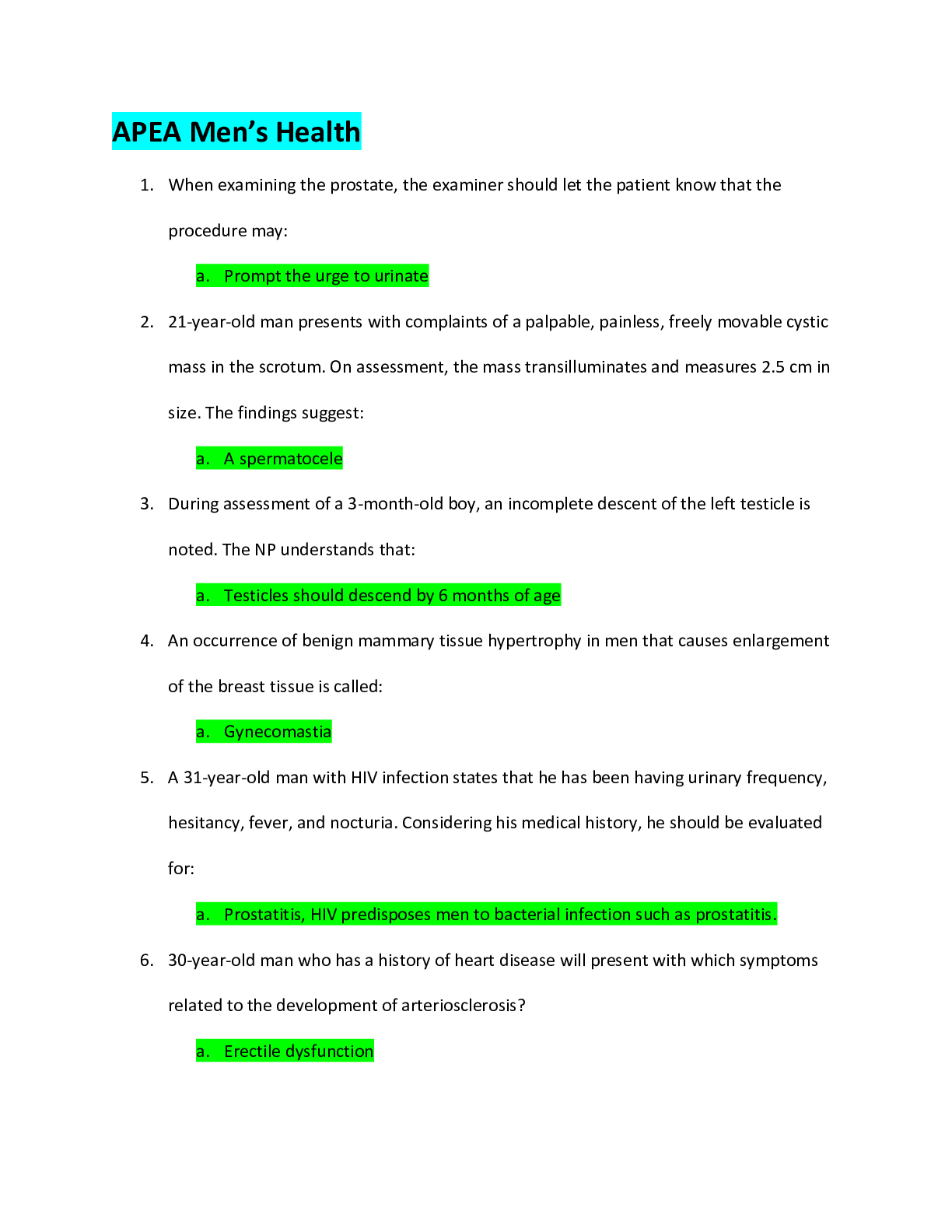
Question: Noninfectious epididymitis is common in:
Question: A 65 year-old patient has a firm, non-tender, symmetrical enlarged prostate gland on examination. His PSA is 3.9 ng/mL. This probably indicates:
Question: W
...
Question: Noninfectious epididymitis is common in:
Question: A 65 year-old patient has a firm, non-tender, symmetrical enlarged prostate gland on examination. His PSA is 3.9 ng/mL. This probably indicates:
Question: What symptom listed below might be seen in a male patient with benign prostatic hyperplasia?
Question: A patient with testicular torsion will have a:
Question: What is the effect of digital rectal examination (DRE) on a male’s PSA (prostate specific antigen) level if it is measured on the same day as DRE?
Question: Which of the following results in a clinically insignificant increase in the prostate specific antigen (PSA)?
Question: 5-alpha-reductase inhibitors work by producing:
Question: A localized tumor in the prostate gland associated with early stage prostate cancer is likely to produce:
Question: A 22 year-old male who is otherwise healthy complains of scrotal pain. His pain has developed over the past 4 days. He is diagnosed with epididymitis. What is the most likely reason?
Question: Hesselbach’s triangle forms the landmark for:
Question: A 25 year-old male patient is training for a marathon. He reports an acute onset of scrotal pain after a 10 mile run. He has nausea and is found to have an asymmetric, high-riding testis on the right side. What should be suspected?
Question: A 70 year-old male presents to your clinic with a lump in his breast. How should this be evaluated?
Question: Digital rectal exam may be performed to assess the prostate gland. Which term does NOT describe a prostate gland that may have a tumor?
Question: Rechecked?
Question: A 50 year-old male comes to the nurse practitioner clinic for evaluation. He complains of fever 101F, chills, pelvic pain, and dysuria. He should be diagnosed with:
Question: The following PSA levels have been observed in a patient. What conclusion can be made following these annual readings? Year 1: 3.2 ng/mL Year 2: 3.8 ng/mL Year 3: 4.2 ng/mL
Question: What is the recommendation of American Cancer Society for initial screening of an African-American male for prostate cancer?
Question: What class of medications can be used to treat benign prostatic hyperplasia and provide immediate relief?
Question: A common presentation of an inguinal hernia is:
Question: Hematuria is not a common clinical manifestation in:
Question: What is American Cancer Society’s recommendation for prostate screening in a 70 year-old male?
Question: What is the recommendation from American Cancer Society for assessment of the prostate gland in a man who is 45 years old and of average risk for development of prostate cancer? He should have:
Question: A male patient has epididymitis. His most likely complaint will be:
Question: Which of the following medications should be avoided in a 65 year-old male with benign prostatic hyperplasia (BPH)?
Question: An elderly male patient is taking finasteride, a 5-alpha-reductase inhibitor. What affect might this have on his PSA level?
Question: What is the recommendation of American Cancer Society for screening an average risk 40 year-old Caucasian male for prostate cancer?
Question: According to ACS, Men should not be screened unless they have received this information. The discussion about screening should take place at:
—————————————————-
Question: Which of the following is inconsistent with the description of benign prostatic hyperplasia (BPH)?
Question: When prescribing antihypertensive therapy for a man with BPH and hypertension, the NP considers that:
Question: When assessing a 78-year-old man with suspected BPH, the NP considers that:
Question: Which of the following medications can contribute to the development of acute urinary retention in an older man with BPH?
Question: A 78-year-old man presents with a 3-day history of new-onset fatigue and difficulty with bladder emptying. Examination reveals a distended bladder but is otherwise unremarkable. Blood urea nitrogen level is 88 mg/dL (31.4 mmol/L); creatinine level is 2.8 mg/dL (247.5 μmol/L). T he most likely diagnosis is:
Question: Surgical intervention in BPH should be … with all of the following except:
Question: Finasteride (Proscar, Propecia) and dutasteride (Avodart) are helpful in the treatment of BPH because of their effect on:
Question: Tamsulosin (Flomax) is helpful in the treatment of BPH because of its effect on:
Question: Concerning BPH, which of the following statements is true?
Question: Concerning herbal and nutritional therapies for BPH treatment, which of the following statements is false?
Question: You examine a 32-year-old man with chancroid and anticipate finding:
Question: All of the following are typical findings for a patient with chancroid except:
Question: The causative organism of chancroid is:
14) Question: Treatment option for Chancroid includes includes all of the following except:
15) Question: When ordering laboratory tests to confirm chancroid the NP considers that:
————————————————————–
Question: Age of Initial Cervical Screening
Question: Cervical Cancer
Question: When do we stop PAP?
Question: How often we screen for PAP?
Question: Discontinue pap
Question: Significant of T zone is where you find squamous cell dysplasia
Question: Colposcopy Indicated
Question: VULVOVAGINITIS
Question: A patient has been … with vulvovaginal candidiasis. Which choices listed below are predisposing factors? Select all that apply? Not number 4. mmunocompetence
Question: Patient symptoms: Normal (clear, white, odorless), PH: 4.0 to 4.5, Whiff: Negative, KOH: Negative
Question: Diagnostic Studies:Candiadias
Question: Management for Yeast or Candidias
Question: Topical agent
Question: Which treatment for vulvovaginal candidiasis relieves symptoms most rapidly?
Question: Atrophic vaginitis
Question: A 60 year old female has begun to have a small amount of blood escaping from the vagina. What is the most common cause of malignancy, when one is … ?
Question: Initially: Exam, EMB, US???
Question: OSTEOPOROSIS
Question: Which T-score reflects a patient with osteopenia
Question: Osteoporosis Screening
Question: Oral Bisphosphonates Considered first line for most patients with osteoperosis
Question: Breast Masses
Question: Screening for breast ca
Question: Which choices below are causes of secondary dysmenorrhea? Select all that apply.
Question: A 17 year old female is HIV positive. What is the recommendation for cervical screening for her?
Question: Truck driver
Question: BENIGN PROSTATIC HYPERPLASIA
Question: At what age is the finding of benign prostatic hyperplasia most likely?
Question: Documentation should include the following for BPH:
Question: PSA
Question: What are the major causes of an … serum PSA? Select all that apply
Question: PSA Velocity = Rate of PSA change over time
Question: Management
Question: ACUTEPROSTATITIS(Think Bacterial, consider STI)
Question: Etiology
Question: Assessment Findings for Bacterial prostatitis
Question: Evaluation for acute prostatitis
Question: Why should “gentle” prostate exam be … in the setting of likely bacterial prostatitis? Select all that apply
Question: Management on bacterial prostatitis
Question: CHRONIC PROSTATITIS
Question: Most men who are … with prostate cancer present with:
Question: Assessment Findings
Question: Screening for prostate cancer is most beneficial in men who
not have a life expectancy of < 10 years.
Question: American Cancer Society
Question: EPIDIDYMITIS
Question: Etiology of Epidymitis
Question: Epididymitis
Question: A 22 year old male patient presents with complaint of scrotal pain after a minor car accident. What must be part of the differential diagnosis?
Question: Which factor … below is NOT a risk factor for erectile dysfunction1.
Question: Why should “gentle” prostate exam be … in the setting of likely bacterial prostatitis? Select all that apply
Question: Management for acute prostatitis
Question: CHRONIC PROSTAT
[Show More]