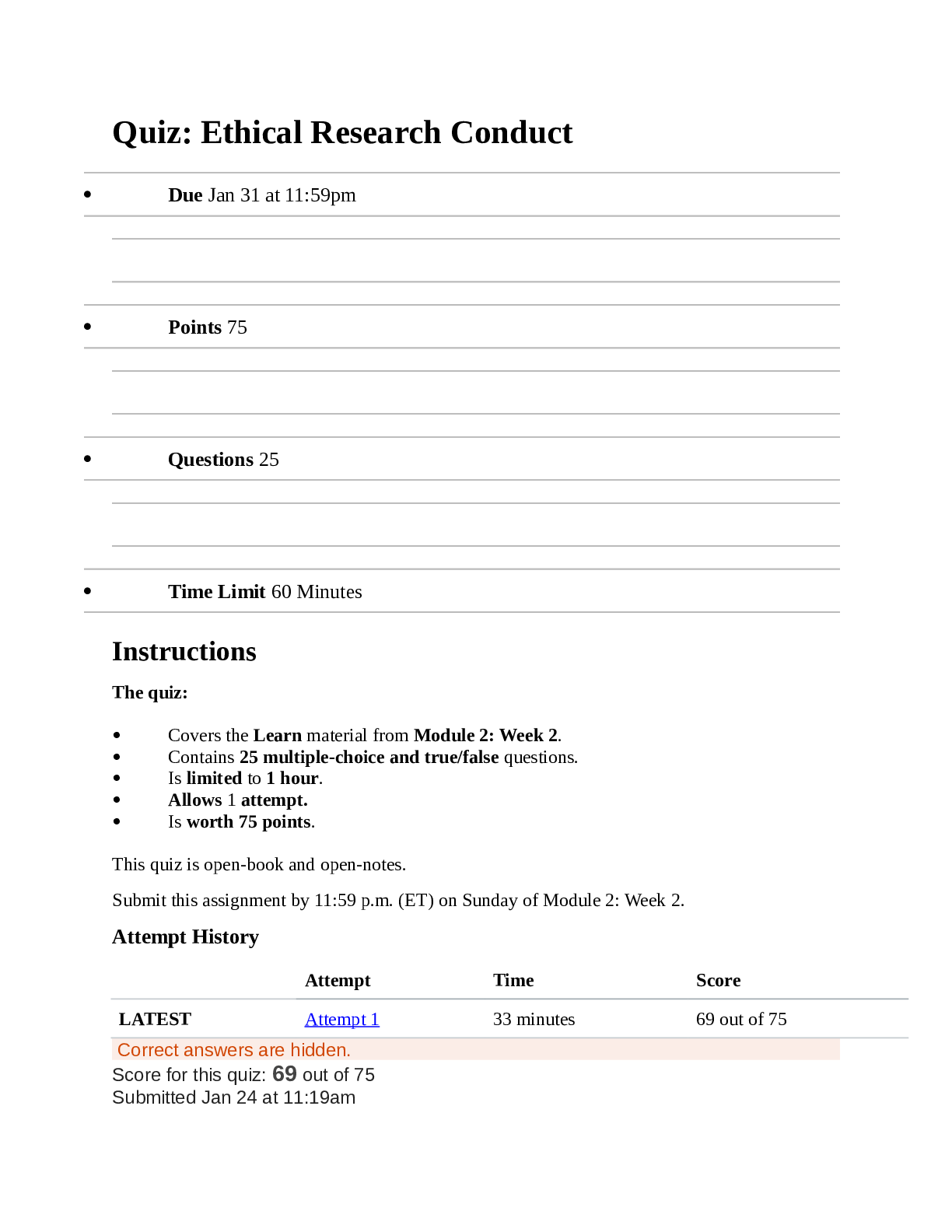
EDUC 750 Quiz 1
• Question 1
3 out of 3 points
Triangulation implies that viewing a situation from different perspectives will help the researcher gain a clearer picture of the educational situation being studie
...
EDUC 750 Quiz 1
• Question 1
3 out of 3 points
Triangulation implies that viewing a situation from different perspectives will help the researcher gain a clearer picture of the educational situation being studied.
Selected Answer: True
• Question 2
3 out of 3 points
Which type of research attempts to answer the question “what is going on here?” Selected Answer: Exploratory
• Question 3
3 out of 3 points
A researcher who is interested in studying bullying primarily because of his own childhood experience as a target of bullying is probably motivated by reasons.
Selected Answer: personal
• Question 4
3 out of 3 points
The philosophy is closely linked to qualitative research approaches. Selected Answer: interpretivism
• Question 5
3 out of 3 points
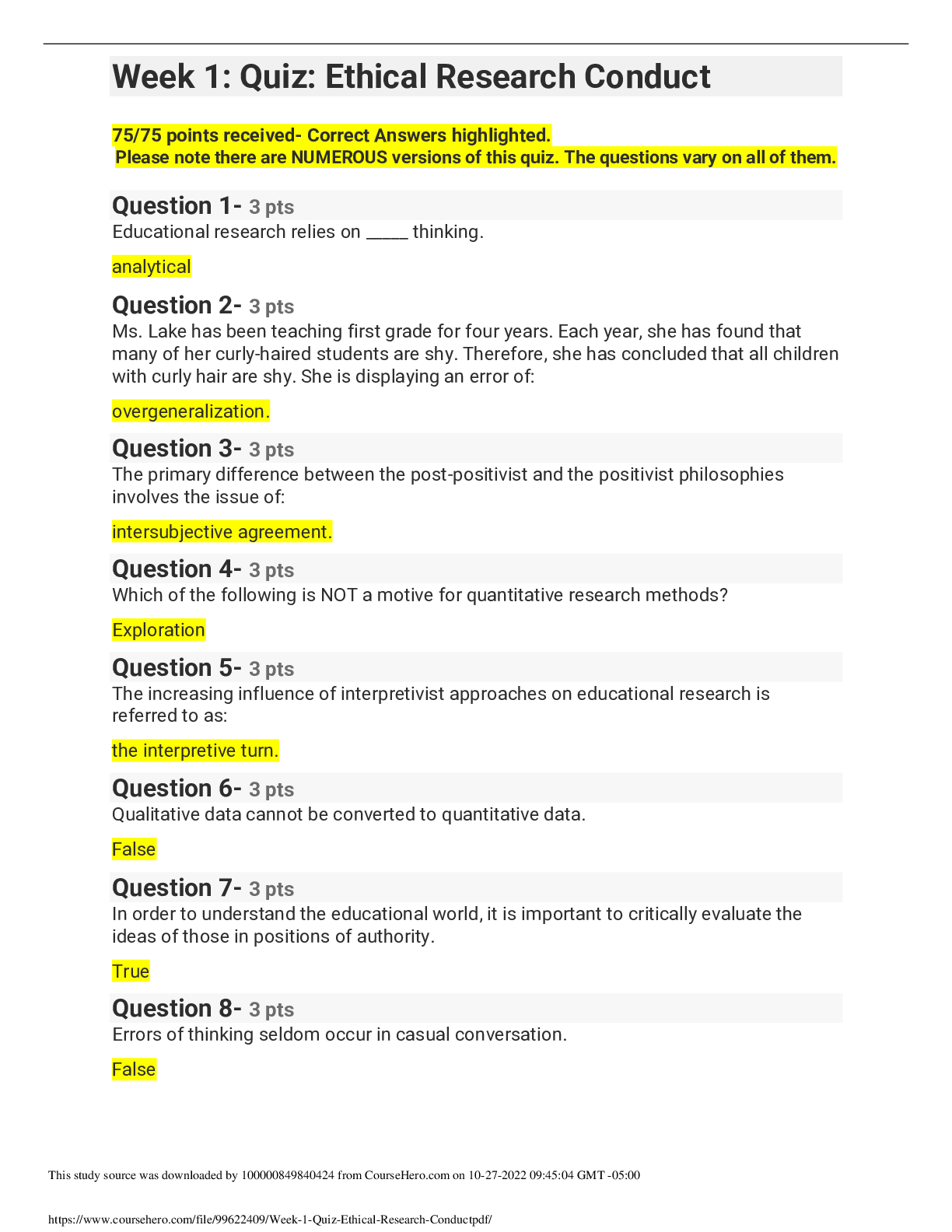
The increasing influence of interpretivist approaches on educational research is referred to as: Selected Answer: the interpretive turn.
• Question 6
3 out of 3 points
Which statement accurately summarizes findings from the U. S. Department of Health and Human Services study on the impact of the Early Head Start program?
Selected Answer: The program reached only 3% of those eligible to receive services.
• Question 7
3 out of 3 points
Educational research relies on thinking. Selected Answer: analytical
• Question 8
3 out of 3 points
Ms. Lake has been teaching first grade for four years. Each year, she has found that many of her curly- haired students are shy. Therefore, she has concluded that all children with curly hair are shy. She is displaying an error of:
Selected Answer: overgeneralization.
• Question 9
0 out of 3 points
Our questions about various research topics are answered by educational theory. Selected Answer: True
• Question 10
3 out of 3 points
Which aspect of a research proposal involves identifying human subjects' issues? Selected Answer: Ethics statement
• Question 11
3 out of 3 points
Which one of the following characteristics is NOT a criterion for a good educational research question? Selected Answer: Intention
• Question 12
3 out of 3 points
No Child Left Behind and the popularity of classroom-based research methods have raised awareness about the goal of :
Selected Answer: practical significance.
• Question 13
3 out of 3 points
An educational research question may be answered through the of empirical data. Selected Answer: collection and analysis
• Question 14
3 out of 3 points
Qualitative researchers often employ a deductive reasoning process. Selected Answer: False
• Question 15
3 out of 3 points
What do the authors recommend researchers do to avoid becoming overwhelmed by the task of formulating a research question?
Selected Answer: Develop the question one step at a time.
• Question 16
3 out of 3 points
When we consider whether or not the answer to a research question will make a difference for society we are addressing:
Selected Answer: educational importance.
• Question 17
3 out of 3 points
When assessing the validity of a study, it is important to:
Selected Answer: understand the research methods.
• Question 18
3 out of 3 points
The standard of confidentiality does not apply to information available in public records. Selected Answer: True
• Question 19
3 out of 3 points
Diana Baumrind and Stanley Milgram agreed that obedience to authority could be studied in a laboratory setting.
Selected Answer: False
• Question 20
3 out of 3 points
Why did Amos Hatch reportedly feel guilty following his six-month study of social interactions in kindergarteners?
Selected Answer: He observed the bullying of a child and did not intervene.
• Question 21
3 out of 3 points
Assessing a study from the perspective of the subject(s) is central to research ethics. Selected Answer: True
• Question 22
3 out of 3 points
In order for an experiment to be considered valid, the research methods must be kept confidential. Selected Answer: False
• Question 23
3 out of 3 points
Minimizing possible harm to subjects and maximizing benefits are cornerstones of the ethical principle referred to as:
Selected Answer: beneficence.
• Question 24
3 out of 3 points
How many of Milgram's 40 subjects shocked the Learner at the highest level (XXX)? Selected Answer: 25
• Question 25
3 out of 3 points
The primary focus of research ethics is: Selected Answer: protecting subjects.
[Show More]