Imagine a Cat Going To School In (ICGTSI - Decision Making Process (6) - ANSWER Prob ID, Data Collection, Solution Generation, Solutions Test, Solution Selection, Solution Implementation
Hard Data Network System Secur
...
Imagine a Cat Going To School In (ICGTSI - Decision Making Process (6) - ANSWER Prob ID, Data Collection, Solution Generation, Solutions Test, Solution Selection, Solution Implementation
Hard Data Network System Security Ecommerce (IS elements) - ANSWER Hardware and Software, Data Resource Mgmt, Network, Systems and Decisions, Security and Ethics, Ecommerce and Social Meida
System that accepts input data and processes it into information as output - ANSWER Information System
Information that have been organized to provide value to an organization - ANSWER Data
Information systems accept _____ as input and process it into ______ as output. - ANSWER data,information
The primary component categories that make up a Computer-based Information System (CBIS) - ANSWER (PPHSND) people, processes, hardware, software, networks, and data
Utility Software - ANSWER Programs perform periodic system maintenance activities, such as virus detection, storage space consolidation, backup and recovery, intrusion detection, and access authentication monitoring
Information systems specialists - ANSWER People who develop, operate, and maintain the systems. Specialists include programmers, systems analysts, testers, computer operators, and other managerial IS personnel
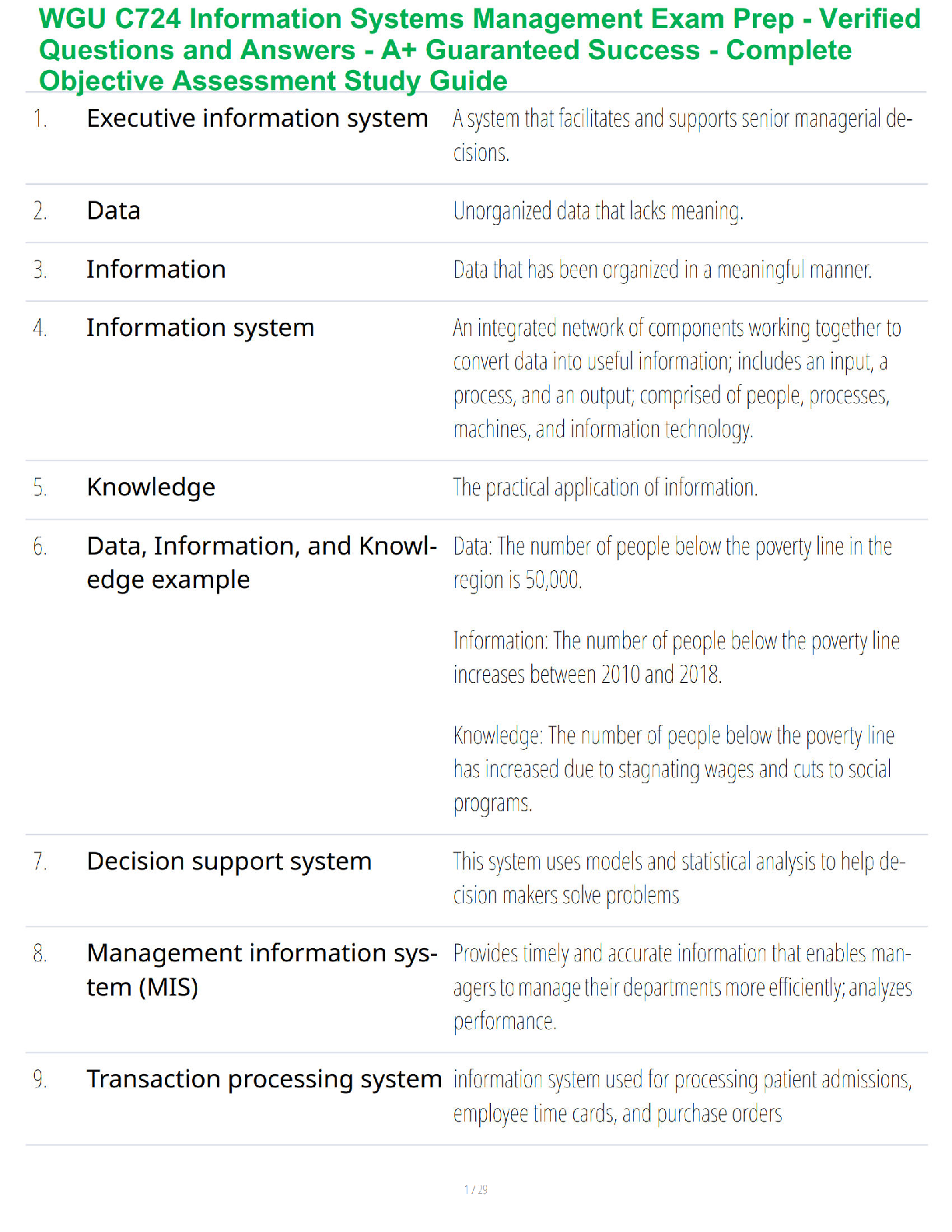
Transaction processing systems (TPS) - ANSWER This system tracks the flow of daily routine transactions that are necessary to conduct business, such as payroll or order processing
Management information systems (MIS) - ANSWER This system provides first level managers with reports on current performance and historical records to help keep an organization running smoothly
Decision-support systems (DSS) - ANSWER This system provides modeling and analytical tools that support middle to senior managers in all aspects of the decision making process, when problems are unique, unstructured, and not easily specified in advance, to project potential future trends
Executive information systems (EIS) - ANSWER This system supports senior executives by providing important data in the form of graphs and charts to analyze and identify long-term trends
IS 4 pyramid - ANSWER TPS, MIS, DSS, EIS
The IS function is _____ in structure and its success depends on its cooperation and relationship with the other functions in an organization - ANSWER Horizontal
About one third of the IS management agenda is expected to change every _____ ______ , confirming the highly dynamic nature of the IS management function. - ANSWER Three years
Example of IS helping HR - ANSWER Monthly payroll
Playboys Produced Hotdogs Since Nutritionists Died (IS) - ANSWER People, processes, hardware, software, networks, and data
Hotdogs Since Nutritionists Died (IT = Sub of IS) - ANSWER Hardware, software, networks and data
Information Technology is a subset of ______ - ANSWER Information Systems
HTTP - ANSWER Hypertext Transfer Protocol is the communications protocol at the foundation of all communication of the World Wide Web
HTTPS - ANSWER Hypertext Transfer Protocol Secure, which uses HTTP as well as technologies such as Secure Socket Layer (SSL) and Transport Layer Security (TLS) to encrypt and decrypt data between the user and Web server
FTP - ANSWER File Transfer Protocol = An unsecure method used to transfer files from one computer to another.
SFTP - ANSWER Secure File Transfer Protocol = Much like HTTPS, SFTP uses secure technologies, this time Secure Shell (SSH), to secure the connection for transferring files from computer to computer
DHCP - ANSWER Dynamic Host Configuration Protocol = A DHCP server or appropriately configured router automatically and temporarily assigns IP addresses to DHCP-enabled systems on the network
SMTP - ANSWER Simple Mail Transfer Protocol = One of several popular email protocols in use today (others include IMAP and POP3)
SNMP - ANSWER Simple Network Management Protocol = Information concerning network status that is periodically passed between a network management server and routers on a network, for the purpose of monitoring network status
TELNET - ANSWER An early and insecure remote access protocol used to allow a user to log on to a remote system. Many newer, more secure and more modern forms exist, including secure shell (SSH) and Remote Desktop Protocol (RDP)
DNS - ANSWER Domain Name Service = Server-based service that translates human language Web address or URL into an IP address, which is used.
LDAP - ANSWER Lightweight Directory Access Protocol = Created by the International Telecommunications Union; a standardized protocol that defines the organization of a set of directory records, such as groups, individual names, and attributes that are associated with them. Many applications use the LDAP standard. The most used example is Microsoft Outlookâs global address list and Microsoft Active Directory
URL - ANSWER Uniform Resource Locator is a protocol used by a client computer to request a website from a server via HTTP or HTTPS
Synchronous - ANSWER Communication occurs in real time, with their client using online chat or instant messaging
Asynchronous - ANSWER Communication occurs at different times via bulletin boards, blogs, and streaming videos
Major business functions by IS - ANSWER Accounting and Finance, HR, Prod and Ops, Sales and Marketing
Accounting and Finance - ANSWER Accounts payable, receivable, budgeting, general ledgers, payroll, cash flow, financial transactions
HR - ANSWER Recruiting and training, employee benefits and regulations management, employee records
Prod and Ops - ANSWER Product life cycle, manufacturing, inventory management, quality control, research and development
Sales and Marketing - ANSWER Sales analysis, set pricing, marketing mix, and product promotions, customer profiling
Which business function is responsible for Quality Control? - ANSWER Prod and Ops
IT Mgmt Challenges - ANSWER Political and Legal Pressures, Cultural Pressures, Technological Pressures, Economic Pressures
Types of computers - ANSWER PC, Workstation (more than 1 person), Server (printers, fax), Mainframe (high performance to process large data), Supercomputer (simulating weather patters, decoding genome structures), Grid computing (supercomputer for many smaller systems connected), Virtual
Document camera - ANSWER Real-time image capture for displaying an object to a large audience
SDLC (Software Development Life Cycle) - ANSWER Traditional method to develop software
[Show More]



.png)