WGU C724 Study Sets. Questions and
accurate answers, 100% Accurate,
graded A+
The evolution of software has produced the ability to manage large databases of information, known as
- ✔✔-database management systems
...
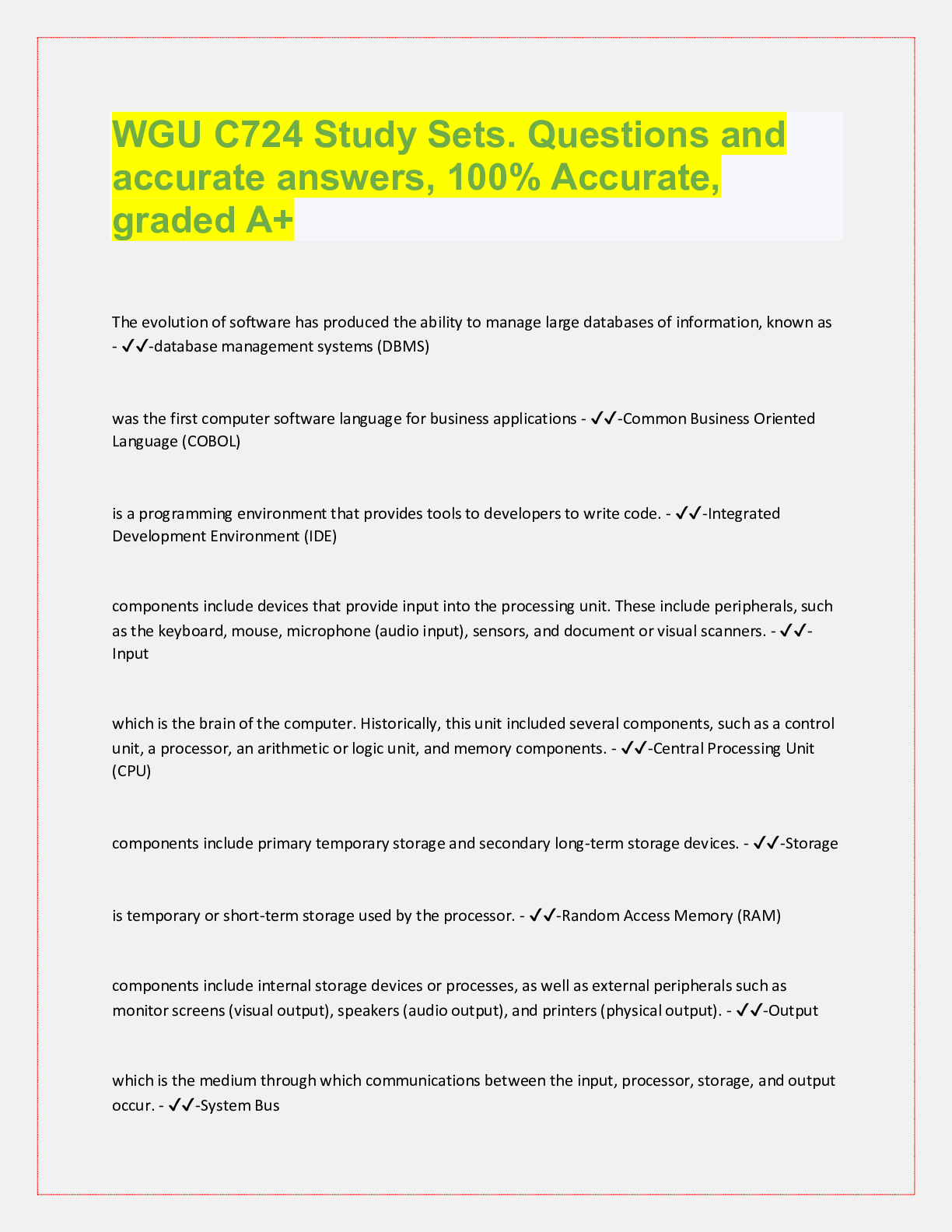
WGU C724 Study Sets. Questions and
accurate answers, 100% Accurate,
graded A+
The evolution of software has produced the ability to manage large databases of information, known as
- ✔✔-database management systems (DBMS)
was the first computer software language for business applications - ✔✔-Common Business Oriented
Language (COBOL)
is a programming environment that provides tools to developers to write code. - ✔✔-Integrated
Development Environment (IDE)
components include devices that provide input into the processing unit. These include peripherals, such
as the keyboard, mouse, microphone (audio input), sensors, and document or visual scanners. - ✔✔-
Input
which is the brain of the computer. Historically, this unit included several components, such as a control
unit, a processor, an arithmetic or logic unit, and memory components. - ✔✔-Central Processing Unit
(CPU)
components include primary temporary storage and secondary long-term storage devices. - ✔✔-Storage
is temporary or short-term storage used by the processor. - ✔✔-Random Access Memory (RAM)
components include internal storage devices or processes, as well as external peripherals such as
monitor screens (visual output), speakers (audio output), and printers (physical output). - ✔✔-Output
which is the medium through which communications between the input, processor, storage, and output
occur. - ✔✔-System Bus
or similarly the backplane, of a system is the device that contains the system bus and connects the
various input and output devices that compose any given computer system. - ✔✔-Motherboard
tracking barcodes and wireless sensor networks, some used in supply chain operations. - ✔✔-radio
frequency identification (RFID)
A person interacts with digital data through a physical environment. - ✔✔-Tangible User Interface (TUI)
is the most advanced integrated circuit and holds millions of integrated circuits in a semiconductor chip.
They are programmable devices that process instructions and incorporate the four functions of a
computer central processing unit (CPU), which includes fetch, decode, execute and store. - ✔✔-
Microprocessor
A chip with multiple CPUs is called a ........ This typically provides more computing power for they can
run multiple instructions in parallel. - ✔✔-Multicore processor
coined by the co-founder of Intel, described that components in integrated circuits or microchips will
double every two years. - ✔✔-Moore's Law
otherwise known as CPU cache and random access memory (RAM), are typically referred to as volatile
flash memory, meaning that information storage is temporary and can only be stored until power is
removed. - ✔✔-Primary Storage
is accessed only through a system's input/output bus and is generally several orders of magnitude
slower than primary storage technologies. On the other hand, costs per byte for ........... have historically
been quite a bit less than primary storage technologies. Examples of ............. include magnetic hard disk
drives, which are spinning magnetic disks with moving read and write heads, as well as newer, more
modern solid state nonvolatile flash storage. ............. also includes removable media, such as magnetic
floppy disks, optical discs (CDs & DVDs), and USB flash drives. - ✔✔-Secondary Storage
Small systems are used on an individual basis (i.e., one-person use) and include traditional
multicomponent desktop systems (monitor, computer, keyboard, mouse) and integrated systems, such
as laptops and tablet computers. - ✔✔-Personal Computer (PC)
A more powerful system used by individuals in order to run more resource-intensive applications. - ✔✔-
Workstation
A system used to provide services to other systems. Servers need not be powerful computers. Server
operating systems may be used on personal computers, including desktops or laptops, though usually
servers are built on more resilient and reliable components. - ✔✔-Server
A high-capacity, high-performance system built for large organizations and used to quickly process large
volumes of data. - ✔✔-Mainframe
This term merely implies the fastest category of computer available. Supercomputers are purpose built
to handle vast amounts of information very quickly. Examples of supercomputer applications include
simulating global weather patterns, decoding genome structures, or simulating the human mind. - ✔✔-
Supercomputer
A form of supercomputer constructed from many smaller systems that have been connected together. -
✔✔-Grid computing
A software-based platform that allows multiple virtual servers, isolated from host computer, to operate
on a single or, potentially, a fabric of many systems. Initially intended to more efficiently use expensive
and underutilized hardware, virtualization has allowed for better fault tolerance and flexible, dynamic,
and automated server operation and maintenance. - ✔✔-Virtual computing
is software whose source-code is freely available to developers and users. .............. is developed not by
single users or companies, but by communities of connected users and groups. - ✔✔-Open Source
Software
is a system used to convert plain-text document into one optimized for viewing as a Web page,
integrating colors, graphics, fonts, and links. - ✔✔-Hyper Text Markup Language (HTML)
A computer language similar to HTML, XML makes it easier to exchange, validate, store, and interpret
data between a variety of applications and systems. - ✔✔-Extensible markup language (XML)
Many graphical and traditional text based HTML editors exist and range from the unsophisticated text
editors to feature rich graphical WYSIWIG (What You See Is What You Get) interfaces. Modern popular
examples include Adobe's Dreamweaver and Microsoft's Visual Studio. - ✔✔-Web design tools
Graphics, video, animations, and interactive multimedia are popular elements in Web pages. Popular
tools used to create these elements include Adobe's Photoshop, Flash, and Premier products. - ✔✔-
Graphics tools
Tools that allow webmasters and developers to achieve better rankings from search engines, implying
that traffic would better route to a site as a result. - ✔✔-Search engine optimization
Services are provided in-house on servers or in a datacenter owned, managed, and administered by the
organization. - ✔✔-On Premises (private cloud)
Software licensed and hosted on centralized or distributed servers that belong to a service provider.
Users access this software using a connection to the Internet and a Web browser. Examples include
Salesforce.com's CRM (Customer Relationship Management) application or Google Apps. - ✔✔-Software
as a service (SAAS
A service provider provides server space, the server, virtualization, operating system, database, and
development environment in a platform that can be used for application development. An example
would be Amazon Web Services. - ✔✔-Platform as a service (PAAS)
A service provider provides a cloud fabric, or pooled services, including server space, servers, storage,
and all other aspects of the computing platform, with the exception of the operating system and
applications, which the client organization would install and manage. Benefits include dynamic scaling
and may include geographic distribution. An example would be Windows Azure or Rackspace. - ✔✔-
Infrastructure as a service (IAAS)
ensures that only authorized personnel are admitted access. - ✔✔-Confidentiality
ensures that data is produced and modified in the correct way. - ✔✔-Integrity
ensures that access to resources is unimpeded. - ✔✔-Availability
The potential for loss, commonly associated with the monetary and non-monetary impact to such a
,,,,,,,,,,, as well as the probability of occurrence. - ✔✔-Risks
A weakness in the technology, process and procedure, or people involved with any given information
asset. Such ,,,,,,,,,,,,,,, may include weaknesses in the technologies used, including their configurations,
and the security policies that are enforced or not within an organization. - ✔✔-Vulnerabilities
The identified and unidentified actors that have the potential for attacking the information assets. Such
actors may include elements both internal and external to the organization. - ✔✔-Threats
The damaging or potentially damaging acts that are the product of an attacker's process, which may
include: reconnaissance, scanning, gaining and maintaining access, escalating privileges, building
backdoors, and destroying evidence. - ✔✔-Attacks
a loss of access created by cut cables or power services, malware, hoaxes, bots and botnets (i.e. a
computer or groups of hijacked computers to attack others, often without notice to their owners), smurf
attacks, SYN floods, DNS poisoning, or outright hijacking and/or redirection of services. - ✔✔-Denial of
service
malicious software applications - ✔✔-Malware One high-profile example of a malware threat is SQL
Injection, which uses vulnerabilities in the most popular type of database, SQL, to modify, delete, or
steal information.
Malware is spread through a variety of methods, direct download (intentional or not), as a part of
another application or utility - ✔✔-Trojan Horse
website visit (e.g. drive-by download), or merely by being connected to the Internet or affected network
- ✔✔-worm
In some cases, internal attackers, such as disgruntled employees, may introduce malware - ✔✔-logic
bomb
One high-profile example of a malware threat is.................... which uses vulnerabilities in the most
popular type of database, SQL, to modify, delete, or steal information. - ✔✔-SQL Injection
a threat or attack that exploits known or unknown vulnerabilities in software. Software developers
quickly patch vulnerabilities once known, though identifying these vulnerabilities takes time. Once found
and fixed, developers must send patches to all affected or potentially affected users, which,
unfortunately, does not occur consistently. In other cases, the public release of patches is used as a tool
for malware authors to reverse engineer and easily attack those who have not updated their systems in
time. - ✔✔-Zero Day Attack
normally low tech attacks used to trick individuals into disclosing information, providing access, or
changing their patterns. Examples include phishing, spear-phishing (i.e. targeted phishing), dumpster
diving, baiting, tailgating, and quid pro quo. - ✔✔-Social Engineering
an authorized and ethical computer hacker**, one who helps organizations to protect their networks
and systems from others, via penetration testing, or the design and implementation of policies. - ✔✔-
White Hat
a computer hacker** with skills and intent to help organizations protect their networks and systems
from others, but whose services may come at a price, or sold to the highest bidder. - ✔✔-Grey Hat
a computer hacker** with criminal intent. - ✔✔-Black Hat
an individual or organization interested in vandalism, cyber-terrorism, or hacking for a stated cause or
purpose. - ✔✔-Hacktivist
an individual or organization interested in exploiting computers and networks for the purpose of
generating revenue. Note that organized crime has a very active presence in cybercrime. - ✔✔-Cyber
Criminal
government focused and funded individuals or organizations interested in cyber-warfare against other
nations and economic infrastructures. - ✔✔-Nation state
A low tech attack where an attacker depends on the victim's greed or curiosity to provide sensitive
information. An example might be an intentionally dropped USB drive left openly in a busy parking lot. A
victim, through greed or curiosity might take such a device and plug it into a corporate computer,
perhaps attempting to identify or return it to its owner or merely to obtain the value of the materials
contained, but receive malicious code. - ✔✔-Baiting
Gathering sensitive or nonsensitive information from refuse. This sometimes illegal act is as simple as
foraging through household or corporate garbage receptacles for information. Even innocuous
information tied with other innocuous information may, when combined, paint an attractive picture for
identity thieves. - ✔✔-Dumpster Diving
Often completed through email, this generic act of fraud is often in the form of an email requesting a
response containing sensitive information, such as a username or password. However, it can also take
the form of a misleading and/or masked hyperlink that directs a victim to an official looking website (i.e.
a pharming page) that asks for sensitive information. - ✔✔-Phishing
creating a believable scenario (e.g. whether innocuous or serious) for the purpose of obtaining
information. For example, a user receives an official looking email that alerts them to recent successful
phishing attacks, and asks them to respond with their credentials in order to ensure their validity. - ✔✔-
Pretexting
An exchange of something of value for information. For example, the gift of a T-Shirt in exchange for
personally identifiable information. - ✔✔-Quid Pro Quo
A low-tech attack that is as simple as watching someone type in their password, or obtaining sensitive
information from a computer screen. - ✔✔-Shoulder Surfing
A low-tech attack that allows unauthorized personnel access to sensitive or restricted areas merely by
overtly or covertly following an authorized employee through a controlled access entry point.
Organization entry points are often protected by electronic badge access, which may be circumvented
by not allowing a door to close properly, or authorized personnel who are not observant, are ignorant of
or not properly trained in information security, intentionally or unintentionally allowing an unauthorized
person to enter an otherwise locked door. - ✔✔-Tailgating
A high-tech attack that is an act of using malicious code to redirect users to a website that mimics the
appearance of an official page, but that merely collects sensitive information such as names, addresses,
phone numbers, usernames and passwords, and security questions and answers. One particularly
insidious example of pharming is DNS poisoning, which changes the DNS record for a specific site to
redirect all requests and web access to another specific site, even without providing the user with a
fraudulent phishing message. - ✔✔-Pharming
of 1996, which requires organizations and individuals who handle medical information to adhere to rules
and procedures for billing and information transfer. - ✔✔-Health Insurance Portability and
Accountability Act (HIPAA)
of 1999, which requires organizations and individuals to adhere to rules and procedures for storing and
transferring financial information. - ✔✔-Financial Services Modernization Act (aka Gramm-Leach-Bliley
Act)
of 2002, which requires organizations to adhere to rules and procedures to ensure the accuracy,
integrity, and security of financial information that leads to the creation and storage of financial
statements. - ✔✔-Public Company Accounting Reform and Investor Act (aka Sarbanes-Oxley Act)
of 1974, which requires educational institutions receiving certain federal funding to protect the
information and privacy of certain aspects of a student record. - ✔✔-Family Education Rights and
Privacy Act (FERPA)
is an important decision point for a business to implement controls or security for any risk, because
managers need to evaluate the benefits versus the financial cost for implementing these controls. - ✔✔-
cost-benefit analysis
(aka strategic level) frameworks are documents that establish the security program, define specific or
general risks that it will be responsible for handling, and specify its purpose, extent, objectives,
responsibilities (including the command structure within the security department), and enforcement. -
✔✔-Program/Charter level policy
address specific issues or concerns that a security policy is needed, or even controversial areas where
the company takes a given position on an issue. Examples include policies for: - ✔✔-Issue specific
policies
which requires each individual in an organization to be appropriately identified and authenticated at
specific entry points to an organization and its information systems, and which help with the
enforcement of access control, with the appropriate authorizations pre-selected for them. - ✔✔-Identity
management
which specifies acceptable and tolerable uses of an organization's computer systems, equipment, and
information assets. - ✔✔-Acceptable use
is a process by which a business identifies its critical processes, or those areas of its business that must
occur without failure lest the business will also fail. Such planning defines specific lengths of time for
acceptable outages, responsible parties, contact information, and partners that have assumed the risk of
supporting emergency continuity services. - ✔✔-Business continuity planning
is that which is primed for discharge in the case that a disastrous event occurs and business operations
need recovery. Such measures include the creation and execution of processes, and the assignment of
certain people to help to restore a business to an operational state. - ✔✔-Disaster recovery planning
is a control known by quite a number of divisions and departments within an organization. to an
accounting department implies that an impartial and independent third party will determine if policies
and procedures have been followed, and whether fraud exists within the organization's finances. - ✔✔-
Auditing
are actions by which individuals may help to avoid data theft, but that may have little to do with the
computer-based actions mentioned below. - ✔✔-Behavioral actions
include those actions that require the use of a computer to apply. Several tactics and strategies exist,
though each is derived from behavioral actions, strategies, and tactics. Awareness, understanding
threats, minimizing or eliminating risks of loss, and acting to ensure fraud and abuse is limited or
eliminated will reduce the potential for impact from computer-related sources. - ✔✔-Computer based
actions
is a process by which data is encoded so that only persons with a decryption code may unlock and
retrieve stored messages. - ✔✔-Encryption
Offsite office space awaiting occupancy, equipment, personnel, and utility service, allowing recovery
within days. - ✔✔-Cold sites
Offsite office space with available systems and service connections, requiring staffing and updates
allowing recovery within hours to days. - ✔✔-Warm sites
Offsite office space with available and up-to-date systems and service connections, requiring only
adequate or prioritized staffing, allowing recovery within minutes to hours. - ✔✔-Hot sites
Offsite facilities shared with other organizations for the purpose of disaster recovery, requiring only
adequate or prioritized staffing, but at a cost shared with another organization. An obvious
disadvantage and risk is that multiple tenants affected by a common event may cause a conflict. - ✔✔-
Shared hot sites
are moral principles and concepts, rules of behavior, and often the underpinning of codes of conduct
based on accepted standards of right and wrong. - ✔✔-Ethics
is a perceived, moral, or legal duty that someone possesses to control or handle a specific or general
task. - ✔✔-Responsibility
is the application of responsibility or an obligation to accept responsibility. An example might be the
person who has agreed to pay for a meal that she or someone else has consumed. - ✔✔-Accountability
is the legal state of being responsible. An example would be the CEO and CFO who have certified the
accuracy and validity of financial documentation and who would be legally penalized should errors be
found. - ✔✔-Liability
Issues created by barriers to access, implying that some should have access while others should not. -
✔✔-Accessibility issues
Issues created by the trustworthiness, accuracy, and legitimacy of information. - ✔✔-Accuracy issues
Issues created by the collection, storage, distribution, or mere availability of potentially sensitive
information. - ✔✔-Privacy issues
Issues created by the association of rights of property ownership to tangible and intangible goods and
information. - ✔✔-Property issues
says that computing power and storage capacity will continue to increase or double approximately every
two years. - ✔✔-Moores Law
With the increasing use of computer-based information systems, an ocean of data has been collected,
stored, and made available for a wide array of analyses. These analyses may be general or specific,
potentially very intricate, and may expose information or nonobvious relationships and connections,
leading to breaches of privacy and trust. - ✔✔-Advanced Data Analysis
Creations of networks that connect widely disparate regions, peoples, and cultures allows for
information sharing on a global scale, causing issues concerning the appropriateness and authority of
those sharing it. Although the availability of information on a wide basis is generally a positive attribute,
property rights and the propriety of information sharing may cause and perpetuate conflict. - ✔✔-
Advanced networking
With the increasing use of mobile computing platforms connected to the Internet, including
smartphones and tablets, more information input and output is available to more people in more places.
This availability of information allows benefits, such as localization and personalization, but direct and
specific invasions of privacy require faster reputation management and for information controls in more
places. - ✔✔-Mobile Information Availability
This big picture approach values choices and motivations that perpetuate value for everyone, to sustain
a positive whole-community benefit, despite individual income or position. - ✔✔-Common good
approach
This approach values individual moral rationality, otherwise referred to as the Golden Rule, or "do unto
others as you would have them do unto you," asks society to reflect on the consistent treatment of
others based on the desires of how an individual expects to be treated. - ✔✔-Fairness approach
This approach values rights specified by society, which may be largely based on the analysis of other
ethical approaches, and allows individuals to weigh decision choices based on legal or legislative
precedent. - ✔✔-Rights approach
This approach assesses the consequences and/or outcomes of an action to determine the greatest good
or least harm for the greatest number, regardless of the justice or fairness of or to the individual. - ✔✔-
Utilitarian approach
This approach values human behaviors that allow us to act in aspirational ways, including compassion,
trustworthiness, honesty, generosity, kindness, autonomy, courage, obedience, and many more. - ✔✔-
Virtue approach
Schema is a planned design of the data organization. - ✔✔-What is a database schema?
Online transaction processing - ✔✔-What does OLTP stand for?
database applications enable businesses to store and analyze essential sales data - ✔✔-How can
database applications help managers respond to changing market conditions?
conceptual, logical, and physical - ✔✔-Data models used when mapping business processes,
relationships, and data requirements
flexibility, consistency, and organization - ✔✔-Benefits of database normalization
structured query language - ✔✔-What computer language is used with relational database applications?
petabytes - ✔✔-What is the typical data size of big data?
improves decision making, delivers business intelligence - ✔✔-Benefits of data warehousing to
businesses
getting data from data sources - ✔✔-What is the definition of data extraction?
dividing database for manageability - ✔✔-What is the definition of a partition in database concepts?
analyzing data to gain insight or intelligence - ✔✔-Describe the proces
[Show More]




.png)

.png)


.png)
.png)









