CyberRookie CSX Fundamentals - Section 5: Incident Response Questions
with Complete Answers
1 / 14
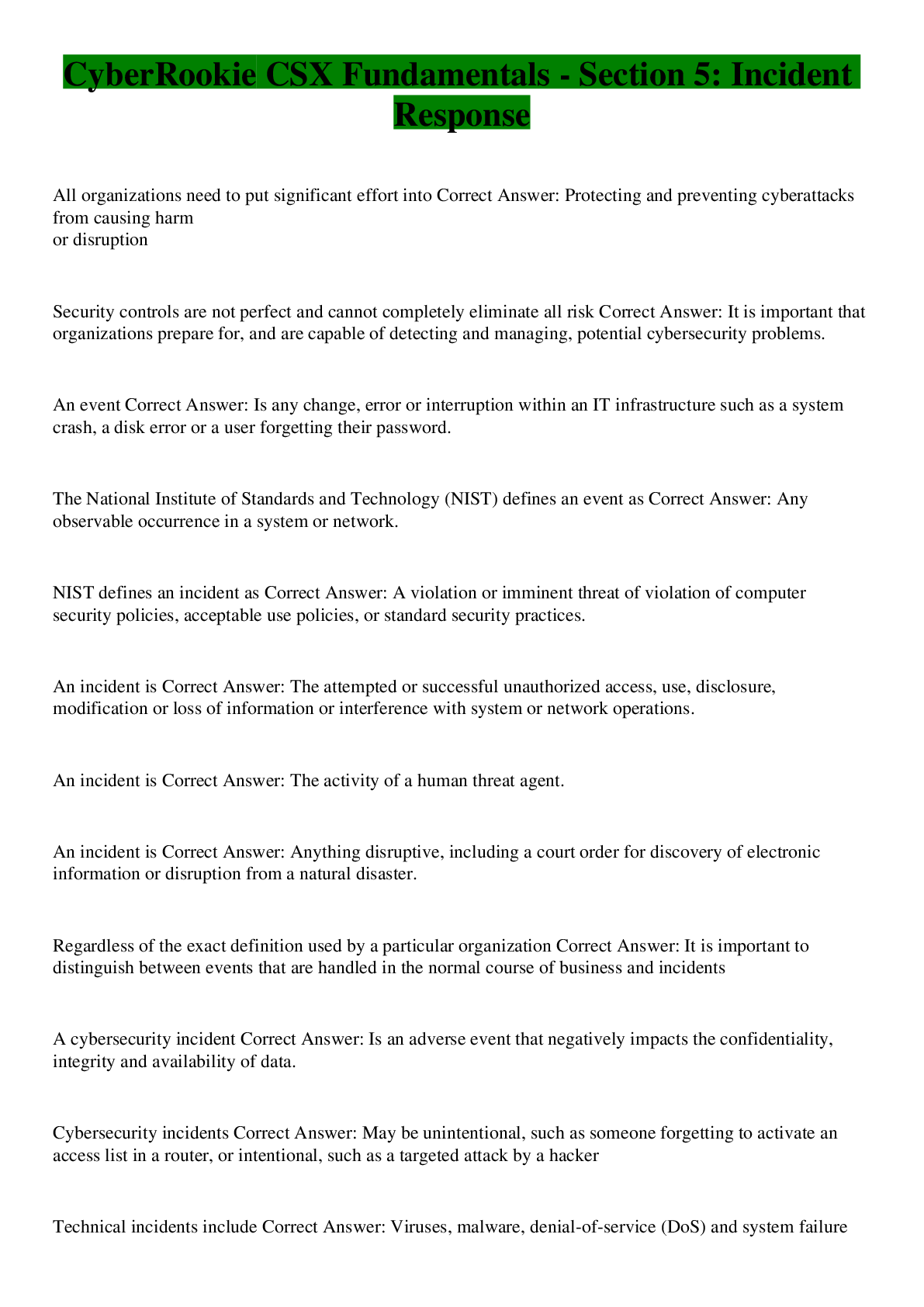
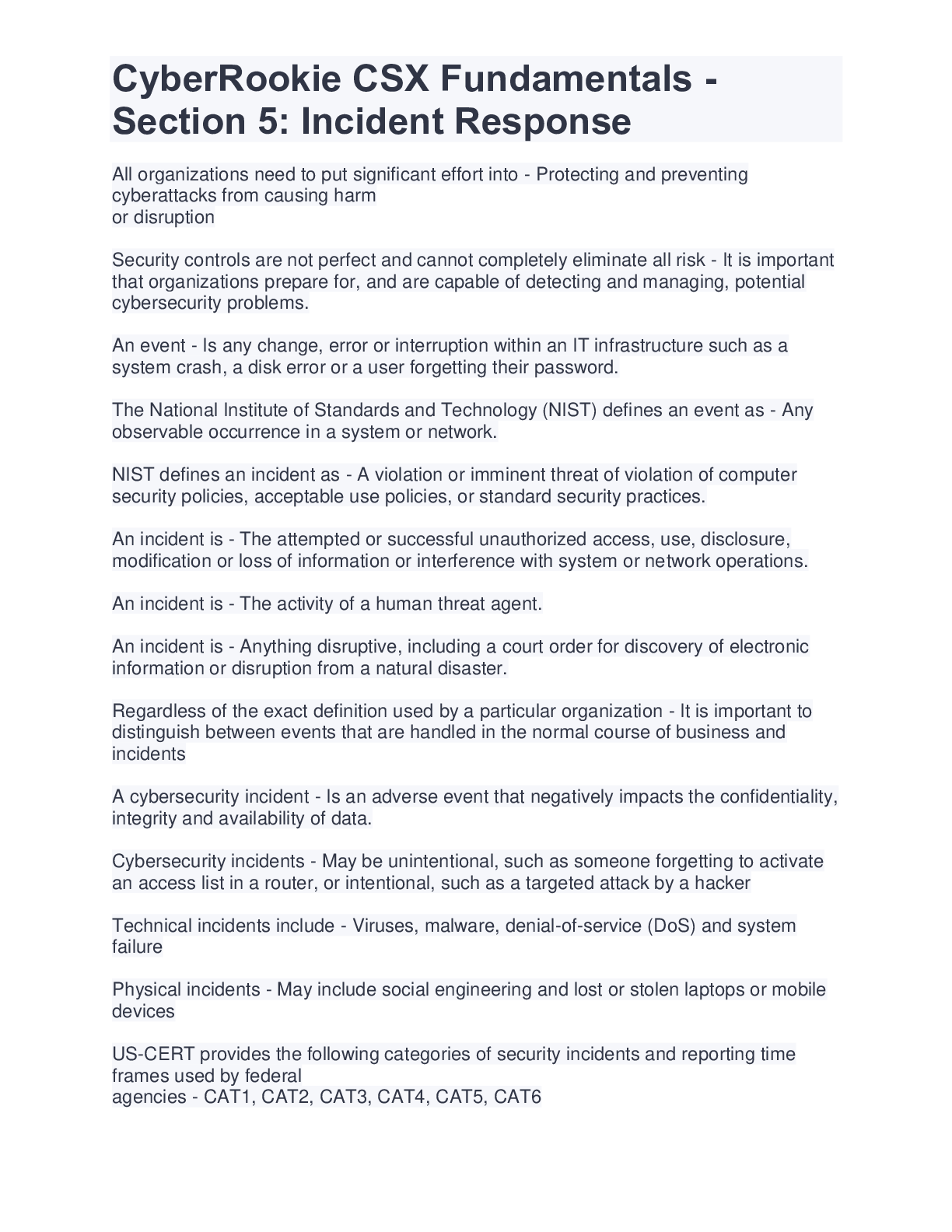
1. All organizations need to put significant effort into: Protecting and preventing cyberattacks from causing harm
or
...
CyberRookie CSX Fundamentals - Section 5: Incident Response Questions
with Complete Answers
1 / 14
1. All organizations need to put significant effort into: Protecting and preventing cyberattacks from causing harm
or disruption
2. Security controls are not perfect and cannot completely eliminate all risk: It
is important that organizations prepare for, and are capable of detecting and
managing, potential cybersecurity problems.
3. An event: Is any change, error or interruption within an IT infrastructure such
as a system crash, a disk error or a user forgetting their password.
4. The National Institute of Standards and Technology (NIST) defines an
event as: Any observable occurrence in a system or network.
5. NIST defines an incident as: A violation or imminent threat of violation of
computer security policies, acceptable use policies, or standard security practices.
6. An incident is: The attempted or successful unauthorized access, use, disclosure, modification or loss of information or interference with system or network
operations.
7. An incident is: The activity of a human threat agent.
8. An incident is: Anything disruptive, including a court order for discovery of
electronic information or disruption from a natural disaster.
9. Regardless of the exact definition used by a particular organization: It is
important to distinguish between events that are handled in the normal course of
business and incidents
10. A cybersecurity incident: Is an adverse event that negatively impacts the
confidentiality, integrity and availability of data.
11. Cybersecurity incidents: May be unintentional, such as someone forgetting
to activate an access list in a router, or intentional, such as a targeted attack by a
hacker
12. Technical incidents include: Viruses, malware, denial-of-service (DoS) and
system failure
13. Physical incidents: May include social engineering and lost or stolen laptops
or mobile devices
14. US-CERT provides the following categories of security incidents and
reporting time frames used by federal
agencies: CAT1, CAT2, CAT3, CAT4, CAT5, CAT6CyberRookie CSX Fundamentals - Section 5: Incident Response Questions
with Complete Answers
2 / 14
15. CAT 1: Unauthorized Access, An individual gains logical
or physical access without permission to a network, system, application, data or
other resource. Within 1 hour of discovery/detection
16. CAT2: Denial-of-service (DoS), An attack that successfully
prevents or impairs normal authorized functionality of networks, systems or applications by exhausting resources. Within 2 hours of discovery/ detection if the
successful
attack is still ongoing
17. CAT3: Malicious Code, Successful installation of malicious software (e.g.,
virus, worm, Trojan horse or other
code-based malicious entity) that infects an operating system or application. Daily;
within 1 hour of
discovery/detection if widespread
18. CAT4: Improper Usage, A person violates acceptable
computing use policies. Weekly
19. CAT5: Scans/Probes/Attempted Access, Any activity that seeks to access or
identify a computer, open ports, protocols, service or any combination. Monthly
20. CAT6: Investigation, Unconfirmed incidents that are potentially malicious or
anomalous activity.
21. Incident response: Is a formal program that prepares an entity for an incident.
22. Incident response generally includes: Preparation, Detection and Analysis,
Investigation, Mitigation and Recovery, Postincident Analysis
23. Preparation: To establish roles, responsibilities and plans for how an incident
will be handled
24. Detection and Analysis: Capabilities to identify incidents as early as possible
and effectively assess the nature of the incident
25. Investigation: Capability if identifying an adversary is required
26. Mitigation and Recovery: Procedures to contain the incident, reduce losses
and return operations to normal
[Show More]