ENGLISH 101
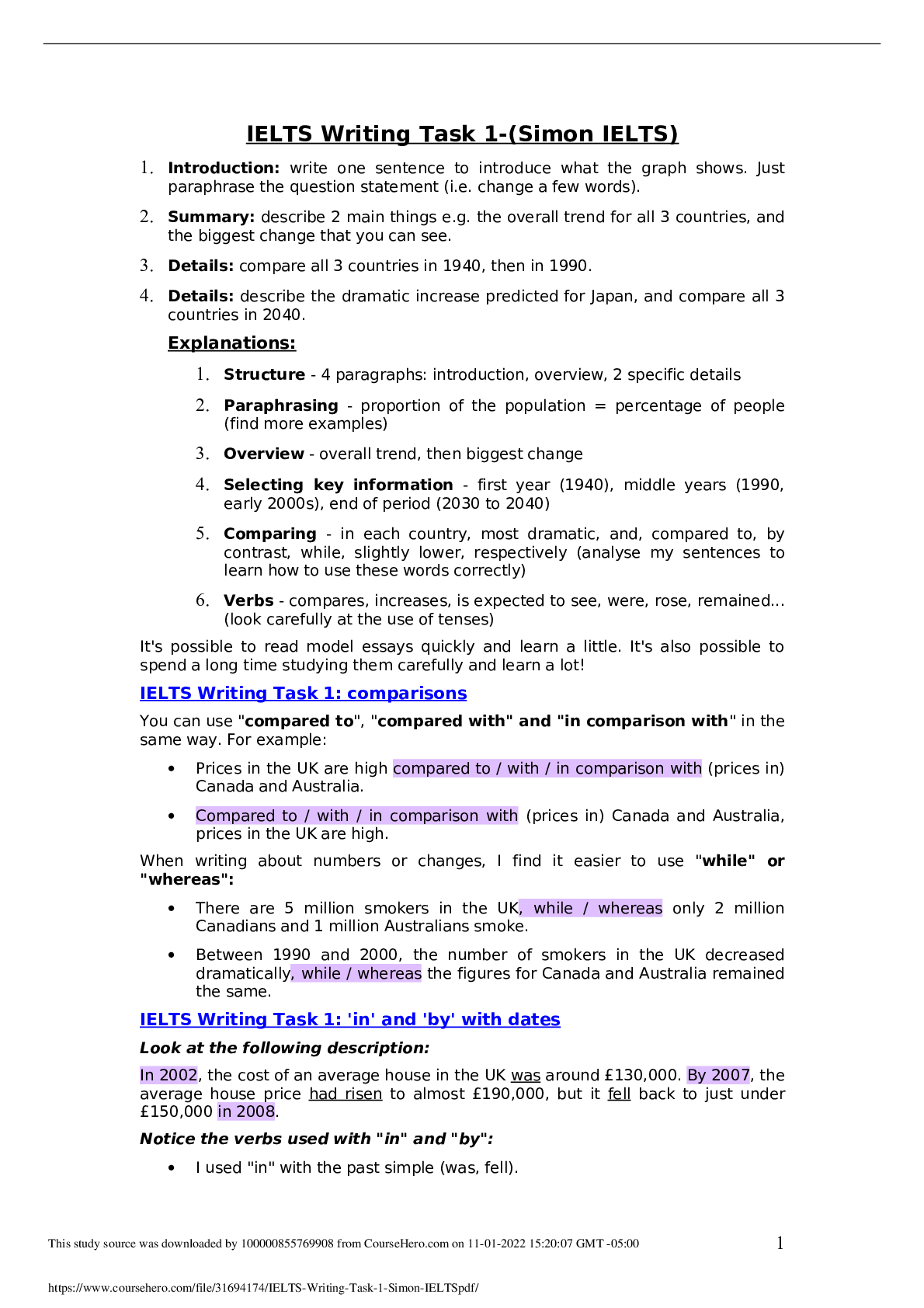
IELTS Writing Task 1-(Simon IELTS)
1. Introduction: write one sentence to introduce what the graph shows. Just
paraphrase the question statement (i.e. change a few words).
2. Summary: describe 2 main th
...
ENGLISH 101
IELTS Writing Task 1-(Simon IELTS)
1. Introduction: write one sentence to introduce what the graph shows. Just
paraphrase the question statement (i.e. change a few words).
2. Summary: describe 2 main things e.g. the overall trend for all 3 countries, and
the biggest change that you can see.
3. Details: compare all 3 countries in 1940, then in 1990.
4. Details: describe the dramatic increase predicted for Japan, and compare all 3
countries in 2040.
Explanations:
1. Structure - 4 paragraphs: introduction, overview, 2 specific details
2. Paraphrasing - proportion of the population = percentage of people
(find more examples)
3. Overview - overall trend, then biggest change
4. Selecting key information - first year (1940), middle years (1990,
early 2000s), end of period (2030 to 2040)
5. Comparing - in each country, most dramatic, and, compared to, by
contrast, while, slightly lower, respectively (analyse my sentences to
learn how to use these words correctly)
6. Verbs - compares, increases, is expected to see, were, rose, remained...
(look carefully at the use of tenses)
It's possible to read model essays quickly and learn a little. It's also possible to
spend a long time studying them carefully and learn a lot!
IELTS Writing Task 1: comparisons
You can use "compared to", "compared with" and "in comparison with" in the
same way. For example:
Prices in the UK are high compared to / with / in comparison with (prices in)
Canada and Australia.
Compared to / with / in comparison with (prices in) Canada and Australia,
prices in the UK are high.
When writing about numbers or changes, I find it easier to use "while" or
"whereas":
There are 5 million smokers in the UK, while / whereas only 2 million
Canadians and 1 million Australians smoke.
Between 1990 and 2000, the number of smokers in the UK decreased
dramatically, while / whereas the figures for Canada and Australia remained
the same.
IELTS Writing Task 1: 'in' and 'by' with dates
Look at the following description:
In 2002, the cost of an average house in the UK was around £130,000. By 2007, the
average house price had risen to almost £190,000, but it fell back to just under
£150,000 in 2008.
Notice the verbs used with "in" and "by":
I used "in" with the past simple (was, fell).
I used "by" with the past perfect (had risen) to give the idea that the
increase had happened in the years leading up to 2007.
To avoid worrying about "by + past perfect" you could write: "Between 2002
and 2007, the average house price rose to..."
IELTS Writing Task 1: to, by, with, at
Several people have asked me to explain how to use to, by, with and at when
describing numbers. Here are some examples to give you a basic idea of the
differences:
1) Use to when describing what happened to the number:
In 2008, the rate of unemployment rose to 10%.
2) Use by when describing the amount of change between two numbers:
In 2009, the rate of unemployment fell by 2% (from 10% to 8%).
3) Use with to give the idea of 'having' the number:
Obama won the election with 52% of the vote.
4) Use at to add the number on the end of a sentence:
Unemployment reached its highest level in 2008, at 10%.
IELTS Writing Task 1: paraphrasing
The easiest way to start your Task 1 essay is by paraphrasing the question.
Paraphrasing means writing something in a different way (using your own words).
Here are some simple changes you can make:
graph = line graph
chart = bar chart
diagram = figure
shows = illustrates (or 'compares' if the graph is comparing)
proportion = percentage
information = data
the number of = the figure for
the proportion of = the figure for
people in the USA = Americans
from 1999 to 2009 = between 1999 and 2009
from 1999 to 2009 = over a period of 10 years
how to produce = the process of producing
in three countries = in the UK, France and Spain (i.e. name the countries)
Tip:
"The figure for / figures for" is a great phrase that not many people use (e.g. the
graph shows figures for unemployment in three countries).
I'll change 3 elements of this sentence:
1. table shows = bar chart compares
2. figures for imprisonment = number of people in prison
3. between... and... = over a period of
So, here's my paraphrased introduction:
Here's my introduction and overview:
The picture illustrates the process of coffee manufacture and preparation for sale
on the market.
It is clear that there are 11 stages in the production of coffee. The process
begins with the picking of coffee beans, and ends at the packing stage.
[Show More]