1. A client diagnosed with anxiety reports to the nurse, "I start my new job next week and I am so afraid my new employer will find out I don't know enough to do my job! What if I get fired?" The nurse understands this c
...
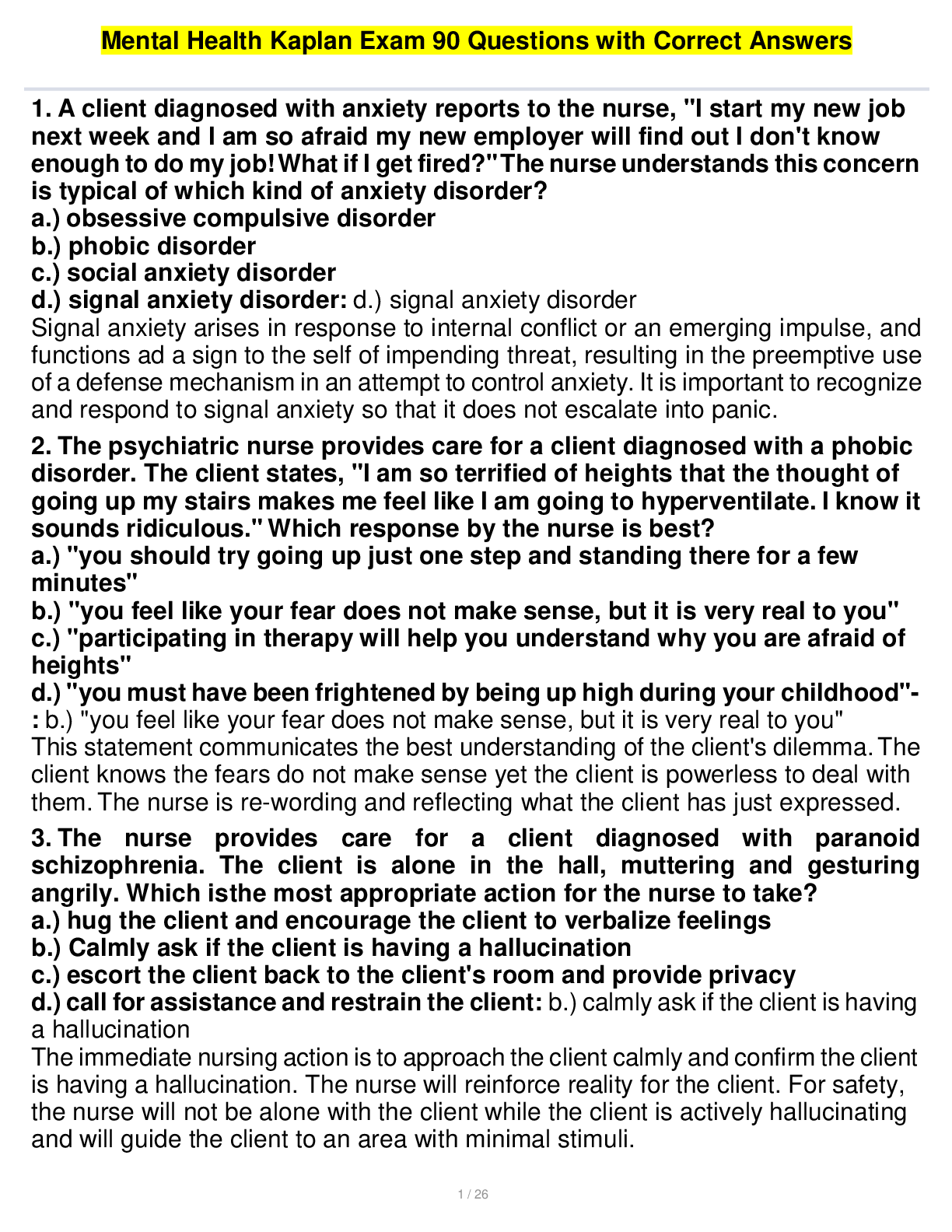
1. A client diagnosed with anxiety reports to the nurse, "I start my new job next week and I am so afraid my new employer will find out I don't know enough to do my job! What if I get fired?" The nurse understands this concern is typical of which kind of anxiety disorder?
a.) obsessive compulsive disorder b.) phobic disorder
c.) social anxiety disorder
d.) signal anxiety disorder: d.) signal anxiety disorder
Signal anxiety arises in response to internal conflict or an emerging impulse, and functions ad a sign to the self of impending threat, resulting in the preemptive use of a defense mechanism in an attempt to control anxiety. It is important to recognize and respond to signal anxiety so that it does not escalate into panic.
2. The psychiatric nurse provides care for a client diagnosed with a phobic disorder. The client states, "I am so terrified of heights that the thought of going up my stairs makes me feel like I am going to hyperventilate. I know it sounds ridiculous." Which response by the nurse is best?
a.) "you should try going up just one step and standing there for a few minutes"
b.) "you feel like your fear does not make sense, but it is very real to you" c.) "participating in therapy will help you understand why you are afraid of heights"
d.) "you must have been frightened by being up high during your childhood"-
: b.) "you feel like your fear does not make sense, but it is very real to you"
This statement communicates the best understanding of the client's dilemma. The client knows the fears do not make sense yet the client is powerless to deal with them. The nurse is re-wording and reflecting what the client has just expressed.
3. The nurse provides care for a client diagnosed with paranoid schizophrenia. The client is alone in the hall, muttering and gesturing angrily. Which is the most appropriate action for the nurse to take?
a.) hug the client and encourage the client to verbalize feelings b.) Calmly ask if the client is having a hallucination
c.) escort the client back to the client's room and provide privacy
d.) call for assistance and restrain the client: b.) calmly ask if the client is having a hallucination
The immediate nursing action is to approach the client calmly and confirm the client is having a hallucination. The nurse will reinforce reality for the client. For safety, the nurse will not be alone with the client while the client is actively hallucinating and will guide the client to an area with minimal stimuli.
4. The nurse provides care for a client diagnosed with alcohol abuse who is receiving counseling. Which is a primary goal of counseling for the client? a.) prevent problems which cause the client to drink
b.) help the client become more dependent on others for decision making c.) identify persons in the client's like who can prevent the client from drinking
d.) assist the client to identify factors that trigger alcohol use: d.) assist the client to identify factors that trigger alcohol use
Clients who abuse substances have a limited ability to tolerate anxiety and use substances to escape difficult feelings. Certain circumstances and situations can trigger feeling and anxiety that can lead to substance abuse. Counseling can help the client identify these situations and develop healthy ways to deal with them.
5. The nurse understands a client's needs must be prioritized. According to Maslow's hierarchy of needs, which needs are most basic to a client's health maintenance plan?
a.) safety and security
b.) esteem and recognition c.) physiological
d.) self-actualization: c.) physiological
Maslow's hierarchy of needs states that some needs are more basic than others, and the basic needs have to be met first. The most basic needs are the physiolog- ical needs (oxygen, food, water, etc.). If the basic needs are not met, the person will die.
6. The middle-aged client is admitted to the hospital with a diagnosis of terminal lung cancer. The client's spouse reports to the nurse that the client did not want to come to the hospital and "refuses to slow down." The nurse gives priority to which measure?
a.) promote rest and relaxation
b.) encourage the client to participate in planning care c.) encourage the client to accept help from others
d.) set limits on excessive activities: b.) encourages the client to participate in planning care
This client obviously thrives on independence; would be most helpful to give client a sense of control over care; give choices whenever possible, and allow self-care when feasible.
7. The nurse admits a client who has a diagnosis of alcoholism and admits to drinking a pint of vodka a day. The client is scheduled for surgical repair of a fractured femur following a motor vehicle accident.
[Show More]
















 with Complete Solution.png)
 Career Information with Complete Solution.png)


 for E-6 Career Information_watermark.png)