What exactly does the SPD do? - ANSWER 1. receives
2. cleans
3. decontaminate
4. assemble
5. disinfect
6 sterilize reusable and surgical devices for safe and effective patient care
What preferred name is recomme
...
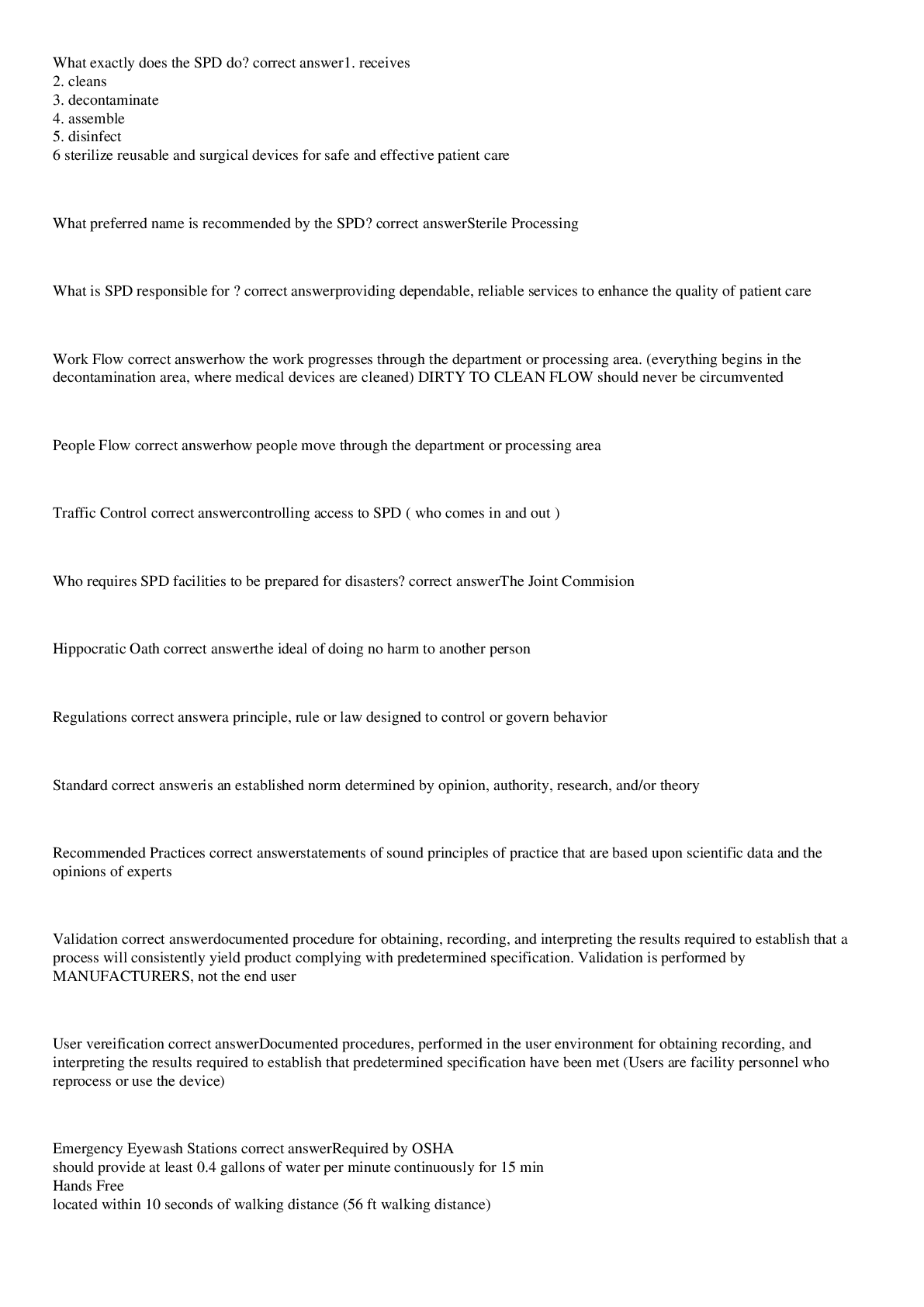
What exactly does the SPD do? - ANSWER 1. receives
2. cleans
3. decontaminate
4. assemble
5. disinfect
6 sterilize reusable and surgical devices for safe and effective patient care
What preferred name is recommended by the SPD? - ANSWER Sterile Processing
What is SPD responsible for ? - ANSWER providing dependable, reliable services to enhance the quality of patient care
Work Flow - ANSWER how the work progresses through the department or processing area. (everything begins in the decontamination area, where medical devices are cleaned) DIRTY TO CLEAN FLOW should never be circumvented
People Flow - ANSWER how people move through the department or processing area
Traffic Control - ANSWER controlling access to SPD ( who comes in and out )
Who requires SPD facilities to be prepared for disasters? - ANSWER The Joint Commision
Hippocratic Oath - ANSWER the ideal of doing no harm to another person
Regulations - ANSWER a principle, rule or law designed to control or govern behavior
Standard - ANSWER is an established norm determined by opinion, authority, research, and/or theory
Recommended Practices - ANSWER statements of sound principles of practice that are based upon scientific data and the opinions of experts
Validation - ANSWER documented procedure for obtaining, recording, and interpreting the results required to establish that a process will consistently yield product complying with predetermined specification. Validation is performed by MANUFACTURERS, not the end user
User vereification - ANSWER Documented procedures, performed in the user environment for obtaining recording, and interpreting the results required to establish that predetermined specification have been met (Users are facility personnel who reprocess or use the device)
Emergency Eyewash Stations - ANSWER Required by OSHA
should provide at least 0.4 gallons of water per minute continuously for 15 min
Hands Free
located within 10 seconds of walking distance (56 ft walking distance)
Blue Diamond - ANSWER Health Hazard
Red Diamond - ANSWER flammability
Yellow Diamond - ANSWER instability
White Diamond - ANSWER special hazard information
Center for Disease Control and Prevention - ANSWER publish widely respected recommendations and guidelines on such topics as hand hygiene, isolation precautions, environmental infection control, and disinfection and sterilization, when new or emerging diseases are identified, the CDC also publishes guidelines .
Fire Extinguisher
Class A - ANSWER cloth, wood, paper, rubber, and many plastics
Fire Extinguisher
Class B - ANSWER gasoline, alcohol, diesel oil, oil-based paints, lacquers, etc.. flammable gases
Fire Extinguisher
Class C - ANSWER Energized Electrical Equipment
Fire Extinguisher
Class D - ANSWER magnesium, titanium, and sodium
Fire Extinguisher
Class K - ANSWER Vegetable oils, animal oils, or fats in cooking appliances. This is for commercial kitchens, including those found in restaurants, cafeteria, and caterers.
Fire Triangle - ANSWER Fuel Source, Oxygen Source, Ignition Source
What does PPE protect you from? - ANSWER Bloodborne Pathogen
Incident Reports - ANSWER report no matter what no later than 24 hours
Why is it necessary to wear warm up jackets in the preparation and packaging area? - ANSWER to prevent bacterial shedding from bare arms
Anatomy - ANSWER branch of science that deals with the structure of body parts: their form and their organization
Physiology - ANSWER functions of the body parts: what they do and how they do it
Levels of Organization of the Human Body - ANSWER 1. Cellular Level
2.Tissue Level
3.Organ Level
4.System Level
Environmental factors of a CELL - ANSWER Water
Food
Oxygen
Heat
Pressure
Alkaline PH Environment
Cell Wall - ANSWER the outer surface of the cell, protects the cell from physical injury
Cell Membrane - ANSWER the outer boundary of the cell. It consists of a thin, continuous sheet of fatty molecules in which proteins are embedded, The cell membrane allows for food, nutrients, and wastes to be passed into and out of the cell.
Nuclear Membrane - ANSWER supports the nucleus and controls the passage of materials between the nucleus and the cytoplasm
Nucleus - ANSWER located near the center of the cell, is the cell's "brain" it contains the genes (which consist of deoxyibonucleic acid [DNA], the heredity material in all organisms) and chromosomes. The nucleus directs everyday cell life and reproduction. It is located near the center of the cell
Cytoplasm - ANSWER where food molecules are received, processed, and used. It functions as a communication system through which molecules can be transported from one cell part to another
Cilia and Flagella - ANSWER motile appendages that extend outward from the surfaces of certain cells.
Skull - ANSWER which is composed of the cranium and the facial bones. The smallest bones of the body are found in the middle ear; these bones are called the anvil, the hammer and the stirrup because that is what they look like
Hyoid Bone - ANSWER located in the neck between the lower jaw and the larynx. It supports the tongue and functions in swallowing
[Show More]