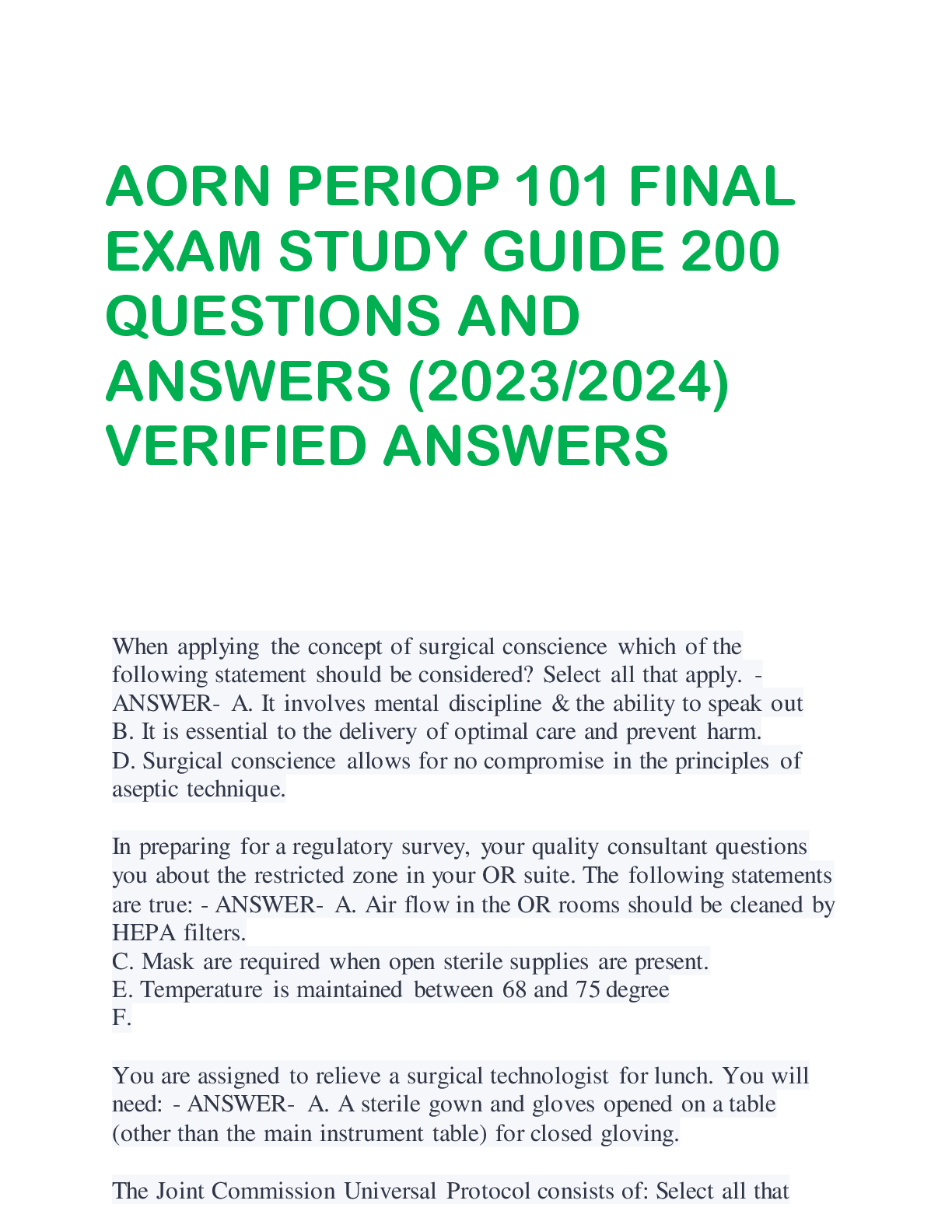
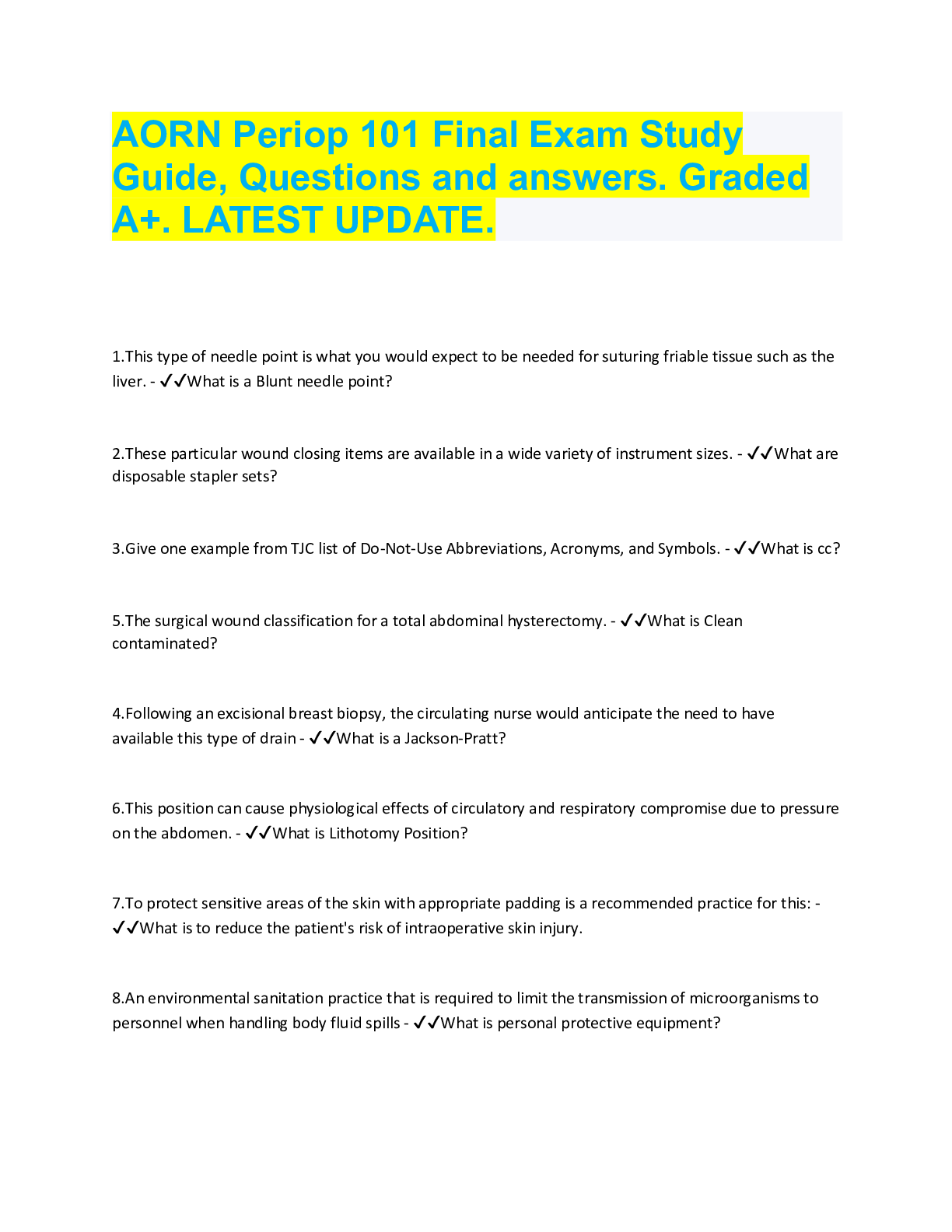
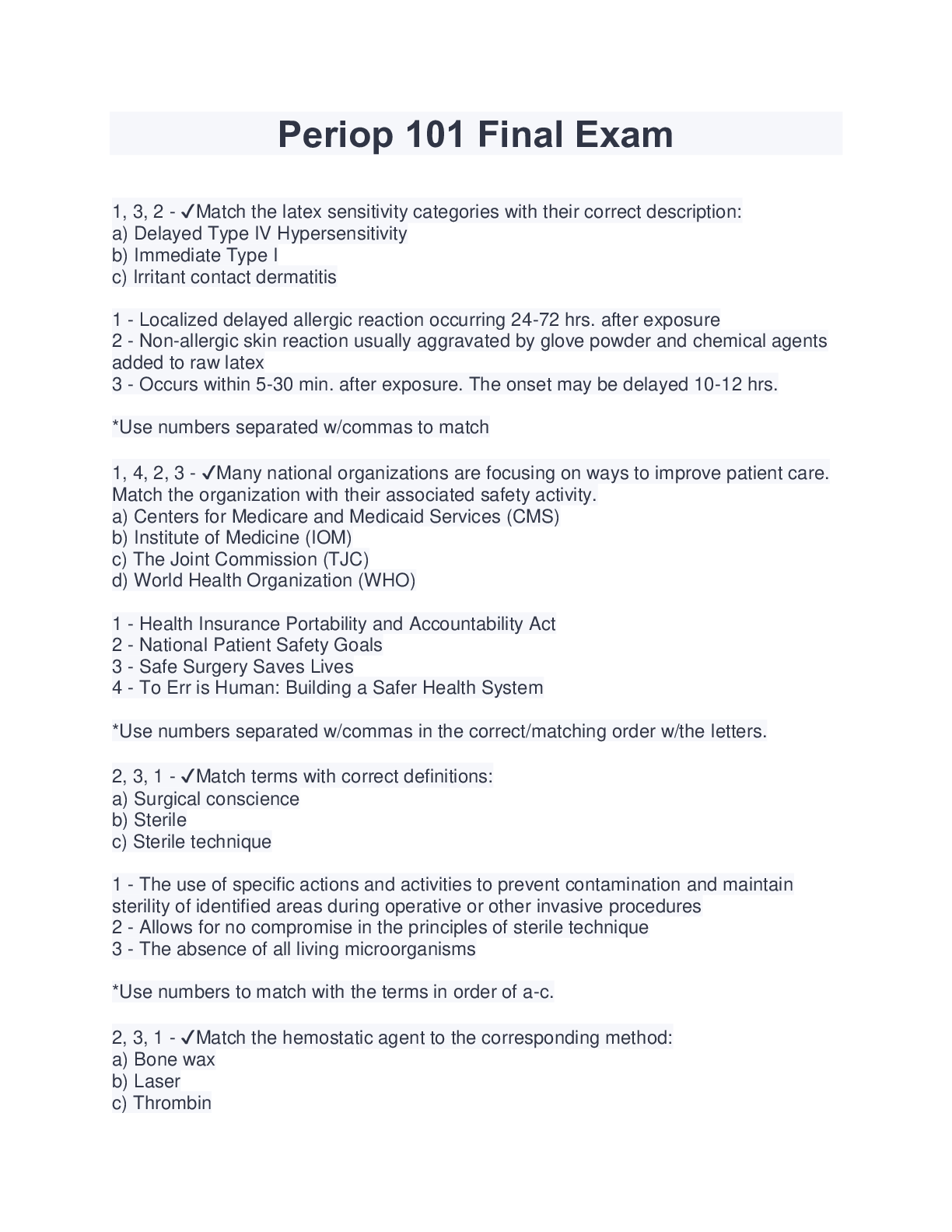
a - ANSWER Evidence-based practice questions are typically formatted as PICO questions. What does PICO stand for?
a) Patient, Intervention, Comparison, Outcome
b) Patient, Investigation, Comparison, Outlier
c) Populat
...
a - ANSWER Evidence-based practice questions are typically formatted as PICO questions. What does PICO stand for?
a) Patient, Intervention, Comparison, Outcome
b) Patient, Investigation, Comparison, Outlier
c) Population, Intervention, Counter-Intervention, Outlier
d) Problem, Investigation, Counter-Intervention, Outcome
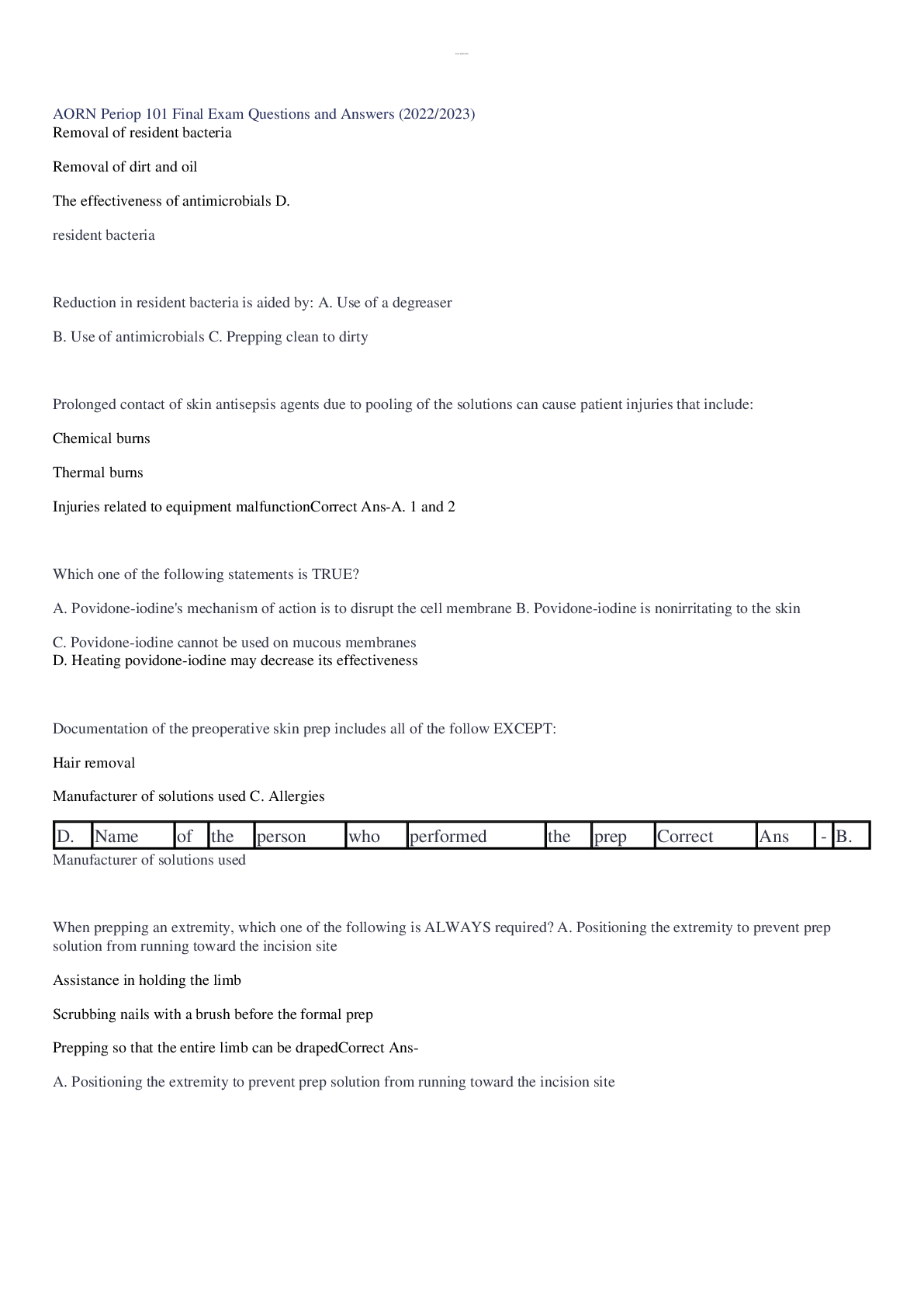
d - ANSWER Every member of the healthcare team has a role to play in cost containment. Which of the following is an example of how the perioperative RN can participate in cost containment in the OR?
a) Ask the surgeon to use a less expensive implant
b) Begin cleaning the OR for the next case before the patient leaves the room
c) Open all supplies listed on preference card, including "available" supplies
d) Verify with surgeon before opening suture
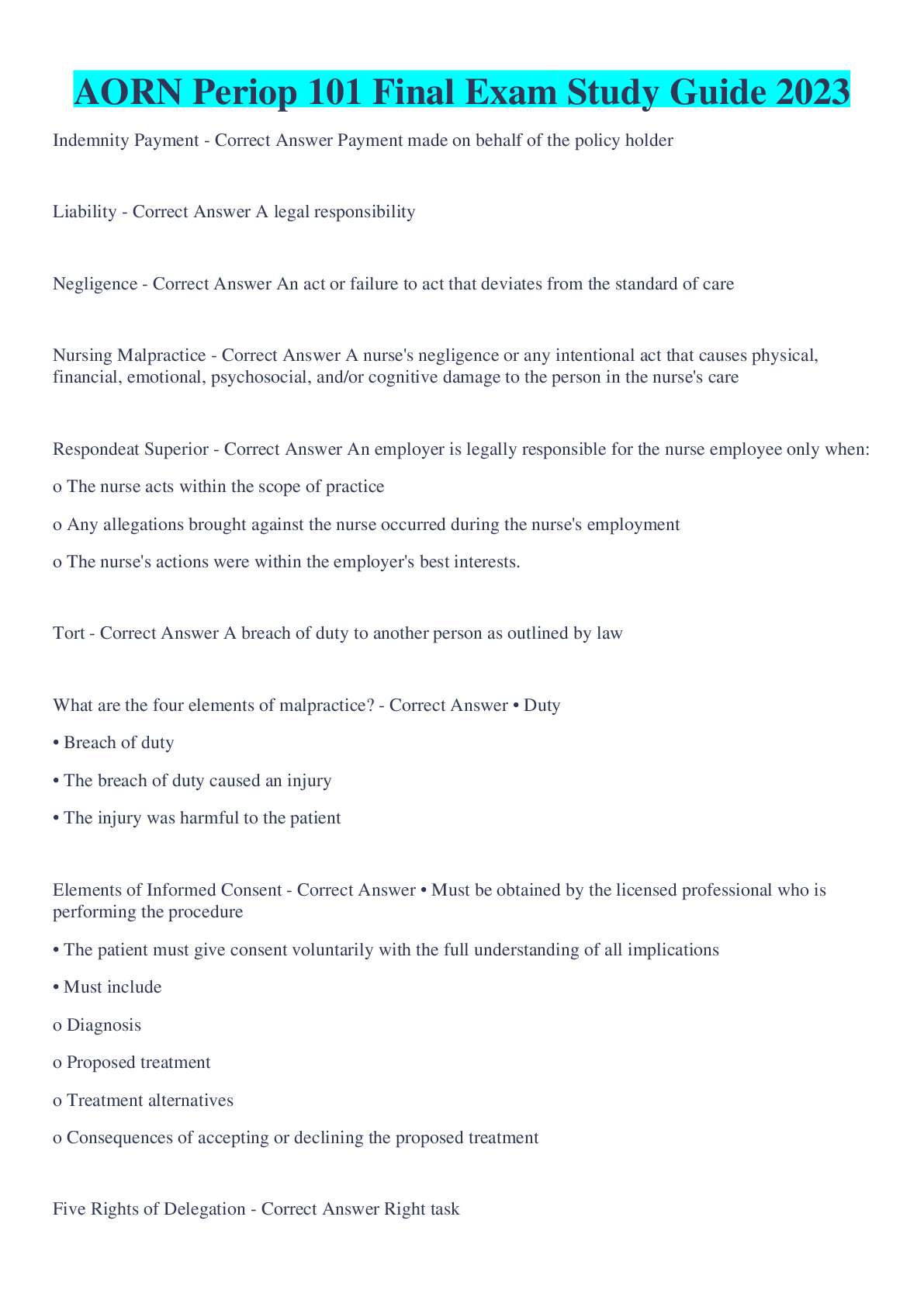
c - ANSWER An RN who attends continuing nursing education and has verified skills, knowledge, and attitudes about perioperative nursing is demonstrating accountability in his/her:
a) Certification requirements for professional achievement in perioperative nursing
b) Collaboration among team members
c) Professional growth and maintenance of competency
d) Verification of nursing knowledge
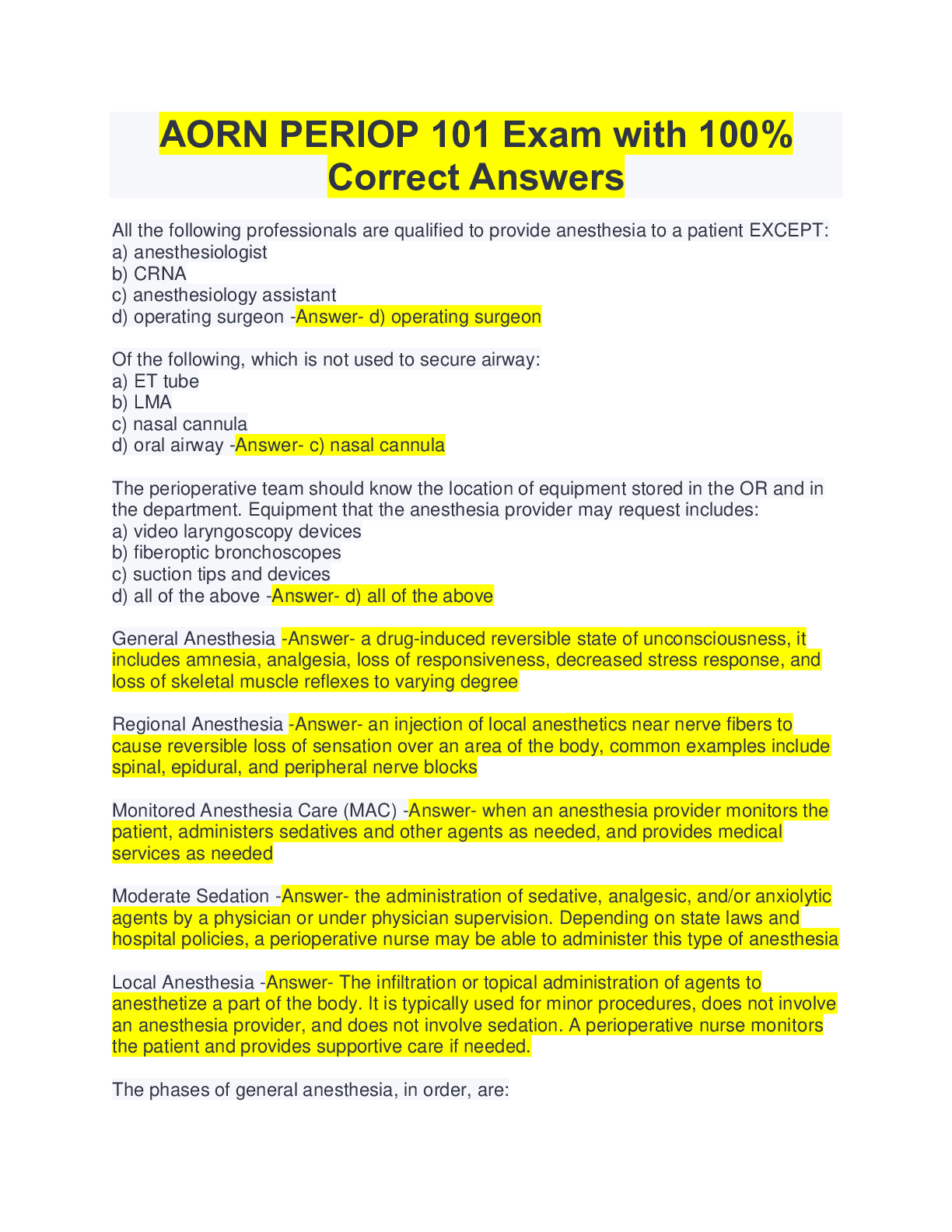
d - ANSWER Which of the following statements is TRUE concerning use of the AORN Guidelines for Perioperative Practice?
a) Both medical and nursing licensing boards require health care institutions to comply with the AORN guidelines
b) The AORN Guidelines legally supersede departmental and institutional policies
c) The AORN Guidelines reflect scientific evidence of how nurses actually practice in perioperative settings
d) Work setting and situation variations may determine the extent to which AORN Guidelines can be applied
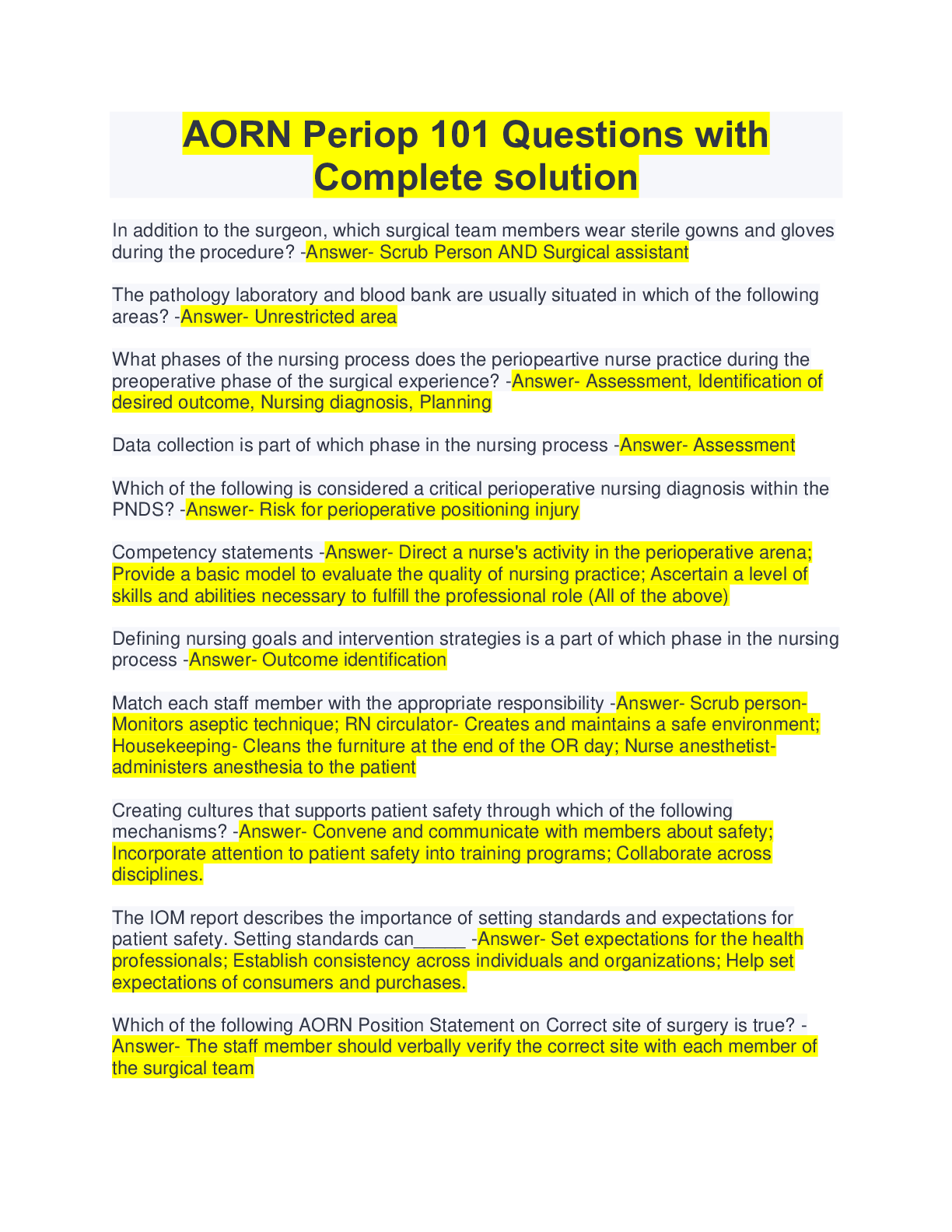
c - ANSWER Which of the following is NOT an example of an ethical dilemma that perioperative nurses may encounter?
a) Do-not-resuscitate (DNR) order for a surgical patient
b) Family disagreement regardings possible organ donation
c) Family disagreement about a below the knee amputation on an 18 year old who has already given consent
d) Human experimentation
b - ANSWER The phrase "At least one individual failed to do what a similarly situated, reasonable, and prudent professional would have done under similar circumstances" is the definition of:
a) Abandonment
b) Negligence
c) Unethical behavior
d) Malpractice
d - ANSWER All of the following are accurate descriptions of "professional accountability" EXCEPT:
a) Becoming certified in your specialty
b) Collaborating with peers in selecting the right instruments and right equipment for each patient
c) Pursuing a higher academic degree
d) Relying ONLY on peer evaluations
e) Staying current with changes in your specialty
b - ANSWER Part of the AORN standards of Professional Practice mandate that nurses evaluate the quality of their nursing practice. Four ways to ensure professional practice related to the AORN practice include: maintaining competency, the use of evidence-based practice, certification, and:
a) Mentoring student nurses
b) Pursuit of lifelong learning
c) Achieving a minimum of an associate's degree
d) Achievement of an advanced practice nurse degree
c - ANSWER After transferring a male patient into the Phase I PACU, the perioperative RN could reasonably expect the PACU RN to FIRST:
a) Administer medication to the patient for nausea and vomiting
b) Ask the patient is he has any pain
c) Assess the patient's airway and respirations
d) Care for this patient and two other patients as assigned
b - ANSWER During a handover report to the PACU RN, the perioperative RN may use a communication method identified by the acronym "SBAR." What does SBAR stand for?
a) Safety, Background, Actions, Recovery expectations
b) Situation, Background, Assessment, Recommendation
c) Safety concerns, Background, Assessment, Responsibility
d) Surgeon, Background, Assessment, Recovery time
c - ANSWER A 40-year-old male patient is awake and alert in the post anesthesia care unit after right shoulder surgery. What is the BEST measure to assess the patient's pain?
a) Discuss the patient's pain with a close family member
b) Observe facial expressions and behaviors
c) Ask patient to describe his pain or use a standardized pain scale
d) Monitor vital sign changes
d - ANSWER What would be the MOST important information for a nurse in Preadmission Testing (PAT) to collect on an insulin dependent diabetic patient?
a) How long the patient has been diabetic
b) If there is someone to drive them home
c) The last time the patient ate or drank
d) The type of insulin the patient takes
c - ANSWER The Perianesthesia nurse has ASPAN to guide their practice. What does ASPAN stand for?
a) American Sterilization of PeriAnesthesia Nurses
b) Association of Specialized PeriAnesthesia Nursing
c) American Society of PeriAnesthesia Nursing
d) Association of Surgical Post Anesthesia Nursing
c - ANSWER You have completed your case and must now transport your patient to PACU. To give report to the PACU nurse, your facility requires that you provide report in SBAR, which stands for:
a) Safety, Background, Actions, Recovery, Expectations
b) Safety concerns, Background, Assessment, Responsibilities
c) Situation, Background, Assessment, Recommendations
d) Surgeon, Background, Assessment, Recovery time
c - ANSWER You have just transferred your patient into the Phase I PACU. Which activities would you expect to observe FIRST?
a) Administering medication for nausea and vomiting
b) Asking patients if they have any pain
c) Assessing patient airway and respirations
d) Caring for patients in 1:3 ratio
c - ANSWER A hand-over communication report is given by the anesthesia professional and the _________________?
a) Surgical resident
b) Medical student
c) OR nurse
d) Inpatient nurse
c - ANSWER What should be included as part of the psychological nursing assessment?
a) Anxiety, temperature, and religious beliefs
b) Anxiety, temperature, and cultural practices
c) Cultural beliefs, perception of surgery, and religious beliefs
d) Cultural practice, religious beliefs, and age
a - ANSWER During a preoperative interview, a patient reports that a surgical prep solution made him breakout in hives after a previous surgical procedure. What action should the perioperative RN take?
a) Alert the surgeon and discuss the selection of preoperative skin antiseptic.
b) Ask the surgeon for an antihistamine to be administered preoperatively
c) Monitor the patient more closely after administrating preoperative sedation
d) Notify the anesthesia professional of a potential interaction with anesthetic agents
e - ANSWER During the preoperative interview, the perioperative RN should ask the patient's about their use of:
a) Alcohol
b) Herbal preparations
c) Recreational Drugs
d) Tobacco products
e) All of the above
a - ANSWER The PRIMARY purpose of conducting a preoperative assessment is to:
a) Define the patient's risk factors and develop a plan of care
b) Determine the length of the procedure and needed supplies
c) Introduce the patient to the surgical team
d) Provide information necessary for discharge
a - ANSWER Which of the following sensory assessment findings is common among elderly patients?
a) Decrease in vision including color and depth perception
b) Decreased ability to understand explanations
c) Increased perception of pain
d) Memory impairment
c - ANSWER A child in which of the following age groups can be described as "likes to socialize and can interpret terms"?
a) 1 to 12 months
b) 1 to 3 years
c) 3 to 6 years
d) 6 to 12 years
d - ANSWER Which of the following statements is true?
a) Blood pressure remains constant with age
b) Body temperature increases with increasing age
c) Heart rate increases with increasing age
d) Lung capacity decreases with increasing age
a - ANSWER Which of the following factors make geriatric patients more sensitive to injury and cold?
a) Decrease in subcutaneous fat
b) Lung capacity decreases with age
c) Bilirubin and hemoglobin shift
d) Medication absorption is decreased
b - ANSWER A preoperative nursing assessment should be conducted by a perioperative RN at what point?
a) Prior to discharge
b) Before the surgery
c) In the surgeon's office
d) Before the surgical consent is signed
d - ANSWER In relation to transcultural needs of the patient, it is important to include _______________ needs in the nursing assessment.
a) Medical
b) Activities of daily living
c) Pharmacological
d) Spiritual
b - ANSWER A directive interview is:
a) Open-ended and unstructured
b) Structured with predetermined questions
c) Used to determine personality traits
d) An observation of the patient's nonverbal behavior
a, b, c - ANSWER Factors that may affect postoperative pain are? Select all that apply.
a) The surgical site
b) The nature and intended purpose of the surgery
c) The patient's fears regarding anesthesia or surgery
d) The level of anxiety of the patient's family members
b - ANSWER Which of the following BEST illustrates the purpose of perioperative patient and family education?
a) To convey genuine caring for the patient's well-being
b) To increase patient and family adherence to the plan of care
c) To increase the patient's and family's satisfaction with the quality of care
d) To support legal, ethical, and regulatory mandates
d - ANSWER Sally is a 43-year-old female scheduled for a laparoscopic cholecystectomy. The perioperative RN should provide preoperative education to Sally and her family, including:
a) Detailed information about the surgical procedure, including risks and benefits
b) Obtaining informed consent from Sally and suspending any DNR orders
c) Verification of financial resources
d) Wound care and pain management
a - ANSWER Which of the following practices violates a patient's ethical right to self-determination?
a) Automatic intraoperative suspension of a do-not-resuscitate decision
b) Including family members in the education process
c) Performing emergency surgery without informed consent
d) Providing information about the scientific evidence for planned care
b - ANSWER Obtaining informed consent is a two-step process of:
a) Weighing the benefits and burdens of tx options
b) Communicating information and documenting the decision
c) Determining patient competency and authenticity of the signature
d) Communicating the plan of care and reaching a decision
b - ANSWER How does the perioperative nurse test patient's level of understanding?
a) By checking to see whether the patient feels knowledgable enough to sign the consent
b) By asking questions about the procedure and evaluating the answer
c) By offering reassurance
d) By returning at another time to test recall
c - ANSWER A preoperative patient's do-not-resuscitate order is:
a) Irrevocable and unchanged once established
b) Not intended to be upheld in the perioperative environment
c) Reconsidered to ensure that the risks and benefits of anesthesia and surgery are discussed before surgery
d) Not reinstated until the patient leaves the perioperative environment
3, 2, 1 - ANSWER Match the designated surgical area with the correct surgical zone:
a) Perioperative patient care area
b) Work area for processing instruments
c) Individual OR suite with sterile supplies opened
1 - Restricted
2 - Semi-restrict
3 - Unrestricted
*(Answer with and separate numbers w/commas)
*(Use numbers to correctly match w/"a, b, c" order)
b - ANSWER Clean supplied do NOT need to be separated from sterile supplies inside the surgical suite:
a) True
b) False
b - ANSWER The relative humidity in the OR suite should be maintained within a range of:
a) 20-30%
b) 20-60%
c) 30-70%
d) 40-50%
c - ANSWER A surgical mask should cover both mouth and nose, and should be:
a) Allowed to hang around the neck between procedures
b) Changed after two hours of use
c) Removed and discarded after every case
d) Tied snugly with strings crossed
b - ANSWER The ventilation system in the restricted area of the OR should have an air exchange rate of at least _____ air exchanged per hour.
a) 5
b) 20
c) 10
d) 15
a - ANSWER The pathology laboratory and blood bank are usually situated in which of the following areas?
a) Unrestricted area
b) Semi-restricted area
c) Restricted area
d) Fully-restricted area
c - ANSWER ___________________________ stockings are used to prevent deep vein thrombosis during a surgical procedure.
a) Symmetrical compression
b) Spatial compression
c) Sequential compression
d) Secondary compression
b - ANSWER Which of the following humidity levels are considered optimal environmental conditions for OR?
a) 10% to 50%
b) 20% to 60%
c) 30% to 60%
d) 40% to 80%
c - ANSWER The patient's hair should be covered before entering the:
a) Semi-restricted zone
b) Unrestricted zone
c) Restricted zone
d - ANSWER Nursing interventions to reduce inadvertent hypothermia include all of the following EXCEPT:
a) Initiating forced air warming
b) Infusing warm IV fluids
c) Applying warm blankets preoperatively
d) Lowering the relative humidity below 20%
b - ANSWER The following statements concerning the surgical suite zone areas are true EXCEPT:
a) Equipment and sterile supply storage are semi-restricted
b) Operating rooms are semi-restricted
c) Sterile processing department is semi-restricted
d) The pre-op holding area is unrestricted
d - ANSWER When transporting soiled instruments from the OR to the decontamination area, the correct traffic pattern follows movement:
a) From the semi-restricted area to the unrestricted area
b) From the unrestricted area to the restricted area
c) From the restricted area to the unrestricted area
d) From the restricted area to the semi-restricted area
b - ANSWER A 65-year-old patient is the the pre-operative holding area. The patient's preoperative laboratory test results show several critical values. Which of the following actions should the circulating nurse complete first?
a) Ask the laboratory to draw confirmatory lab tests
b) Inform the anesthesia provider of the lab values
c) Notify the charge nurse of your findings
d) Proceed with the scheduled case
d - ANSWER Which statement about immediate use steam sterilization (IUSS) is the recommended practice?
a) After an item is immediate use steam sterilized, it may be packaged and stored for future use
b) Because the instrument is needed quickly, the cleaning process may be omitted
c) Instruments may be immediate use steam sterilized when there is inadequate inventory
d) Instruments may be immediate use steam sterilized only when there is insufficient time to process by the preferred wrapped or container method
d - ANSWER What is the BEST method for keeping instruments clean on the sterile field?
a) Soak instruments in a basin of normal saline
b) Wipe instruments with a sponge moistened with sterile water
c) Spray instruments with an enzymatic detergent
d) Wipe instruments with a sponge moistened with sterile water and flush lumens with sterile water
2, 3, 1 - ANSWER Select the appropriate Spaulding Classification System category for each item listed:
a) Blood pressure cuff
b) Laryngoscope blade
c) Orthopedic implants
1 - Critical
2 - Non-critical
3 - Semi-critical
*(Answer with and separate numbers w/commas)
*(Use numbers to correctly match w/"a, b, c" order)
a - ANSWER What is the FIRST step in reprocessing surgical instruments after they have been used in a procedure?
a) Cleaning
b) Decontamination
c) Disinfection
d) Transport to the sterilizer
b - ANSWER Biological monitoring:
a) Is utilized to document the sterility of an item
b) Indicates that the intended physical conditions in the sterilizer were met
c) Can be read immediately after the sterilization cycle is complete
d) Should never be used in immediate use steam sterilizers (IUSS)
c - ANSWER A ___________ does not permit a person to excuse an error but rather to admit and rectify one readily.
a) Adherence to aseptic technique
b) Practice of professional
c) Surgical conscience
d) Just culture
c - ANSWER Endoscopic instrumentation maintenance may be enhanced by the following EXCEPT
a) Cleaning off external debris during the case
b) Flushing channels with sterile water during surgery to remove gross soil
c) Irrigating channels with normal saline at the end of each case
d) Testing scissors for sharpness prior to sterilization
b - ANSWER According to AORN Recommended Practices, the shelf life of a sterile package kept in storage is:
a) Time-related
b) Event-related
c) Content-related
d) Sterilization-related
b - ANSWER According to Spaulding's Classification System, to prepare items such as blood pressure cuffs for patient use the appropriate process is:
a) Decontamination
b) Low-level disinfection
c) High-level disinfection
d) Sterilization
b - ANSWER An integrator is a multiparameter indicator designed to measure which of the following parameters?
a) Pressure, steam, and temperature
b) Temperature, time, and presence of steam
c) Pressure and sterility
b - ANSWER In which surgical wound category should a total abdominal hysterectomy be classified?
a) Clean
b) Clean contaminated
c) Contaminated
d) Dirty
b - ANSWER Immediate use steam sterilization can be used:
a) For implants
b) In urgent situations
c) Under no circumstances
d) For all items
b, c, d - ANSWER The AORN Surgical Wound Classification Decision Tree is helpful in determining: Select all that apply.
a) If closed drainage is necessary
b) If a major break in technique will affect the wound class
c) What constitutes an old injury
d) Which wound class a surgery should be assigned
a - ANSWER What are the three types of transmission-based precautions?
a) Contact, Droplet, Airborne
b) Direct Contact, Enteric, Standard
c) Indirect Contact, Direct Contact, Standard Contact
d) MRSA, VRE, C-Diff
c - ANSWER Which is the BEST method for preventing blood-borne pathogen exposure?
a) Allowing for proper air exchange to occur between cases
b) Inspecting all sharps to ensure they are intact after use
c) Using PPE and handwashing
d) Wearing non-sterile gloves at all times when in the surgical suite
d - ANSWER You are circulating on a laparoscopic appendectomy. Upon entering the abdomen, the surgeon encounters purulent inflammation and asks for a culture. The procedure using the laparoscope without need to open the abdomen. In completing your documentation of wound class, the best choice would be:
a) Clean
b) Clean contaminated
c) Contaminated
d) Dirty
a - ANSWER What are the principle elements required for infection to occur?
a) A method of transmission, a reservoir, a susceptible host
b) A susceptible host, middle age patient, skin integrity
c) A susceptible host, a warm, moist environment, a method of transmission
d) Limited air flow in the OR suite, a source or reservoir, a method of transmission
a - ANSWER The body's first line of defense against infection is:
a) The skin
b) Surgical gloves
c) The bones
d) Prepping with povidone-iodine (Betadine) solution
d - ANSWER Which of the following environmental sanitation practices is used to limit the transmission of microorganisms?
a) All contaminated disposable items should be considered potentially infectious
b) Place soiled linens in cloth bags that can be laundered along with the linens
c) Use a spray bottle with hospital approved disinfectant to clean small spills
d) Use personal protective equipment when handling body fluid spills
a - ANSWER Which of the following is a method for preventing blood-borne pathogen exposure?
a) Changing gloves after each patient or procedure
b) Using surgical gowns made from material that allow air and fluid to move freely in order to minimize thermal discomfort of the team during the case
c) Wearing exam gloves under surgical gloves as an additional barrier
d) Wearing reading glasses to improve sight accuracy during the procedure
c - ANSWER The best method that a perioperative nurse can utilize to prevent the spread of infection is to:
a) Isolate all patients who are suspected of having an infection
b) Rinse hands with a strong antiseptic solution
c) Wash hands before and after each patient contact
d) Wear sterile gloves while performing nursing procedures
b - ANSWER Which of the following strategies should be considered for implementing successful infection control?
a) Leaving the syringe in a vial of bupivacaine to facilitate dispensing additional medication if needed during the case
b) Washing your hands prior to greeting the patient in the pre-operative area
c) Wearing an extra warm-up jacket when prepping the patient who has an infected wound
d) Wiping down the OR table with saline at the end of each case to prevent mattress deterioration
3 - ANSWER Vaccine-preventable disease against which health care providers should be immunized include:
a) Hepatitis B
b) Seasonal influenza
c) Tuberculosis
d) Varicella
1 - B and C
2 - A and D
3 - A, B, and D
4 - A, B, C, and D
*Answer with the correct NUMBER only.
c - ANSWER Which of the three elements required for an infection to occur is related to inanimate environmental surfaces?
a) Method of transmission
b) Susceptible host
c) Source or reservoir
a - ANSWER Which of the following observations are critical when doing skin antisepsis on pediatric patients?
a) Take measures to prevent the loss of body heat
b) The relatively small bodies of ped. patients require smaller amounts of antimicrobial agents
c) Children are not sensitive to chemical agents
d) The whole body must be prepped irrespective of the operative site
b - ANSWER If a highly contaminated area is part of the surgical procedure, the area with lower bacterial count should be:
a) Confined and contained
b) Prepped first
c) Prepped last
d) Prepped with gentle friction
a - ANSWER A patient is scheduled for reconstruction of her external ear following a dog bite injury. Which skin prep agent is indicated for use in this case?
a) Aqueous iodophor
b) CHG-alcohol
c) CHG
d) Iodophor-alcohol
[Show More]


![Preview of AORN PERIOP 101 FINAL EXAM 2026 QUESTIONS AND VERIFIED ANSWERS [LATEST UPDATE]](https://browseimages.nyc3.digitaloceanspaces.com/paper-images/2026/04/07/sGJvJ3aH2026-04-07-04-5869d464cbba16f.png)