Question 1
1 / 1 pts
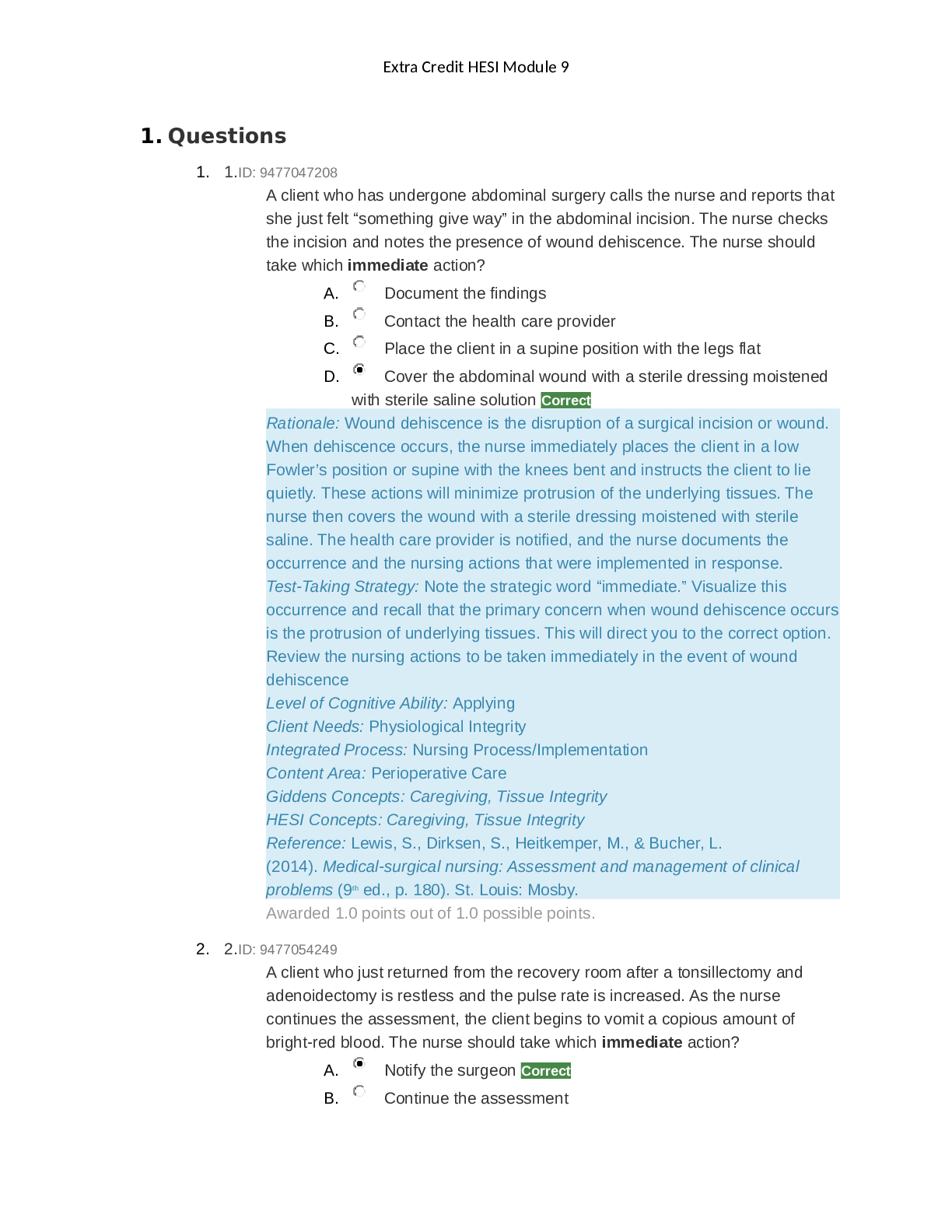
A client who has undergone abdominal surgery calls the nurse and reports that she just
felt “something give way” in the abdominal incision. The nurse checks the incision and
notes the presence of
...
Question 1
1 / 1 pts
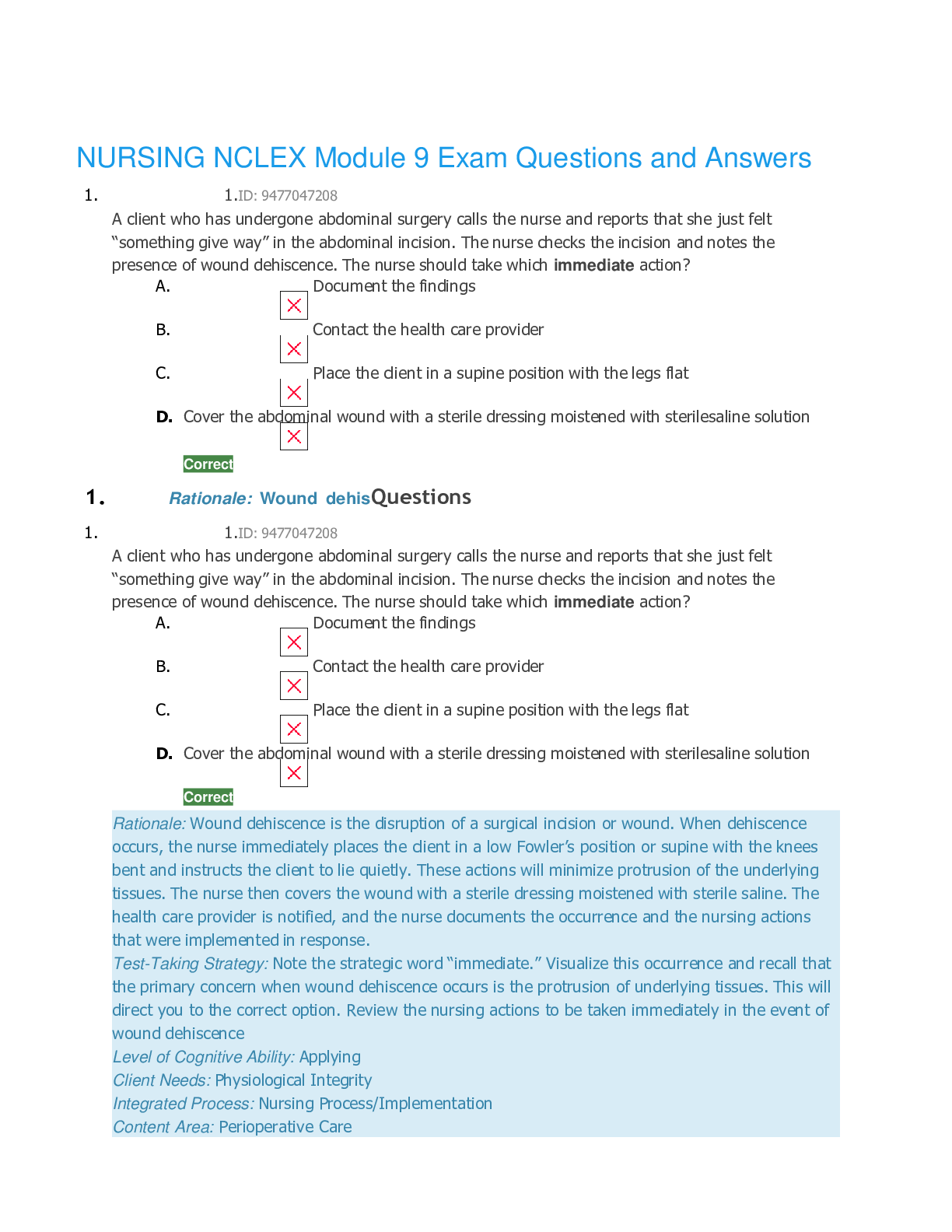
A client who has undergone abdominal surgery calls the nurse and reports that she just
felt “something give way” in the abdominal incision. The nurse checks the incision and
notes the presence of wound dehiscence. The nurse should take
which immediate action?
Contact the health care provider
Place the client in a supine position with the legs flat
Document the findings
Correct!
Cover the abdominal wound with a sterile dressing moistened with sterile saline solution
Rationale: Wound dehiscence is the disruption of a surgical incision or wound. When
dehiscence occurs, the nurse immediately places the client in a low Fowler’s position or
supine with the knees bent and instructs the client to lie quietly. These actions will
minimize protrusion of the underlying tissues. The nurse then covers the wound with a
sterile dressing moistened with sterile saline. The health care provider is notified, and
the nurse documents the occurrence and the nursing actions that were implemented in
response.
Test-Taking Strategy: Note the strategic word “immediate.” Visualize this occurrence
and recall that the primary concern when wound dehiscence occurs is the protrusion of
underlying tissues. This will direct you to the correct option. Review the nursing actions
to be taken immediately in the event of wound dehiscence
Level of Cognitive Ability: Applying
Client Needs: Physiological Integrity
Integrated Process: Nursing Process/Implementation
Content Area: Perioperative Care
Giddens Concepts: Caregiving, Tissue Integrity
HESI Concepts: Caregiving, Tissue Integrity
Reference: Lewis, S., Dirksen, S., Heitkemper, M., & Bucher, L. (2014). Medicalsurgical
nursing: Assessment and management of clinical problems (9th ed., p. 180). St.
Louis: Mosby.
Question 2
1 / 1 pts
A client who just returned from the recovery room after a tonsillectomy and
adenoidectomy is restless and the pulse rate is increased. As the nurse continues the
assessment, the client begins to vomit a copious amount of bright-red blood. The nurse
should take which immediate action?
Obtain a flashlight, gauze, and a curved hemostat
Check the client’s blood pressure
Continue the assessment
Correct!
Notify the surgeon
Rationale: Hemorrhage is a potential complication after tonsillectomy and
adenoidectomy. If the client vomits a large amount of bright-red blood or the pulse rate
increases and the patient is restless, the nurse must notify the surgeon immediately.
The nurse should obtain a light, mirror, gauze, curved hemostat, and waste basin to
facilitate examination of the surgical site. The nurse should also gather additional
assessment data, but the surgeon must be contacted immediately.
Test-Taking Strategy: Note the strategic word, immediate. Noting the words “bright-red
blood” will assist in directing you to the correct option. Remember that the presence of
bright-red blood indicates active bleeding. Review the nursing actions to be taken
immediately when bleeding occurs after a tonsillectomy and adenoidectomy
Level of Cognitive Ability: Applying
Client Needs: Physiological Integrity
Integrated Process: Nursing Process/Implementation
Content Area: Critical Care: Emergency Situation/Management
Giddens Concepts: Collaboration, Clotting
HESI Concepts: Collaboration/Managing Care, Perfusion-Clotting
Reference: Ignatavicius, D., & Workman, M. (2013). Medical-surgical nursing: Patientcentered
collaborative care. (7th ed., p. 644). St. Louis: Saunders.
[Show More]