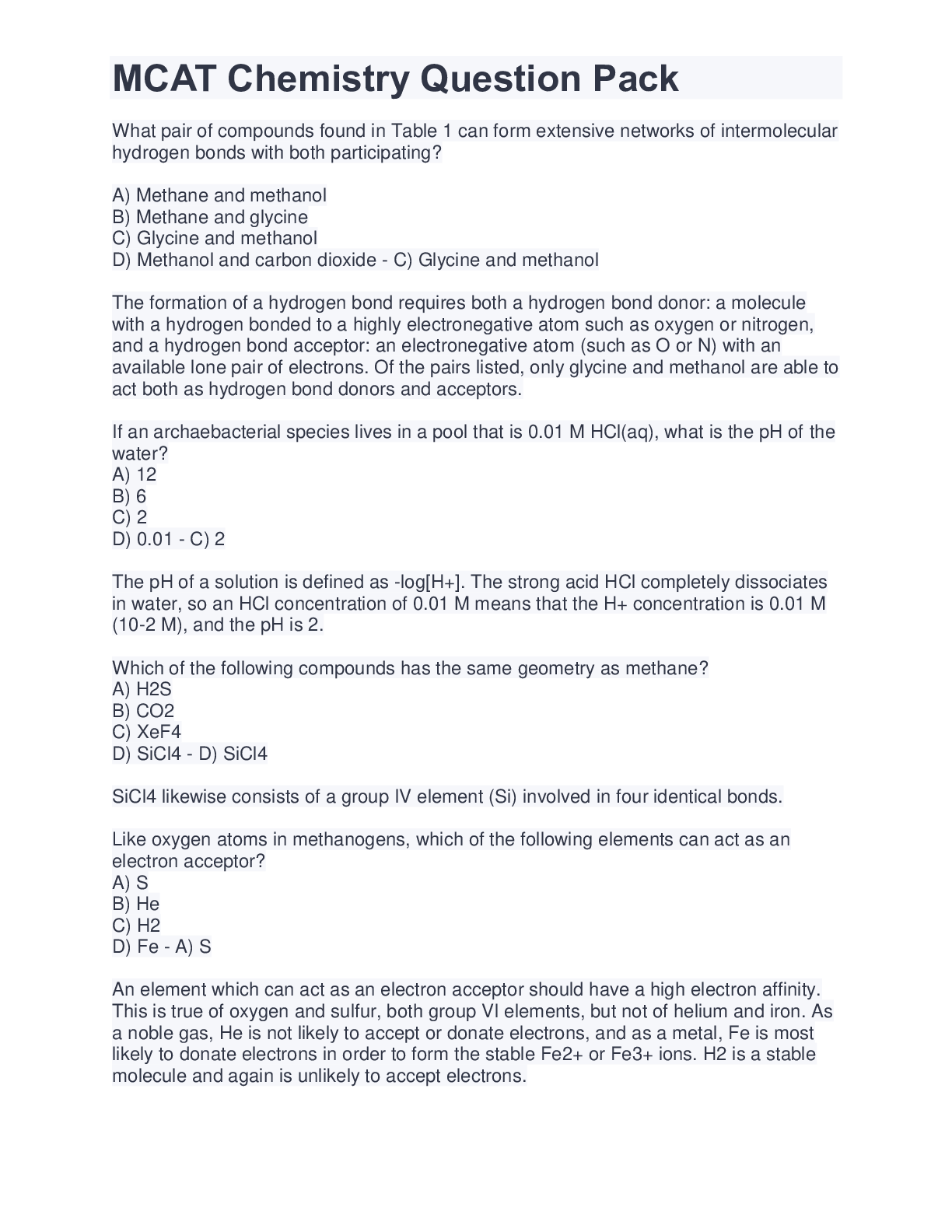
What pair of compounds found in Table 1 can form extensive networks of intermolecular hydrogen bonds with both participating?
A) Methane and methanol
B) Methane and glycine
C) Glycine and methanol
D) Methanol and
...
What pair of compounds found in Table 1 can form extensive networks of intermolecular hydrogen bonds with both participating?
A) Methane and methanol
B) Methane and glycine
C) Glycine and methanol
D) Methanol and carbon dioxide Correct Answer: C) Glycine and methanol
The formation of a hydrogen bond requires both a hydrogen bond donor: a molecule with a hydrogen bonded to a highly electronegative atom such as oxygen or nitrogen, and a hydrogen bond acceptor: an electronegative atom (such as O or N) with an available lone pair of electrons. Of the pairs listed, only glycine and methanol are able to act both as hydrogen bond donors and acceptors.
If an archaebacterial species lives in a pool that is 0.01 M HCl(aq), what is the pH of the water?
A) 12
B) 6
C) 2
D) 0.01 Correct Answer: C) 2
The pH of a solution is defined as -log[H+]. The strong acid HCl completely dissociates in water, so an HCl concentration of 0.01 M means that the H+ concentration is 0.01 M (10-2 M), and the pH is 2.
Which of the following compounds has the same geometry as methane?
A) H2S
B) CO2
C) XeF4
D) SiCl4 Correct Answer: D) SiCl4
SiCl4 likewise consists of a group IV element (Si) involved in four identical bonds.
Like oxygen atoms in methanogens, which of the following elements can act as an electron acceptor?
A) S
B) He
C) H2
D) Fe Correct Answer: A) S
An element which can act as an electron acceptor should have a high electron affinity. This is true of oxygen and sulfur, both group VI elements, but not of helium and iron. As a noble gas, He is not likely to accept or donate electrons, and as a metal, Fe is most likely to donate electrons in order to form the stable Fe2+ or Fe3+ ions. H2 is a stable molecule and again is unlikely to accept electrons.
The most likely function of the ebulliator is to:
A) keep the condensed vapors cool in the receiving flask
B) promote the establishment of a high vacuum in the system
C) prevent superheati
[Show More]