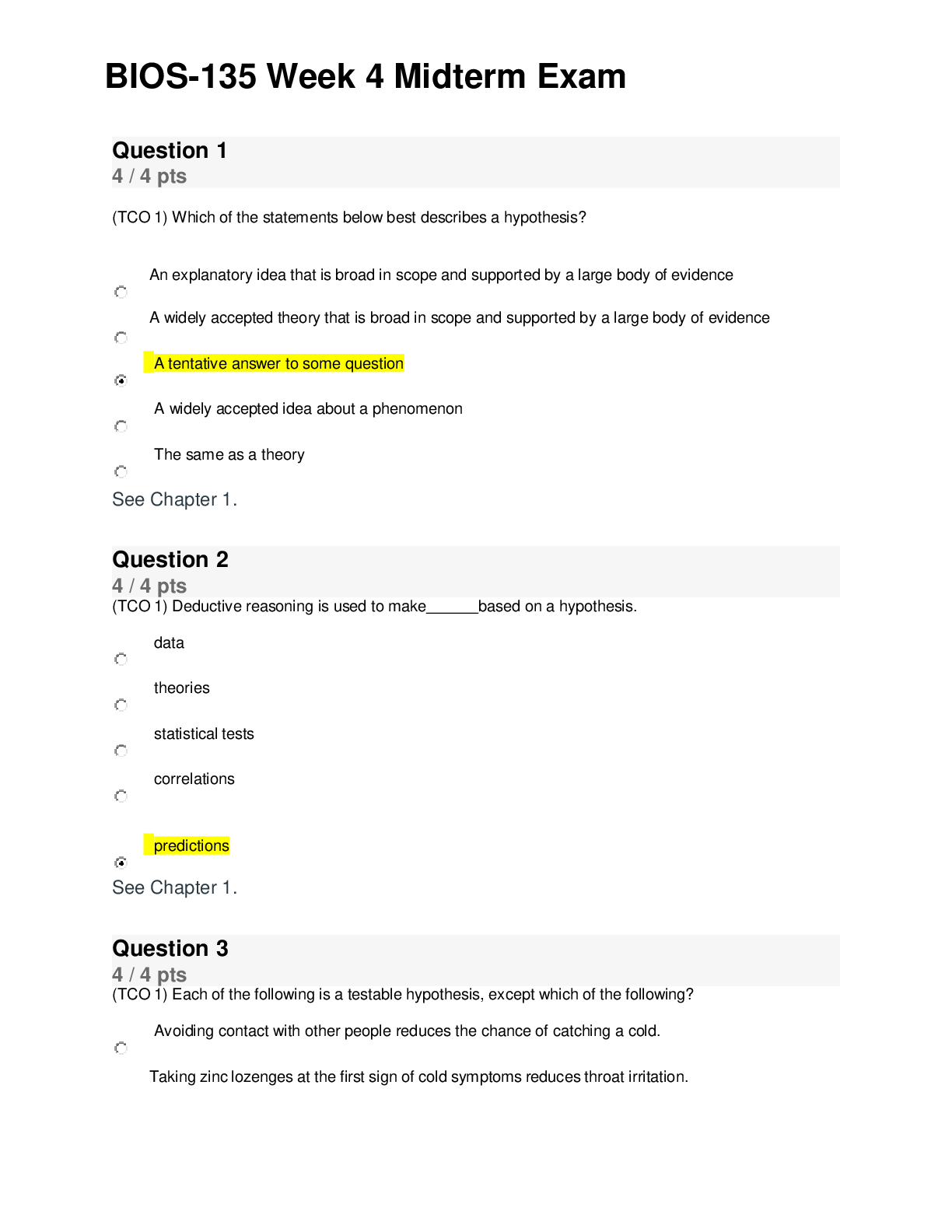
(TCO 1) Which of the statements below best describes a hypothesis?
An explanatory idea that is broad in scope and supported by a large body of evidence
A widely accepted theory that is broad in scope and supported
...
(TCO 1) Which of the statements below best describes a hypothesis?
An explanatory idea that is broad in scope and supported by a large body of evidence
A widely accepted theory that is broad in scope and supported by a large body of evidence A tentative answer to some question
A widely accepted idea about a phenomenon The same as a theory
See Chapter 1.
(TCO 1) Deductive reasoning is used to make based on a hypothesis.
data theories
statistical tests correlations
predictions
See Chapter 1.
(TCO 1) Each of the following is a testable hypothesis, except which of the following?
Avoiding contact with other people reduces the chance of catching a cold. Taking zinc lozenges at the first sign of cold symptoms reduces throat irritation.
Being a good driver makes you less likely to catch a cold. Sleeping 8 hours a night reduces the severity of a cold. All of the above are testable hypotheses.
See Chapter 1.
(TCO 2) The formation of a liquid from a solid is known as .
evaporation deposition freezing
melting sublimation
See Chapter 2. Solids melt to form liquids.
(TCO 2) A single-serve box of cereal contains 40 g of carbohydrate. How many kcal are obtained from the
carbohydrate in the cereal?
10 kcal
20 kcal
40 kcal
360 kcal
160 kcal
See Chapter2. 40 g (4 kcal/g) = 160 kcal.
(TCO 2) Which of the following is an example of kinetic energy?
A roller coaster car at the top of a hill Water stored in a reservoir
Burning wood An apple
An unopened soda bottle
See Chapter 2.
(TCO 2) Which of the following is a not a homogeneous mixture?
5% glucose IV solution Iced tea
Salt water Skim milk
Ice cream float
See Chapter 3.
(TCO 3) During cellular respiration, energy is released. Cellular respiration is classified as a(n) .
catalyzed reaction
exothermic reaction
decomposition reaction endothermic reaction oxidation-reduction reaction
See Chapter 5.
(TCO 3) Emily has a box that contains 0.01 mole of aluminum. How many particles of aluminum are in the
box?
6.02
3.01 × 10²¹
3.01 × 10²²
6.02 × 10²²
6.02 × 10²¹
See Chapter 5.
(TCO 3) How many atoms of phosphate are found in a molecule of Zn3(PO4)2?
Two Four One Eight Three
See Chapter 4. Each PO43- ion has one P atom. There are two PO43- ions, so there
are two total P atoms.
(TCO 4) Which of the following describes the purpose of a buffer?
A buffer is used to change color at the end point of a titration.
A buffer helps maintain the pH of a solution. A buffer acts as a strong base.
A buffer helps maintain a neutral pH. A buffer acts as a strong acid.
See Chapter 7.
(TCO 4) Sodium hydroxide (NaOH) accepts a proton from water. Which of the statements listed below is
true according to Bronsted-Lowry definitions?
Sodium hydroxide is a base. Sodium hydroxide is an acid.
Sodium hydroxide produces H+ ions in aqueous solutions. Sodium hydroxide acts as a solvent.
Sodium hydroxide is neutral.
See Chapter 7.
(TCO 4) How much 0.70 M HNO3 could you make from 200 mL of 1.40 M HNO3?
100 mL
196 mL
400 mL
83 mL
0.075 mL
See Chapter 6. V1C1 = V2C2. 200 mL 1.40 M = V2 0.70 M. V2 = (200 mL 1.40 M) 0.70 M = 400 mL.
(TCO 5) Amides and carboxylic acids are related in that they .
each contain at least one nitrogen atom
both contain carbonyl groups
each contain at least two oxygen atoms both form acidic solutions in water
See Chapter 8.
(TCO 5) Which of the following statements about cellulose and starch is true?
The monomers of cellulose are held together by covalent bonds, whereas the monomers of starch
are held together by hydrogen bonds.
Cellulose is made by animals, and starch is made only by plants.
Starch is easily digested, but few animals can break down cellulose.
Starch is made of glucose monomers, and cellulose is made of fructose monomers. All of the above
See Chapter 8.
(TCO 6) How are a chloroplast, a mitochondrion, and a nucleus similar?
They are all surrounded by two membranes. They are all green.
They are all found in prokaryotes.
They are all manufactured by the nucleolus. They are all able to synthesize lipids.
See Chapter 9.
(TCO 6) Which of the following terms describes where substrate binds on an enzyme?
Active site Primary structure Inhibitor site Conformation Denatured
See Chapter 9.
(TCO 6) An animal cell is placed in a hypotonic solution. Which will happen?
The cell will lyse.
The cell will experience turgor.
Nothing will happen. The cell will shrivel. The cell will lose water.
See Chapter 9.
(TCO 7) Which of the following summarizes the process of aerobic cellular respiration?
Glucose > lactic acid + energy
Energy + carbon dioxide + water > glucose + oxygen + water Glucose > ethyl alcohol + carbon dioxide + energy
Glucose + lactose > galactose + water
Glucose + oxygen > carbon dioxide + water + energy
See Chapter 11.
(TCO 7) Jasmine is running in a 10 K race. After the halfway point, her muscles need more oxygen than
her blood can provide. Which happens now? Her muscles are working anaerobically.
She is past her aerobic capacity.
Her muscle cells start producing lactic acid.
All of the above None of the above
See Chapter 9.
(TCO 7) Which waste product does yeast produce under anaerobic conditions?
Ethyl alcohol Pyruvic acid Lactic acid Glucosamine Creatine
See Chapter 11.
(TCO 7) The energy from breaking down glucose is during respiration.
transferred to starch
used to manufacture glucose by exergonic reactions
released all at once carried by electrons
None of the above
See Chapter 11.
(TCO 7) How many ATPs can be made from one molecule of glucose during aerobic cellular respiration?
1
2
30
38
42
See Chapter 11.
(TCO 7) The first stage of aerobic respiration is .
the Calvin cycle
the electron transport chain the citric acid cycle
lactic acid fermentation
glycolysis
See Chapter 11.
(TCO 7) Anaerobic respiration occurs .
without bacteria without ATP without CO2 with O2
without O2
See Chapter 11.
(TCO 6) Discuss the differences and similarities between prokaryotic and eukaryotic cells. You must list
both differences and similarities for full credit.
Your Answer:
Prokaryotic cells are usually much smaller than eukaryotic cells, and their structure is much simpler. Unlike eukaryotic cells, prokaryotes don’t have membrane-enclosed organelles. In a eukaryotic cell, there’s a nucleus surrounded by a double-membrane. But prokaryotic cells don’t have a nucleus, so its DNA is housed in a “nucleoid region, which, unlike a true nucleus, is not partitioned from the rest of the cell by membranes” (Cherif, n.d., pg. 323). Essentially, a prokaryote is like a house with an open floor plan. There are specific areas in which certain tasks are completed, but they’re not separated by walls or partitioned. By contrast, a eukaryote is like an office building. Each function is performed in a specific compartment, closed off from other segments of the cell.
Prokaryotic cells have also been around about 1.4 billion years longer than eukaryotic cells.
Despite their many differences, prokaryotes and eukaryotes do have some similarities. They both house DNA, for example. They just do it in different ways. And they both perform specific tasks in specific areas, though the barriers aren’t the same. They also both have plasma membranes that help “regulate the traffic of molecules between the cells and their surroundings” (Cherif, n.d., pg. 324).
Reference
Cherif, A. Foundations of Modern Biology and Chemistry, 1st Edition. [Bookshelf Online]. Retrieved from https://bookshelf.vitalsource.com/#/books/9781256058311/
See Chapter 9. Prokaryotes are structurally simpler than eukaryotic cells. They lack a nucleus and membrane-bound organelles. Prokaryotes have a cell wall (such as plant cells, unlike animal cells). Prokaryotes are 10–100 times smaller than eukaryotic cells. Features in common include a cell membrane, DNA, and ribosomes.
(TCO 3) Calculate the molar mass of calcium chloride, CaCl2. You must show your work for full credit.
Your Answer:
Molar mass of Calcium = 40.078 Molar mass of Chlorine = 35.45
Per our textbook, "to determine the molar mass of a compound, multiply the molar mass of each element by its subscript in the formula, and add the results" (Cherif, n.d. pg.
173).
So, since we're working with CaCl2:
=40.078 + (35.45*2)
=40.078 + 70.9
=110.978
Molar mass is rounded to the nearest tenth, so the answer is 111.1
Reference
Cherif, A. Foundations of Modern Biology and Chemistry, 1st Edition. [Bookshelf Online]. Retrieved from https://bookshelf.vitalsource.com/#/books/9781256058311/
The atomic mass of Ca is 40.08, and the atomic mass of Cl is 35.45. The molar mass of CaCl2 is 40.08 + (2 × 35.45) = 110.98 g.
(TCO 7) Redox reactions are a major part of cellular respiration. Define a redox reaction, and explain the
role of NAD+ in ATP generation.
Your Answer:
Redox reactions are also referred to as oxidation-reduction reactions. During a redox reaction, electrons are transferred from one substance to another (Cherif, n.d., pg. 366). An example of a redox reaction would be the one in which hydrogen and oxygen react to form water. Hydrogen passes an electron to oxygen and "BAM"! Heat energy is released, and we have water.
The way NAD+ fits into all this is that it serves as an electron carrier. They pick up electrons, gaining a hydrogen atom at the same time, and then drop the electrons off at their destinations and lose their hydrogen atoms to go right back to normal. Each time they do this, they expend a tiny amount of energy that generates ATP from ADP (Cherif, n.d., pg. 367).
Reference
Cherif, A. Foundations of Modern Biology and Chemistry, 1st Edition. [Bookshelf Online]. Retrieved from https://bookshelf.vitalsource.com/#/books/9781256058311/
Redox or oxidation reduction reactions involve transfer of electrons from one substance to another. The substance losing electrons is oxidized, and the substance gaining electrons is reduced. In cellular respiration, the terminal electron acceptor is oxygen.
During the reactions of glycolysis and the citric acid cycle, the electron acceptor NAD+ is reduced to NADH. NADH then donates its electrons to the electron transport chain located in the inner membrane of the mitochondria, resulting in the generation of most
of the ATP produced by the breakdown of glucose.
Quiz Score: 112 out of 120
[Show More]