Vsim Carl Shapiro Vanessa Forrest CONCEPT MAP WORKSHEET
Vsim Carl Shapiro Vanessa Forrest CONCEPT MAP WORKSHEET
CONCEPT MAP WORKSHEET
DESCRIBE DISEASE PROCESS AFFECTING PATIENT (INCLUDE PATHOPHYSIOLOGY OF DIS
...
Vsim Carl Shapiro Vanessa Forrest CONCEPT MAP WORKSHEET
Vsim Carl Shapiro Vanessa Forrest CONCEPT MAP WORKSHEET
CONCEPT MAP WORKSHEET
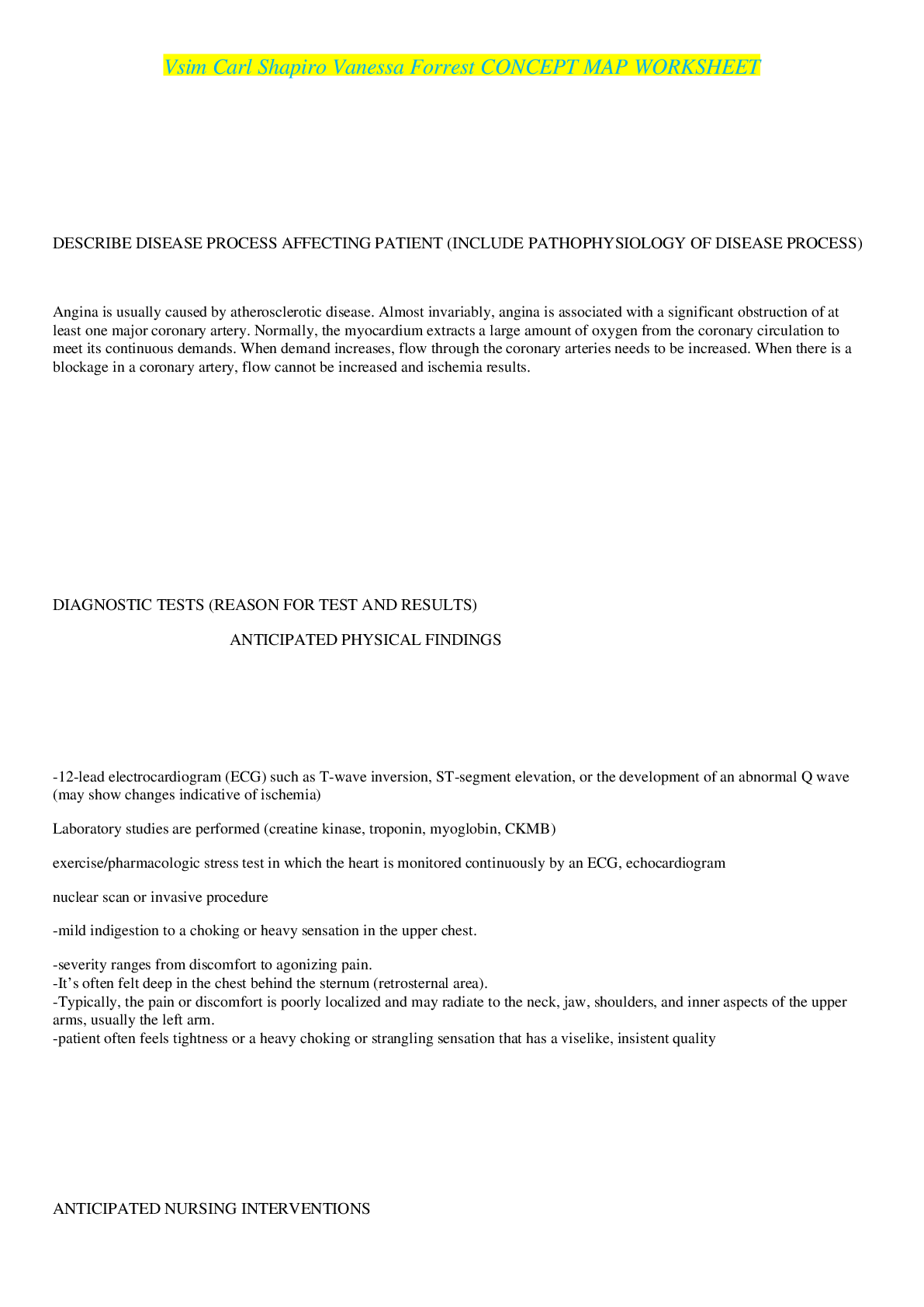
DESCRIBE DISEASE PROCESS AFFECTING PATIENT (INCLUDE PATHOPHYSIOLOGY OF DISEASE PROCESS)
Angina is usually caused by atherosclerotic disease. Almost invariably, angina is associated with a significant obstruction of at least one major coronary artery. Normally, the myocardium extracts a large amount of oxygen from the coronary circulation to meet its continuous demands. When demand increases, flow through the coronary arteries needs to be increased. When there is a blockage in a coronary artery, flow cannot be increased and ischemia results.
DIAGNOSTIC TESTS (REASON FOR TEST AND RESULTS)
PATIENT INFORMATION ANTICIPATED PHYSICAL FINDINGS
-12-lead electrocardiogram (ECG) such as T-wave inversion, ST-segment elevation, or the development of an abnormal Q wave (may show changes indicative of ischemia)
- Laboratory studies are performed (creatine kinase, troponin, myoglobin, CKMB)
- exercise/pharmacologic stress test in which the heart is monitored continuously by an ECG, echocardiogram
- nuclear scan or invasive procedure
-mild indigestion to a choking or heavy sensation in the upper chest.
-severity ranges from discomfort to agonizing pain.
-It’s often felt deep in the chest behind the sternum (retrosternal area).
-Typically, the pain or discomfort is poorly localized and may radiate to the neck, jaw, shoulders, and inner aspects of the upper arms, usually the left arm.
-patient often feels tightness or a heavy choking or strangling sensation that has a viselike, insistent quality
ANTICIPATED NURSING INTERVENTIONS
-~ The nurse assesses the patient’s pain level (PQRST)
~Pharmacologic therapy (nitroglycerin, anticoagulants, beta blockers, etc.)
~Measuring vital signs and observing for signs of respiratory distress.
~ 12-lead ECG is usually obtained and assessed for ST-segment and T-wave changes
~ The nurse administers oxygen therapy if the patient’s respiratory rate is increased or if the oxygen
vSi T
INT
Your name, position (RN), unit you are working on
SITUATION
Patient’s name, age, specific reason for visit
BACKGROUND
Patient’s primary diagnosis, date of admission, current orders for patient
ASSESSMENT
Current pertinent assessment data using head to toe approach, pertinent diagnostics, vital signs
RECOMMENDATION
Any orders or recommendations you mayhave for this patient
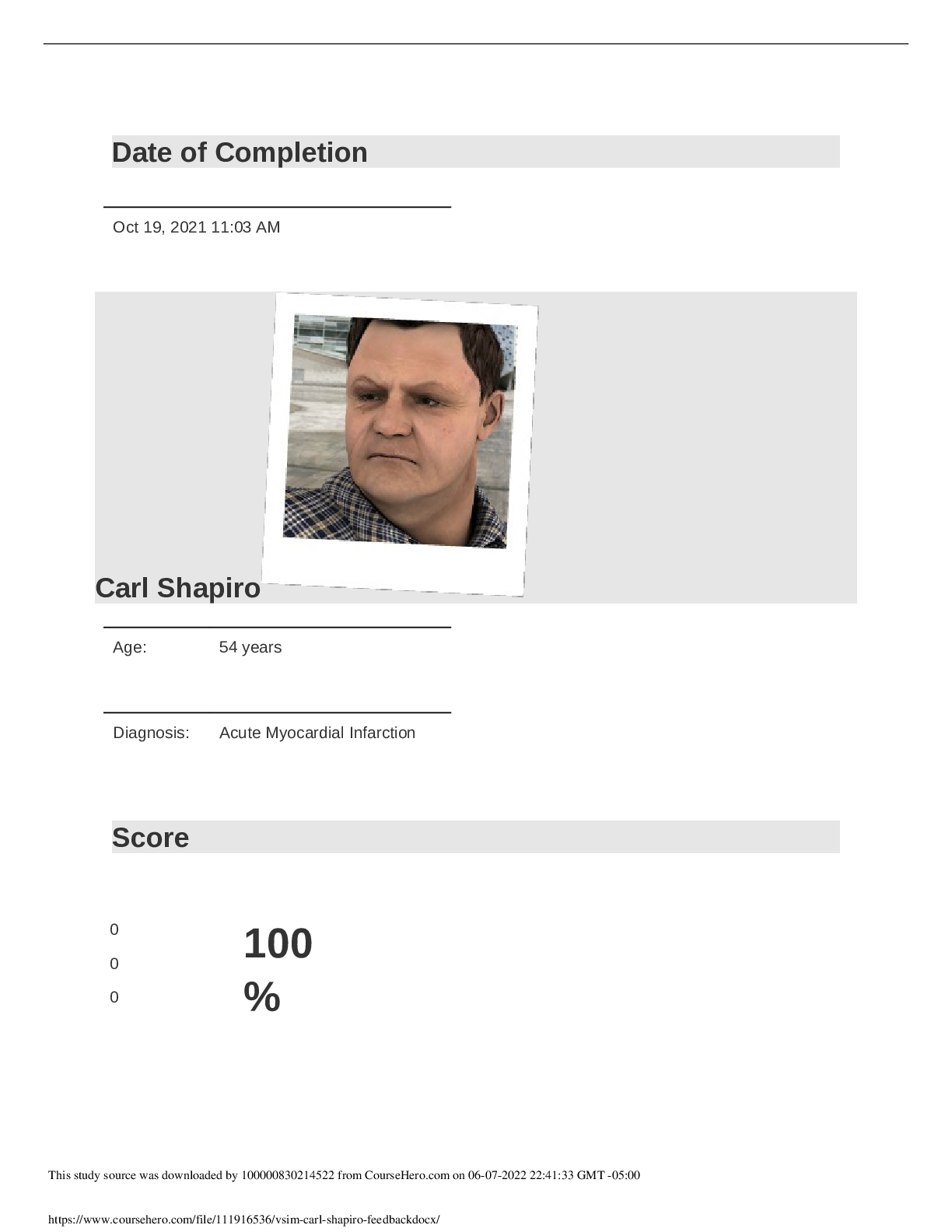
Shapiro, Carl 54-year-old
Acute Chest Pain
Primary: Coronary Artery Disease Date of Admission: 4/15/20 Current Orders:
-IV normal saline at 25 mL/hour
-Oxygen to maintain SpO2 over 92%
-Continuous ECG and SpO2 monitoring
-activity: bed rest with bathroom privileges
-healthy heart diet
-Chest Xray, basic metabolic panel, CBC, troponin and CK-MB every 8 hrs x 3
Meds:
-Morphine 2 mg IV push PRN chest pain every 10 mins x 3; every 2 hrs; notify HCP if chest pain returns
RR- 12 breaths per min BP: 124/74 mmhg
HR- 81 bpm Temp-99 F SPO2- 98%
-~ The nurse assesses the patient’s pain level (PQRST)
~Pharmacologic therapy (nitroglycerin, anticoagulants, beta blockers, etc.)
~Measuring vital signs and observing for signs of respiratory distress.
~ 12-lead ECG is usually obtained and assessed for ST-segment and T- wave changes
~ The nurse administers oxygen therapy if the patient’s respiratory rate is increased or if the oxygen saturation level is decreased
~ Implement stress reduction methods such as guided imagery or music therapy
PHARM-4-FUN PATIENT EDUCATION WORKSHEET
NAME OF MEDICATION, CLASSIFICATION, AND INCLUDE PROTOTYPE
MEDICATION: amiodarone hydrochloride CLASSIFICATION: Antiarrhythmics PROTOTYPE: Nexterone, Pacerone
SAFE DOSE OR DOSE RANGE, SAFE ROUTE
Injection: 50 mg/mL; 150 mg/100 mL; 360 mg/200 mL; 450 mg/9 mL; 450 mg/200 mL; 750 mg/500 mL; 900 mg/18
mL; 900 mg/500 mL; 1,000 mg/500 mL
Tablets: 100 mg; 200 mg; 400 mg
Adults: Give loading dose of 800 to 1,600 mg PO daily or divided into two equal doses daily for 1 to 3 weeks until first therapeutic response occurs; then 600 to 800 mg PO daily for 1 month, followed by maintenance dose of 400 mg PO daily or, for patients with severe GI intolerance, 200 mg PO b.i.d. Determine long-term maintenance dose according to antiarrhythmic effect
PURPOSE FOR TAKING THIS MEDICATION
Prevention of recurrent life-threatening ventricular arrhythmias, such as ventricular fibrillation or hemodynamically unstable ventricular tachycardia
Intended for use only in patients with life-threatening recurrent ventricular fibrillation or recurrent hemodynamically unstable ventricular tachycardia unresponsive to adequate doses of other antiarrhythmics or when alternative drugs can’t be tolerated
PATIENT EDUCATION WHILE TAKING THIS MEDICATION
Advise patient to wear sunscreen or protective clothing to prevent sensitivity reaction to the sun. Monitor patient for skin burning or tingling, followed by redness and blistering. Exposed skin may turn blue-gray. Advise patient to keep follow-up appointments, including eye exams and blood tests.
Tell patient to report vision changes, weakness, “pins and needles” or numbness, poor coordination, weight change, heat or cold intolerance, neck swelling, progressive rash, or mucosal lesions.
Tell patient to take oral drug with food if GI reactions occur.
Inform patient that adverse effects of drug are more common at high doses and become more frequent with treatment lasting longer than 6 months, but are generally reversible when drug is stopped. Resolution of adverse reactions may take up to 4 months.
Tell patient not to stop taking this medication without consulting with prescriber.
PHARM-4-FUN PATIENT EDUCATION WORKSHEET
NAME OF MEDICATION, CLASSIFICATION, AND INCLUDE PROTOTYPE
MEDICATION: vasopressin CLASSIFICATION: Antidiuretic hormones PROTOTYPE: Vasostrict
SAFE DOSE OR DOSE RANGE, SAFE ROUTE
Injection: 20 units/mL in 1-mL and 10-mL vials
PURPOSE FOR TAKING THIS MEDICATION
Vasodilatory shock in patients who remain hypotensive despite fluids and catecholamines.
Causes contraction of smooth muscle in the vascular bed and increases systemic vascular resistance and mean arterial BP and decreases HR and cardiac output.
PATIENT EDUCATION WHILE TAKING THIS MEDICATION
• Tell patient to immediately report all adverse reactions, especially bleeding, chest pain, palpitations, limb pain, limb coldness and pallor, paresthesia, nausea, vomiting, or abdominal pain.
• Tell patient to immediately report signs or symptoms of hypersensitivity reactions (breathing difficulty, wheezing, hives, nausea, vomiting, or swelling of the face, lips, or tongue).
• Tell patient to immediately report infusion-site symptoms.
PHARM-4-FUN PATIENT EDUCATION WORKSHEET
NAME OF MEDICATION, CLASSIFICATION, AND INCLUDE PROTOTYPE
MEDICATION: Nitroglycerin
CLASSIFICATION: Nitrates
PROTOTYPE: GoNitro, Minitran, Nitro-Dur, Nitrolingual, NitroMist, Nitrostat, Rectiv, Trinipatch
SAFE DOSE OR DOSE RANGE, SAFE ROUTE
Safe dose, safe route: 1 SL tablet (1/200 grain, 1/150 grain, or 1/100 grain) dissolved under the tongue or in the buccal pouch as soon as angina begins. Repeat every 5 minutes, if needed, to a maximum of three doses within a 15-minute period. For HTN Initially, infuse at 5 mcg/minute, increasing as needed by 5
mcg/minute every 3 to 5 minutes until response occurs.
PURPOSE FOR TAKING THIS MEDICATION
Purpose: To prevent chronic anginal attacks, Acute angina pectoris; to prevent or minimize anginal attacks before stressful events, HTN from surgery, HF after MI, angina pectoris in acute situations; to produce controlled
hypotension during surgery (by IV infusion)
PATIENT EDUCATION WHILE TAKING THIS MEDICATION
• Caution patient to take nitroglycerin regularly, as prescribed, and to have it accessible at all times.
• Advise patient that stopping drug abruptly may cause coronary artery spasm.
• Teach patient how to give the prescribed form of nitroglycerin.
PHARM-4-FUN PATIENT EDUCATION WORKSHEET
NAME OF MEDICATION, CLASSIFICATION, AND INCLUDE PROTOTYPE
MEDICATION: Aspirin
CLASSIFICATION: Salicylates
PROTOTYPE: Asaphen, Asatab, Bayer Aspirin, Durlaza, Ecotrin, Entrophen,Novasen
SAFE DOSE OR DOSE RANGE, SAFE ROUTE
Adults: 75 to 325 mg PO daily. Or, 162.5 mg extended-release capsule PO daily.
PURPOSE FOR TAKING THIS MEDICATION
To reduce risk of MI in patients with previous MI, unstable angina, and chronic stable angina pectoris
PATIENT EDUCATION WHILE TAKING THIS MEDICATION
• Tell patient who’s allergic to tartrazine to avoid aspirin.
• Advise patient on a low-salt diet that 1 tablet of buffered aspirin contains 553 mg of sodium.
• Advise patient to take drug with food, milk, antacid, or large glass of water to reduce GI reactions.
• Tell patient not to crush or chew enteric-coated or extended-release forms but to swallow them whole.
• Advise patient to take extended-release capsules at same time each day.
• Warn patient not to drink alcohol 2 hours before or 1 hour after taking extended-release capsule and not to take extra capsule to make up for a missed dose.
• Remind patient taking drug for a chronic condition not to stop drug without first discussing with prescriber.
PHARM-4-FUN PATIENT EDUCATION WORKSHEET
NAME OF MEDICATION, CLASSIFICATION, AND INCLUDE PROTOTYPE
MEDICATION: Morphine Sulfate
CLASSIFICATION: Opioid Analgesic
PROTOTYPE: Arymo ER , Duramorph PF, Infumorph, Kadian, , M-Ediat, M-Eslon , MorphaBond , Morphine LP Epidural , MS Contin, MS.IR , Statex, Statex DPS
SAFE DOSE OR DOSE RANGE, SAFE ROUTE
Adults: Initially, 10 mg (based on 70 kg individual) IM or 0.1 to 0.2 mg/kg IV every 4 hours as needed.
Or, 15 to 30 mg (immediate-release tablets) PO, or 10 to 20 mg (oral solution) PO, or 10 to 20 mg PR every 4 hours as needed IV route
PURPOSE FOR TAKING THIS MEDICATION
Moderate to severe pain
PATIENT EDUCATION WHILE TAKING THIS MEDICATION
• Caution patient or caregiver of patient taking an opioid with a benzodiazepine, CNS depressant, or alcohol to seek immediate medical attention for dizziness, light-headedness, extreme sleepiness, slowed or difficult breathing, or unresponsiveness.
• • Explain assessment and monitoring process to patient and family. Instruct them to immediately report difficulty breathing or other signs or symptoms of a potential adverse opioid- related reaction.
• • Encourage patient to report all medications being taken, including prescription and OTC medications and supplements.
• • Warn patient that morphine can cause constipation.
• • Caution patient to immediately report signs and symptoms of serotonin syndrome, adrenal insufficiency, and decreased sex hormone levels.
• • When drug is used after surgery, encourage patient to turn, cough, deep-breathe, and use incentive spirometer to prevent lung problems.
• Caution ambulatory patient about getting out of bed or walking.
• • Warn outpatient to avoid driving and other potentially hazardous activities that require mental
alertness until drug’s adverse CNS effects are known.
PHARM-4-FUN PATIENT EDUCATION WORKSHEET
NAME OF MEDICATION, CLASSIFICATION, AND INCLUDE PROTOTYPE
MEDICATION: epinephrine
CLASSIFICATION: Adrenergics (Vasopressors)
PROTOTYPE: Adrenaline
SAFE DOSE OR DOSE RANGE, SAFE ROUTE
Adults: 1 mg IV or intraosseously every 3 to 5 minutes until return of spontaneous circulation.
PURPOSE FOR TAKING THIS MEDICATION
Cardiac resuscitation
PATIENT EDUCATION WHILE TAKING THIS MEDICATION
• If patient has acute hypersensitivity reactions (such as to bee stings), it may be necessary to teach patient how to self-inject.
• Instruct patient in autoinjector use. Tell patient to give autoinjector in outer thigh and not into buttock.
• Caution patient or caregiver to only give two sequential doses unless under direct medical supervision. Patient should seek immediate medical care for acute hypersensitivity reactions.
• Tell patient to promptly report all adverse reactions.
Clinical Worksheet
Date: 4/2/2020 Student Name: Vanessa Forrest Assigned vSim: Shapiro, Carl
Initial: Diagnosis: Coronary Artery Disease HCP: Chin Revis, MD Isolation: IV Type:
18 gauge Location:
Right Forearm
Fluid/Rate:
Normal Saline 25 ml/hr Critical Labs:
CK-MB: 20
Troponin T: 2.2 ng/mL Glucose: 122 mg/dL
Creatinine: 1.2 mg/dl
Chloride: 80 mEq/L
Bicarb: 18 mEq/L Other Services:
CS
Fall Risk:
Age: 54 Consults: Consults Needed:
Length of Stay:
M/F: M Transfer:
Code Status: FULL 1 day
Allergies: NKA
3. Provide pharmacologic therapy (ex. Morphine, anti-thrombolytics)
program.
Path to Death or Injury: Palliative care is not being considered at this time.
Alerts:
What are you on alert for with this patient? (Signs & Symptoms)
1. chest pain, shortness of breath, indigestion
2. Nausea/Anxiety
3. Cool, pale, and moist skin
What Assessments will focus on for this patient? (How will I identify the above signs &Symptoms?)
4. chest pain, shortness of breath, indigestion
5. Nausea/Anxiety
6. Cool, pale, and moist skin
List Complications that may occur related to dx, procedure, comorbidities:
7. Heart Failure
8. Heart Attack
9. Sudden Death
What nursing or medical interventions may prevent the above Alert or complications?
10. Smoking Cessation
11. Control hypertension
12. Educate patient on physical activity to maintain healthy weight
13. Maintain Oxygen level above 90%
Management of Care: What needs to be done for this Patient Today?
1. Treat Angina
2. Reduce anxiety
3. Identify the level of activity that causes the patient’s pain or prodromal symptoms, and plans the patient’s activities accordingly
4. Acid-Base Gas diagnostic testing
5. Monitor SpO2 levels above 92% and monitor continuous ECG
6. Administer Antihypertensive and Antianginal medications such as Nitroglycerin, Antiplatelets, and Beta/Calcium blockers.
7. Non-pharmacological interventions to reduce stress Priorities for Managing the Patient’s Care Today
1. Circulation of oxygen to tissues and to heart; Spo2 over 92%
2. Decrease chest pain related to angina
3. Promote stress reduction and smoking cessation
4. Maintain heart healthy diet
What aspects of the patient care can be Delegated and who can do it?
-Vital signs can be done by the certified nursing assistant or UPC
-promotion of fluids and nutrition can be done by CNA or UPC
-administration of urgent meds can only be done by the RN
-CPR can be done by any staff member that is licensed
Clinical Worksheet
Reflection Questions
1. How did the scenario make you feel?
The scenario was different from any other one I have completed so far. I was surprised to see patient to become unresponsive. I was scared at first because I didn’t what to do, but then I realized the best thing to do was CPR. It felt good to have followed mostly the correct steps throughout the scenario.
2. What could have been the causes of Carl Shapiro’s ventricular fibrillation?
The lab results revealed that his troponin and CK-MB were high, which are indicative of damage to his heart tissues. The patient also has a history of smoking and obesity and suffers from severe stress related to work.
3. When performing CPR for Carl Shapiro, what are quality indicators you are performing resuscitation correctly?
From what I reviewed in the suggested readings, chest compression fraction >80% Compression rate of 100-120/min. Compression depth of at least 50 mm (2 inches) in adults and at least 1/3 the AP dimension of the chest in infants and children. No excessive ventilation.-High-quality CPR includes compressing hard and fast, allowing complete recoil after each compression, reducing hands-off time by minimizing interruptions in compressions, switching providers every 2 minutes, and avoiding excessive ventilation
4. Discuss safety aspects during defibrillation.
Do not touch the patient during defibrillation (clearing bed at least twice before defibrillating), do not allow any objects to touch the bed, ensure the patient is dry before using the AED, do not use AED over a pacemaker/metallic device, ensure the AED is functional, ensure pads are in correct position, ensure patient does not have nitroglycerin patch, ensure there are no flammable substances (remove oxygen from the bed)
5. If Carl Shapiro would have had return of spontaneous circulation (ROSC), what would your next interventions be? I would first assess the carotid pulse, administer epinephrine, administer amiodarone
6. What key elements would you include in the handoff report for this patient? Consider the SBAR (situation, background, assessment, recommendation) format.
S- This is 54-year old Carl Shapiro experienced VFIB, code team was called, emergency response measures were implemented to include CPR and AED shock. B- 54-year-old male. He was seen in the Emergency Department at 1:30 p.m. for complaints of chest pain, diaphoresis, and shortness of breath. He was treated in the Emergency Department with aspirin and two doses of sublingual nitroglycerin. Chest pain improved with nitroglycerin administration. A- Patient started breathing spontaneously again. R- Recommend patient cardiac status is closely monitored
7. If Carl Shapiro’s family members had been present at the bedside during the arrest, describe what you could have done to support them during this crisis.
The patient is the main concern during
this situation, but I would ensure they were
escorted out of the room so the focus could be on the patient, but if they insisted to
stay I would reassure them that we are doing everything we can to ensure his health
and safet
The patient is the main concern during this situation, but I would ensure they were escorted out of the room so the focus could be on the patient, but if they insisted to stay I would reassure them that we are doing everything we can to ensure his health and safety
8. What would you do differently if you were to repeat this scenario? How would your patient care change?
I would have reviewed the suggested readings on cardiac arrest and the protocol more in-depth. I felt that I knew exactly what to do already, but this simulation showed me that the steps are not so simple and any small change away from the correct technique can cause serious damage to the patient.
Clinical Judgement Components
Scoring:
Exemplary = 4 point Accomplished = 3 points Developing = 2 points Beginning = 1 point
Noticing: Score: vSim 1 Score: vSim 2 Score: vSim 3
Focused Observation: E A D B 2
Recognizing Deviations from
Expected Patterns: E A D B 2
Information Seeking: E A D B 3
Total for category: 5
Interpreting:
Prioritizing Data: E A D B 3
Making Sense of Data: E A D B 3
[Show More]