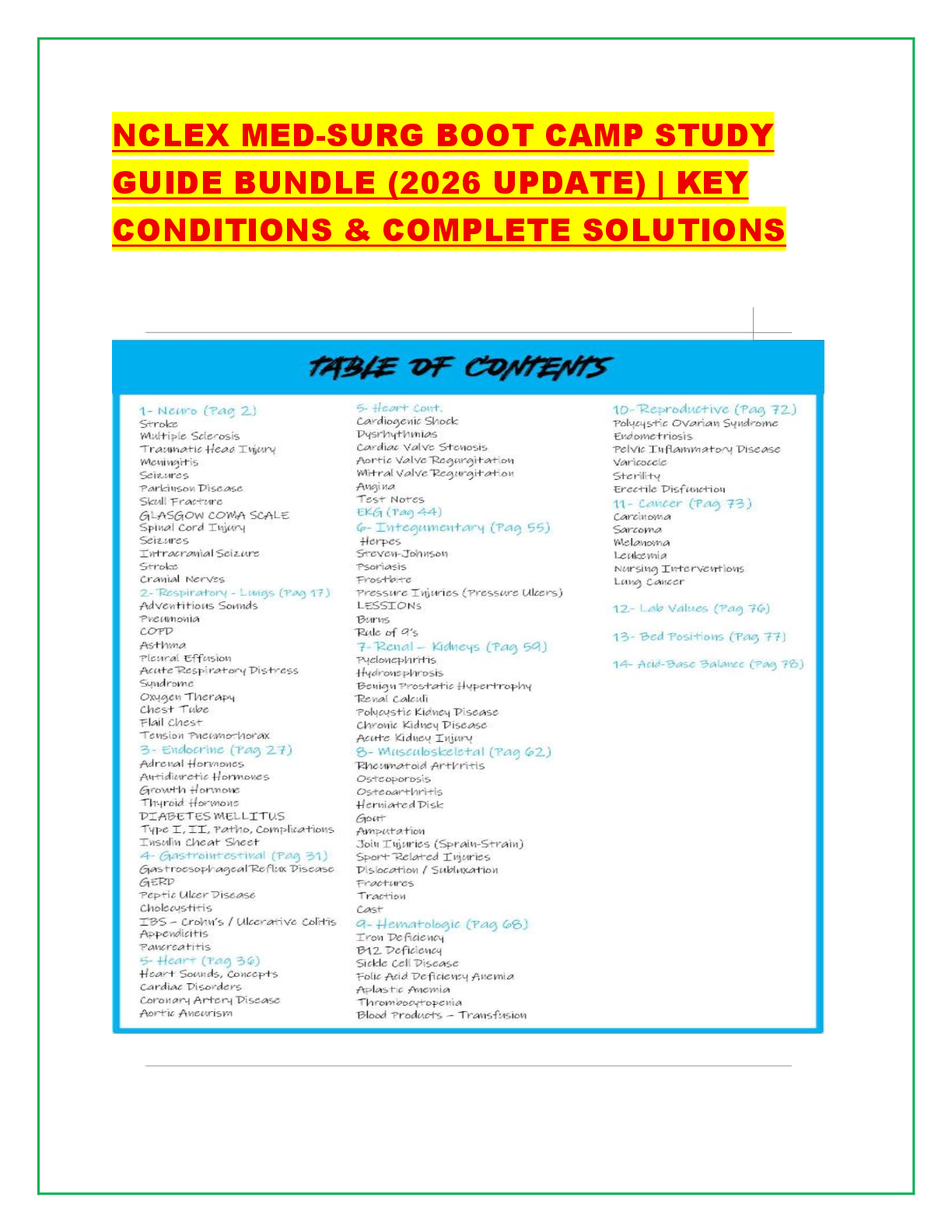
Saunders Medsurg Skin Integumentary
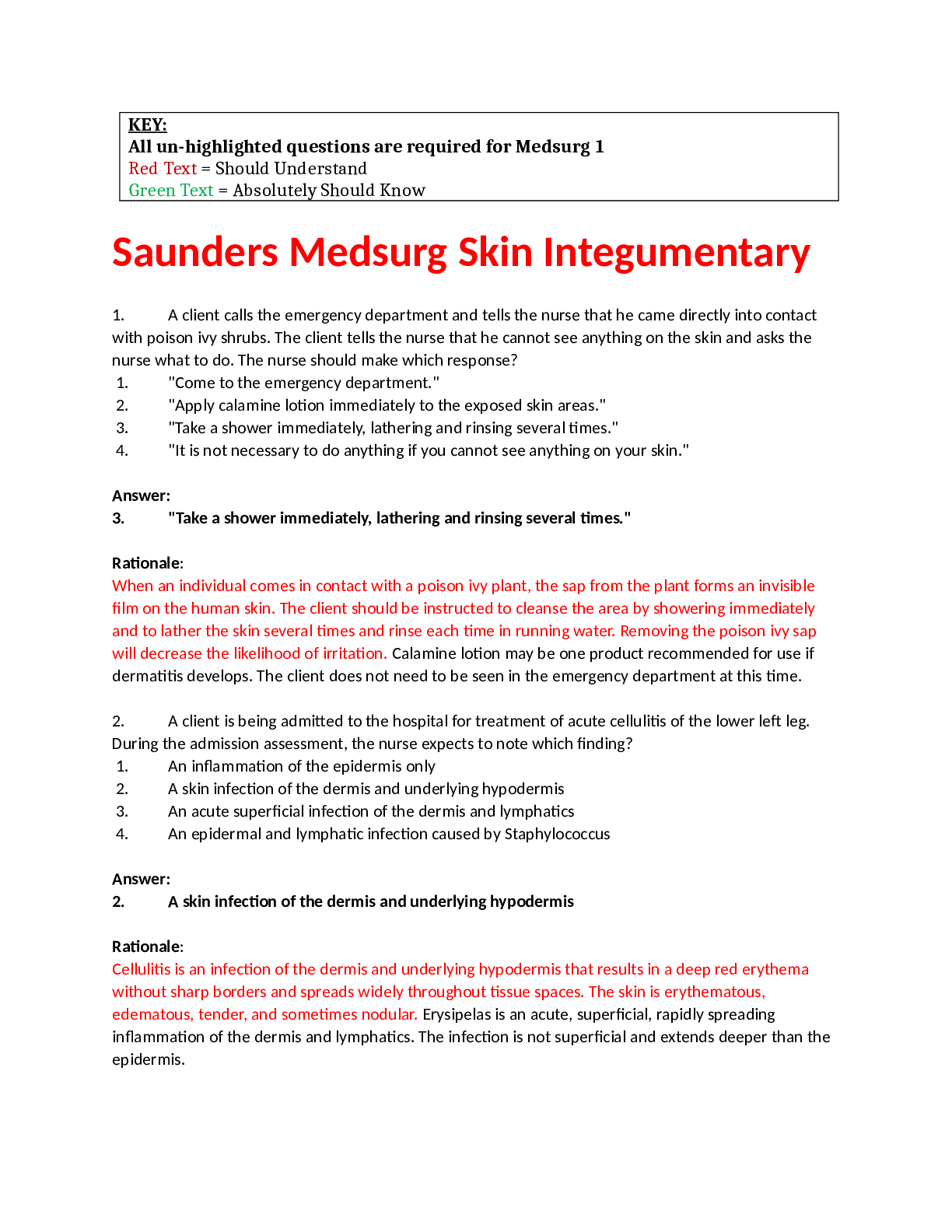
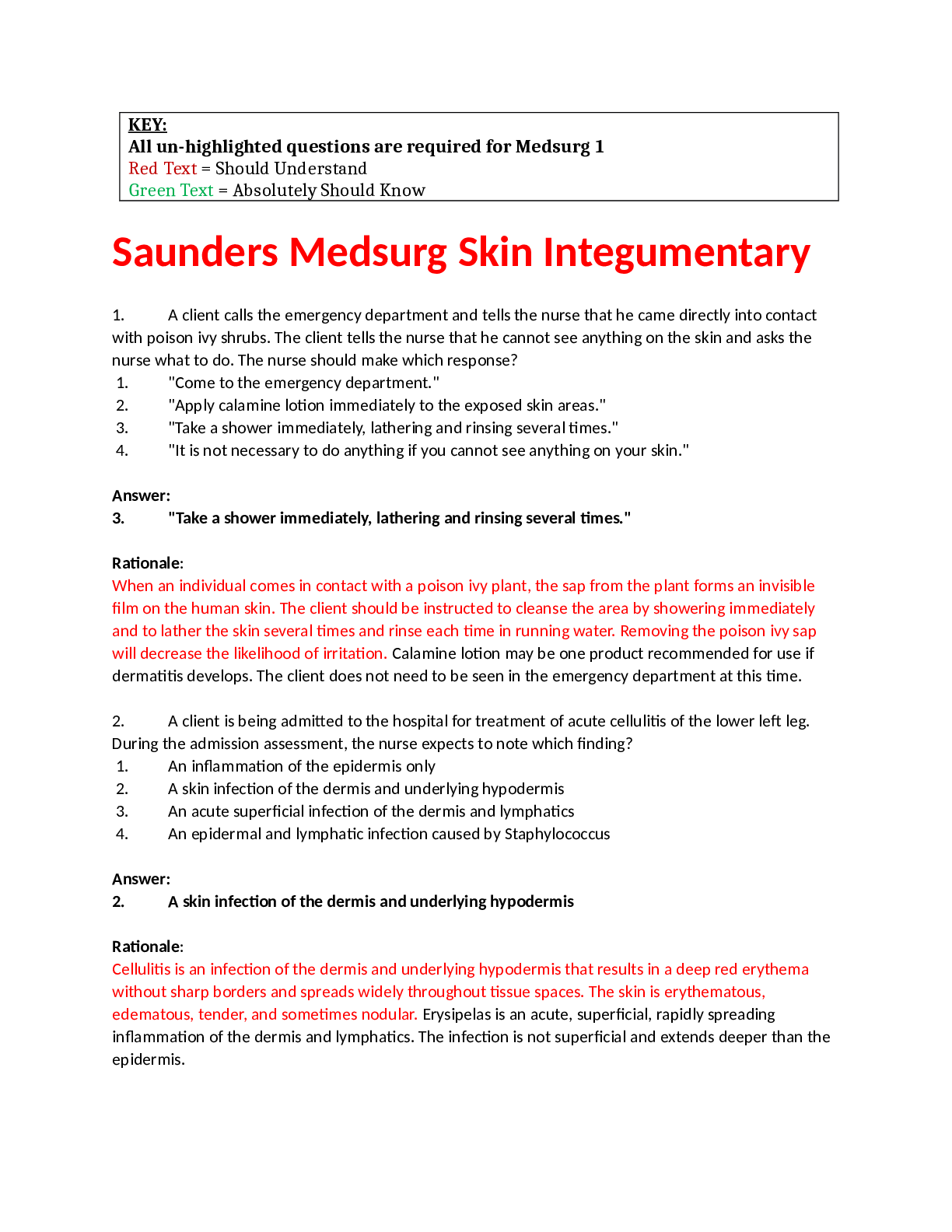
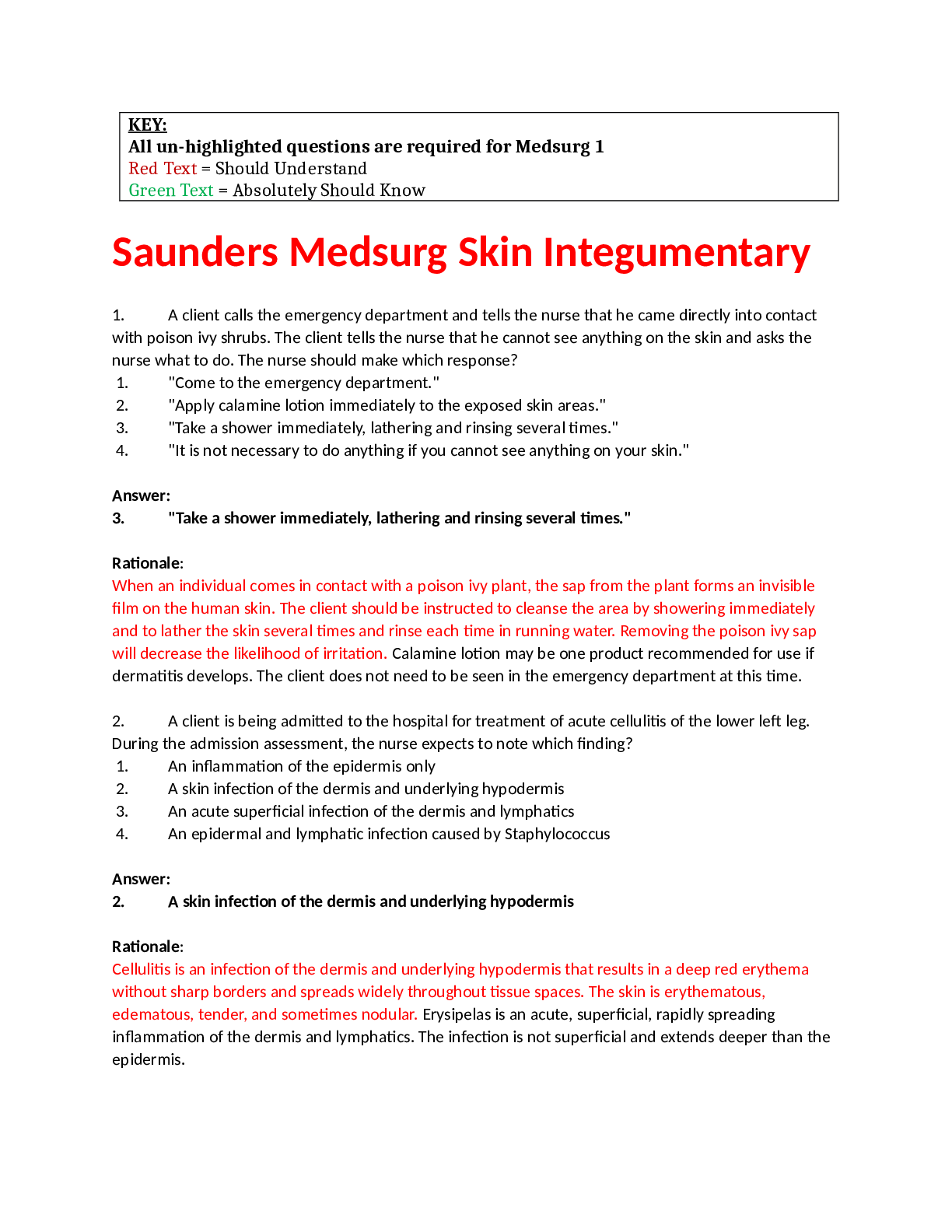
Saunders Medsurg Skin Integumentary
1. A client calls the emergency department and tells the nurse that he came directly into contact
with poison ivy shrubs. The client tells the
...
Saunders Medsurg Skin Integumentary
Saunders Medsurg Skin Integumentary
1. A client calls the emergency department and tells the nurse that he came directly into contact
with poison ivy shrubs. The client tells the nurse that he cannot see anything on the skin and asks the
nurse what to do. The nurse should make which response?
1. "Come to the emergency department."
2. "Apply calamine loton immediately to the exposed skin areas."
3. "Take a shower immediately, lathering and rinsing several tmes."
4. "It is not necessary to do anything if you cannot see anything on your skin."
Answer:
3. "Take a shower immediately, lathering and rinsing several tmes."
Ratonale:
When an individual comes in contact with a poison ivy plant, the sap from the plant forms an invisible
flm on the human skin. The client should be instructed to cleanse the area by showering immediately
and to lather the skin several tmes and rinse each tme in running water. Removing the poison ivy sap
will decrease the likelihood of irritaton. Calamine loton may be one product recommended for use if
dermatts develops. The client does not need to be seen in the emergency department at this tme.
2. A client is being admited to the hospital for treatment of acute cellulits of the lower lef leg.
During the admission assessment, the nurse expects to note which fnding?
1. An inflammaton of the epidermis only
2. A skin infecton of the dermis and underlying hypodermis
3. An acute superfcial infecton of the dermis and lymphatcs
4. An epidermal and lymphatc infecton caused by Staphylococcus
Answer:
2. A skin infecton of the dermis and underlying hypodermis
Ratonale:
Cellulits is an infecton of the dermis and underlying hypodermis that results in a deep red erythema
without sharp borders and spreads widely throughout tssue spaces. The skin is erythematous,
edematous, tender, and sometmes nodular. Erysipelas is an acute, superfcial, rapidly spreading
inflammaton of the dermis and lymphatcs. The infecton is not superfcial and extends deeper than the
epidermis.3. The clinic nurse assesses the skin of a client with psoriasis afer the client has used a new topical
treatment for 2 months. The nurse identfes which characteristcs as improvement in the manifestatons
of psoriasis? Select all that apply.
1. Presence of striae
2. Palpable radial pulses
3. Absence of any ecchymosis on the extremites
4. Thinner and decrease in number of reddish papules
5. Scarce amount of silvery-white scaly patches on the arms
Answers:
4. Thinner and decrease in number of reddish papules
5. Scarce amount of silvery-white scaly patches on the arms
Ratonale:
Psoriasis skin lesions include thick reddened papules or plaques covered by silvery-white patches. A
decrease in the severity of these skin lesions is noted as an improvement. The presence of striae (stretch
marks), palpable pulses, or lack of ecchymosis is not related to psoriasis.
4. The clinic nurse notes that the health care provider has documented a diagnosis of herpes zoster
(shingles) in the client's chart. Based on an understanding of the cause of this disorder, the nurse
determines that this defnitve diagnosis was made by which diagnostc test?
1. Positve patch test
2. Positve culture results
3. Abnormal biopsy results
4. Wood's light examinaton indicatve of infecton
Answer:
2. Positve culture results
Ratonale:
With the classic presentaton of herpes zoster, the clinical examinaton is diagnostc. However, a viral
culture of the lesion provides the defnitve diagnosis. Herpes zoster (shingles) is caused by a reactvaton
of the varicella-zoster virus, the virus that causes chickenpox. A patch test is a skin test that involves the
administraton of an allergen to the surface of the skin to identfy specifc allergies. A biopsy would
provide a cytological examinaton of tssue. In a Wood's light examinaton, the skin is viewed under
ultraviolet light to identfy superfcial infectons of the skin.
5. A client returns to the clinic for follow-up treatment following a skin biopsy of a suspicious lesion
performed 1 week ago. The biopsy report indicates that the lesion is a melanoma. The nurse
understands that melanoma has which characteristcs? Select all that apply.
1. Lesion is painful to touch.
2. Lesion is highly metastatc.
3. Lesion is a nevus that has changes in color.
4. Skin under the lesion is reddened and warm to touch.5. Lesion occurs in body area exposed to outdoor sunlight.
Answers:
2. Lesion is highly metastatc.
3. Lesion is a nevus that has changes in color.
Ratonale:
Melanomas are pigmented malignant lesions originatng in the melanin-producing cells of the epidermis.
Melanomas cause changes in a nevus (mole), including color and borders. This skin cancer is highly
metastatc, and a person's survival depends on early diagnosis and treatment. Melanomas are not
painful or accompanied by sign of inflammaton. Although sun exposure increases the risk of melanoma,
lesions are most commonly found on the upper back and legs and on the soles and palms of persons
with dark skin.
7. A client arriving at the emergency department has experienced frostbite to the right hand. Which
fnding would the nurse note on assessment of the client's hand?
1. A pink, edematous hand
2. Fiery red skin with edema in the nail beds
3. Black fngertps surrounded by an erythematous rash
4. A white color to the skin, which is insensitve to touch
Answer:
4. A white color to the skin, which is insensitve to touch
Ratonale:
Assessment fndings in frostbite include a white or blue color; the skin will be hard, cold, and insensitve
to touch. As thawing occurs, flushing of the skin, the development of blisters or blebs, or tssue edema
appears. Optons 1, 2, and 3 are incorrect.
8. The evening nurse reviews the nursing documentaton in a client's chart and notes that the day nurse
has documented that the client has a stage II pressure ulcer in the sacral area. Which fnding would the
nurse expect to note on assessment of the client's sacral area?
1. Intact skin
2. Full-thickness skin loss
3. Exposed bone, tendon, or muscle
4. Partal-thickness skin loss of the dermis
Answer:
4. Partal-thickness skin loss of the dermis
Ratonale:
In a stage II pressure ulcer, the skin is not intact. Partal-thickness skin loss of the dermis has occurred. It
presents as a shallow open ulcer with a red-pink wound bed, without slough. It may also present as anintact or open/ruptured serum-flled blister. The skin is intact in stage I. Full-thickness skin loss occurs in
stage III. Exposed bone, tendon, or muscle is present in stage IV.
9. An adult client was burned in an explosion. The burn initally affected the client's entre face (anterior
half of the head) and the upper half of the anterior torso, and there were circumferental burns to the
lower half of both arms. The client's clothes caught on fre, and the client ran, causing subsequent burn
injuries to the posterior surface of the head and the upper half of the posterior torso. Using the rule of
nines, what would be the extent of the burn injury?
1. 18%
2. 24%
3. 36%
4. 48%
Answer:
3. 36%
Ratonale:
According to the rule of nines, with the inital burn, the anterior half of the head equals 4.5%, the upper
half of the anterior torso equals 9%, and the lower half of both arms equals 9%. The subsequent burn
included the posterior half of the head, equaling 4.5%, and the upper half of posterior torso, equaling
9%. This totals 36%.
10. The nurse is preparing to care for a burn client scheduled for an escharotomy procedure being
performed for a third-degree circumferental arm burn. The nurse understands that which fnding is the
antcipated therapeutc outcome of the escharotomy?
1. Return of distal pulses
2. Brisk bleeding from the site
3. Decreasing edema formaton
4. Formaton of granulaton tssue
Answer:
1. Return of distal pulses
Ratonale:
Escharotomies are performed to relieve the compartment syndrome that can occur when edema forms
under nondistensible eschar in a circumferental third-degree burn. The escharotomy releases the
tourniquet-like compression around the arm. Escharotomies are performed through avascular eschar to
subcutaneous fat. Although bleeding may occur from the site, it is considered a complicaton rather than
an antcipated therapeutc outcome. Usually, direct pressure with a bulky dressing and elevaton control
the bleeding, but occasionally an artery is damaged and may require ligaton. Escharotomy does not
affect the formaton of edema. Formaton of granulaton tssue is not the intent of an escharotomy.11. The nurse is caring for a client who sustained superfcial partal-thickness burns on the anterior lower
legs and anterior thorax. Which fnding does the nurse expect to note during the resuscitaton/emergent
phase of the burn injury?
1. Decreased heart rate
2. Increased urinary output
3. Increased blood pressure
4. Elevated hematocrit levels
Answer:
4. Elevated hematocrit levels
Ratonale:
The resuscitaton/emergent phase begins at the tme of injury and ends with the restoraton of capillary
permeability, usually at 48 to 72 hours following the injury. During the resuscitaton/emergent phase, the
hematocrit level increases to above normal because of hemoconcentraton from the large fluid shifs.
Hematocrit levels of 50% to 55% (0.50 to 0.55) are expected during the frst 24 hours afer injury, with
return to normal by 36 hours afer injury. Initally, blood is shunted away from the kidneys and renal
perfusion and glomerular fltraton are decreased, resultng in low urine output. The burn client is prone
to hypovolemia and the body atempts to compensate by increased pulse rate and lowered blood
pressure. Pulse rates are typically higher than normal, and the blood pressure is decreased as a result of
the large fluid shifs.
12. The nurse is administering fluids intravenously as prescribed to a client who sustained superfcial
partal-thickness burn injuries of the back and legs. In evaluatng the adequacy of fluid resuscitaton, the
nurse understands that which assessment would provide the most reliable indicator for determining the
adequacy?
1. Vital signs
2. Urine output
3. Mental status
4. Peripheral pulses
Answer:
2. Urine output
Ratonale:
Successful or adequate fluid resuscitaton in the client is signaled by stable vital signs, adequate urine
output, palpable peripheral pulses, and clear sensorium. However, the most reliable indicator for
determining adequacy of fluid resuscitaton, especially in a client with burns, is the urine output. For an
adult, the hourly urine volume should be 30 to 50 mL.
13. The nurse is caring for a client following an autograf and grafing to a burn wound on the right knee.
What would the nurse antcipate to be prescribed for the client?
1. Out-of-bed actvites
2. Bathroom privileges
3. Immobilizaton of the affected leg4. Placing the affected leg in a dependent positon
Answer:
3. Immobilizaton of the affected leg
Ratonale:
Autografs placed over joints or on the lower extremites afer surgery ofen are elevated and
immobilized for 3 to 7 days. This period of immobilizaton allows the autograf tme to adhere to the
wound bed. Getng out of bed, going to the bathroom, and placing the grafed leg dependent would put
stress on the grafed wound.
14. The health educaton nurse provides instructons to a group of clients regarding measures that will
assist in preventng skin cancer. Which instructons should the nurse provide? Select all that apply.
1. Sunscreen should be applied every 8 hours.
2. Use sunscreen when partcipatng in outdoor actvites.
3. Wear a hat, opaque clothing, and sunglasses when in the sun.
4. Avoid sun exposure in the late afernoon and early evening hours.
5. Examine your body monthly for any lesions that may be suspicious.
Answers:
2. Use sunscreen when partcipatng in outdoor actvites.
3. Wear a hat, opaque clothing, and sunglasses when in the sun.
5. Examine your body monthly for any lesions that may be suspicious.
Ratonale:
The client should be instructed to avoid sun exposure between the hours of brightest sunlight: 10 a.m.
and 4 p.m. Sunscreen, a hat, opaque clothing, and sunglasses should be worn for outdoor actvites. The
client should be instructed to examine the body monthly for the appearance of any cancerous or any
precancerous lesions. Sunscreen should be reapplied every 2 to 3 hours and afer swimming or sweatng;
otherwise, the duraton of protecton is reduced.
27. The community health nurse is visitng a homeless shelter and is assessing the clients in the shelter
for the presence of scabies. Which assessment fnding should the nurse expect to note if scabies is
present?
1. Brown-red macules with scales
2. Pustules on the trunk of the body
3. White patches noted on the elbows and knees
4. Multple straight or wavy threadlike lines underneath the skin
Answer:
4. Multple straight or wavy threadlike lines underneath the skin
Ratonale:Scabies can be identfed by the multple straight or wavy threadlike lines beneath the skin. The skin
lesions are caused by the female, which burrows beneath the skin to lay its eggs. The eggs hatch in a few
days, and the baby mites fnd their way to the skin surface, where they mate and complete the life cycle.
Optons 1, 2, and 3 are not characteristcs of scabies.
29. The nurse is concerned about potental skin integrity problems for an unconscious client. Which
interventons would be most appropriate to include in the plan of care for this client? Select all that
apply.
1. Repositon every 2 hours.
2. Use a bed cradle as indicated.
3. Apply protectve pads to heels and elbows.
4. Add a small amount of alcohol to the daily bath water.
5. Provide perineal care every 8 hours and afer incontnence.
Answers:
1. Repositon every 2 hours.
2. Use a bed cradle as indicated.
3. Apply protectve pads to heels and elbows.
5. Provide perineal care every 8 hours and afer incontnence.
Ratonale:
Unconscious clients are completely immobile, having lost the protectve reflexes to shif body weight. It
is up to the nurse to minimize the risk of prolonged pressure that could cause skin ischemia and
breakdown. This is accomplished by repositoning the client every 2 hours. Use of a bed cradle can
protect the client's toes from breakdown due to weight from linens. Protectve pads can be applied to
the heels and elbows to reduce fricton and shear. Appropriate perineal care is essental to keep waste
products from excoriatng the skin. The nurse can reduce skin dryness and irritaton by adding a
superfaty soluton (such as baby oil or castle soap) to the daily bath water. Drying agents such as
alcohol are avoided because dry skin can crack and break down.
30. The emergency department nurse is caring for a client who has sustained chemical burns to the
esophagus afer ingeston of lye. The nurse reviews the health care provider's prescriptons and should
plan to queston which prescripton?
1. Gastric lavage
2. Intravenous (IV) fluid therapy
3. Nothing by mouth (NPO) status
4. Preparaton for laboratory studies
Answer:
[Show More]




![Preview of ATI Med-SURG Proctored Exam [2021 / 2022] - Chamberlain College of Nursing | UPDATED & GRA](https://scholarfriends.com/storage/ATI Med-Surg free A21.png)