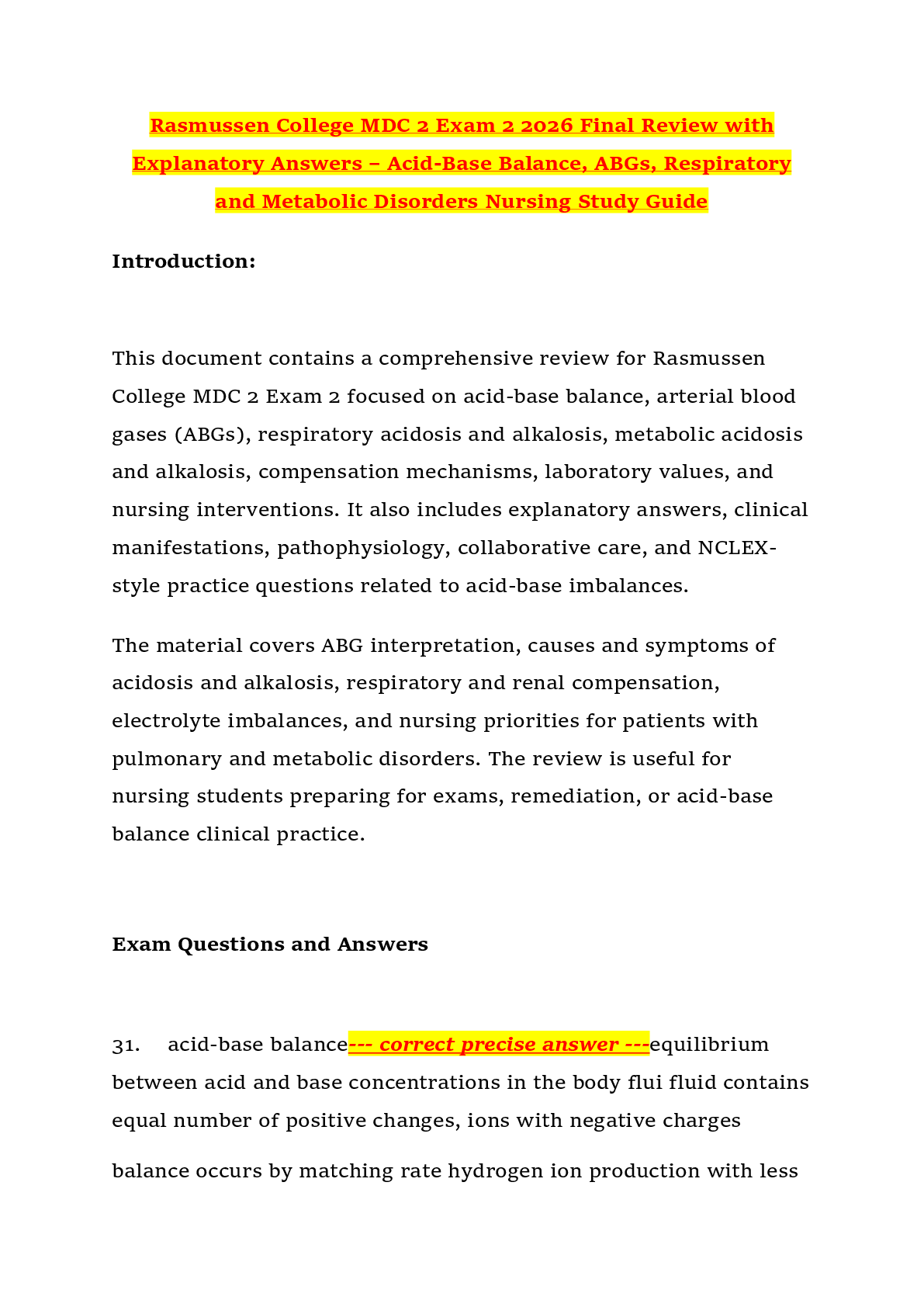
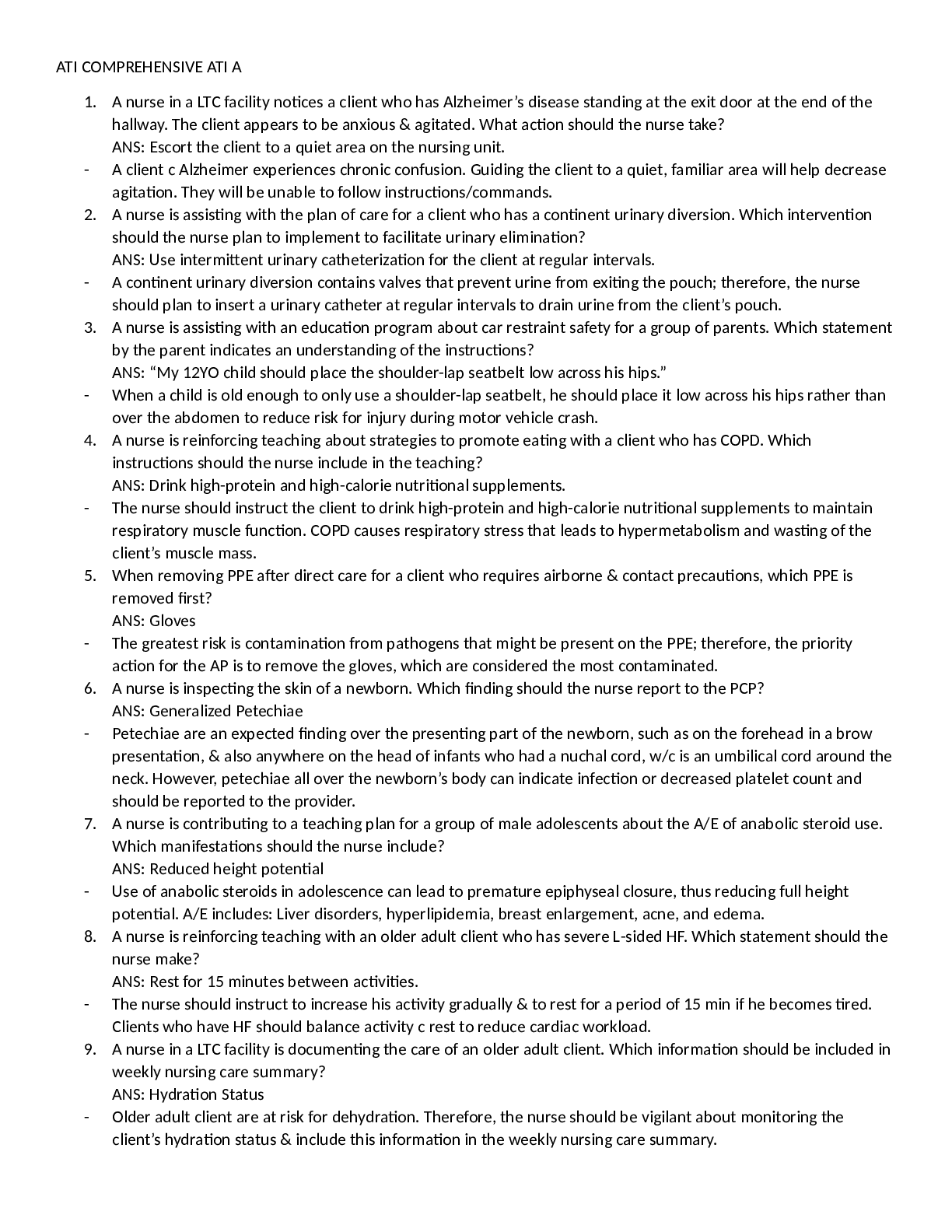
NURS 200 Foundations of Nursing I Module 2 Quiz Vital Signs
NURS 200 Foundatons of Nursing I
Module 2 Quiz Vital Signs – Group Assignment
Name: Click here to enter text.
Instructons: Answer the following questons a
...
NURS 200 Foundations of Nursing I Module 2 Quiz Vital Signs
NURS 200 Foundatons of Nursing I
Module 2 Quiz Vital Signs – Group Assignment
Name: Click here to enter text.
Instructons: Answer the following questons as a group and provide a reference from your textbook for
your ratonale (including the page number) and submit your assignment on Canvas. Ratonales should be
included for all correct and incorrect answers. Why did you choose the opton that you chose?
Outcome 1: Defne the key terms and normal ranges related to vital sign assessment.
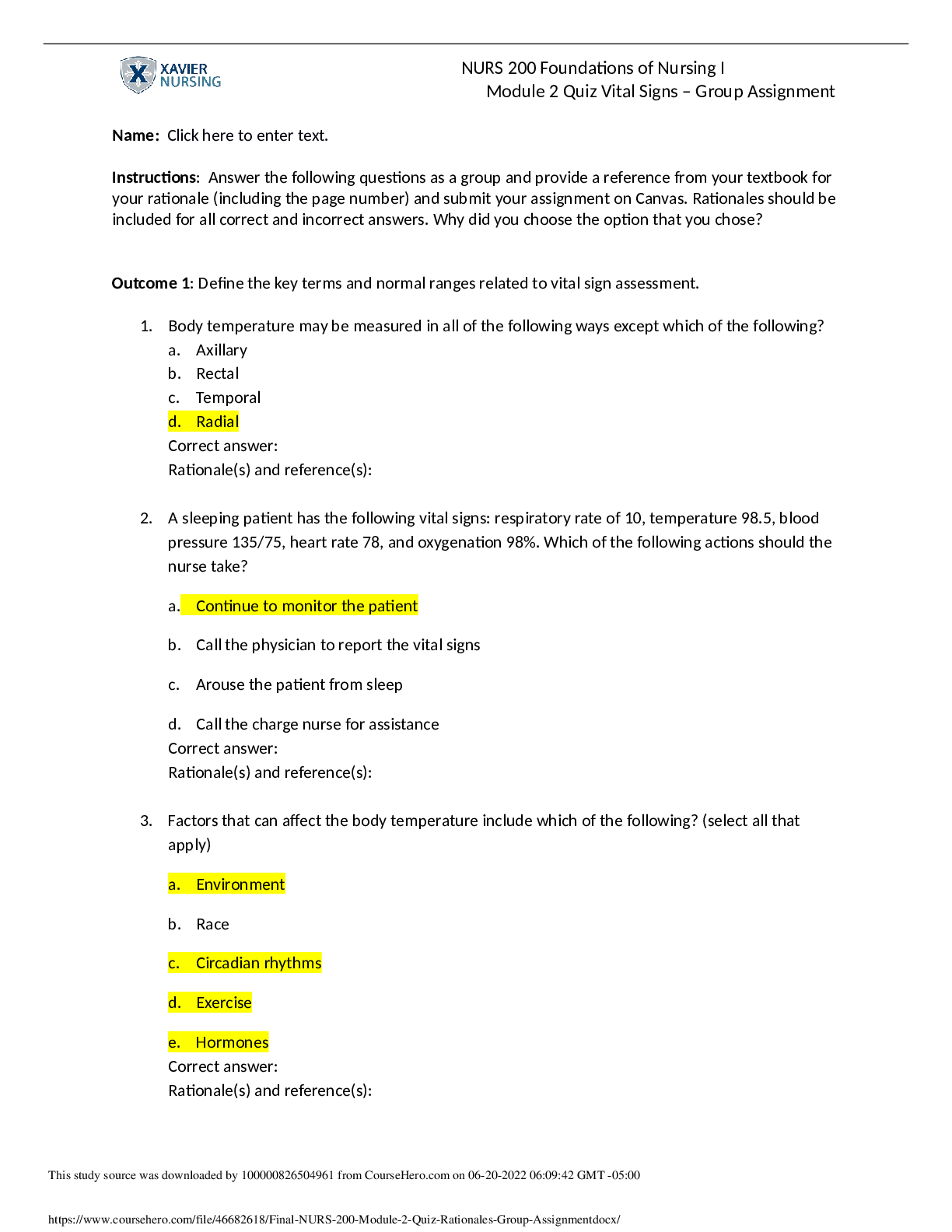
1. Body temperature may be measured in all of the following ways except which of the following?
a. Axillary
b. Rectal
c. Temporal
d. Radial
Correct answer:
Ratonale(s) and reference(s):
2. A sleeping patent has the following vital signs: respiratory rate of 10, temperature 98.5, blood
pressure 135/75, heart rate 78, and oxygenaton 98%. Which of the following actons should the
nurse take?
a. Contnue to monitor the patent
b. Call the physician to report the vital signs
c. Arouse the patent from sleep
d. Call the charge nurse for assistance
Correct answer:
Ratonale(s) and reference(s):
3. Factors that can affect the body temperature include which of the following? (select all that
apply)
a. Environment
b. Race
c. Circadian rhythms
d. Exercise
e. Hormones
Correct answer:
Ratonale(s) and reference(s):
This study source was downloaded by 100000826504961 from CourseHero.com on 06-20-2022 06:09:42 GMT -05:00
https://www.coursehero.com/file/46682618/Final-NURS-200-Module-2-Quiz-Rationales-Group-Assignmentdocx/NURS 200 Foundatons of Nursing I
Module 2 Quiz Vital Signs – Group Assignment
4. Which determinant of blood pressure would best explain a patent's blood pressure reading of
120/100?
a. Blood viscosity
b. Blood volume
c. Pumping acton of the heart
d. Peripheral vascular resistance
Correct answer:
Ratonale(s) and reference(s):
Outcome 2: Discuss the importance of notcing trends in vital signs.
5. A patent’s admission vital signs are: temperature 99.1 degrees F, pulse 75, respiratons 16 and
unlabored, and blood pressure 185/110. Which of the following vital signs is the most
concerning to the nurse?
a. Pulse
b. Respiratons
c. Blood pressure
d. Temperature
Correct answer:
Ratonale(s) and reference(s):
6. Before discharge from the hospital a patent is taught to exercise by gradually increasing the
distance walked. Which vital sign should the nurse teach the patent to monitor to determine
whether to increase or decrease the exercise level?
a. Blood pressure
b. Pulse rate
c. Body temperature
d. Respiratory rate
Correct answer:
Ratonale(s) and reference(s):
This study source was downloaded by 100000826504961 from CourseHero.com on 06-20-2022 06:09:42 GMT -05:00
https://www.coursehero.com/file/46682618/Final-NURS-200-Module-2-Quiz-Rationales-Group-Assignmentdocx/NURS 200 Foundatons of Nursing I
Module 2 Quiz Vital Signs – Group Assignment
7. While assessing the dorsalis pedis pulse of a patent, the nurse determines that the pulse is not
palpable. However, the extremity is warm and pink with nail beds blanching at 2 to 3 seconds of
capillary reflling tme. Which of the following is likely cause of these fndings?
a. A change in the patent's health status has occurred.
b. The patent has thrown a blood clot in that extremity.
c. The nurse's watch has stopped working.
d. Too much pressure was applied over the pulse site
Correct answer:
Ratonale(s) and reference(s):
Outcome 3: Recognize lifespan consideratons when obtaining vital signs.
8. An older patent has an oral temperature reading of 97.2 degrees F. The nurse realizes that this
patent’s low temperature could be due to which observaton?
a. The anxiety level of the patent has increased.
b. Hormones have fluctuated in this patent.
c. Muscle actvity has increased during the patent's therapy session.
d. Loss of subcutaneous fat is noted.
Correct answer:
Ratonale(s) and reference(s):
Outcome 4: Identfy variables influencing pulse rate, blood pressure, and body temperature.
9. The nurse notces the pulse oximetry of the client is 85% oxygen saturaton. What is the frst
acton the nurse should take?
a. Notfy the physician
b. Call the respiratory therapist
c. Ensure that the pulse oximeter is working correctly
d. Assess the pulse at the oximeter site for one minute
Correct answer:
Ratonale(s) and reference(s): Instead of taking unnecessary tme notfying the physician or
calling the respiratory therapist, the nurse should frst carry out the oximeter test a second tme
to make sure the pulse oximeter is working correctly. If the test results are stll off afer the
This study source was downloaded by 100000826504961 from CourseHero.com on 06-20-2022 06:09:42 GMT -05:00
https://www.coursehero.com/file/46682618/Final-NURS-200-Module-2-Quiz-Rationales-Group-Assignmentdocx/NURS 200 Foundatons of Nursing I
Module 2 Quiz Vital Signs – Group Assignment
second atempt, then additonal critcal steps can be carried out. (Berman, Snyder, & Frandsen,
2015, p. 510)
10. When preparing a patent for discharge the nurse notes that the patent has a temperature of
101.8. Which phrase is most appropriate for the nurse to use when speaking with the
healthcare provider?
a. “This patent should not be discharged because he has a temperature of 101.8.”
b. “I am concerned about the patent’s readiness for discharge because his most recent
temperature was 101.8.”
c. “I called the nursing home and cancelled this patent’s discharge because he has a
temperature of 101.8.”
d. “This patent has a temperature of 101.8. Don’t you think we should cancel his discharge?”
Correct answer:
Ratonale(s) and reference(s): Since a temperature of 101.8 is above normal the nurse needs to
notfy the healthcare provider but should do so in a positve manor. In this scenario phrases for
a, c and d come off in a negatve tone and could cause fricton between team members. “I am
concerned about the patent’s readiness for discharge because his most recent temperature was
101.8” provides a clear statement of concern that can be talked over between the nurse and
healthcare provider prior to discharging the patent. (Berman, Snyder, & Frandsen, 2015, p. 486)
Outcome 5: Recognize the role of delegaton as it pertains to obtaining vital signs.
11. The nurse needs vital signs assessed for four patents. Which patent should the nurse assess and
not assign to the UAP?
a. Patent returning to the nursing unit afer cardiac catherizaton
b. Patent on 2 liters of oxygen via nasal cannula
c. Pneumonia patent nearing discharge
d. Post-operatve patent of 2 days from gallbladder surgery
Correct answer:
Ratonale(s) and reference(s): The tasks listed for b, c and d are all cleared to be delegated to
UAP. Vital signs taken directly afer heart procedures, specifcally cardiac catherizaton, are
unable to be delegated to UAP. (Wit & Elsevier, 2015, p. 82)
This study source was downloaded by 100000826504961 from CourseHero.com on 06-20-2022 06:09:42 GMT -05:00
https://www.coursehero.com/file/46682618/Final-NURS-200-Module-2-Quiz-Rationales-Group-Assignmentdocx/NURS 200 Foundatons of Nursing I
Module 2 Quiz Vital Signs – Group Assignment
Outcome 6: Describe hygienic care that nurses provide patents.
12. The nurse is shampooing a patent’s hair. Which assessment fnding should the nurse consider as
expected?
a. Dry, dark, thin
b. Smooth, taut, shiny
c. Smooth texture and not oily or dry
d. Tender, warm scalp
Correct answer:
Ratonale(s) and reference(s): Smooth textured hair that isn’t dry or oily is the expected
conditon of healthy hair. Excessive coarseness and dryness may be associated with endocrine
disorders such as hypothyroidism. (Berman, Snyder, & Frandsen, 2015, p. 697). Oily hair tends to
look stringy and dirty, and it feels unclean to the person. (Berman, Snyder, & Frandsen, 2015,
p. 701).
Outcome 7: Identfy factors influencing personal hygiene.
13. When preparing for a bed bath why should the nurse offer the patent a bedpan, urinal, or the
commode prior to performing the procedure?
a. Warm water and actvity can stmulate the need to void
b. Increase in air current in the room can promote voiding
c. The patent should be offered toiletng prior to any procedure
d. So the nurse does not have to change the bed linens
Correct answer:
• Ratonale(s) and reference(s): Prior to a bed bath the nurse needs to offer the client a bedpan or
urinal or ask whether the client wishes to use the toilet or commode. Warm water and actvity can
stmulate the need to void. The client will be more comfortable afer voiding and voiding before
cleaning the perineum is advisable. (Berman, Snyder, & Frandsen, 2015, p. 677).
Outcome 8: Identfy normal and abnormal assessment fndings while providing hygiene care.
14. The nurse understands that redness of the skin associated with a variety of conditons is
described as which of the following?
a. Excessive dryness
b. Abrasion
c. Erythema
This study source was downloaded by 100000826504961 from CourseHero.com on 06-20-2022 06:09:42 GMT -05:00
https://www.coursehero.com/file/46682618/Final-NURS-200-Module-2-Quiz-Rationales-Group-Assignmentdocx/NURS 200 Foundatons of Nursing I
Module 2 Quiz Vital Signs – Group Assignment
d. Hirsutsm
Correct answer:
Ratonale(s) and reference(s): Erythema is defned as redness associated with a variety of
conditons such as rashes, exposure to sun and elevated body temperature.
(Berman, Snyder, & Frandsen, 2015, p.671).
Outcome 9: Recognize when it is appropriate to delegate hygiene skills for clients to unlicensed assistve
personnel.
15. The nurse has delegated the making of unoccupied beds to unlicensed assistve personnel. What
should the nurse assess regarding patent safety once the beds are completed?
a. Folding of the top sheet
b. Directon of the pillow
c. Call light being readily available
d. Presence of mitered corners
Correct answer:
Ratonale(s) and reference(s): When delegatng any bed making tasks to UAP the importance of
the call light being readily available while the client is out of bed needs to be stressed. The basic
principles of bed making seen in the answers for a, b and d are not critcal for patent safety.
[Show More]