*NURSING  >  STUDY GUIDE  >  BIOCHEM C785: COMPREHESIVE LATEST 2022/2023 STUDY GUIDE FINAL (All)

BIOCHEM C785: COMPREHESIVE LATEST 2022/2023 STUDY GUIDE FINAL

Document Content and Description Below

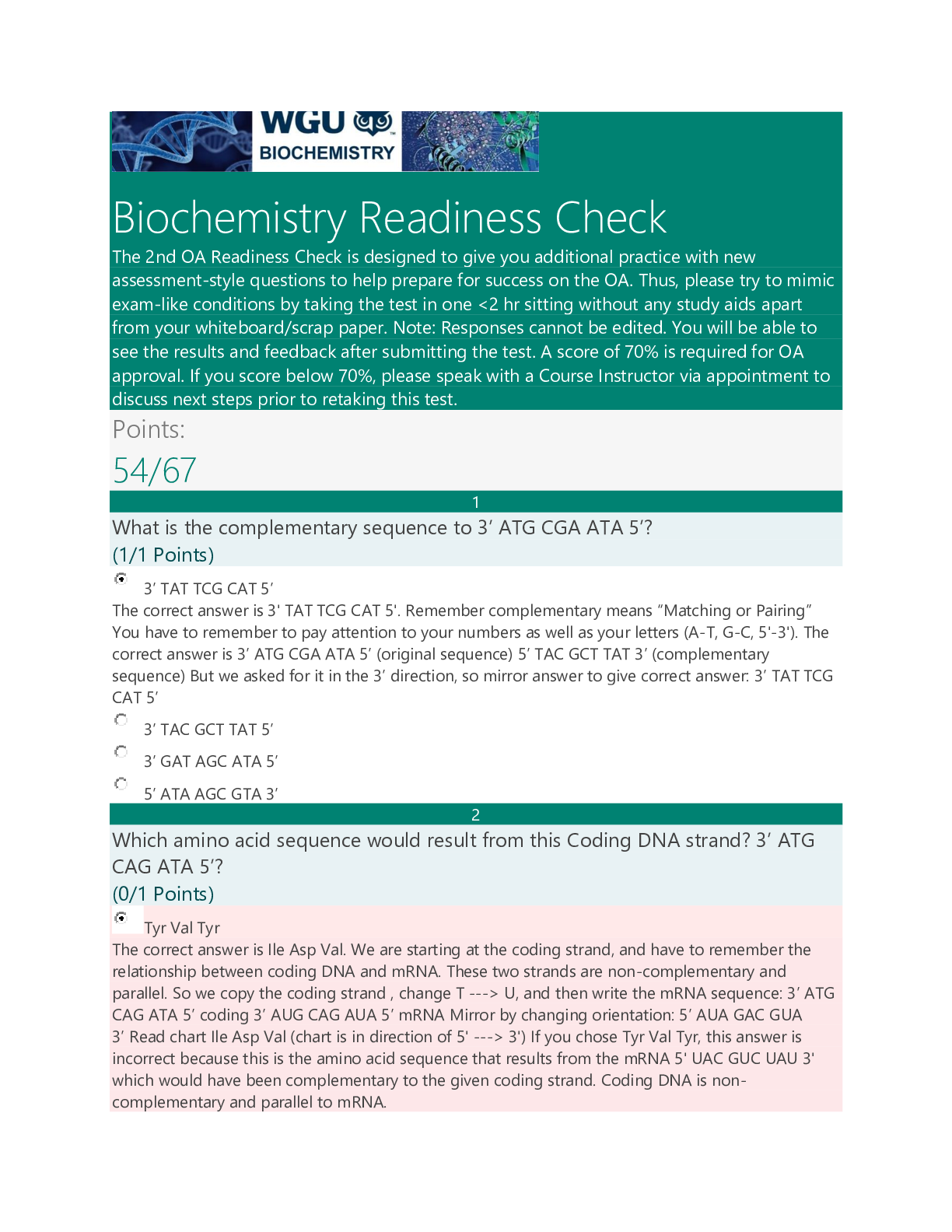
Biochemistry: Mod 1  DNA = phosphate + deoxyribose sugar + A/T/C/G o Contains two strands. The strands are antiparallel (opposite each other). o 5’ → 3’ 3’ ← 5’  RNA = phosphate ... + ribose sugar + A/U/C/G o Single strand, can fold back onto itself and form pairs between itself (stem-loop).  Each nucleic acid is made up of polymers (many monomers) that are called nucleotides. o Nucleotides contain one or more phosphates, a five-carbon sugar, and a nitrogen base. o Nucleotides are always made in the 5’ to 3’ direction. o 5 is always the beginning of the strand, 3 is the end where nucleotides are added.  DNA organization: DNA is wrapped around proteins called histones → nucleosome → chromatin fiber→ chromosomes  Steps to the central dogma: o Coding DNA → template DNA → mRNA → tRNA (amino acid) o DNA → transcribed to mRNA → translated to protein o Each step is complementary (opposite) to the previous step, but if you skip a step it will be identical to the previous step. o Example  1. Coding DNA strand 5’ AAA TTT GGG CCC 3’  2. Template DNA strand 3’ TTT AAA CCC GGG 5’  3. mRNA 5’ AAA UUU GGG CCC 3’  4. tRNA Lys Phe Gly Pro  Pairing: o DNA: A → T o RNA: A → U  DNA replication: o Because DNA is a double helix, one strand can be separated and serve as a template for synthesis of a new strand. o Semi-conservative: each copy of DNA contains a template strand and a new strand. o Steps of replication: Page 1 of 41 o 1. The DNA must be separated, creating a replication fork. This is done by helicase. o 2. Primase attaches an RNA primer, where the replication is to start. o 3. DNA polymerase adds bases to the remaining of the strand until it reaches a stop codon. This is done in fragments, called okazaki fragments.  If an error is detected, it removes the nucleotides and replaces them with correct ones, known as exonuclease. o Exonuclease removes all of the RNA primers, and DNA polymerase fills in those gaps. o DNA ligase seals the two strands forming a double helix.  DNA → transcribed → mRNA → translated → protein  Transcription occurs in the nucleus: o Initiation: RNA polymerase binds to a sequence of DNA called the promoter, found near the beginning of a gene. Each gene has its own promoter. Once bound, RNA polymerase separates the DNA strands, providing the single-stranded template needed for transcription. Page 2 of 41 o Elongation: One strand of DNA, the template strand, acts as a template for RNA polymerase. As it "reads" this template one base at a time, the polymerase builds an RNA molecule out of complementary nucleotides, making a chain that grows from 5' to 3'. The RNA transcript carries the same information as the non-template (coding) strand of DNA, but it contains the base uracil (U) instead of thymine (T). Page 3 of 41 o Termination. Sequences called terminators signal that the RNA transcript is complete. Once they are transcribed, they cause the transcript to be released from the RNA polymerase. o Pre-mRNA must go through extra processing before it can direct translation.  They must have their ends modified, by addition of a 5' cap (at the beginning) and 3' poly-A tail (at the end).  Pre-mRNAs must also undergo splicing. In this process, parts of the pre-mRNA (called introns) are chopped out, and the remaining pieces (called exons) are stuck back together.  Translation occurs in the cytoplasm: o Initiation: The ribosome assembles around the mRNA to be read and tRNA brings in its perspective protein, decoding 3 bases at a time, beginning with the start codon, AUG. o These 3 base pairs of mRNA are called codons. The mRNA base pairs are complementary to the base pairs of the tRNA, called anticodons. o Elongation: The amino acid chain gets longer. The mRNA is read one codon at a time, and the amino acid matching each codon is added to a growing protein chain. When the complementary pairs are formed, they are added to the protein chain by peptide bonds, the result is polypeptides. o Termination: The finished polypeptide chain is released when a stop codon (UAG, UAA, or UGA) enters the ribosome. [Show More]

Last updated: 3 years ago

Preview 1 out of 41 pages

Buy Now

Instant download

We Accept:

Payment methods accepted on Scholarfriends (We Accept)
Preview image of BIOCHEM C785: COMPREHESIVE LATEST 2022/2023 STUDY GUIDE FINAL document

Buy this document to get the full access instantly

Instant Download Access after purchase

Buy Now

Instant download

We Accept:

Payment methods accepted on Scholarfriends (We Accept)

Reviews( 0 )

$13.00

Buy Now

We Accept:

Payment methods accepted on Scholarfriends (We Accept)

Instant download

Can't find what you want? Try our AI powered Search

112
0

Document information


Connected school, study & course


About the document


Uploaded On

Nov 09, 2022

Number of pages

41

Written in

All

Seller


Profile illustration for TestGuider Of All Time
TestGuider Of All Time

Member since 3 years

3 Documents Sold

Additional information

This document has been written for:

Uploaded

Nov 09, 2022

Downloads

 0

Views

 112

Document Keyword Tags

More From TestGuider Of All Time

View all TestGuider Of All Time's documents »

Recommended For You

Get more on STUDY GUIDE »
$13.00
What is Scholarfriends

Scholarfriends.com Online Platform by Browsegrades Inc. 651N South Broad St, Middletown DE. United States.

We are here to help

We're available through e-mail, Twitter, and live chat.
 FAQ
 Questions? Leave a message!


Copyright © Scholarfriends · High quality services·