NUR 256 Mental Health worksheet: Exam 3
Define the following term: Understand what each means and how to manage those patients.
❖ Visual hallucinations: When the patient state they are seen something that is not ther
...
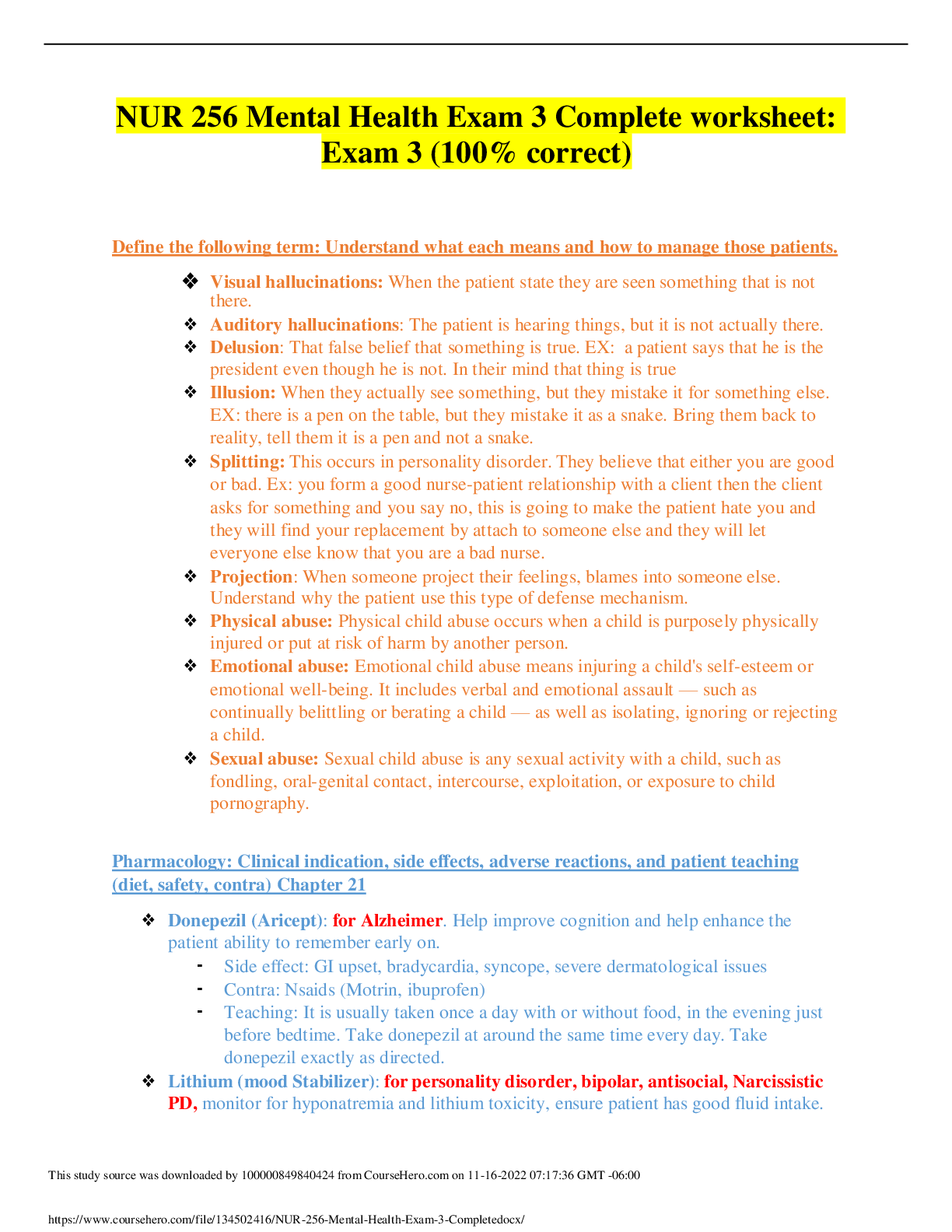
NUR 256 Mental Health worksheet: Exam 3
Define the following term: Understand what each means and how to manage those patients.
❖ Visual hallucinations: When the patient state they are seen something that is not there.
❖ Auditory hallucinations: The patient is hearing things, but it is not actually there.
❖ Delusion: That false belief that something is true. EX: a patient says that he is the president even though he is not. In their mind that thing is true
❖ Illusion: When they actually see something, but they mistake it for something else. EX: there is a pen on the table, but they mistake it as a snake. Bring them back to reality, tell them it is a pen and not a snake.
❖ Splitting: This occurs in personality disorder. They believe that either you are good or bad. Ex: you form a good nurse-patient relationship with a client then the client asks for something and you say no, this is going to make the patient hate you and they will find your replacement by attach to someone else and they will let everyone else know that you are a bad nurse.
❖ Projection: When someone project their feelings, blames into someone else.
Understand why the patient use this type of defense mechanism.
❖ Physical abuse: Physical child abuse occurs when a child is purposely physically injured or put at risk of harm by another person.
❖ Emotional abuse: Emotional child abuse means injuring a child's self-esteem or emotional well-being. It includes verbal and emotional assault — such as continually belittling or berating a child — as well as isolating, ignoring or rejecting a child.
❖ Sexual abuse: Sexual child abuse is any sexual activity with a child, such as fondling, oral-genital contact, intercourse, exploitation, or exposure to child pornography.
Pharmacology: Clinical indication, side effects, adverse reactions, and patient teaching (diet, safety, contra) Chapter 21
❖ Donepezil (Aricept): for Alzheimer. Help improve cognition and help enhance the patient ability to remember early on.
• Side effect: GI upset, bradycardia, syncope, severe dermatological issues
• Contra: Nsaids (Motrin, ibuprofen)
• Teaching: It is usually taken once a day with or without food, in the evening just before bedtime. Take donepezil at around the same time every day. Take donepezil exactly as directed.
❖ Lithium (mood Stabilizer): for personality disorder, bipolar, antisocial, Narcissistic PD, monitor for hyponatremia and lithium toxicity, ensure patient has good fluid intake.
• Teaching: Take lithium exactly as directed. Swallow the extended-release tablet whole; do not split, chew, or crush it. Too little salt in your diet could lead to serious side effects. Adequate fluid intake
• A safe blood level of lithium is 0.6 and 1.2 liter (mEq/L). Lithium toxicity can happen when this level reaches 1.5 mEq/L or higher. Severe lithium toxicity happens at a level of 2.0 mEq/L and above, which can be life-threatening in rare cases.
❖ Methylphenidate (Stimulant) Ritalin: For ADHD patient which is diagnosed around
the age of 7-20. This is an amphetamine like drug, it is a stimulant.
• Side effect: It can cause weight loss because it suppresses appetite thus anorexia tachycardia, insomnia.
• Teaching: Take in the morning to prevent patient from staying up late. If an ADHD child take this it calms them down, if a child that do not need it and take it will make them very hyper. Monitor nutritional intake especially age 7-11 that is missing school lunch, and their Blood glucose is dropping, monitor height weight and other issues in grade school. If prescribe for twice a day, then do not give after 4pm otherwise the child will be up all night. Because this is a amphetamine like drug the patient can get aggressive when take the drug. monitor I&O and cardiac function, ensure patient is getting a yearly EKG from cardiologist, watch sleep pattern. Drug holiday is okay it’s the great time to gain weight while not in school during the summer.
❖ Cholinesterase (ChE) inhibitor: For Alzheimer’s disease. There is not enough acetylcholine, so these medications work to increase the availability of acetylcholine. Disease modifying not cures (effectiveness wanes after 1 - 2 years)
• Side effect: Nausea, Vomiting, Diarrhea, Muscle cramps, Weight loss, Headache, Insomnia, Abnormal dreams, blurred vision, bradycardia, dry mouth
• Medications: Donepezil (Aricept), Rivastigmine (Exelon, Exelon patch), Galantamine (Razadyne, Razadyne ER)
❖ Manifestations for depression, know S/S, know how this patient present will, plan of care (how will we treat this patient): These patient sleep overtime, they loss interest in things around them. Teenagers tend to want to be left alone and parents mistake that sign as a teen phase. Monitor for suicidal ideation. Ensure safety, provide coping therapeutic communication. When patient first come to the ER the priority is their physical need (food, sleep) then once we stabilize them they are safe and stable, that’s when we begin to develop the plan of care and develop therapeutic communication and how to help them cope
❖ Plan of care for patients with depression: We will develop therapeutic communication, help them cope. As nurses we need to make sure we have a good plan of care that we are always meeting physical needs first is key.
❖ Define ADHD and treatment plan: Pg. 183 these patients tend to get in trouble because of that impulsivity, they tend to have a hard time to blend in socially. As nurses we need to address and getting the help they need, they have accommodation, they have the resources needed to be successful, make sure they take their medication as prescribed, involve caregivers in the inter-disciplinary team.
o Treatment plan:
▪ Stimulants educate parents on side effects of CNS stimulants such as insomnia, appetite suppression, headache, abdominal pain, SEE ABOVE MEDICATIONS**
❖ Clinical manifestations of Tourette’s Disorder and tic disorders: Pg. 179
❖ Patient teaching on types of tics and management: there’s 3 types.
o 1.) Provisional tic disorder- Single or multiple motor and or vocal tics for less than 1 year.
o 2.) Persistent motor or vocal tic disorder- Single or multiple motor or vocal tics but not both for more than 1 year.
o 3.) Tourette’s disorder- Multiple motor tics and at least one vocal tic for more than 1 year.
-Central nervous system stimulants increase severity of tics, so medications must be carefully monitored in children with coexisting ADHD.
• Sometimes they are very small, exaggerated. As they get older their tick’s change. EX: Every time the patient takes three steps they hop, now that the patient is older every time this patient takes three steps the squat, they no longer hop. It is not uncommon for a tic to change overtime, so teach family members is aware. some patients can channel that tic energy somewhere else as they get older meaning that they able to have some control over it.
• Management:
o Behavioral techniques can reduce tic expression; habit reversal (Most common is
comprehensive behavior intervention).
o FDA approved drugs include first-generation antipsychotics
▪ Haloperidol (Haldol)
▪ Pimozide (Orap)
o Second-generation Antipsychotics include:
▪ Aripiprazole (Abilify)
▪ Risperidone (Risperdal) is commonly used but does NOT have FDA approval.
- A pacemaker for the brain, deep brain stimulation (DBS) is used when more conservative treatments fail.
❖ Clinical manifestations of Autism: Pg. 181 there are different level of this spectrum.
Some children may be more functioning than others. It is not uncommon for them to have a lower IQ but have very strong talent in other areas. EX: nonverbal but can play instrument. The Goal is to focus on strength not weakness but enhance what they can do and cultivate them to do better. They don’t like to socialize nor eye contact. They like to get in your space, but they are not part of the space. They have their routines and habits as well as their favorite toy, and meltdown. Do not disrupt their routine otherwise causing Chaos for them. Prepare family to understand.
o Symptoms associated with autism spectrum disorder include deficits in social relatedness, which are manifested in disturbances in developing and maintaining relationships.
o Other behaviors include stereotypical repetitive speech, obsessive focus on specific objects, over adherence to routines or rituals, hyperreactivity or hypo- reactivity to sensory input, and extreme resistance to change.
❖ Types of therapeutic Communication with a child: (Pg. 177) play, coloring, music.
Any ways that we are able to have them express what happened. Sometime the child acts out that repetitive event to express what happen. These children don’t have the tool to verbally express. Help parent to understand that this is the child form of communication, give them their space but be very observant. This is use in post-traumatic stress patient. The earlier the intervention the better the outcome.
❖ Understand how Resilient children can be: (Pg. 299, 173) this is the relationship
between a person’s inborn strength and success in handling stressful environmental factors.
❖ Understand how temperament plays a role: (Pg. 173) this is the usual attitude, mood,
or behavior that a child habitually uses to cope with the demands and expectation of the
environment. If there is an incongruent between child and parent temperament, there is a risk of insecure attachment and developmental problem leading to future problems.
❖ Define Fictitious Disorders: “Munchausen by proxy”, these are disorders that don’t
exist. The patient do a lot of doctor shopping they know the specific about the disease and mimic to make themselves to appear to be sick, no sickness appears on lab results. They basically have the needed to be needed. As nurse we need to figure out why is this patient seen so many doctors
❖ Define the following learning disorders, what is the treatment plan to help them to
be successful, the IEP plan: Pg. 183
❖ Dyslexia: having difficulty with reading, may read the words backward
❖ Dyscalculia: having difficulty with math
❖ Dysgraphia: having difficulty with writing; writing expression
Disorders: Pg. 431
❖ Dementia: Chronic, Non-emergent, progressive, and irreversible
❖ Delirium: It is acute, something triggers this response (infection, medication etc), and if we remove the problem then the delirium is gone. It is possible for a dementia patient to develop delirium; delirium is a symptom of something that is going on. As nurses we need to figure out what just change
❖ Identify s/s of delirium and causes:
• Causes: Medications (reactions, interactions, recently discontinued, etc..), Electrolyte
imbalances, Hypoxia, Infections, Substance abuse, Hypoglycemia, Dehydration, Head injury
• Four cardinal features: Acute onset and fluctuating course, Inattention,
Disorganized thinking, Disturbance of consciousness
❖ Define conversion disorder and manifestations: There is a neurological deficit but there is nothing wrong, find the trigger.
❖ Define Dissociative Identity disorder and clinical manifestations, and why does it happen:
• The presence of 2 or more distinct personalities that alternate control. Each personality (alter) has its own pattern of relating to the environment, acting and thinking.
• Primary personality (host) usually not aware of alters, Alternate personality (alters) or subpersonalities take control of behavior, Alters often aware of each other, Each alter thinks and behaves as a separate individual
❖ Compare and contrast PTSD and ASD:
• PTSD: A huge traumatic event that they witness or was a part of (physical, sexual, or
emotional abuse). It can be a long-term lifetime term which will require therapy.
• ASD: (Pg. 306) An acute event that we treat immediately, it may or may not have directly involve them, it may have been that the patient was at the wrong place at the wrong time and saw something which would trigger the acute stress disorder. Within a month the symptoms have resolve, if the symptoms have not resolve and it continue for greater than 6 month it is now PTSD.
❖ Compare the differences between Somatic Disorder, Illness Anxiety disorder and
Conversion disorders. (Pg. 316)
• Somatic Disorder: Characterized by a focus on somatic (physical) symptoms such as pain, or fatigue to the point of excessive concern, preoccupation, and fear. These patients experience a high level of functional impairment.(EX: I have a stomachache, headache)
• Illness Anxiety Disorder: It is more exaggerated and pronounce, almost like
hypochondriac. Extreme worry and fear about the possibility of having a disease.
• Conversion Disorder: Absence of neurological diagnosis but manifesting with neurological symptoms; presence of deficits in voluntary motor or sensory functions
including paralysis, blindness, movement disorder, gait disorder, numbness, paresthesia (tingling of burning sensations), loss of vision or hearing, or episodes resembling epilepsy.
❖ Identify what type of therapeutic communication the nurse would use to assess and treat the patient: (Pg. 321, box) Assessment guidelines
Always address the physical needs. Even if we know the patient is experiencing somatic, anxiety or conversion, if the patient say they have pain or if they don’t feel good then as nurses you must address the need first before helping them to cope. If assessment is required then do that, if there are no findings then continue and ask them if they even been treated for this condition before.
❖ Define oppositional defiant disorder, manifestations, and nursing interventions,
know how to communicate with them: They get very aggressive, they get in trouble with the law, a parent may have had this problem. When they are young Other people tend to think they are just bad.
o There’s currently no medications for the treatment of ODD.
❖ Manifestation of suicidal ideation and treatment plan for children, adults, and elderly, know what hard and soft cues looks like: We need to make sure we are seen the signs and seen what is going on with them, and how will we provide them with what they needs is it through group therapy. Consider if the patient has attempt suicidal ideation before, involve the family as part of the plan, maybe patient has poor appetite or sleeping all the time.
Personality Disorders, know what would patient say, what would the patient do, and what should the nurse response be, what to do to keep theses patient safe, Search patient belonging or gifts in front of them rather than behind them at admission otherwise you will lose that trust Chapter 24
❖ Cluster A - Paranoid, Schizoid, Schizotypal (Behaviors described as odd or eccentric)
❖ Cluster B- Histrionic, narcistic, antisocial, borderline (Behaviors described as dramatic, emotional, or erratic)
❖ Cluster C-Avoidant, Dependent, Obsessive compulsive (Behaviors described as anxious
or fearful)
❖ Define Antisocial personality disorder (previously known as sociopath), manifestations, and nursing interventions:
• This is a pattern of disregard for and violation of the rights of others. Referred to
as sociopaths. The patient is deceitful and manipulative for personal gain or
hostile if needs are blocked. Occur from age 15.
• Boundaries, consistency, support, and limits, Realistic choices, Teamwork and safety (prime), Therapeutic communication, Pharmacological interventions (mood stabilizers)
❖ Define borderline personality disorder, manifestations, and nursing interventions:
• The major features of this disorder are patterns of marked instability in emotional
control or regulation, impulsivity, identity or self-image distortions, unstable
mood, and unstable interpersonal relationships.
• Provide clear and consistent boundaries, use clear, straightforward communication, calmly review therapeutic goals, Teamwork, and safety, Respond matter-of-factly to superficial self-injuries.
• Pharm intervention: Psychotropics geared toward symptom relief
• Psychotherapy: CBT, Dialectical behavior therapy (DBT), Schema-focused therapy
• Finding the best approach that works with patients in the setting in which they are treated is important. Therapies such as dialectical behavior therapy and mindfulness-based therapies offer staff evidence-based interventions, clinical structure, and formalized support for identifying best practices.
❖ List nursing interventions that would ensure safety on the mental health unit.
• Dealing with emotional issues that arise in the milieu requires a calm, united
approach by the staff to maintain safety and to enhance self-control. Check the
patient belongings and their gifts in front of them rather than behind them.
❖ Define Narcissistic personality disorder, manifestations, and nursing interventions:
• Feelings of entitlement, exaggerated self-importance, Lack of empathy; tendency to exploit others, Weak self-esteem and hypersensitivity to criticism, Constant need for admiration, Less functional impairment than other personality disorders.
• Nursing care: Remain neutral, avoid power struggles or becoming defensive., Role model empathy.
❖ Define Histrionic Personality disorder, clinical manifestations, and nursing
interventions:
• Excitable, dramatic; often high functioning, Bold external behaviors. Limited ability to develop meaningful relationships, Attention-seeking, self-centered; low- frustration level, Excessive emotions; may be provocative; smothering, No insight into disorder or role in ruining relationships.
• Psychotherapy is treatment of choice.
• Nursing care: Know that seductive behavior is a response to distress, keep interactions professional; ignore flirtations. Model concrete language., Help patient clarify inner-feelings, teach and role-model assertiveness.
❖ Define paranoid personality disorders, clinical manifestations, and nursing
interventions:
• May be apparent in childhood, Social anxiety in childhood. Jealous, controlling as adults, Unwillingness to forgive and projection of feelings.
• Treatment:
Counteract mistrust by (a) adhering to schedules and (b) avoiding being overly friendly, and (c) projecting a neutral but kind affect.
Psychotherapy versus group therapy Short-term antidepressants
❖ Define schizotypal personality disorders, clinical manifestations, and nursing
interventions:
• Severe social and interpersonal deficits, Anxiety in social situations, Rambling conversation, Paranoia, suspiciousness, anxiety, distrust, Brief, intermittent episodes of hallucination or delusion, can be made aware of their own odd beliefs, May be vulnerable to involvement with cults or unusual religious/occult groups.
• Nursing Care: Respect patient’s need for social isolation. , Be aware of and intervene appropriately with patient’s suspiciousness. Perform careful diagnostic assessment for symptoms that may need intervention (e.g., suicidal thoughts)., Withhold judgment or ridicule.
• Treatment: Psychotherapy (investigate possible involvement with cults). Low- dose antipsychotics
❖ Define schizoid personality disorder, clinical manifestations, and nursing
interventions.
• Symptoms appear in childhood and adolescence. Loners, poor academic performance, Increased prevalence of disordered family life, Avoid close relationships. Depersonalization, detachment
• Nursing Care: Avoid being too “nice” or “friendly”, Do not try to increase socialization, assess for symptoms the patient is reluctant to discuss, Protect against group’s ridicule.
• Treatment: Psychotherapy, Group therapy, Antidepressants
❖ Clinical manifestation and know the differences for dependent personality disorders, avoidant personality disorders and obsessive-compulsive disorders:
• Dependent personality disorder: They require someone to be there, they do not want to be there, they would even stay in an abusive relationship just so they are not left alone.
• Avoidant personality disorder: they avoid every situation possible; they avoid socialization, they want to be left alone.
• Obsessive Compulsive Disorders: these patients are very strict, they must have their routine, if you disrupt their routine, it will cause them to stress out. If a patient wants to clean, then let them clean otherwise you will lose that trust. Once they are done working with that mental thing, they have going on than you can start therapeutic communication. Tell me more About what is going on, never ask why.
❖ Define clinical manifestations for patient with Dementia and Alzheimer:
• Dementia: (Pg. 436) it may only involve issues with basic self-care; you start with
Dementia then move to Alzheimer’s. Collection of symptoms (criteria on pg. 435) More symptoms
• Alzheimer: (Pg. 438) progressive deterioration of cognitive functioning. Form of Dementia.
❖ Develop a care plan for a patient with Alzheimer’s and patient teaching for the
family or caregiver, think about caregiver burn out:
❖ Nursing diagnosis for patients with Alzheimer’s and dementia.
❖ Age related changes for the older adult, management of care and medication management
• Normal age-related changes: an older adult may forget something, ex forgot about an appointment, but they remember it later, they are still able to manage their own care, as well as cooking meals and taking their medication. Anxiety, depression, and delirium are most common.
• To help manage medication: Pg. 580, Box 31.9 let us get a calendar, a list, a pill box, what can you do to keep them as independent as possible. its all about the dignity and quality of life.
• Firs-line treatment for anxiety disorders in SSRI’s along with cognitive behavioral therapy. Benzodiazepines such as lorazepam, alprazolam, or diazepam are also used to treat anxiety but are often prescribed inappropriately in older adults.
❖ Identify the difference between dissociative amnesia and dissociative Fugue.
• dissociative amnesia: This is when a traumatic event happened to the patient and they
completely forget the event. It is as if they made it, so it did not happen. They can tell you anything before that event then skip that event and the tell you anything after that event moving forward.
• dissociative Fugue: it is rare, EX: The patient wakes up in a completely different state, I
was in FL today and I woke up in Pennsylvania. They do not know how they got there, do not know their name, they do not know what is going on.
❖ What signs/actions would the nurse note when assessing a client for suicidal ideation, ask patient if they have a plan
❖ How does the nurse determine the lethality of a suicide plan:
• That is that hard and soft cues. What would the patient do or say?
❖ Examples of a hard method and soft method when confirming a patient has stated they have “a plan.”
• Hard method: shoot myself, stage a car accident, jump off a building, I am going to do something dramatic.
• Soft Method: I am going to take sleeping pills and go to sleep.
[Show More]