10/1/2017 Chapter 5 Homework-Sally Nihill
Instructor: Paul Jacques
Course: MGT 348-01 - Fall 2017 Assignment: Chapter 5 Homework
Prepare a product-by-value analysis for the following products, and given the position i
...
10/1/2017 Chapter 5 Homework-Sally Nihill
Instructor: Paul Jacques
Course: MGT 348-01 - Fall 2017 Assignment: Chapter 5 Homework
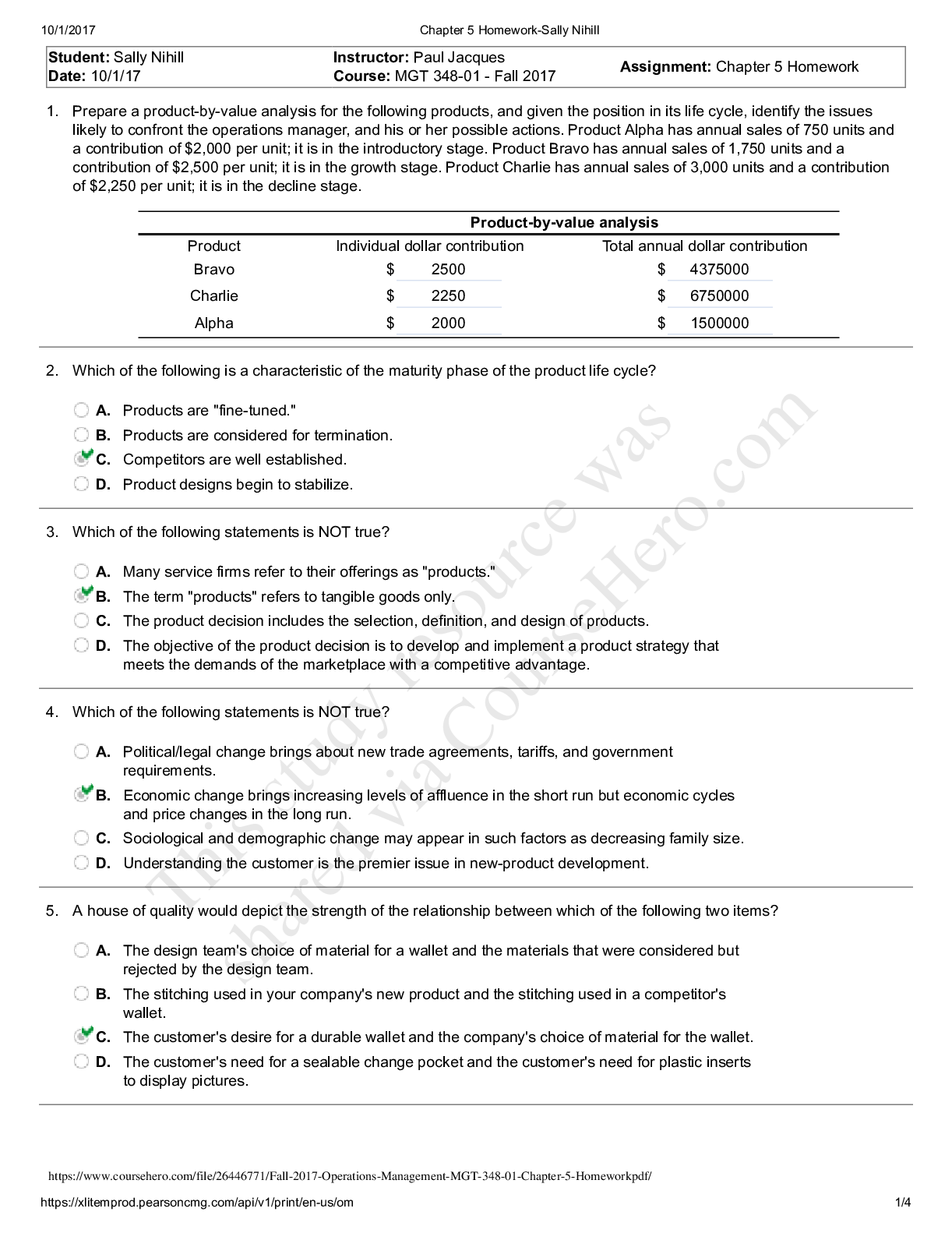
Prepare a product-by-value analysis for the following products, and given the position in its life cycle, identify the issues
likely to confront the operations manager, and his or her possible actions. Product Alpha has annual sales of units and
a contribution of per unit; it is in the introductory stage. Product Bravo has annual sales of units and a
contribution of per unit; it is in the growth stage. Product Charlie has annual sales of units and a contribution
of per unit; it is in the decline stage.
Product-by-value analysis
Product Individual dollar contribution Total annual dollar contribution
Bravo $ 2500 $ 4375000
Charlie $ 2250 $ 6750000
Alpha $ 2000 $ 1500000
Which of the following is a characteristic of the maturity phase of the product life cycle?
A. Products are "fine-tuned."
B. Products are considered for termination.
C. Competitors are well established.
D. Product designs begin to stabilize.
Which of the following statements is NOT true?
A. Many service firms refer to their offerings as "products."
B. The term "products" refers to tangible goods only.
C. The product decision includes the selection, definition, and design of products.
D. The objective of the product decision is to develop and implement a product strategy that
meets the demands of the marketplace with a competitive advantage.
Which of the following statements is NOT true?
A. Political/legal change brings about new trade agreements, tariffs, and government
requirements.
B. Economic change brings increasing levels of affluence in the short run but economic cycles
and price changes in the long run.
C. Sociological and demographic change may appear in such factors as decreasing family size.
D. Understanding the customer is the premier issue in new-product development.
A house of quality would depict the strength of the relationship between which of the following two items?
A. The design team's choice of material for a wallet and the materials that were considered but
rejected by the design team.
B. The stitching used in your company's new product and the stitching used in a competitor's
wallet.
C. The customer's desire for a durable wallet and the company's choice of material for the wallet.
D. The customer's need for a sealable change pocket and the customer's need for plastic inserts
to display pictures.
https://www.coursehero.com/file/26446771/Fall-2017-Operations-Management-MGT-348-01-Chapter-5-Homeworkpdf/
This study resource was
shared via CourseHero.com10/1/2017 Chapter 5 Homework-Sally Nihill
https://xlitemprod.pearsoncmg.com/api/v1/print/en-us/om 2/4
Which of the following is NOT a benefit generated by manufacturability and value engineering?
A. reduced complexity of the product
B. improved job design and job safety
C. reduced standardization of components
D. reduction of environmental impact
When ordering a new zagflatz, customers must choose the style of three major components, each of which has about ten
variations. This is an example of
A. modular design.
B. environmentally friendly design.
C. robust design.
D. CAD.
Which of the following technologies is particularly useful for prototype development and small lot production?
A. 3-D printing
B. CAM
C. CAD
D. STEP
Which of the following is an external product development strategy?
A. joint ventures
B. enhancements to existing products
C. new internally developed products
D. migrations of existing products
Which of the following statements is NOT true regarding joint ventures?
A. Ownership can be 50-50, or one owner can assume a larger portion to ensure tighter control.
B. Joint ventures are more likely to work when the risks are unknown.
C. Joint ventures are usually between just two firms.
D. Joint ventures are firms establishing joint ownership to pursue new products or markets.
Defining a product means
A. to list the hiearchy of components, their description, and the quantity of each required to make
one unit of a product.
B. to identify components by a coding scheme that specifies size, shape, and the type of
processing.
C. to define the new good's or service's function.
D. to decide to produce a component or service or purchase from an outside source.
Most manufacturing items and their components are defined by
A. the make-or-buy decision.
B. an engineering drawing.
C. group technology.
D. a BOM.
A route sheet
A. shows in schematic form how a product is assembled.
B. is a correction or modification of an engineering drawing or bill of materials.
C. lists the operations necessary to produce the component.
D. is an instruction to make a given quantity of a particular item.
In a make-to-order system, when a customer places a request for a product or service with a producer,
A. an engineering change notice is created.
B. an assembly chart is created.
C. a work order is created.
D. a route sheet is created.
What is analysis that focuses on the ways in which processes can be designed to optimize interaction between firms and
their customers?
A. value analysis
B. product-by-value analysis
C. value engineering
D. process-chain-network analysis
Operation of a hair salon is an example of
A. modularization.
B. an assembly line.
C. delayed customization.
D. automation.
MacDonald Products, Inc., of Clarkson, New York, has the option of
(a) proceeding immediately with production of a new top-of-the-line stereo TV that has just completed prototype testing
or
(b) having the value analysis team complete a study.
If Ed Lusk, VP for operations, proceeds with the existing prototype (option a), the firm can expect sales to be units
at $ each, with a probability of and a probability of at $ . If, however, he uses the value analysis
team (option b), the firm expects sales of units at $ , with a probability of and a probability of
units at $ . Value engineering, at a cost of $ , is only used in option b. Which option has the highest
expected monetary value (EMV)?
100,000
560 0.46 0.54 60,000 560
85,000 710 0.63 0.37
60,000 710 90,000
The EMV for option a is $ and the EMV for option b is $ . Therefore, option has the
highest expected monetary value. (Enter your responses as integers.)
43904000 53692500 b
McBurger, Inc., wants to redesign its kitchens to improve productivity and quality. Three designs, called designs K1, K2,
and K3, are under consideration. No matter which design is used, daily production of sandwiches at a typical McBurger
restaurant is for sandwiches. A sandwich costs to produce. Non-defective sandwiches sell, on the average, for
per sandwich. Defective sandwiches cannot be sold and are scrapped.
600 $1.20
$2.50
The goal is to choose a design that maximizes the expected profit at a typical restaurant over a 300-day period. Designs
K1, K2, and K3 cost $120,000, $130,000, and $180,000, respectively.
Under design K1, there is a .80 chance that 90 out of each 100 sandwiches are non-defective and a .20 chance that 70 out
of each 100 sandwiches are non-defective. Under design K2, there is a .85 chance that 90 out of each 100 sandwiches
are non-defective and a .15 chance that 75 out of each 100 sandwiches are non-defective. Under design K3, there is a .90
chance that 95 out of each 100 sandwiches are non-defective and a .10 chance that 80 out of each 100 sandwiches are
non-defective.
The expected profit level of design K1 is $ . (Enter your response as a real number rounded to two decimal
places.)
243000
The expected profit level of design K2 is $ . (Enter your response as a real number rounded to two decimal
places.)
The expected profit level of design K3 is $ . (Enter your response as a real number rounded to two decimal
places.)
What is the expected profit level of the design that achieves the maximum expected 300-day profit level?
Design (1) achieves the maximum expected 300-day profit level, with a profit of
$ . (Enter your response as a real number rounded to two decimal places.)
Which of the following statements is NOT true regarding decision trees?
A. Decision trees should only be used for new-product decisions when no uncertainty is present.
B. A decision tree is a great tool for thinking through a problem.
C. Decision trees can be used for other management problems besides product design.
D. Decision trees are particularly helpful when there are a series of decisions and various
outcomes that lead to subsequent decisions followed by other outcomes.
Moving a product from development to production is referred to as
A. product design.
B. product development.
C. product definition.
D. transition to production.
[Show More]


.png)