Module 4 Exam: HESI Module 4 Exam: HESI Module 4 Exam: HESI
7/19/2021 Module 4 Exam: HESI VN TXGRP 1912COHORT(VNE 39)
https://concorde.instructure.com/courses/18612/quizzes/83901?module_item_id=1519720 1/116
Questi
...
Module 4 Exam: HESI Module 4 Exam: HESI Module 4 Exam: HESI
7/19/2021 Module 4 Exam: HESI VN TXGRP 1912COHORT(VNE 39)
https://concorde.instructure.com/courses/18612/quizzes/83901?module_item_id=1519720 1/116
Question 1 1 / 1 pts
A client with schizophrenia says, “I’m away for the day ... but
don’t think we should play … or do we have feet of clay?” Which
alteration in the client’s speech does the nurse document?
Neologism
Word salad
Correct! Correct! Clang association
Associative looseness
Rationale: Clang association is the meaningless rhyming
of words in which the rhyming is more important than the
context of the words. A neologism is a made-up word that
has meaning only to the client. Word salad is the term for
a mixture of meaningless phrases, either to the client or to
the listener. Associative looseness is a term used to
describe schizophrenic speech in which connections and
threads are interrupted or missing.
Test-Taking Strategy: Knowledge of the speech patterns
exhibited by the client with schizophrenia is needed to
answer this question. Focus on the data in the question
and note the meaningless rhyming of words. Review these
speech patterns with schizophrenia if you had difficulty
with this question.
Cognitive Ability: Applying
Client Needs: Psychosocial Integrity
Integrated Process: Communication and Documentation
Content Area: Mental Health
Question 2 1 / 1 pts7/19/2021 Module 4 Exam: HESI VN TXGRP 1912COHORT(VNE 39)
https://concorde.instructure.com/courses/18612/quizzes/83901?module_item_id=1519720 2/116
A client with schizophrenia and his parents are meeting with the
nurse. One of the young man’s parents says to the nurse, “We
were stunned when we learned that our son had schizophrenia.
He was no different than from his older brother when they were
growing up. Now he’s had another relapse, and we can’t
understand why he stopped his medication.” Which response by
the nurse is appropriate?
Telling the parents, “Medication noncompliance is the most
frequent reason that people with this diagnosis relapse.”
Telling the parents, “Well, it’s his decision to take his medicine,
but it’s yours to have him live with you if he stops the
medication.”
Asking the client, “How can we help you to take your medicine or
to tell us when you’re having problems so that your medication
can be adjusted?”
Correct! Correct!
Saying to the parents, “Your concerns are appropriate, but I
wonder whether your son was having trouble telling someone
that he had concerns about his medication.”7/19/2021 Module 4 Exam: HESI VN TXGRP 1912COHORT(VNE 39)
https://concorde.instructure.com/courses/18612/quizzes/83901?module_item_id=1519720 3/116
Rationale: The therapeutic response is the one in which
the nurse models speaking directly to the client. This
facilitates further assessment of the situation and helps
elicit the causes of and motivations for the client’s
behavior for both the nurse and the family. In the correct
option, the nurse also seeks clarification of the degree of
openness and mutuality felt by the client and his family
toward each other. The nurse provides information to the
family when stating that noncompliance is the most
frequent reason for relapse in people with this diagnosis.
However, the statement is nontherapeutic at this time
because it does not facilitate the expression of feelings.
The nurse uses a superego style of communication when
stating, “Well, it’s his decision to take his medicine, but it’s
yours to have him live with you if he stops the medication.”
The content of this statement may be true, but it is
nontherapeutic in that it carries a threatening message
and may prevent the family from trusting the nurse. By
stating “Your concerns are appropriate, but I wonder
whether your son was having trouble telling someone that
he had concerns about his medication,” the nurse gives
approval and prematurely analyzes the client’s motivation
without sufficient assessment.
Test-Taking Strategy: Use your knowledge of therapeutic
communication techniques and remember to focus on the
client’s feelings. Also note that the correct option is the
only option in which the nurse directly addresses the
client. Review therapeutic communication techniques if
you had difficulty with this question.
Cognitive Ability: Applying
Client Needs: Psychosocial Integrity
Integrated Process: Communication and Documentation
Content Area: Mental Health
Question 3 1 / 1 pts
An acutely ill client with schizophrenia says to the nurse, “He
keeps saying that he likes you, and I keep telling him you’re
married, but he won’t listen, and I think he’s going to get fresh
with you.” Once the nurse has determined that the client is7/19/2021 Module 4 Exam: HESI VN TXGRP 1912COHORT(VNE 39)
https://concorde.instructure.com/courses/18612/quizzes/83901?module_item_id=1519720 4/116
hallucinating, which response to the client would be most
appropriate statement?
“Try not to listen to the voices right now so that I can talk with
you.”
Correct! Correct!
“I think that you can help him stop his behavior if you
concentrate.”
“Tell him I said to mind his p’s and q’s or I’ll call the police on
him.”
“I think that you’re trying to share your own feelings toward me,
but you’re shy.”
Rationale: The appropriate statement by the nurse is the
one that does not acknowledge the client’s hallucinations.
By responding “I think that you can help him stop his
behavior if you concentrate” or “Tell him I said to mind his
p’s and q’s or I’ll call the police on him,” the nurse
acknowledges the hallucinations. The nurse attempts to
interpret the client’s thinking with a statement such as “I
think that you’re trying to share your own feelings toward
me, but you’re shy.”
Test-Taking Strategy: Use your knowledge of therapeutic
communication techniques and remember that the nurse
should not acknowledge the client’s hallucinations. Also
note that the correct option is the only one that
encourages realistic verbalization from the client. Review
therapeutic communication techniques with a client who is
hallucinating if you had difficulty with this question.
Cognitive Ability: Applying
Client Needs: Psychosocial Integrity
Integrated Process: Communication and Documentation
Content Area: Mental Health7/19/2021 Module 4 Exam: HESI VN TXGRP 1912COHORT(VNE 39)
https://concorde.instructure.com/courses/18612/quizzes/83901?module_item_id=1519720 5/116
Question 4 0 / 1 pts
A client says to the nurse, “It’s over for me—the whole thing is
over.” Which response by the nurse would be therapeutic?
Y You Answered ou Answered “What do you mean, ‘The whole thing is over’?”
“Over? Well, that sounds pretty drastic to me. Let’s discuss this in
the strictest confidence.”
“Can you tell me more about why it’s over for you? I’ll keep your
thoughts strictly confidential.”
“Let’s talk more about your feeling that the whole thing is over for
you. This is important, and I may need to share your feelings with
other staff members.”
Correct Answer Correct Answer7/19/2021 Module 4 Exam: HESI VN TXGRP 1912COHORT(VNE 39)
https://concorde.instructure.com/courses/18612/quizzes/83901?module_item_id=1519720 6/116
Rationale: The therapeutic response seeks clarification,
employs paraphrasing, and informs the client that the
nurse needs to share any information that requires crisis
intervention with other staff members. Asking “What do
you mean, ‘The whole thing is over’?” employs
paraphrasing, but the message is blunt and closed-ended.
In stating “Over? Well, that sounds pretty drastic to me.
Let’s discuss this in the strictest confidence,” the nurse
uses hysterical exaggeration (at an inappropriate time)
and gives incorrect information regarding confidentiality. In
stating “Can you tell me more about why it’s over for you?
I’ll keep your thoughts strictly confidential,” the nurse uses
the therapeutic technique of seeking clarification but does
not clarify with the client that the information might need to
be shared.
Test-Taking Strategy: Use the process of elimination.
Eliminate the comparable or alike options that indicate that
shared information will be maintained as confidential. To
select from the remaining options, focus on the statement
that addresses the client’s feelings. Review therapeutic
communication techniques if you had difficulty with this
question.
Cognitive Ability: Applying
Client Needs: Safe and Effective Care Environment
Integrated Process: Communication and Documentation
Content Area: Mental Health
Question 5 1 / 1 pts
A nurse performing a lethality assessment asks the client whether
he is thinking of suicide. Which statement by the client would be
of most concern to the nurse?
Correct! Correct! “No, I wasn’t, but I am now, thanks to you.”
“I hadn’t thought of that, but I can see that you are.”
“Of course not, but there are days when I think that I should be.”7/19/2021 Module 4 Exam: HESI VN TXGRP 1912COHORT(VNE 39)
https://concorde.instructure.com/courses/18612/quizzes/83901?module_item_id=1519720 7/116
“What is suicide going to do for me except get me
excommunicated from the church?”
Rationale: The client’s response that he is now thinking
about suicide is of the greatest concern to the nurse. In
making the statement “I hadn’t thought of that, but I can
see that you are” the client projects his own thoughts of
suicide onto the nurse. In stating “Of course not, but there
are days when I think that I should be,” the client is being
sarcastic but is not specifically talking about suicide. In
stating “What is suicide going to do for me except get me
excommunicated from the church?” the client indicates
that suicide is not an option because of his religious
beliefs.
Test-Taking Strategy: Use the process of elimination and
note the strategic words “of most concern to the nurse.”
Note the words “but I am now” in the correct option. This is
the only option that identifies definite suicidal thoughts.
Review lethality assessment in the suicidal client if you
had difficulty with this question.
Cognitive Ability: Analyzing
Client Needs: Safe and Effective Care Environment
Integrated Process: Nursing Process/Assessment
Content Area: Mental Health
Question 6 1 / 1 pts
A client who has expressed suicidal ideation in the past says to
the nurse, while shuffling several documents in an effort to
organize them, “Well, I’m feeling so much better now since I got
organized. My lawyer wrote my will and durable power of
attorney.” Which response by the nurse is appropriate?
“Good grief! You don’t look organized to me.”7/19/2021 Module 4 Exam: HESI VN TXGRP 1912COHORT(VNE 39)
https://concorde.instructure.com/courses/18612/quizzes/83901?module_item_id=1519720 8/116
“Okay, what are you up to today? Your behavior is not
appropriate.”
“You talk about getting organized. Are you thinking of killing
yourself?”
Correct! Correct!
“If you keep behaving like this, you know that I’ll have to tell the
doctor, and we’ll have to seclude you.”
Rationale: The client is exhibiting behaviors that indicate
plans for suicide. Talking of suddenly “feeling so much
better” and putting affairs in order are key verbal and
behavioral clues that the client is planning to commit
suicide. In exclaiming “Good grief! You don’t look
organized to me,” the nurse nontherapeutically uses
hysterical exaggeration, which minimizes the client’s
feelings. In asking “Okay, what are you up to today? Your
behavior is not appropriate,” the nurse uses teasing to
determine the client’s behaviors, which minimizes them.
Additionally, the nurse is employing a nontherapeutic
technique of judging. In stating “If you keep behaving like
this, you know that I’ll have to tell the doctor and we’ll have
to seclude you,” the nurse uses a threat.
Test-Taking Strategy: Use the process of elimination.
Focus on the information in the question and note the
relationship between the words “expressed suicidal
ideation” in the question and “thinking of killing yourself” in
the correct option. Review the clues that indicate the
potential for suicide if you had difficulty with this question.
Cognitive Ability: Applying
Client Needs: Safe and Effective Care Environment
Integrated Process: Communication and Documentation
Content Area: Mental Health
Question 7 1 / 1 pts7/19/2021 Module 4 Exam: HESI VN TXGRP 1912COHORT(VNE 39)
https://concorde.instructure.com/courses/18612/quizzes/83901?module_item_id=1519720 9/116
An adolescent client says, “I’m just a burden to my folks. They
wish I’d never been born. My dad told me he had to marry Mom
because she got pregnant.” Which response by the nurse would
be therapeutic?
“You’re feeling that your folks didn’t want you, but they chose to
marry and have you.”
Correct! Correct!
“You feel that you were a burden and not wanted? Let’s talk with
your parents to see whether you’re right.”
“Let’s speak with your parents about what you’ve just told me.
Let’s ask whether you were truly unwanted.”
“Sounds like your father was very inappropriate, but I’m certain
that he didn’t mean that you were a burden to him.”7/19/2021 Module 4 Exam: HESI VN TXGRP 1912COHORT(VNE 39)
https://concorde.instructure.com/courses/18612/quizzes/83901?module_item_id=1519720 10/116
Rationale: In the correct option, the nurse uses reflection
to explore the client’s lethality risk and then uses reframing
to determine whether the client is able to view what
happened in a different way. In suggesting “You feel that
you were a burden and not wanted? Let’s talk with your
parents to see whether you’re right,” the nurse uses
paraphrasing but is then nontherapeutic in trying to
persuade the client to talk to the parents. In suggesting
“Let’s speak with your parents about what you’ve just told
me. Let’s ask whether you were truly unwanted,” the nurse
uses a parental approach, which may be threatening to
the client, who seems to have been unable to talk with the
parents before now. In stating “Sounds like your father
was very inappropriate, but I’m certain that he didn’t mean
that you were a burden to him,” the nurse offers an opinion
about the client’s father and then provides false
reassurance.
Test-Taking Strategy: Use the process of elimination.
Eliminate the comparable or alike options that address
discussing the client’s feelings with the parents. In
selecting from the remaining options, remember to focus
on the client’s feelings. Select the option that exemplifies
therapeutic communication technique. This will direct you
to the correct option. Review therapeutic communication
techniques if you had difficulty with this question.
Cognitive Ability: Applying
Client Needs: Psychosocial Integrity
Integrated Process: Communication and Documentation
Content Area: Mental Health
Question 8 1 / 1 pts
A client says to the nurse, “I’ve ruined my life. I left college with
only a few credits to go. I keep telling myself that I’m going to
make it as a writer, but I’ll be a loser and a nothing for the rest of
my life.” Which response by the nurse is therapeutic?
“What are you saying? Sounds like you need to pull yourself
together and go back to school.”7/19/2021 Module 4 Exam: HESI VN TXGRP 1912COHORT(VNE 39)
https://concorde.instructure.com/courses/18612/quizzes/83901?module_item_id=1519720 11/116
“Having faith in yourself is one thing, but looking at your
alternatives realistically is another.”
“You seem to be saying that your choices are final and that
you’ve lost any other opportunities.”
Correct! Correct!
“Sounds like you feel that things should come easy for you,
unlike the rest of us, who work for what we get.”
Rationale: The client in this question is engaging in
catastrophizing rather than reframing and viewing other
alternatives. The task for the nurse is to assess the client’s
situation and to help the client feel empowered to take
another course of action and find the perseverance and
confidence to do so. The therapeutic response here is the
one that is nonjudgmental. In responding “What are you
saying? Sounds like you need to pull yourself together and
go back to school,” or “Sounds like you feel that things
should come easy for you, unlike the rest of us, who work
for what we get,” the nurse communicates with the client
as a parent, using a judging style. In stating “Having faith
in yourself is one thing, but looking at your options
realistically is another,” the nurse communicates
prematurely and gives advice.
Test-Taking Strategy: Use the process of elimination and
your knowledge of therapeutic communication techniques.
Eliminate the comparable or alike options that
demonstrate the nurse using a judging style to deal with
the client. To select from the remaining options, eliminate
the option that is nontherapeutic in that the nurse gives
advice. Review therapeutic communication techniques if
you had difficulty with this question.
Cognitive Ability: Applying
Client Needs: Psychosocial Integrity
Integrated Process: Communication and Documentation
Content Area: Mental Health7/19/2021 Module 4 Exam: HESI VN TXGRP 1912COHORT(VNE 39)
https://concorde.instructure.com/courses/18612/quizzes/83901?module_item_id=1519720 12/116
Question 9 1 / 1 pts
A client who has twice attempted suicide says, “If people would
just leave me alone and let me do what I want with my life, I could
get on with what I want to do.” Which response should the nurse
should give to the client?
“Of course you can’t be left alone to get on with what you want to
do.”
“Okay, go ahead and do whatever you want to do. Human beings
have free will.”
“You’ve tried to end your life twice, yet you feel that everyone
should let you do what you want to do?”
Correct! Correct!
“Sounds like you’re angry with people for caring enough about
you to try to keep you from hurting yourself.”7/19/2021 Module 4 Exam: HESI VN TXGRP 1912COHORT(VNE 39)
https://concorde.instructure.com/courses/18612/quizzes/83901?module_item_id=1519720 13/116
Rationale: The therapeutic response is the one that offers
reflection, which permits the client to observe the content
of what she is saying. In stating “Of course, you can’t be
left alone to get on with what you want to do,” the nurse
makes a response that is social and belittles the client’s
feelings. In stating “Okay, go ahead and do whatever you
want to do. Human beings have free will,” the nurse
makes a response that seems sarcastic and angry; it is
also judgmental and biased. In stating “Sounds like you’re
angry with people for caring enough about you to try to
keep you from hurting yourself,” the nurse makes a
premature judgment.
Test-Taking Strategy: Use your knowledge of therapeutic
communication techniques. The correct option is the only
response that is therapeutic in that it uses reflection.
Review therapeutic communication techniques if you had
difficulty with this question.
Cognitive Ability: Applying
Client Needs: Safe and Effective Care Environment
Integrated Process: Communication and Documentation
Content Area: Mental Health
Question 10 1 / 1 pts
A homeless client with an antisocial disorder is brought to the
emergency department by the police after disturbing customers in
a department store. The client says to the nurse, “I need to be
hospitalized. It’s getting cold out, and I need a warm bed. If you
don’t get me into a hospital, I’ll jump off a bridge.” Which nursing
intervention would be therapeutic?
Sending the client to the psychiatric hospital intake center
immediately for evaluation
Asking the police to pick the client up and arrest him for
vagrancy, as they should have done immediately7/19/2021 Module 4 Exam: HESI VN TXGRP 1912COHORT(VNE 39)
https://concorde.instructure.com/courses/18612/quizzes/83901?module_item_id=1519720 14/116
Discharging the client with a follow-up appointment for the next
day and guaranteeing him a hospital bed if he shows up
Sending the client to a shelter that will provide temporary housing
if he signs a contract agreeing not to attempt suicide
Correct! Correct!
Rationale: The client is clearly using suicide as a threat so
that he will be hospitalized. As long as self-harm is not an
issue, providing the client with shelter will meet his needs.
Sending the client to the psychiatric hospital intake center
immediately for evaluation is an intervention that should
be used if the client refuses to sign a contract for “no
suicide.” Guaranteeing the client a hospital bed if he
shows up for a follow-up appointment is manipulation,
which is a nontherapeutic intervention. The nurse would
not order the police to arrest a client.
Test-Taking Strategy: Use knowledge of the subject, selfharm issues, to assist you with the process of elimination.
Eliminate the option that indicates arresting the client,
because it is not the nurse’s role to determine who
requires arrest by the police. Next eliminate the option that
involves manipulation. From the remaining options, select
the option that provides the client shelter and addresses
the risk of self-harm. Review self-harm issues and the
appropriate nursing interventions if you had difficulty with
this question.
Cognitive Ability: Applying
Client Needs: Safe and Effective Care Environment
Integrated Process: Nursing Process/Implementation
Content Area: Mental Health
Question 11 1 / 1 pts
A client is admitted to the medical-surgical unit of a hospital, and
suicide precautions are taken until the client can be admitted to
the psychiatric unit. Which nursing intervention does the nurse
implement?7/19/2021 Module 4 Exam: HESI VN TXGRP 1912COHORT(VNE 39)
https://concorde.instructure.com/courses/18612/quizzes/83901?module_item_id=1519720 15/116
Placing the client in a private room and locking the client’s
closets and bathroom
Placing the client in a private room and removing all knives and
glass from the client’s meal tray
Allowing the client to go out on pass as long as the client is
accompanied by a responsible adult
Placing the client in a semiprivate room, providing plastic utensils
for eating, and keeping an arm’s distance from the client at all
times
Correct! Correct!
Rationale: When a client is suicidal, someone must be at
arm’s length at all times, observing the client, and the
client must be in view at all times, even while toileting and
showering. Plastic utensils are used for eating. A
semiprivate room is better than isolation in a private room.
Searching the client and the client’s room for harmful
objects is done openly and randomly. Glass mirrors are
removed and the bathroom is harm-proofed by replacing
the metal shower curtain rod with a plastic rod that falls
when 50 pounds of pressure is placed on it. Off-unit
passes are not issued when a client is suicidal.
Test-Taking Strategy: Use the process of elimination and
focus on the subject, suicide precautions. Eliminate the
options that are comparable or alike and involve the
provision of a private room, because this environment
further isolates the client. Next recall that a suicidal client
would not be allowed off the nursing unit. Review suicide
precautions if you had difficulty with this question.
Cognitive Ability: Applying
Client Needs: Safe and Effective Care Environment
Integrated Process: Nursing Process/Implementation
Content Area: Mental Health7/19/2021 Module 4 Exam: HESI VN TXGRP 1912COHORT(VNE 39)
https://concorde.instructure.com/courses/18612/quizzes/83901?module_item_id=1519720 16/116
Question 12 1 / 1 pts
A client is admitted to the psychiatric inpatient unit and suicide
precautions are instituted. Which intervention does the nurse
implement?
Restricting visitors
Placing the client in a private room and locking the bathroom
door
Removing perfume, shampoo, and other toiletries from the
client’s room
Correct! Correct!
Placing flowers brought to the client in a small glass vase and
putting them in the client’s room
Rationale: When suicide precautions are instituted, all of
the client’s belongings that are potentially harmful are
removed and placed in a locked area from which the
nursing staff can retrieve them as the client needs to use
them. Visitors are not restricted. However, any items that a
visitor brings to the client must be checked by the nurse.
Glass items are not placed in the suicidal client’s room.
Test-Taking Strategy: Use the process of elimination and
focus on the subject, suicide precautions. Eliminate the
option that is a violation of client rights; the client is
allowed to have visitors. Next eliminate the options that
contain the words “private room” and “glass.” Review
suicide precautions if you had difficulty with this question.
Cognitive Ability: Applying
Client Needs: Safe and Effective Care Environment
Integrated Process: Nursing Process/Implementation
Content Area: Mental Health7/19/2021 Module 4 Exam: HESI VN TXGRP 1912COHORT(VNE 39)
https://concorde.instructure.com/courses/18612/quizzes/83901?module_item_id=1519720 17/116
Question 13 1 / 1 pts
A client who is undergoing psychiatric counseling calls a nurse on
a hotline crying and states, “My priest assaulted me when I was
an altar boy, and my dad just found out. He’s got a gun, and he’s
driving over to the church rectory. I don’t know what to do.” Which
response by the nurse is most appropriate initially?
“How did your dad learn of your abuse by clergy?”
“Call the police immediately and then call the priest to warn him
that your dad has a gun.”
“Call the priest immediately and tell him to lock the doors until the
police arrive. I’ll call the police.”
Correct! Correct!
“You will want to come in to see our psychiatrist with your father,
but for now, call the police and tell them what happened.”7/19/2021 Module 4 Exam: HESI VN TXGRP 1912COHORT(VNE 39)
https://concorde.instructure.com/courses/18612/quizzes/83901?module_item_id=1519720 18/116
Rationale: Usually the volunteers on hotlines are trained to
keep the client on the line, but in this case, the duty to
warn the priest of the danger he is facing is paramount.
When violence erupts, the nurse must think and act
quickly and with clarity. “How did your dad learn of your
abuse by clergy?” is off focus and inappropriate to the
situation. Telling the client “Call the police immediately and
then call the priest to warn him that your dad has a gun” is
incorrect because the priest should be warned first. In
stating “You will want to come in to see our psychiatrist
with your father, but for now, call the police and tell them
what happened,” the nurse does not focus on the
imminent violence described in the question.
Test-Taking Strategy: Note the strategic words “initially.”
Eliminate the comparable or alike options that direct the
client to call the police first. To select from the remaining
options, consider the seriousness of the situation. This will
direct you to the correct option. The priest needs to be
warned of the danger. Review nursing responsibilities in
violent situations if you had difficulty with this question.
Cognitive Ability: Applying
Client Needs: Safe and Effective Care Environment
Integrated Process: Nursing Process/Implementation
Content Area: Mental Health
Question 14 0 / 1 pts
A nurse determines that a client whose son died in a car accident
is at risk for self-harm. Which intervention is most appropriate
initially?
Correct Answer Correct Answer Making a “no suicide” contract with the client
Telling the client that anger should be suppressed
Providing a peaceful place for the client to meditate
Y You Answered ou Answered Helping the client control expression of his feelings7/19/2021 Module 4 Exam: HESI VN TXGRP 1912COHORT(VNE 39)
https://concorde.instructure.com/courses/18612/quizzes/83901?module_item_id=1519720 19/116
Rationale: The nurse would first plan to implement a “no
suicide” contract when a client is at risk for self-harm. The
safety of the client is the priority. The nurse would
encourage the client to express angry, hostile feelings, not
suppress them. Providing a peaceful place for the client to
meditate is incorrect because the nurse would not want
the client to isolate himself. Rather, the nurse would
promote social interaction for the client. The nurse would
help the client express (not control expression of) feelings
that are painful.
Test-Taking Strategy: Use the process of elimination and
note the strategic word “initially.” Note the relationship
between the words “at risk for self-harm” in the question
and “‘no suicide’ contract” in the correct option. Review
initial interventions for the client at risk for suicide if you
had difficulty with this question.
Cognitive Ability: Applying
Client Needs: Safe and Effective Care Environment
Integrated Process: Nursing Process/Implementation
Content Area: Mental Health
Question 15 1 / 1 pts
A client says to the nurse, “I’m worried about my husband. He’s
talking about ending it all since his law practice dropped off and
his son by his late first wife died of a drug overdose—but he’s too
intelligent to hurt himself, isn’t he?” Which response by the nurse
is appropriate?
“Yes, he’s too intelligent to end it all.”
“I’m not sure. I don’t know him that well.”
“Most people who talk about ending it all are just looking for
attention.”7/19/2021 Module 4 Exam: HESI VN TXGRP 1912COHORT(VNE 39)
https://concorde.instructure.com/courses/18612/quizzes/83901?module_item_id=1519720 20/116
“Your husband is displaying behaviors that indicate a risk for selfharm.”
Correct! Correct!
Rationale: Risk factors for suicide include male gender,
professional status (physician, attorney, dentist, military
personnel), loss to death, financial problems, and physical
illness. Other risk indicators include a suicide plan,
depressed mood, and prior attempts at suicide. In stating
“Yes, he’s too intelligent to end it all,” the nurse provides
false reassurance. In responding “I’m not sure. I don’t
know him that well,” the nurse may be accurate, but the
answer avoids the client’s concern. The statement “Most
people who talk about ending it all are just looking for
attention” is inaccurate. Any implication of suicide should
be taken seriously.
Test-Taking Strategy: Use the process of elimination and
focus on the data in the question. Recalling the risk factors
associated with suicide will direct you to the correct option.
Review risk factors for self harm if you had difficulty with
this question.
Cognitive Ability: Applying
Client Needs: Psychosocial Integrity
Integrated Process: Communication and Documentation
Content Area: Mental Health
Question 16 1 / 1 pts
A client says to the nurse, “I came in to see you because I’ve
been off my medication for 4 years but I feel as though I may be
getting depressed again. I’ve been despondent and thinking I
should have ended it. That’s why I’m here to get help.” Which
response by the nurse would be therapeutic?
“Well, you really have had a good long drug-free time, but it
sounds as if the doctor needs to reorder your medication at
once.”7/19/2021 Module 4 Exam: HESI VN TXGRP 1912COHORT(VNE 39)
https://concorde.instructure.com/courses/18612/quizzes/83901?module_item_id=1519720 21/116
“If you’ve been able to be drug free all this time, you probably
don’t need to restart the medicine. You probably just need some
therapy to help you manage stress.”
“Well, it’s been more than 4 years, so you’ve done really well.
Sounds like you’re right about getting depressed again, though.
Can you tell me what’s been happening with you lately?”
Correct! Correct!
“Well, it’s similar to when a client is battered; things have to boil
over before the police can act, so you need to be suicidal to get
admitted to a hospital or hurt yourself before the doctor can
restart the medication.”7/19/2021 Module 4 Exam: HESI VN TXGRP 1912COHORT(VNE 39)
https://concorde.instructure.com/courses/18612/quizzes/83901?module_item_id=1519720 22/116
Rationale: The therapeutic response is the one in which
the nurse validates the client’s drug-free time. In addition,
in the correct option the nurse validates the client’s selfassessment and supports and offers positive
reinforcement. Finally the nurse begins to assess the
client completely and attempts to identify precipitants. By
stating “Well, you really have had a good long drug-free
time, but it sounds as if the doctor needs to reorder your
medication at once,” the nurse is premature in determining
that the medication needs to be restarted; a thorough
assessment must be performed first. In stating “If you’ve
been able to be drug free all this time, you probably don’t
need to restart the medicine. You probably just need some
therapy to help you manage stress,” the nurse jumps to
giving advice and offering suggestions without performing
a complete assessment. In stating “Well, it’s similar to
when a client gets battered; things have to boil over before
the police can act, so you need to be suicidal to get
admitted to a hospital or hurt yourself before the doctor
can restart the medication,” the nurse provides an
incorrect statement and sarcastic information.
Test-Taking Strategy: Use your knowledge of therapeutic
communication techniques and the steps of the nursing
process, remembering that assessment is the first step.
The only option that involves the process of assessment is
the correct option. Review therapeutic communication
techniques if you had difficulty with this question.
Cognitive Ability: Applying
Client Needs: Psychosocial Integrity
Integrated Process: Communication and Documentation
Content Area: Mental Health
Question 17 1 / 1 pts
A client who delivered a baby 4 months ago says, “I keep thinking
that this boy is some sort of demon. All he does is cry. It’s as if I
can’t feed him enough or satisfy him in any way. My daughter
never gave me this kind of trouble. I really can’t stand it.” Which
statement by the nurse is most important?7/19/2021 Module 4 Exam: HESI VN TXGRP 1912COHORT(VNE 39)
https://concorde.instructure.com/courses/18612/quizzes/83901?module_item_id=1519720 23/116
Correct! Correct! “Have you been having any thoughts of hurting your baby?”
“Do you think that something physically wrong is causing your
baby to cry?”
“Do you think that your baby cries so frequently because he’s not
getting enough nourishment from breastfeeding?”
“You say that he doesn’t seem to be satisfied. Do you feel that
this is significantly different from when your daughter was a
baby?”
Rationale: The most important statement is the one in
which the nurse assesses the client for her risk of harming
the baby. This client may be experiencing postpartum
depression, and the rumination over the baby could lead
the mother to harm the baby. The statements in the
incorrect options change the subject and close off
expressions of concern by the client.
Test-Taking Strategy: Use knowledge of the subject,
potential for harm to others, to assist you with the process
of elimination. Noting the words “I really can’t stand it” in
the question will direct you to the correct option. Review
assessment of the client at risk for harming others if you
had difficulty with this question.
Cognitive Ability: Applying
Client Needs: Safe and Effective Care Environment
Integrated Process: Communication and Documentation
Content Area: Mental Health
Question 18 1 / 1 pts
A client who is an alcoholic has been admitted to the mental
health unit and states to the nurse, “The judge made me come in
here. My blood alcohol level was only 0.20% when the cop pulled7/19/2021 Module 4 Exam: HESI VN TXGRP 1912COHORT(VNE 39)
https://concorde.instructure.com/courses/18612/quizzes/83901?module_item_id=1519720 24/116
me over in my car.” Which statement by the nurse is most
appropriate?
“Did you ask the judge to clarify his decision to make you come
here?”
“This limit means that you had consumed enough alcohol to put
you close to the legal intoxication level. You were lucky because
you just missed that level.”
“Well, the legal limit is much less than that, so you avoided a
drunken driving charge by coming here. Seems to me that the
judge treated you pretty leniently by allowing you to take refuge
here. Don’t you agree?”
“This level means that you consumed several drinks of alcohol
and would be experiencing depressed motor function of the
brain. You would have been staggering and clumsy, and your
judgment would have been impaired, but you seem to feel that
the judge was unreasonable for sending you here.”
Correct! Correct!7/19/2021 Module 4 Exam: HESI VN TXGRP 1912COHORT(VNE 39)
https://concorde.instructure.com/courses/18612/quizzes/83901?module_item_id=1519720 25/116
Rationale: In most states (although the blood alcohol level,
or BAL—designated as the indicator of intoxication—does
vary), the legal alcohol limit is 0.08%. The most
appropriate response is the one that teaches the client
about his BAL and directs him to focus on his action and
behaviors. In asking “Did you ask the judge to clarify his
decision to make you come here?” the nurse seeks
clarification from the client, which closes off the expression
of feelings by changing the focus of the discussion. In
stating “This reading means that you had consumed
enough alcohol to put you close to the legal intoxication
level. You were lucky because you just missed that level,”
the nurse gives inaccurate information about the BAL. In
responding “Well, the legal limit is much less than that, so
you avoided a drunken driving charge by coming here.
Seems to me that the judge treated you pretty leniently by
allowing you to take refuge here. Don’t you agree?” the
nurse gives opinions and is judgmental, then asks for
agreement in a sarcastic style of communication.
Test-Taking Strategy: Use the process of elimination and
your knowledge of the subject, BAL. Recalling that in most
states the legal alcohol limit is 0.08% will direct you to the
correct option. Eliminate options that do not show use of
therapeutic communication techniques. Review the BAL
and therapeutic communication techniques if you had
difficulty with this question.
Cognitive Ability: Applying
Client Needs: Physiological Integrity
Integrated Process: Nursing Process/Implementation
Content Area: Mental Health
Question 19 0 / 1 pts
An adolescent client has graduated high school and is preparing
to leave home to attend college. The adolescent is distressed
about this life change. The nurse plans to implement crisis
interventions, knowing that this situation is characteristic of which
type of crisis?
A situational crisis7/19/2021 Module 4 Exam: HESI VN TXGRP 1912COHORT(VNE 39)
https://concorde.instructure.com/courses/18612/quizzes/83901?module_item_id=1519720 26/116
Y You Answered ou Answered An individual crisis
Correct Answer Correct Answer A maturational crisis
An adventitious crisis
Rationale: A maturational crisis involves the normal life
transitions that produce changes in individuals and how
they perceive themselves, their roles, and their status. A
situational crisis occurs when a specific external event
disturbs an individual’s psychological equilibrium. An
adventitious crisis is an unpredictable tragedy that occurs
without warning. An individual may experience crisis;
however, there is no formal type of crisis known as
“individual crisis.”
Test-Taking Strategy: Use the process of elimination and
your knowledge of the subject, various types of crises.
Focus on the data in the question to direct you to the
correct option. Review the description of the types of
crises if you had difficulty with this question.
Cognitive Ability: Applying
Client Needs: Psychosocial Integrity
Integrated Process: Nursing Process/Planning
Content Area: Mental Health
Question 20 1 / 1 pts
A heroin addict who overdoses on the drug is brought into the
emergency department. The client is having seizures, and the
nurse notes that his pupils are constricted. Which intervention
does the nurse anticipate that the emergency department health
care provider will prescribe?
Gastric lavage
Intravenous fluid7/19/2021 Module 4 Exam: HESI VN TXGRP 1912COHORT(VNE 39)
https://concorde.instructure.com/courses/18612/quizzes/83901?module_item_id=1519720 27/116
Correct! Correct! Naloxone
Ammonium chloride
Rationale: An opioid antagonist such as naloxone would
be prescribed to treat a heroin overdose to reverse central
nervous system depression. Gastric lavage is used for oral
overdose of or oral poisoning with certain substances.
Intravenous fluid is a general intervention in many
situations. Ammonium chloride is used to acidify the urine
of a client who overdoses on amphetamines.
Test-Taking Strategy: Focus on the subject, an overdose
of heroin. Recalling that naloxone is an opioid antagonist
will direct you to the correct option. Review this naloxone
and the treatment for heroin overdose if you had difficulty
with this question.
Cognitive Ability: Analyzing
Client Needs: Psychosocial Integrity
Integrated Process: Nursing Process/Planning
Content Area: Mental Health
Question 21 1 / 1 pts
A client in a retirement center rings the night alarm and says to
the nurse, “Look at this old man! He keeps breaking into my
apartment! You’ve got to get him to stay out of here so I can
sleep.” Which statement by the nurse would be most therapeutic?
“Why not just throw him out yourself and lock up once and for
all?”
“Now, you know that you’re always seeing things and people at
night who aren’t there.”7/19/2021 Module 4 Exam: HESI VN TXGRP 1912COHORT(VNE 39)
https://concorde.instructure.com/courses/18612/quizzes/83901?module_item_id=1519720 28/116
“This must be very troubling to you, but I can’t see the old man.
Perhaps I could stay with you for an hour or so while you try to
rest.”
Correct! Correct!
“I’m sure you’re very frightened right now. Do you recall my telling
you that this is called sundowner syndrome? Go to sleep and
he’ll leave your apartment.”
Rationale: The most therapeutic nursing response is the
one that expresses empathy and helps orient the client to
reality. It also offers self, builds trust, and provides support
for the client’s distress. In asking “Why not just throw him
out yourself and lock up once and for all?” the nurse
reinforces the hallucination and delusional thinking by
responding as if the old man is really there. In stating
“Now, you know that you’re always seeing things and
people at night who aren’t there,” the nurse is patronizing
and belittling in responding to the client’s concerns, a
nontherapeutic communication. In responding “I’m sure
that you’re very frightened right now. Do you recall my
telling you that this is called sundowner syndrome? Go to
sleep and he’ll leave your apartment,” the nurse is
lecturing the client and giving advice, which is not
therapeutic.
Test-Taking Strategy: Use your knowledge of therapeutic
communication techniques. The only option that
addresses the client’s fears and feelings is the correct
option. Review therapeutic communication techniques if
you had difficulty with this question.
Cognitive Ability: Applying
Client Needs: Psychosocial Integrity
Integrated Process: Communication and Documentation
Content Area: Mental Health
Question 22 1 / 1 pts7/19/2021 Module 4 Exam: HESI VN TXGRP 1912COHORT(VNE 39)
https://concorde.instructure.com/courses/18612/quizzes/83901?module_item_id=1519720 29/116
A client with schizophrenia is seen seemingly talking to someone
who isn’t there. Which nursing statement would be most
therapeutic initially?
“Today is my birthday. Would you like to go on an outing with my
family?”
“You need to wash up and get ready to go to supper in the
cafeteria with the other clients now.”
“I’ve noticed your eyes darting back and forth, and I wondered
whether you might be hearing voices.”
Correct! Correct!
“You were telling me yesterday that your mother died last June of
cancer. Can you tell me more about that?”7/19/2021 Module 4 Exam: HESI VN TXGRP 1912COHORT(VNE 39)
https://concorde.instructure.com/courses/18612/quizzes/83901?module_item_id=1519720 30/116
Rationale: The most therapeutic nursing statement is the
one in which the nurse addresses the client’s behavior and
asks whether the client is hearing voices. With this
statement, the nurse also assesses the client’s behavior. If
the client is hearing voices, the nurse prevents
reinforcement of the hallucinatory thinking by telling the
client that he or she does not hear them. In asking “Today
is my birthday. Would you like to go on an outing with my
family?” the nurse nontherapeutically changes the focus
from the client. In stating “You need to wash up and get
ready to go to supper in the cafeteria with the other clients
now,” the nurse ignores the client’s obvious psychotic
behavior and directs the client to socialize with others.
Such an intervention is not usually positive because it
floods the client with stimuli that may contribute to an
escalation of psychotic behavior. In asking “You were
telling me yesterday that your mother died last June of
cancer. Can you tell me more about that?” the nurse uses
distraction, summarization, and refocusing.
Test-Taking Strategy: Note the strategic word “initially” and
eliminate the options that are unrelated to the client’s
behavior. Also, focus on the data in the question. The
correct option is the only one that addresses the client’s
behavior. Review care of the client who is hallucinating if
you had difficulty with this question.
Cognitive Ability: Applying
Client Needs: Psychosocial Integrity
Integrated Process: Communication and Documentation
Content Area: Mental Health
Question 23 1 / 1 pts
A nurse brings a meal tray to a client with psychosis who is in his
hospital room. The client refuses the meal and says, “I’m not
eating any more poisoned food while I’m vacationing here. I’m
starting on a fast to stay healthy and alive.” Which nursing
intervention would be most appropriate initially?
Taking the tray away and canceling all meals until further notice7/19/2021 Module 4 Exam: HESI VN TXGRP 1912COHORT(VNE 39)
https://concorde.instructure.com/courses/18612/quizzes/83901?module_item_id=1519720 31/116
Having the client eat with other clients in the community dining
room
Correct! Correct!
Eating some of the food from the client s tray to prove that it isn t
poisoned
Telling the client that the psychiatrist will be called for a
prescription for a tube feeding
Rationale: Having the client eat with other clients in the
community room decreases the amount of time in which
the client can stay isolated and engage in suspicious
thinking. Of the options provided, this would be the initial
intervention. It does not guarantee that the client will eat
but does reduce the client’s isolation time. Taking the tray
away and canceling all meals until further notice and
eating some of the food off the client’s tray to prove that it
isn’t poisoned are both incorrect because they support the
client’s delusional thinking. Telling the client that the
psychiatrist will be called for a prescription for a tube
feeding is incorrect because it is a premature action that
would lead to a regressive struggle with the client and is
also a threat to the client.
Test-Taking Strategy: Note the strategic word “initially.”
First eliminate the option in which the nurse threatens the
client. From the remaining options, eliminate comparable
or alike options that support the client’s delusional
thinking, a nontherapeutic intervention. Review care of the
client with psychosis if you had difficulty with this question.
Cognitive Ability: Applying
Client Needs: Psychosocial Integrity
Integrated Process: Nursing Process/Implementation
Content Area: Mental Health
Question 24 1 / 1 pts7/19/2021 Module 4 Exam: HESI VN TXGRP 1912COHORT(VNE 39)
https://concorde.instructure.com/courses/18612/quizzes/83901?module_item_id=1519720 32/116
A nurse caring for a client with schizophrenia is assessing the
client’s ability to control distorted thought processes. Which
finding indicates a positive outcome?
The client is able to identify when hallucinations or delusions are
real.
The client can describe in detail the frequency and context of the
hallucinatory and delusional behavior.
The client can describe the hallucinations and delusions in detail
and is able to interact with others and share in their delusional
systems.
The client can identify the recurrence of hallucinations, can
refrain from responding to them, and reports a significant
decrease in the incidence of hallucinations.
Correct! Correct!7/19/2021 Module 4 Exam: HESI VN TXGRP 1912COHORT(VNE 39)
https://concorde.instructure.com/courses/18612/quizzes/83901?module_item_id=1519720 33/116
Rationale: Identifying the reoccurrence of hallucinations,
refraining from responding to them, and reporting a
significant decrease in the incidence of hallucinations are
all positive client outcomes. Other positive outcomes
include appropriately interacting with others,
demonstrating thinking that is based in reality, and
grasping others’ ideas. The other options are incorrect
because they are not positive outcomes with regard to the
client’s ability to control distorted thought processes and
focus on the reality of the distorted thought processes.
Test-Taking Strategy: Use the process of elimination.
Focus on the subject, the client’s ability to control distorted
thought processes. The correct option is the only one that
identifies control. Review care of the client who is
experiencing distorted thought processes if you had
difficulty with this question.
Cognitive Ability: Evaluating
Client Needs: Psychosocial Integrity
Integrated Process: Nursing Process/Evaluation
Content Area: Mental Health
Question 25 1 / 1 pts
A client with schizophrenia says, “I feel like I’m rotting away
inside and all of my organs are rusting.” Which type of delusion
does the nurse identify in the client’s statement?
Correct! Correct! Somatic
Jealousy
Persecution
Idea of reference7/19/2021 Module 4 Exam: HESI VN TXGRP 1912COHORT(VNE 39)
https://concorde.instructure.com/courses/18612/quizzes/83901?module_item_id=1519720 34/116
Rationale: Somatic delusions are false beliefs that one’s
body is changing in an unusual way, such as rusting or
rotting away. The most therapeutic intervention in such a
situation is to gain the client’s cooperation in taking the
antipsychotic medication prescribed by the psychiatrist. A
delusion of jealousy is the false belief that one’s significant
other is being unfaithful. A delusion of persecution is the
false belief that one is being singled out for harm by
others. This usually takes the form of a plot by individuals
in power against the person. A client subject to ideas of
reference misconstrues trivial events and remarks so that
he or she may attach personal significance to them.
Test-Taking Strategy: Use the process of elimination and
your knowledge of the subject, various types of delusions.
Note the data in the question, and remember that the
client is describing a physiological manifestation. This will
direct you to the correct option. Review the different types
of delusions if you had difficulty with this question.
Cognitive Ability: Analyzing
Client Needs: Psychosocial Integrity
Integrated Process: Nursing Process/Assessment
Content Area: Mental Health
Question 26 1 / 1 pts
A client with schizophrenia is attending a support group held by a
clinic nurse and says to the nurse and the group, “I’ve been laid
off from my job at the factory, and so have 300 other people, so
I’ll have to get a new job. For now, there’s unemployment.” Which
statement by the nurse would be most therapeutic at this time?
“It seems that the stock market is responsible for mass
unemployment in our factory-based city.”
“I’m sorry to hear that you’ve lost your job. Why not make an
appointment to come in and talk with me this week?”7/19/2021 Module 4 Exam: HESI VN TXGRP 1912COHORT(VNE 39)
https://concorde.instructure.com/courses/18612/quizzes/83901?module_item_id=1519720 35/116
“How do people feel about this loss of employment? Does
anyone in the group who experienced this have any advice?”
“Have other people in the group been feeling the job crunch this
week? When changes like this occur, it’s best to increase the
number of your appointments with me for a short time.”
Correct! Correct!
Rationale: The nurse is leading a support group for
schizophrenic clients, so it is important to address every
group member when possible and not single out one
member for special attention. The correct option is openended, encourages group sharing of experiences and
support, and teaches the members about the need to
increase visits whenever schedules change abruptly and
create stressful situations. In stating “It seems that the
stock market is responsible for mass unemployment in our
factory-based city,” the nurse changes the focus from
feelings and experiences to intellectualize, a
nontherapeutic intervention. In responding “I’m sorry to
hear that you’ve lost your job. Why not make an
appointment to come in and talk with me this week?” the
nurse expresses sympathy rather than empathy and
personalizes the invitation for an appointment that may
cause jealousy among the other clients in the group. In
asking “How do people feel about this loss of
employment? Does anyone in the group who experienced
this have any advice?” the nurse asks a question of the
group that is off focus.
Test-Taking Strategy: Focus on the environment of the
question, a support group. The only option that addresses
all members of the group is the correct option. It is also the
umbrella option. Review the functions of support groups if
you had difficulty with this question.
Cognitive Ability: Applying
Client Needs: Psychosocial Integrity
Integrated Process: Nursing Process/Implementation
Content Area: Mental Health7/19/2021 Module 4 Exam: HESI VN TXGRP 1912COHORT(VNE 39)
https://concorde.instructure.com/courses/18612/quizzes/83901?module_item_id=1519720 36/116
Question 27 1 / 1 pts
A client with schizophrenia arrives for a scheduled appointment
with the mental health nurse. The nurse notes that the client’s
hygiene is poor and that the client is having difficulty
concentrating on what the nurse is saying and responding
appropriately. Which nursing intervention would be most
appropriate?
Saying nothing and contacting the psychiatrist to sign a
commitment order
Saying, “I notice that you don’t seem to be caring for yourself.
Are you taking your medication?”
Correct! Correct!
Giving the client his antipsychotic medication and asking him to
return in the morning for a follow-up visit
Asking, “Will you voluntarily admit yourself for a couple of days
so that you can straighten out your medicine and thinking?”7/19/2021 Module 4 Exam: HESI VN TXGRP 1912COHORT(VNE 39)
https://concorde.instructure.com/courses/18612/quizzes/83901?module_item_id=1519720 37/116
Rationale: When the nurse’s observations indicate that the
client is noncompliant with his medicine, the most
appropriate intervention is the one in which the nurse
makes observations and assesses noncompliance. Saying
nothing and contacting the psychiatrist to sign a
commitment order is inappropriate. Commitment
proceedings may be necessary if the client is a danger to
self or others. Giving the client his antipsychotic
medication and asking him to return in the morning for a
follow-up visit is inappropriate because the client needs
assessment and intervention immediately. Waiting until the
next morning does not meet the client’s immediate needs.
In asking “Will you voluntarily admit yourself for a couple
of days so that you can straighten out your medicine and
thinking?” the nurse asks the client to enter the hospital
voluntarily. This intervention is premature because further
assessment of the client is needed.
Test-Taking Strategy: Use the process of elimination.
Eliminate the comparable or alike options that involve a
delay in addressing the client’s needs. To select from the
remaining options, focus on the data in the question and
choose the one that addresses observations made by the
nurse. Review care of the client with schizophrenia and
observations that indicate medication noncompliance if
you had difficulty with this question.
Cognitive Ability: Applying
Client Needs: Psychosocial Integrity
Integrated Process: Nursing Process/Implementation
Content Area: Mental Health
Question 28 1 / 1 pts
A postpartum client says to the nurse, “Sometimes I hear voices
telling me to kill my baby to save her all the heartache I’ve been
through.” Which statement by the nurse would be most
therapeutic?
“The voices will disappear in a few weeks as your hormones
stabilize.”7/19/2021 Module 4 Exam: HESI VN TXGRP 1912COHORT(VNE 39)
https://concorde.instructure.com/courses/18612/quizzes/83901?module_item_id=1519720 38/116
“This must be very distressing to you. Can you tell me more
about the voices?”
“It is so good that you shared your feelings and thoughts with me.
I’m going to help you get immediate attention for your voices.”
Correct! Correct!
“You will want to tell the doctor about them when you visit him
next week. He is very interested in these voices and will want to
help you with them.”
Rationale: The client is experiencing serious postpartum
psychosis and command hallucinations. They require
immediate medical attention and intervention for the
protection of both the mother and her baby. In stating “The
voices will disappear in a few weeks as your hormones
stabilize,” the nurse disregards serious clinical
manifestations. In responding, “This must be very
distressing to you. Can you tell me more about the
voices?” the nurse is trying to obtain additional data, but
the client’s statement indicates a psychiatric emergency
that requires immediate intervention. In stating, “You will
want to tell the doctor about them when you visit him next
week. He is very interested in these voices and will want
to help you with them,” the nurse delays and refers the
client to a psychiatrist 1 week from now, an intervention
that may be too late for the mother and baby.
Test-Taking Strategy: Focus on the data in the question,
noting the words “voices telling me to kill my baby.” The
only option that provides immediate attention to this
serious statement is the correct option. Review
interventions for the client who indicates the possibility of
self-harm or harm to others if you had difficulty with this
question.
Cognitive Ability: Applying
Client Needs: Safe and Effective Care Environment
Integrated Process: Nursing Process/Implementation
Content Area: Mental Health7/19/2021 Module 4 Exam: HESI VN TXGRP 1912COHORT(VNE 39)
https://concorde.instructure.com/courses/18612/quizzes/83901?module_item_id=1519720 39/116
Question 29 1 / 1 pts
A client with schizophrenia exhibits confused and unintelligible
speech. Which nursing statement would be most therapeutic?
“Got it. The ‘blinks’ are ‘taking over’ the ‘bumpers.’”
“I can’t understand what you’re saying. You have to talk more
clearly!”
“This morning you are participating in the tree-decorating
ceremony for the unit.”
Correct! Correct!
“I can’t understand you. Are you asking me to stay with you while
you eat supper?”7/19/2021 Module 4 Exam: HESI VN TXGRP 1912COHORT(VNE 39)
https://concorde.instructure.com/courses/18612/quizzes/83901?module_item_id=1519720 40/116
Rationale: The most therapeutic technique for assisting a
client whose speech is confused and unintelligible is to
emphasize what is happening in the here and now and
involve the client in simple reality-based activities. “Got it.
The ‘blinks’ are ‘taking over’ the ‘bumpers’” is unintelligible
speech on the part of the nurse and reinforces the client's
behavior. In stating “I can’t understand what you’re saying.
You have to talk more clearly!” the nurse begins with an
appropriate response, but demanding that the client speak
more clearly is inappropriate. In responding “I can’t
understand you. Are you asking me to stay with you while
you eat supper?” the nurse is guessing at what the client
has said.
Test-Taking Strategy: Use knowledge of the subject,
communication with a client using unintelligible speech, to
assist you with the process of elimination. First eliminate
the option that is unintelligible. Next eliminate the option
that is demanding that the client speak more clearly. As
you choose from the remaining options, remember that a
client with schizophrenia who exhibits confusion and
unintelligible speech should be involved in simple realitybased activities. Review care of the client with
schizophrenia if you had difficulty with this question.
Cognitive Ability: Applying
Client Needs: Psychosocial Integrity
Integrated Process: Nursing Process/Implementation
Content Area: Mental Health
Question 30 1 / 1 pts
A client with schizophrenia says to the nurse, “I keep getting
these thoughts and hearing voices. They worry and consume me
so that I can’t always stop myself like my doctor told me to.”
Which intervention would the nurse suggest as a distraction
technique?
“Pretend that you’re on the phone and talk to the voices.”
Correct! Correct! “Have you tried to count back from 100 or listen to music?”7/19/2021 Module 4 Exam: HESI VN TXGRP 1912COHORT(VNE 39)
https://concorde.instructure.com/courses/18612/quizzes/83901?module_item_id=1519720 41/116
“The next time this happens, try telling the voices to go away.”
“Tell the voices that you will only listen to them just before you
watch television at 8:30 in the evening.”
Rationale: Distracting ways of coping with voices include
reading aloud, describing an object in detail, listening to
music, and watching television. Having the client try to
count back from 100 or listen to music will assist in
distraction. In the remaining options, the nurse suggests
interacting techniques that reinforce the client’s belief that
the voices are real.
Test-Taking Strategy: Use the process of elimination.
Eliminate the comparable or alike options that indicate that
the voices are real. Review care of the client with
schizophrenia who is hallucinating if you had difficulty with
this question.
Cognitive Ability: Applying
Client Needs: Psychosocial Integrity
Integrated Process: Nursing Process/Implementation
Content Area: Mental Health
Question 31 1 / 1 pts
A nurse is participating in a care planning conference for a client
who is being treated for psychosis. Which step would be included
during the stable or discharge phase of treatment?
Evaluation of neurological status
Use of directive communications with the client
Administration of acute psychotropic medications
Correct! Correct! Keeping the client active with hobbies, exercise, and work7/19/2021 Module 4 Exam: HESI VN TXGRP 1912COHORT(VNE 39)
https://concorde.instructure.com/courses/18612/quizzes/83901?module_item_id=1519720 42/116
Rationale: Desired outcomes for a psychotic client during
the stable or discharge phase of treatment include
maintenance of a consistent sleeping pattern; avoidance
of caffeine and alcohol; maintenance of daily and weekly
routines, including enjoyable activities; and a regular
medication schedule. Evaluation of neurological status,
the use of directive communications, and the
administration of acute psychotropic medications with the
client are all active-phase interventions.
Test-Taking Strategy: Use the process of elimination and
focus on the subject, the stable or discharge phase of
treatment. First eliminate the option that contains the word
“acute.” To select from the remaining options, focus on the
subject. Evaluation of neurological status and use of
directive communications with the client are part of the
acute phase of treatment. Review interventions for the
client with psychosis who is preparing for discharge if you
had difficulty with this question.
Cognitive Ability: Applying
Client Needs: Psychosocial Integrity
Integrated Process: Nursing Process/Planning
Content Area: Mental Health
Question 32 1 / 1 pts
A client with schizophrenia is admitted to the inpatient psychiatric
unit. The client is exhibiting clang associations, word salad, and
loose associations. Which problem does the nurse recognize that
the client is experiencing?
Defensive coping
Inability to cope effectively
Sensory perception alterations
Correct! Correct! Inability to communicate effectively7/19/2021 Module 4 Exam: HESI VN TXGRP 1912COHORT(VNE 39)
https://concorde.instructure.com/courses/18612/quizzes/83901?module_item_id=1519720 43/116
Rationale: Clang associations, word salad, and loose
associations are language disturbances that indicate a
client’s inability to communicate effectively. These
manifestations are not associated with coping or sensory
alterations.
Test-Taking Strategy: Focus on the data in the question.
Eliminate the comparable or alike options: Defensive
coping is the same as inability to cope effectively. To
select from the remaining options, recall that clang
associations, word salad, and loose associations are signs
of disturbed thought process and impaired verbal
communication, which will direct you to the correct option.
Review the characteristics of schizophrenia if you had
difficulty with this question.
Cognitive Ability: Analyzing
Client Needs: Psychosocial Integrity
Integrated Process: Nursing Process/Data Collection
Content Area: Mental Health
Question 33 1 / 1 pts
A 24-year-old client with schizophrenia says, “I was in college
and suddenly I was hearing voices telling me I was no good and
that I should jump off the bridge by our college. My parents came
and got me when I called them. We thought that I had
inadvertently taken drugs at a party or something. My psychiatrist
says that if I can improve, I can return to college next semester.”
Which guideline does the nurse plan to incorporate into teaching
of the client and family about self-care on the client’s return to
college?
Compliance with the treatment regimen, immediate reporting of
any relapse signs, avoidance of alcohol and drugs, and living a
balanced lifestyle
Correct! Correct!7/19/2021 Module 4 Exam: HESI VN TXGRP 1912COHORT(VNE 39)
https://concorde.instructure.com/courses/18612/quizzes/83901?module_item_id=1519720 44/116
Telling all friends about the illness so that they support the client
s avoidance of alcohol and drugs and help the client maintain a
balanced lifestyle
Limiting college attendance to commuter status to maintain a
supportive family group and avoiding drugs, alcohol, and the
strain of socialization
Compliance with treatment, immediate reporting of any relapse
signs, avoidance of alcohol and drugs, and socialization with one
supportive friend
Rationale: Self-care guidelines for the client include
compliance with the treatment regimen, immediate
reporting of any relapse signs, avoidance of alcohol and
drugs, and living a balanced lifestyle. Telling all friends
about the illness so that they can support the client’s
avoidance of alcohol and drugs and help the client
maintain a balanced lifestyle is incorrect. Although the
closest supportive friends need to know and understand
the illness, not everybody does. Limiting college
attendance to commuter status to maintain a supportive
family group and avoiding drugs, alcohol, and the strain of
socialization is incorrect. Not allowing the client to be
independent and follow a normal growth and development
pattern would retard the client’s growth. Socializing with
one supportive friend is incorrect because it is best to
bring as many supportive persons to the client as possible.
Test-Taking Strategy: Use the process of elimination and
focus on the data in the question and the subject, selfcare. Eliminate the options that contain the words “one,”
“all,” and “limiting.” Also note that the correct option is the
umbrella option. Review care of the client with
schizophrenia if you had difficulty with this question.
Cognitive Ability: Applying
Client Needs: Psychosocial Integrity
Integrated Process: Teaching and Learning
Content Area: Mental Health7/19/2021 Module 4 Exam: HESI VN TXGRP 1912COHORT(VNE 39)
https://concorde.instructure.com/courses/18612/quizzes/83901?module_item_id=1519720 45/116
Question 34 0 / 1 pts
A client with schizophrenia in the psychiatric inpatient unit is
yelling, “The CIA is trying to kill me. I know they’re plotting to kill
me so they can overthrow the government.” On the basis of the
client’s statement, which clinical manifestation would the nurse
document in the client record?
Demonstrates paranoia
Exhibits ideas of reference
Correct Answer Correct Answer Evidence of persecutory delusions
Y You Answered ou Answered Evidence of ideas of somatic delusions
Rationale: A persecutory delusion is the false belief that
one is being singled out for harm by others, generally in
the form of a plot by other people against the client.
Paranoia is an intense and strongly defended irrational
suspicion. An idea of reference is the misconstruing of
trivial events in order to give them personal significance. A
somatic delusion is the false belief that the body is
changing in an unusual way (e.g., rotting inside).
Test-Taking Strategy: Use the process of elimination.
Focus on the information in the question, focusing on the
client’s statement and note the relationship between the
words “trying to kill me” in the question and “persecutory”
in the correct option. Review the characteristics of
schizophrenia if you had difficulty with this question.
Cognitive Ability: Understanding
Client Needs: Psychosocial Integrity
Integrated Process: Nursing Process/Data Collection
Content Area: Mental Health
Question 35 1 / 1 pts7/19/2021 Module 4 Exam: HESI VN TXGRP 1912COHORT(VNE 39)
https://concorde.instructure.com/courses/18612/quizzes/83901?module_item_id=1519720 46/116
A client experiencing mania who tends to be manipulative says
angrily, “You had better let me out of here, or I’m going to call my
lawyer. My boss is good friends with the owners of this tin-pot
place you call a ‘mind holism respite.’” Which statement by the
nurse would be most therapeutic?
“When you can talk to me without yelling and being aggressive,
I’ll be happy to speak with you.”
“Just get your anger out with me, because we’re not going to
allow you be discharged until you calm down.”
“Do threats and name-calling usually work for you? Do people
tend to listen to you and do as you order them to?”
“I know that you feel that you’re doing your very best right now,
but you are yelling. Take some time out and some deep breaths,
and I’ll speak to you in half an hour.”
Correct! Correct!7/19/2021 Module 4 Exam: HESI VN TXGRP 1912COHORT(VNE 39)
https://concorde.instructure.com/courses/18612/quizzes/83901?module_item_id=1519720 47/116
Rationale: Anger is an emotional response to the
perception of frustration of desires, threat to one’s needs
(emotional or physical), or a challenge. It reflects rage,
hostility, and the potential for physical or verbal
destructiveness. With manipulative clients, solutions that
provide options and empathy work best. An authoritarian
style in which the nurse labels aggression is inappropriate
and is not effective with such clients. Additionally, the
remaining options may further anger the client and
escalate the client’s behavior.
Test-Taking Strategy: Use the process of elimination.
Eliminate the comparable or alike options that may further
anger the client. Also note that the correct option provides
praise to the client and provides an option for dealing with
the client’s behavior. Review interventions to defuse anger
if you had difficulty with this question.
Cognitive Ability: Applying
Client Needs: Psychosocial Integrity
Integrated Process: Nursing Process/Implementation
Content Area: Mental Health
Question 36 1 / 1 pts
A client in a mental health unit gets into a fight with another client
over the use of the public telephone on the unit. The client is
accused of making two telephone calls and staying on the
telephone for 1 hour. Which intervention by the nurse would be
most therapeutic?
Taking telephone privileges away from both clients for the day
and giving them time-outs in their rooms
Saying to the clients, “Okay, this is the last straw. Neither of you
may use the telephone until tomorrow, and then only with a nurse
timing you.”7/19/2021 Module 4 Exam: HESI VN TXGRP 1912COHORT(VNE 39)
https://concorde.instructure.com/courses/18612/quizzes/83901?module_item_id=1519720 48/116
Saying to the clients, “Go to your rooms, both of you. I don’t want
to hear anything more about the telephone on this unit for at least
2 hours.”
Saying to the clients, “You may each use the phone for 10
minutes. I will time the calls for both of you. Do you both agree to
abide by my decision?”
Correct! Correct!
Rationale: The most therapeutic intervention is the one in
which the nurse gives an alternative solution and asks for
the clients’ cooperation. If this approach fails, the nurse
must eliminate the phone privilege for both clients and
give time-outs to deescalate the situation. Taking
telephone privileges away from both clients for the day
and giving them time-outs in their rooms is nontherapeutic
because the nurse is not being empathetic. In stating
“Okay, this is the last straw. Neither of you may use the
telephone until tomorrow, and then only with a nurse
timing you,” the nurse displays anger and is
nontherapeutic in punishing the clients. In responding “Go
to your rooms, both of you. I don’t want to hear anything
more about the telephone on this unit for at least 2 hours,”
the nurse is nontherapeutically authoritarian and does not
provide empathy.
Test-Taking Strategy: Use the process of elimination.
Eliminate the comparable or alike options in that the nurse
acts in a punishing and authoritarian way. Also, note that
the correct option is the only option that provides an
alternative solution for both clients. Review measures for
dealing with an angry client if you had difficulty with this
question.
Cognitive Ability: Applying
Client Needs: Psychosocial Integrity
Integrated Process: Nursing Process/Implementation
Content Area: Mental Health
Question 37 1 / 1 pts7/19/2021 Module 4 Exam: HESI VN TXGRP 1912COHORT(VNE 39)
https://concorde.instructure.com/courses/18612/quizzes/83901?module_item_id=1519720 49/116
A nursing instructor enters a classroom to begin class and finds
two students yelling and physically assaulting each other. Which
intervention by the instructor would be most appropriate?
Walking out of the classroom and asking the secretary to call
security, then telling all of the students to leave and go to the
nursing laboratory
Getting the class to leave with her and sending everyone to the
nursing laboratory, then calling security to the classroom and
reentering to observe what is happening with the two students.
Telling the class, “Take a break. I’ll come and get you to restart
class as soon as I can,” then closing the classroom door, refusing
to let anyone else in, and asking a passing instructor to get
security
Telling the class to go to the nursing laboratory at once, then
asking a student to tell the nursing secretary to have security
come to the classroom, and asking the students who are fighting
to stop fighting and take their seats
Correct! Correct!7/19/2021 Module 4 Exam: HESI VN TXGRP 1912COHORT(VNE 39)
https://concorde.instructure.com/courses/18612/quizzes/83901?module_item_id=1519720 50/116
Rationale: The first concern is to ensure student safety, so
in the correct option, the students are directed to go to the
nursing laboratory. Someone is asked to notify security,
and then the instructor determines whether the students
who are fighting can obey the direction to stop and take a
seat. Leaving the classroom without attempting to verbally
direct the students to stop fighting results in an unsafe
environment for the students who are fighting. Although
closing the classroom door might be helpful in
discouraging other students from watching the fight, it is
not generally considered a safe intervention to bar access
to an exit when violence has erupted.
Test-Taking Strategy: Focus on the information in the
question, and recall that safety is the priority. The correct
option is the only one that provides safety to all involved.
Review interventions for a violent situation if you had
difficulty with this question.
Cognitive Ability: Applying
Client Needs: Psychosocial Integrity
Integrated Process: Nursing Process/Implementation
Content Area: Mental Health
Question 38 1 / 1 pts
A student calls the campus crisis hotline and tells the nurse, “I
went out to a sorority party last week and drank too much.
Someone raped me, but when I told my folks about it, they acted
like it was my fault. I feel so dirty and used.” Which statement by
the nurse would be most therapeutic?
“Would you come in to talk with me in the strictest confidence?”
“I believe that you can feel a lot better about yourself. Won’t you
come in to see me tomorrow?”7/19/2021 Module 4 Exam: HESI VN TXGRP 1912COHORT(VNE 39)
https://concorde.instructure.com/courses/18612/quizzes/83901?module_item_id=1519720 51/116
“Parents always feel that their daughters could never be raped. I
could talk to them for you, if you’ll let me.”
“You’ve had an awful experience, but it’s not your fault that it
happened. Can you come in and talk to me about it in more
detail?”
Correct! Correct!
Rationale: Rape is vaginal or anal penetration against the
victim’s will and consent. The student is in crisis and
needs counseling. Her call seems to be the result of her
being unable to turn to her parents as she might have
been able to in the past. The nurse needs to let the
student know that the rape was not her fault. Many
students overdrink but are not raped just because they
were inebriated. By asking “Would you come in to talk with
me in the strictest confidence?” the nurse assures
confidentiality, but this option is nontherapeutic because a
bridge of trust has not yet been established with the client.
In responding “I believe that you can feel a lot better about
yourself. Won’t you come in to see me tomorrow?” the
nurse offers opinions on outcomes and delays treatment,
which is nontherapeutic. In responding “Parents always
feel that their daughter could never be raped. I could talk
to them for you, if you'll let me,” the nurse lectures the
student on why her parents are not supportive without
ever having met them. This answer is nontherapeutic and
insensitive.
Test-Taking Strategy: Use the process of elimination and
your knowledge of therapeutic communication techniques.
The correct option, the umbrella option, acknowledges the
client’s experience, informs the client that the rape was not
her fault, expresses support, and provides immediate
treatment. Review interventions for the client who is a
victim of abuse if you had difficulty with this question.
Cognitive Ability: Applying
Client Needs: Psychosocial Integrity
Integrated Process: Nursing Process/Implementation
Content Area: Mental Health7/19/2021 Module 4 Exam: HESI VN TXGRP 1912COHORT(VNE 39)
https://concorde.instructure.com/courses/18612/quizzes/83901?module_item_id=1519720 52/116
Question 39 1 / 1 pts
A psychiatric nurse is playing a card game with a client in the day
room. The client states to the nurse, “The voice in my head is
telling me that you’re cheating.” Which response by the nurse is
therapeutic?
Correct! Correct! “I do not hear any voices. Has the voice said anything else?”
“Is the voice telling you to do anything?”
“It isn't possible for people to hear voices in their head.”
“I don't believe that you are hearing voices.”
Rationale: When caring for a client experiencing delusions
or hallucinations, the nurse should listen to the client,
present reality, and collect more data regarding the
content of the delusion and/or hallucination. Stating “I do
not hear any voices. Has the voice said anything else?” is
correct because it presents reality and collects more data
from the client. Although stating “Is the voice telling you to
do anything?” collects more data, it does not present
reality. Stating “It isn't possible for people to hear voices in
their head” and “I don’t believe that you are hearing
voices” are nontherapeutic and do not address the needs
or feelings of the client.
Test-Taking Strategy: Use therapeutic communication
techniques to answer this question. Recalling that it is
important to both present reality and collect more data
from a client actively experiencing delusions and/or
hallucinations will assist in directing you to the correct
option. Review therapeutic communication techniques if
you had difficulty with this question.
Cognitive Ability: Applying
Client Needs: Psychosocial Integrity
Integrated Process: Communication and Documentation
Content Area: Mental Health7/19/2021 Module 4 Exam: HESI VN TXGRP 1912COHORT(VNE 39)
https://concorde.instructure.com/courses/18612/quizzes/83901?module_item_id=1519720 53/116
Question 40 1 / 1 pts
A client says to the nurse, “I’m really phobic about flying, so my
husband and I always drove or took the train everywhere. Now
he’s been offered a big job in Europe, and if I don’t get over this
and fly with him, he says we’re done. I’ll be left to bring up our
three children by myself.” Which statement by the nurse would be
therapeutic?
“No problem. You can be hypnotized to sleep through your trip.”
“I’m interested that it took his threat of leaving you to motivate
you to seek help.”
“You seem more anxious and afraid of raising three children
alone than of flying.”
“I can teach you strategies to help master your panic. An
antianxiety medicine would also help you.”
Correct! Correct!7/19/2021 Module 4 Exam: HESI VN TXGRP 1912COHORT(VNE 39)
https://concorde.instructure.com/courses/18612/quizzes/83901?module_item_id=1519720 54/116
Rationale: A phobia is a persistent, irrational fear of a
specific object, activity, or situation that leads to a desire
for avoidance or actual avoidance of the object, activity, or
situation. The nurse can teach strategies, such as
relaxation training and thought-stopping, to help the client
master her anxiety. There are also medications that the
psychiatrist can prescribe to help ease the client’s phobia.
In stating “No problem. You can be hypnotized to sleep
through your trip,” the nurse provides false reassurance
and belittles the client’s worries and fears. In responding
“I’m interested that it took his threat of leaving you to
motivate you to seek help,” the nurse uses a
nontherapeutic change of subject that can only increase
the client’s anxiety and fear. This response also lowers the
client’s trust in her relationship with the nurse. In stating
“You seem more anxious and afraid of raising three
children alone than of flying,” the nurse changes the
subject.
Test-Taking Strategy: Use the process of elimination and
therapeutic communication techniques. Eliminate the
comparable or alike options that do not focus on the
client’s concern or provide false reassurance. The correct
option is focused on the client’s concern and provides a
reasonable solution. Review therapeutic communication
techniques if you had difficulty with this question.
Cognitive Ability: Applying
Client Needs: Psychosocial Integrity
Integrated Process: Communication and Documentation
Content Area: Mental Health
Question 41 1 / 1 pts
A nurse is trying to deescalate aggressive behavior exhibited by a
client with schizophrenia. Which nursing action would be
contraindicated in this situation?
Being assertive with the client
Negotiating options with the client7/19/2021 Module 4 Exam: HESI VN TXGRP 1912COHORT(VNE 39)
https://concorde.instructure.com/courses/18612/quizzes/83901?module_item_id=1519720 55/116
Maintaining a nonaggressive posture
Standing close to the client and telling the client that the behavior
is unacceptable
Correct! Correct!
Rationale: To deescalate aggressive behavior, the nurse
should maintain calm and a nonaggressive posture. The
nurse should also give the client clear instructions that are
brief and assertive and negotiate options with the client.
Negotiation of options allows the client to feel that he or
she has some room in making decisions. The nurse needs
to maintain personal space and should not stand closer
than about 8 feet from the client, which would convey a
threatening message.
Test-Taking Strategy: Focus on the subject, deescalation
of aggressive behavior, and note the strategic word
“contraindicated.” Visualize each of the options in terms of
how it might protect or threaten the client. This will direct
you to the correct option. If you had difficulty with this
question, review measures to deescalate aggressive
behavior.
Cognitive Ability: Applying
Client Needs: Psychosocial Integrity
Integrated Process: Nursing Process/Implementation
Content Area: Mental Health
Question 42 1 / 1 pts
A client is scheduled to undergo electroconvulsive therapy (ECT).
Which client concern is of the highest priority?
Fear
Anxiety
Distorted body image7/19/2021 Module 4 Exam: HESI VN TXGRP 1912COHORT(VNE 39)
https://concorde.instructure.com/courses/18612/quizzes/83901?module_item_id=1519720 56/116
Correct! Correct! Risk for impaired breathing
Rationale: NPO (nothing by mouth) status for 6 to 8 hours
before a procedure, removal of dentures during the
procedure, and administration of medication as prescribed
to diminish oral secretions are all safeguards against
aspiration during ECT. Although fear and anxiety could
also be concerns, they are not the most important ones.
There is no reason to infer that distorted body image is a
consideration.
Test-Taking Strategy: Use Maslow’s Hierarchy of Needs
theory to answer the question. Physiological needs are the
priority, so select the option that addresses these needs.
Additionally, remember the ABCs—airway, breathing, and
circulation. Airway is the concern with the risk of
aspiration. If you had difficulty with this question, review
procedures related to ECT.
Cognitive Ability: Analyzing
Client Needs: Physiological Integrity
Integrated Process: Nursing Process/Planning
Content Area: Mental Health
Question 43 1 / 1 pts
The mother of a child who is taking methylphenidate
hydrochloride tells the school nurse that she is administering an
over-the-counter (OTC) cough syrup to her son. Which response
by the nurse would be appropriate?
“His cough could be a side effect of the Ritalin.”
“Your son should never take any medicine, even if it’s OTC.”
“You may administer a small amount of OTC cough syrup without
a problem, but not for more than 3 days.”7/19/2021 Module 4 Exam: HESI VN TXGRP 1912COHORT(VNE 39)
https://concorde.instructure.com/courses/18612/quizzes/83901?module_item_id=1519720 57/116
“I think that you should stop giving this medicine to your son until
I can check its content with the pharmacy.”
Correct! Correct!
Rationale: When a client is taking methylphenidate
hydrochloride, no OTC medications should be
administered without the approval of the pharmacist or
health care provider. Such medications could contain
caffeine or pseudoephedrine, which must be avoided. In
stating “Your son should never take any medicine, even if
it’s OTC,” the nurse is lecturing and belittling. In stating
“His cough could be a side effect of the Ritalin” or “You
may administer a small amount of OTC cough syrup
without a problem, but not for more than 3 days,” the
nurse provides inaccurate information.
Test-Taking Strategy: Use the process of elimination.
Eliminate the option that contains the closed-ended word
“never.” To select from the remaining options, recall that
OTC medications should not be taken by clients taking
prescription medications without the approval of the health
care provider. Review the contraindications associated
with methylphenidate hydrochloride if you had difficulty
with this question.
Cognitive Ability: Applying
Client Needs: Psychosocial Integrity
Integrated Process: Nursing Process/Implementation
Content Area: Mental Health
Question 44 1 / 1 pts
A nurse notices a client who has paranoia staring at the nurse
during a conversation. The client then begins to fidget and gets
up to pace around the room. Which action(s) by the nurse would
be beneficial?
Allowing the client to pace
Escorting the client to a quiet room7/19/2021 Module 4 Exam: HESI VN TXGRP 1912COHORT(VNE 39)
https://concorde.instructure.com/courses/18612/quizzes/83901?module_item_id=1519720 58/116
Changing the conversation to a less threatening subject
Sharing the observation with the client and helping the client
recognize and acknowledge his or her feelings
Correct! Correct!
Rationale: Sharing observations with clients may help
them recognize and acknowledge their feelings. Moving
the client to a quiet room or changing the subject will not
help a client recognize his or her behaviors and feelings.
Allowing clients to pace provides no assistance and may
lead to their becoming out of control.
Test-Taking Strategy: Use the process of elimination and
therapeutic communication techniques. Eliminate the
options that do not address the client’s behavior.
Remembering that the sharing observations with the client
and helping the client recognize and acknowledge his or
her feelings will be of help to the client who is experiencing
paranoid behaviors. Review care of the client with
paranoia if you had difficulty with this question.
Cognitive Ability: Applying
Client Needs: Psychosocial Integrity
Integrated Process: Nursing Process/Implementation
Content Area: Mental Health
Question 45 1 / 1 pts
A nurse working in a mental health unit reads a client’s medical
record and notes documentation that the client has been
experiencing flashbacks. The nurse interprets this as a classic
sign of which disorder?
Depression
Schizophrenia
Correct! Correct! Posttraumatic stress disorder7/19/2021 Module 4 Exam: HESI VN TXGRP 1912COHORT(VNE 39)
https://concorde.instructure.com/courses/18612/quizzes/83901?module_item_id=1519720 59/116
Obsessive-compulsive disorder
Rationale: Flashbacks are the classic manifestation of
posttraumatic stress disorder, or PTSD, and are not
associated with depression, obsessive-compulsive
disorder, or schizophrenia.
Test-Taking Strategy: Use the process of elimination and
note the strategic word “flashbacks.” Review each option
and think about the manifestations of each disorder to
answer correctly. Review the manifestations of each of
PTSD if you had difficulty with this question.
Cognitive Ability: Analyzing
Client Needs: Psychosocial Integrity
Integrated Process: Nursing Process/Data Collection
Content Area: Mental Health
Question 46 1 / 1 pts
A client arrives in the emergency department in a crisis state. The
client demonstrates signs of profound anxiety and is unable to
focus on anything but the object of the crisis and the impact on
herself. The nurse plans to focus the initial data collection on
which matter?
Sources of support
The object of the crisis
The client’s coping mechanisms
Correct! Correct! The physical condition of the client7/19/2021 Module 4 Exam: HESI VN TXGRP 1912COHORT(VNE 39)
https://concorde.instructure.com/courses/18612/quizzes/83901?module_item_id=1519720 60/116
Rationale: The initial priority in the nursing care of a client
in a crisis state is to collect data on the physical condition,
potential for self-harm, and potential for harm to others.
Once these questions have been answered and the
appropriate interventions have been initiated, the nurse
may proceed in providing psychosocial care.
Test-Taking Strategy: Use Maslow’s Hierarchy of Needs
theory. Physiological needs take priority over other needs.
The correct option is the only option that addresses a
physiological need. Review care of the client in crisis if you
had difficulty with this question.
Cognitive Ability: Applying
Client Needs: Psychosocial Integrity
Integrated Process: Nursing Process/Data Collection
Content Area: Mental Health
Question 47 1 / 1 pts
A nurse has been closely observing a client who has been
displaying aggressive behaviors and notes that the client’s
aggressiveness is escalating. Which nursing intervention would
be least helpful to this client at this time?
Correct! Correct! Initiating confinement measures
Acknowledging the client’s behavior
Assisting the client to an area that is quiet
Maintaining a safe distance with the client7/19/2021 Module 4 Exam: HESI VN TXGRP 1912COHORT(VNE 39)
https://concorde.instructure.com/courses/18612/quizzes/83901?module_item_id=1519720 61/116
Rationale: During the escalation period, the client’s
behavior is moving toward loss of control. Nursing actions
include taking control, maintaining a safe distance,
acknowledging the behavior, moving the client to a quiet
area, and medicating the client as appropriate. It is not
appropriate during this period to initiate confinement
measures; this action is most appropriate during the crisis
period.
Test-Taking Strategy: Note the strategic words “least
helpful,” and focus on the data in the question. Nursing
actions will vary depending on the level of aggressive
behavior that the client is exhibiting. Knowledge of these
levels and the appropriate nursing actions is required to
answer this question. However, focusing on the strategic
words will direct you to the correct option. Review care of
the client exhibiting aggressive behavior if you had
difficulty with this question.
Cognitive Ability: Applying
Client Needs: Psychosocial Integrity
Integrated Process: Nursing Process/Implementation
Content Area: Mental Health
Question 48 0 / 1 pts
A nurse is assigned to care for a client experiencing a crisis.
What is the appropriate initial nursing intervention for this client?
Correct Answer Correct Answer Providing authority and action
Displaying an attitude of detachment and efficiency
Providing hope and reassurance that the crisis is temporary
Demonstrating confidence in the client’s ability to deal with the
crisis
Y You Answered ou Answered7/19/2021 Module 4 Exam: HESI VN TXGRP 1912COHORT(VNE 39)
https://concorde.instructure.com/courses/18612/quizzes/83901?module_item_id=1519720 62/116
Rationale: A crisis is an acute time-limited state of
disequilibrium resulting from situational, developmental, or
societal sources of stress. A person in this state is
temporarily unable to cope with or adapt to the stressor
with the use of previously successful problem-solving
methods. Someone who intervenes in this situation (the
nurse) takes over for the client who is not in control and
devises a plan (action) to secure and maintain the client’s
safety. The nurse then works collaboratively with the
client, demonstrating confidence in the client’s ability to
cope and providing reassurance that the crisis is
temporary. Displaying an attitude of detachment is
inappropriate.
Test-Taking Strategy: Use the process of elimination and
note the strategic word “initial.” The client who
experiences a crisis is in acute disequilibrium. Remember,
in a crisis, an authority figure must emerge to take action.
Review crisis intervention and the nurse’s responsibilities
if you had difficulty with this question.
Cognitive Ability: Applying
Client Needs: Psychosocial Integrity
Integrated Process: Nursing Process/Implementation
Content Area: Mental Health
Question 49 1 / 1 pts
A home care nurse makes a visit to a client with a diagnosis of
depression. The nurse finds the client unconscious on the floor,
and an empty bottle of a prescribed tricyclic antidepressant is
lying near the client. What action must the nurse take
immediately?
Inducing vomiting
Correct! Correct! Calling an ambulance
Administering syrup of ipecac7/19/2021 Module 4 Exam: HESI VN TXGRP 1912COHORT(VNE 39)
https://concorde.instructure.com/courses/18612/quizzes/83901?module_item_id=1519720 63/116
Counting the pills remaining in the bottle
Rationale: An overdose of a tricyclic antidepressant can
be fatal, regardless of the amount ingested. Serious lifethreatening symptoms may develop after an overdose.
Immediate emergency medical attention and cardiac
monitoring are needed in the event of an overdose of a
tricyclic antidepressant. The nurse would not induce
vomiting or administer anything by way of the oral route if
the client is unconscious. Counting the remaining pills
provides no useful information and delays necessary and
immediate intervention. Additionally, the question notes
that the bottle of pills is empty.
Test-Taking Strategy: Use the process of elimination and
note the strategic words “immediately.” Eliminate the
option that delays measures to provide immediate
treatment and provides no useful information (i.e.,
counting the pills remaining in the bottle). Induction of
vomiting or administration of an oral substance would not
be performed in a client who is unconscious, so eliminate
these options as well. Review immediate measures
required for an overdose of a tricyclic antidepressant if you
had difficulty with this question.
Cognitive Ability: Applying
Client Needs: Psychosocial Integrity
Integrated Process: Nursing Process/Implementation
Content Area: Mental Health
Question 50 1 / 1 pts
Which client is at the highest risk for suicide?
A 24-year-old man who is angry with his family
A 71-year-old man with mild depression and social withdrawal7/19/2021 Module 4 Exam: HESI VN TXGRP 1912COHORT(VNE 39)
https://concorde.instructure.com/courses/18612/quizzes/83901?module_item_id=1519720 64/116
A 75-year-old woman with severe depression and disabling
arthritis
Correct! Correct!
A 30-year-old newly divorced woman who has custody of her
children
Rationale: An individual with a terminal or crippling illness
is at high risk for suicide. Other high-risk groups include
adolescents, drug abusers, individuals who have
experienced social problems or recent losses or have little
or no social support, and individuals with a history of
suicide attempts and a suicide plan.
Test-Taking Strategy: Note the strategic words “highest
risk.” Note that the correct option contains the words
“severe” and “ disabling.” If you are unfamiliar with the risk
factors and groups at risk for suicide, review this content.
Cognitive Ability: Analyzing
Client Needs: Psychosocial Integrity
Integrated Process: Nursing Process/Data Collection
Content Area: Mental Health
Question 51 1 / 1 pts
A client brought to the emergency department by the police after
being mugged is extremely agitated, trembling, and
hyperventilating. What is the appropriate initial nursing action?
Correct! Correct! Staying with the client
Teaching the client how to relax
Asking the client questions about the mugging7/19/2021 Module 4 Exam: HESI VN TXGRP 1912COHORT(VNE 39)
https://concorde.instructure.com/courses/18612/quizzes/83901?module_item_id=1519720 65/116
Allowing the client to be alone in a room at the end of the
emergency department corridor, where it is quiet
Rationale: This client is in a severe state of anxiety. When
a client is in a severe or panic state of anxiety, it is critical
for the nurse to remain with the client. Processing the
anxiety (e.g., asking questions) at this point will further
increase the client’s anxiety. The client in a severe state of
anxiety is not able to learn relaxation techniques.
Test-Taking Strategy: Note the data in the question and
remember that the client is exhibiting a severe level of
anxiety. Remember to use therapeutic techniques. The
best technique in this situation is to remain with the client.
If you are unfamiliar with the symptoms of the different
levels of anxiety and the interventions that are indicated,
review this information.
Cognitive Ability: Applying
Client Needs: Psychosocial Integrity
Integrated Process: Nursing Process/Implementation
Content Area: Mental Health
Question 52 1 / 1 pts
A woman is brought to the emergency department after an
assault. She presents with complaints of dizziness, dyspnea,
visual disturbance, and motor tension with hyperactivity. Which
level of anxiety does the nurse recognize in the client’s
presentation?
Mild
Panic
Correct! Correct! Severe
Moderate7/19/2021 Module 4 Exam: HESI VN TXGRP 1912COHORT(VNE 39)
https://concorde.instructure.com/courses/18612/quizzes/83901?module_item_id=1519720 66/116
Rationale: A client who has severe anxiety complains of
dizziness, dyspnea, and visual disturbances and exhibits
motor tension with hyperactivity. A client with mild anxiety
is alert and attentive. A client with moderate anxiety
experiences a sense of helplessness, apprehension,
irritability, and vigilance. A client in panic experiences
chest pain and a feeling of impending doom or death.
Test-Taking Strategy: Note the data in the question
regarding the client’s symptoms. Also, use your
knowledge of the subject, levels of anxiety, to answer the
question. Remember, a client who has severe anxiety
complains of dizziness, dyspnea, and visual disturbances
and exhibits motor tension with hyperactivity. Review the
signs and symptoms associated with each level of anxiety
if you had difficulty with this question.
Cognitive Ability: Understanding
Client Needs: Psychosocial Integrity
Integrated Process: Nursing Process/Data Collection
Content Area: Mental Health
Question 53 1 / 1 pts
A nurse is monitoring a client who is in seclusion. The nurse
determines that it is safe for the client to come out of seclusion
when the client makes which statement?
“I need to go to the bathroom.”
Correct! Correct! “I’m no longer a threat to myself or others.”
“I want to be alone for a while in my own room.”
“I can’t breathe in here. The walls are closing in on me.”7/19/2021 Module 4 Exam: HESI VN TXGRP 1912COHORT(VNE 39)
https://concorde.instructure.com/courses/18612/quizzes/83901?module_item_id=1519720 67/116
Rationale: The client in seclusion must be assessed at
regular intervals (usually every 15 to 30 minutes) for
fulfillment of physical needs, safety, and comfort and
should be released from seclusion as soon as possible,
provided that safety has been ensured. The statement “I'm
no longer a threat to myself or others” indicates that it may
be safe to remove the client from seclusion. The statement
“I need to go to the bathroom” indicates a physical need
that could be met with a urinal or bedpan, if necessary. It
does not indicate that the client has calmed down enough
to leave the seclusion room. The statement “I want to be
alone for a while in my own room” could be an attempt to
manipulate the nurse. It gives no indication that the client
will control him or herself when alone in his or her room.
The statement “I can’t breathe in here. The walls are
closing in on me” indicates the need for supportive
communication or possibly a prescribed medication. It
does not necessitate the discontinuation of seclusion.
Test-Taking Strategy: The subject of the question
specifically relates to safety. Use the process of
elimination to answer the question. Thinking about the
purpose of seclusion will assist in directing you to the
correct option. Review seclusion procedures if you had
difficulty with this question.
Cognitive Ability: Evaluating
Client Needs: Psychosocial Integrity
Integrated Process: Nursing Process/Evaluation
Content Area: Mental Health
Question 54 1 / 1 pts
A nurse is preparing a discharge plan for a client who has
attempted suicide. The nurse understands that the plan of care
should focus on which aspect?
Follow-up appointments
Providing the hospital phone number7/19/2021 Module 4 Exam: HESI VN TXGRP 1912COHORT(VNE 39)
https://concorde.instructure.com/courses/18612/quizzes/83901?module_item_id=1519720 68/116
Correct! Correct! Contracts and immediate available crisis resources
Encouraging the family to always be with the client
Rationale: Crises may occur between appointments.
Contracts help make clients feel responsible for keeping
their promises, giving them a feeling of control.
Encouraging the family to always be with the client is
unrealistic. Follow-up appointments and providing phone
numbers will not ensure immediate crisis intervention.
Test-Taking Strategy: The subject of the question is the
availability of immediate resources for the client when
needed. Eliminate the option that contains the closeended word “always.” Next, eliminate the options that will
not necessarily provide immediate resources. Also note
the strategic word “immediate” in the correct option.
Review discharge planning for a client who has attempted
suicide if you had difficulty with this question.
Cognitive Ability: Applying
Client Needs: Psychosocial Integrity
Integrated Process: Nursing Process/Planning
Content Area: Mental Health
Question 55 1 / 1 pts
A nurse observes that a client is pacing back and forth. The nurse
asks the client how she is feeling, and the client responds by
telling the nurse that she feels “out of control!” Which intervention
is most appropriate initially to maintain a safe environment?
Restraining the client
Placing the client in seclusion
Continuing to monitor the client7/19/2021 Module 4 Exam: HESI VN TXGRP 1912COHORT(VNE 39)
https://concorde.instructure.com/courses/18612/quizzes/83901?module_item_id=1519720 69/116
Moving the client to a quiet room and talking about her feelings
Correct! Correct!
Rationale: The anxiety symptoms demonstrated by this
client require some form of intervention. Moving the client
to a quiet place decreases environmental stimuli, and
talking gives the nurse an opportunity to identify the cause
of the client’s feelings and determine the appropriate
interventions. Seclusion or restraint is not appropriate.
Test-Taking Strategy: Use the process of elimination.
Eliminate the comparable or alike options (restraint and
seclusion). From the remaining options, select the option
that addresses the client’s feelings. Additionally, note that
the final incorrect option delays necessary intervention.
Remember, the client’s feelings are most important.
Review interventions for a client who feels out of control if
you had difficulty with this question.
Cognitive Ability: Applying
Client Needs: Psychosocial Integrity
Integrated Process: Nursing Process/Implementation
Content Area: Mental Health
Question 56 1 / 1 pts
A nurse employed in an emergency department is assisting in
caring for an adult client who is a victim of family violence. Which
priority instruction does the nurse include in the discharge plan?
Calling the police
Self-defense classes
Correct! Correct! The locations of shelters
The importance of leaving the violent situation7/19/2021 Module 4 Exam: HESI VN TXGRP 1912COHORT(VNE 39)
https://concorde.instructure.com/courses/18612/quizzes/83901?module_item_id=1519720 70/116
Rationale: Tertiary prevention of family violence includes
assisting the victim after abuse has occurred. The nurse
should provide the client with information on where to turn
for help. This includes a specific plan for removing oneself
from the abuser and information on escaping, hotlines,
and shelter locations. An abused person is usually
reluctant to call the police. Teaching the victim to fight
back is not the appropriate action for a client dealing with
a violent person. Explaining the importance of leaving the
violent situation does not provide the client with ways to
seek assistance and shelter.
Test-Taking Strategy: Use the process of elimination and
note the strategic word “priority.” Focus on the subject of
the question, the provision of a safe environment for the
client. Use Maslow’s Hierarchy of Needs theory to find the
correct option. If you had difficulty with this question,
review nursing measures for a victim of family violence.
Cognitive Ability: Applying
Client Needs: Safe and Effective Care Environment
Integrated Process: Nursing Process/Implementation
Content Area: Mental Health
Question 57 1 / 1 pts
A nurse is caring for a client who has been identified as a victim
of physical abuse. Which action is the priority as the nurse plans
care for the client?
Notifying the caseworker of the situation
Adhering to mandatory abuse reporting laws
Correct! Correct! Removing the client from any immediate danger
Obtaining treatment for the abusing family member7/19/2021 Module 4 Exam: HESI VN TXGRP 1912COHORT(VNE 39)
https://concorde.instructure.com/courses/18612/quizzes/83901?module_item_id=1519720 71/116
Rationale: Whenever the abused client remains in the
abusive environment, priority must be placed on
determining whether the person is in any immediate
danger and, if so, taking emergency action to remove the
client from the situation. Notifying the caseworker of the
situation, adhering to mandatory abuse reporting laws,
and obtaining treatment for the abusing family member
may be appropriate interventions but are not the priority.
Test-Taking Strategy: Note the strategic word “priority.”
Use Maslow’s Hierarchy of Needs theory, remembering
that if a physiological need is not present, then safety is
the priority. This should direct you to the correct option, the
only one that directly addresses client safety. Review care
of the client who is a victim of physical abuse if you had
difficulty with this question.
Cognitive Ability: Applying
Client Needs: Safe and Effective Care Environment
Integrated Process: Nursing Process/Planning
Content Area: Mental Health
Question 58 1 / 1 pts
A nurse in the emergency department is helping care for a young
female survivor of sexual assault. The client’s physical
assessment is complete, and physical evidence has been
collected. The nurse notes that the client is withdrawn, confused,
and, at times, physically immobile. The nurse interprets these
behaviors in which way?
These are signs of depression.
Correct! Correct! These are normal reactions to a devastating event.
This is indicative of the need for hospital admission.
This is evidence that the client is at high risk for suicide.7/19/2021 Module 4 Exam: HESI VN TXGRP 1912COHORT(VNE 39)
https://concorde.instructure.com/courses/18612/quizzes/83901?module_item_id=1519720 72/116
Rationale: The symptoms noted in the question indicate a
normal reaction to an intensely difficult crisis event.
Although the client’s initial reactions may be predictive of
later problems, they do not constitute an abnormal initial
response (e.g., depression, need for hospital admission,
high suicide risk).
Test-Taking Strategy: Use the process of elimination.
Eliminate the comparable or alike options that present
abnormal reactions. Remember, during the acute phase of
the rape crisis (sexual assault), the client may display a
wide range of emotional and somatic responses. If you
had difficulty with this question, review normal and
abnormal client responses to dealing with devastating
crisis events.
Cognitive Ability: Analyzing
Client Needs: Psychosocial Integrity
Integrated Process: Nursing Process/Data Collection
Content Area: Mental Health
Question 59 1 / 1 pts
A nurse preparing to admit a client with obsessive-compulsive
disorder (OCD) to the mental health unit observes the client for
certain characteristic behaviors. What are they?
Hostility
Correct! Correct! Inflexibility
Adaptability
Extreme fear7/19/2021 Module 4 Exam: HESI VN TXGRP 1912COHORT(VNE 39)
https://concorde.instructure.com/courses/18612/quizzes/83901?module_item_id=1519720 73/116
Rationale: Inflexible behavior is characteristic of the client
with OCD. Clients are not usually hostile unless they are
prevented from performing the obsession or compulsion,
because that is what eases the anxiety. Extreme fear,
hostility, and adaptability are not characteristics of OCD.
Test-Taking Strategy: Use knowledge of the subject,
behavior associated with OCD, to assist you with the
process of elimination. Recalling that the client with OCD
performs certain acts over and over as a means of easing
anxiety will direct you to the correct option. Review the
characteristics of OCD if you had difficulty with this
question.
Cognitive Ability: Analyzing
Client Needs: Psychosocial Integrity
Integrated Process: Nursing Process/Data Collection
Content Area: Mental Health
Question 60 1 / 1 pts
A client has just been admitted to the mental health unit with a
diagnosis of obsessive-compulsive disorder. The nurse observes
the client for compulsive behavior involving which repetitive
behaviors?
Fears
Correct! Correct! Actions
Thoughts
Delusions7/19/2021 Module 4 Exam: HESI VN TXGRP 1912COHORT(VNE 39)
https://concorde.instructure.com/courses/18612/quizzes/83901?module_item_id=1519720 74/116
Rationale: A compulsion is a repetitive act, whereas an
obsession is a repetitive thought. A phobia is a repetitive
fear, and delusions are characteristic of schizophrenia.
Test-Taking Strategy: Use the process of elimination and
note the strategic words “compulsive behavior” in the
question. This tells you that the correct option is
something that can be observed by the nurse and will
direct you to the correct option. Review the characteristics
of obsessive-compulsive disorder if you had difficulty with
this question.
Cognitive Ability: Understanding
Client Needs: Psychosocial Integrity
Integrated Process: Nursing Process/Data Collection
Content Area: Mental Health
Question 61 1 / 1 pts
A client with obsessive-compulsive disorder who continually
cleans her room with paper towels becomes enraged with her
roommate for throwing the package of paper towels into the
waste basket, begins to yell, and slaps the roommate. Which
action would the nurse take first?
Restraining the client
Filling out an incident report
Correct! Correct! Removing both clients to safe locations
Calling the hospital’s risk-management department7/19/2021 Module 4 Exam: HESI VN TXGRP 1912COHORT(VNE 39)
https://concorde.instructure.com/courses/18612/quizzes/83901?module_item_id=1519720 75/116
Rationale: The first responsibility of the nurse is to ensure
the safety of all clients. Removing each client to a safe
location is the only option that fulfills the needs of both of
the clients in the question. The other actions are either
contraindicated (i.e., restraining the client) or are of lesser
priority (i.e., filling out an incident report, which may not be
indicated, depending on the level of injury to the second
client, and calling the hospital’s risk-management
department).
Test-Taking Strategy: Use the process of elimination and
note the strategic word “first.” Use Maslow’s Hierarchy of
Needs theory, and recall that if a physiological need does
not exist, then safety is the priority. This will direct you to
the correct option. Also note that the correct option fulfills
the needs of both clients in the question. Review methods
for dealing with an aggressive client if you had difficulty
with this question.
Cognitive Ability: Applying
Client Needs: Psychosocial Integrity
Integrated Process: Nursing Process/Implementation
Content Area: Mental Health
Question 62 1 / 1 pts
A nurse is participating in a care planning conference for a client
with obsessive-compulsive disorder (OCD). Which does the
nurse expect to see as the focus of care?
Group therapy
Recreational therapy
Correct! Correct! Reducing the client’s anxiety
Stopping the client’s behavior immediately7/19/2021 Module 4 Exam: HESI VN TXGRP 1912COHORT(VNE 39)
https://concorde.instructure.com/courses/18612/quizzes/83901?module_item_id=1519720 76/116
Rationale: The focus of care will be reducing the client’s
anxiety because OCD is a type of anxiety disorder. Group
and recreational therapy may eventually reduce the
anxiety, but the focus should be primarily on anxiety
reduction. Stopping the client’s behavior immediately
would likely increase the client’s anxiety level.
Test-Taking Strategy: Use the process of elimination and
note the strategic words “focus of care.” Eliminate
comparable or alike options such as group and
recreational therapy. The nontherapeutic option can also
be eliminated. Review the care of the client with OCD if
you had difficulty with this question.
Cognitive Ability: Applying
Client Needs: Psychosocial Integrity
Integrated Process: Nursing Process/Planning
Content Area: Mental Health
Question 63 1 / 1 pts
A moderately depressed client who was admitted to the mental
health unit 2 days ago suddenly begins smiling and reports that
the crisis is over. The client says to the nurse, “I’m finally cured.”
The nurse interprets this behavior as a cue to modify the
treatment plan by taking which action?
Suggesting a reduction of medication
Allowing increased in-room activities
Correct! Correct! Increasing the level of suicide precautions
Allowing the client off-unit privileges as necessary7/19/2021 Module 4 Exam: HESI VN TXGRP 1912COHORT(VNE 39)
https://concorde.instructure.com/courses/18612/quizzes/83901?module_item_id=1519720 77/116
Rationale: A client who is moderately depressed and has
only been hospitalized for 2 days is very unlikely to have
had such a dramatic cure. When a depressed mood
suddenly lifts, it is likely that the client has made the
decision to harm himself or herself. It is at this time that
the client has the energy to perform the act. Therefore
suicide precautions are necessary to keep the client safe.
The other interventions will not provide the necessary
safety precautions.
Test-Taking Strategy: Use the process of elimination, and
focus on the data in the question. Eliminate comparable or
alike options that support the client’s notion that a cure
has been effected. Safety is of the utmost importance now,
so the correct option is the one that provides a safe action.
Review care of the client with depression if you had
difficulty with this question.
Cognitive Ability: Analyzing
Client Needs: Safe and Effective Care Environment
Integrated Process: Nursing Process/Planning
Content Area: Mental Health
Question 64 1 / 1 pts
A nurse employed in a mental health unit is reviewing the work
schedule. At what time does the nurse expect that additional
client safety precautions will be provided?
Day shift
Weekdays
Correct! Correct! Weekends
7 to 10 a.m.7/19/2021 Module 4 Exam: HESI VN TXGRP 1912COHORT(VNE 39)
https://concorde.instructure.com/courses/18612/quizzes/83901?module_item_id=1519720 78/116
Rationale: Because there is less availability of nursing
staff on the weekends, risk to client safety increases,
necessitating extra attention on the part of staff. There is
often less availability of staff during shift changes as well.
The nurse should increase precautions at these times.
The night shift is also a high-risk time.
Test-Taking Strategy: Use the process of elimination. The
nurse would anticipate that periods with less supervision
of the clients are times of increased risk to client safety.
Eliminate the comparable or alike options that refer to
times when more staff are usually available. This will direct
you to the correct option. Review the guidelines for safety
of the client with a mental illness if you had difficulty with
this question.
Cognitive Ability: Applying
Client Needs: Safe and Effective Care Environment
Integrated Process: Nursing Process/Planning
Content Area: Mental Health
Question 65 1 / 1 pts
An adolescent is returning home after an acute psychiatric
hospitalization for a suicide attempt. Which strategy will be least
effective in preparing the client for discharge?
Encouraging the sharing of feelings
Correct! Correct! Suggesting that the client’s mother quit her job
Identifying the family’s strengths and weaknesses
Offering and providing the family options and resources7/19/2021 Module 4 Exam: HESI VN TXGRP 1912COHORT(VNE 39)
https://concorde.instructure.com/courses/18612/quizzes/83901?module_item_id=1519720 79/116
Rationale: Suggesting that the client’s mother quit her job
is clearly the least effective option because it disrupts
family processes. Encouraging the sharing of feelings,
identifying the family’s strengths and weaknesses, and
offering and providing the family options and resources
are helpful ways of enhancing the family processes.
Test-Taking Strategy: Use the process of elimination and
note the strategic words “least effective.” Eliminate the
comparable or alike options that identify therapeutic and
positive measures. This will direct you to the correct
option. Review care of the client at risk for suicide if you
had difficulty with this question.
Cognitive Ability: Analyzing
Client Needs: Psychosocial Integrity
Integrated Process: Nursing Process/Planning
Content Area: Mental Health
Question 66 1 / 1 pts
A client is admitted to the psychiatric unit after a serious suicide
attempt involving a drug overdose. Which is the priority nursing
intervention?
Correct! Correct! Remain with the client at all times.
Request that a family member remain with the client at all times.
Remove the client’s clothing and dress the client in a hospital
gown.
Place the client in a seclusion room from which all potentially
dangerous articles have been removed.7/19/2021 Module 4 Exam: HESI VN TXGRP 1912COHORT(VNE 39)
https://concorde.instructure.com/courses/18612/quizzes/83901?module_item_id=1519720 80/116
Rationale: Drug overdose constitutes a serious suicide
attempt. The plan of care must comprise actions that will
promote the client’s safety. Constant observation by a staff
member who is never less than an arm’s length away is
the best action. Requesting that a family member remain
with the client at all times, removing the client’s clothing
and dressing the client in a hospital gown, and placing the
client in a seclusion room from which all potentially
dangerous articles have been removed are all
inappropriate actions. It is not a family member’s
responsibility to safeguard the client. Removing one’s
clothing does not ensure safety, and it minimizes the
client’s dignity. Seclusion is used as a last resort for clients
who are aggressive or violent and a threat to self or
others.
Test-Taking Strategy: Note the strategic word “priority.”
Eliminate the options that use the close-ended word “all.”
From the remaining options, select the option that involves
constant supervision in this critical situation. Review care
of the client at risk for suicide if you had difficulty with this
question.
Cognitive Ability: Applying
Client Needs: Psychosocial Integrity
Integrated Process: Nursing Process/Implementation
Content Area: Mental Health
Question 67 1 / 1 pts
A nurse working with a sexual assault survivor in a clinic setting is
assisting with the development of a plan of care for the client.
Which short-term initial goal is most appropriate?
The client will care for her own physical wounds.
Correct! Correct! The client will verbalize her feelings about the event.
The client will identify an appropriate treatment plan.7/19/2021 Module 4 Exam: HESI VN TXGRP 1912COHORT(VNE 39)
https://concorde.instructure.com/courses/18612/quizzes/83901?module_item_id=1519720 81/116
The client will resolve feelings of fear and anxiety related to the
rape trauma.
Rationale: A good initial short-term goal is verbalization of
feelings about the event by the client. It is the nurse’s
responsibility to treat the client’s physical wounds and
provide information to her about the treatment plan.
Resolution of feelings of fear and anxiety is a long-term
goal.
Test-Taking Strategy: Note the strategic words “short-term
initial goal.” Use the process of elimination, considering
the reality of the option statement and the client’s ability
initially. This will direct you to the correct option. Review
realistic goals for a client who is a survivor of sexual
assault if you had difficulty with this question.
Cognitive Ability: Applying
Client Needs: Psychosocial Integrity
Integrated Process: Nursing Process/Planning
Content Area: Mental Health
Question 68 1 / 1 pts
A furious and aggressive client is put in restraints and told that
the restraints will be removed once the she regains control. At
which time is removal of the restraints by the nurse appropriate?
When medication that has been administered has taken effect
When the client apologizes and tells the nurse that it will never
happen again
When the nurse explores with the client the reasons for the angry
and aggressive behavior7/19/2021 Module 4 Exam: HESI VN TXGRP 1912COHORT(VNE 39)
https://concorde.instructure.com/courses/18612/quizzes/83901?module_item_id=1519720 82/116
When no acts of aggression are observed in the hour after the
release of two extremity restraints
Correct! Correct!
Rationale: The best indicator that the behavior is under
control is that the client exhibits no sign of anger or
aggression after being partially released from the
restraints. After medication that has been administered
has taken effect, the nurse explores with the client the
reasons for the angry and aggressive behavior. An
apology from the client is not an indication that it is safe to
remove the restraints.
Test-Taking Strategy: Use your knowledge of the subject,
legal and ethical issues involving restraints, to answer this
question. Also note the relationship between the word
“aggressive” in the question and “aggression” in the
correct option. Review the issues related to restraints if
you had difficulty with this question.
Cognitive Ability: Evaluating
Client Needs: Psychosocial Integrity
Integrated Process: Nursing Process/Evaluation
Content Area: Mental Health
Question 69 1 / 1 pts
A nurse is participating in a care planning conference for an older
client with a diagnosis of depression. In preparing the plan, the
nurse recalls which piece of information?
Older clients do not commit suicide.
Depression in an older person is never treatable.
Depression in an older person will not cause physical
manifestations.7/19/2021 Module 4 Exam: HESI VN TXGRP 1912COHORT(VNE 39)
https://concorde.instructure.com/courses/18612/quizzes/83901?module_item_id=1519720 83/116
Indications of dementia may be present in an older client with
depression.
Correct! Correct!
Rationale: Signs of dementia may be noted in an older
client with depression. Often the older client is aware of
the changes in mentation, leading to depression. The
other options are all inaccurate statements.
Test-Taking Strategy: Use the process of elimination and
focus on the subject, an older client with depression.
Eliminate the options containing the closed-ended words
“not” and “never.” Review depression in the older client if
you had difficulty with this question.
Cognitive Ability: Understanding
Client Needs: Psychosocial Integrity
Integrated Process: Nursing Process/Planning
Content Area: Mental Health
Question 70 1 / 1 pts
A resident of a long-term care facility who has Alzheimer disease
becomes agitated when a group of children comes to sing and
dance at the facility and tries to take one of the children to her
room. Which piece of information should the nurse use when
approaching the client about this behavior?
This resident is a dangerous individual.
Individuals with Alzheimer disease are likely to be child
molesters.
This resident probably had an unfortunate experience while
singing and dancing in her own youth.7/19/2021 Module 4 Exam: HESI VN TXGRP 1912COHORT(VNE 39)
https://concorde.instructure.com/courses/18612/quizzes/83901?module_item_id=1519720 84/116
Individuals with Alzheimer disease have difficulty tolerating
excessive stimulation and changes in routine.
Correct! Correct!
Rationale: Clients with Alzheimer disease, a form of
dementia, are likely to be intolerant of excessive
stimulation and changes in routine. The remaining options
are incorrect statements about clients with Alzheimer
disease.
Test-Taking Strategy: Use the process of elimination
focusing on the subject, the client’s diagnosis, Alzheimer
disease. Recalling the pathophysiology associated with
this disease and that it is a form of dementia will direct you
to the correct option. Review Alzheimer disease if you had
difficulty with this question.
Cognitive Ability: Applying
Client Needs: Psychosocial Integrity
Integrated Process: Nursing Process/Implementation
Content Area: Mental Health
Question 71 1 / 1 pts
A nurse is working to formulate a plan for discharge with an older
client who has been hospitalized and the client’s family. Working
with the registered nurse in guiding the discussion with the client
and family, the nurse understands that most older persons prefer
to live in which situation?
Alone
With their children
In long-term care facilities
Correct! Correct! Independently but close to their children7/19/2021 Module 4 Exam: HESI VN TXGRP 1912COHORT(VNE 39)
https://concorde.instructure.com/courses/18612/quizzes/83901?module_item_id=1519720 85/116
Rationale: Most older people prefer to maintain their
independence while having the resource of children or
family nearby to help in times of need. In general terms,
the other options are not as favorably received by older
adults, but their reception also depends on the specific
client and the specific situation.
Test-Taking Strategy: Use knowledge of the subject,
developmental stages of the older client, to answer the
question. Think about your knowledge of the older client
and remember that most want to maintain their
independence. Review the developmental characteristics
of the older adult if you had difficulty with this question.
Cognitive Ability: Applying
Client Needs: Psychosocial Integrity
Integrated Process: Nursing Process/Planning
Content Area: Fundamental Skills—Developmental Stages
Question 72 1 / 1 pts
A nurse is collecting data from a client in crisis and assessing the
potential for self-harm. Which finding indicates that the client is at
high risk for suicide?
The client is impulsive.
The client is disorganized.
The client has a history of suicide attempts.
Correct! Correct! The client has an immediate plan for a suicide attempt.7/19/2021 Module 4 Exam: HESI VN TXGRP 1912COHORT(VNE 39)
https://concorde.instructure.com/courses/18612/quizzes/83901?module_item_id=1519720 86/116
Rationale: Clients at high risk for suicide include those
with a history of a dual diagnosis of mental illness and
substance abuse, a personal or family history of suicide
attempts, depression, alcoholism, and psychotic episodes.
Having a plan, however, particularly involving a method
that is immediate and available, puts the client at very high
risk. The client may have lethality potential if he or she
appears impulsive and disorganized, but these two
findings are not as immediately alarming as a suicide plan.
Test-Taking Strategy: Use the process of elimination.
Noting the strategic words “at high risk” should easily
direct you to the correct option. Also note the strategic
words “immediate plan” in the correct option. Review the
risk factors associated with suicide if you had difficulty with
this question.
Cognitive Ability: Analyzing
Client Needs: Psychosocial Integrity
Integrated Process: Nursing Process/Data Collection
Content Area: Mental Health
Question 73 1 / 1 pts
A nurse is providing information to a group of nursing staff
members about caring for suicidal clients. Which should be
provided in the discussion?
Correct! Correct! Discussing suicide with a client is not harmful.
Those clients who talk about suicide never actually try it.
Depressed clients are the only people who commit suicide.
When a person makes suicide threats, the only thing the person
wants is attention.7/19/2021 Module 4 Exam: HESI VN TXGRP 1912COHORT(VNE 39)
https://concorde.instructure.com/courses/18612/quizzes/83901?module_item_id=1519720 87/116
Rationale: An open discussion of suicide is not harmful,
will not encourage a client to make the decision to commit
suicide, and will, in fact, often help prevent it. Such a
discussion gives health care personnel the opportunity to
assess the likelihood of a suicide attempt by the client and
take the necessary precautions to keep the client safe.
The remaining options present incorrect information.
Test-Taking Strategy: Use the process of elimination and
your knowledge of the subject, concepts related to suicide.
Eliminate the options that contain the words “never” and
“only” because these words are closed-ended. If you had
difficulty with this question, review information on the
suicidal client.
Cognitive Ability: Applying
Client Needs: Safe and Effective Care Environment
Integrated Process: Teaching and Learning
Content Area: Mental Health
Question 74 1 / 1 pts
A 2-year-old child is a suspected victim of child abuse, and the
nurse is interviewing the child’s parent. Which statement by the
parent indicates the possibility of child abuse?
“My child can’t be expected to learn everything at once.”
“I can expect my child to talk using some words at this age.”
“I expect my child to try doing some things without my help.”
“When I tell my child to do something, I don’t expect to have to
repeat myself.”
Correct! Correct!7/19/2021 Module 4 Exam: HESI VN TXGRP 1912COHORT(VNE 39)
https://concorde.instructure.com/courses/18612/quizzes/83901?module_item_id=1519720 88/116
Rationale: One characteristic of abusive parents is toohigh expectations. As a result, the child cannot live up to
the expectation of the adult parent. Unrealistic
expectations result in parental disappointment and
frustration; the parent may even believe that the action of
the child is intentional or done out of spite and may react
in an excessive manner, resulting in severe injury to the
child. Therefore the nurse would be concerned about child
abuse if a parent were to state, “When I tell my child to do
something, I don’t expect to have to repeat myself.” The
statements in the other options are not characteristic of a
child abuser.
Test-Taking Strategy: Use the process of elimination and
focus on the subject, a characteristic statement that might
be made by a child abuser. Eliminate the comparable or
alike options that are statements reflecting appropriate
understanding of the growth and development activities of
the 2-year-old. Also note that the correct option presents
an unrealistic expectation. If you had difficulty with this
question, review growth and development and the
characteristics associated with child abusers.
Cognitive Ability: Analyzing
Client Needs: Safe and Effective Care Environment
Integrated Process: Nursing Process/Data Collection
Content Area: Mental Health
Question 75 1 / 1 pts
A mental health nurse is conducting the initial assessment of a
client who weighs 325 pounds. The client confides that she was
sexually molested at age 7 and began putting on weight
thereafter. The nurse determines that the client’s symptoms are
compatible with a somatization disorder and recalls that obesity
for this client most likely represents which factor?
Satisfaction with self
A form of functional coping7/19/2021 Module 4 Exam: HESI VN TXGRP 1912COHORT(VNE 39)
https://concorde.instructure.com/courses/18612/quizzes/83901?module_item_id=1519720 89/116
Correct! Correct! Protection from the risk of intimacy
Long-term lack of compliance with weight programs
Rationale: Clients who become obese after a trauma such
as the one described in the question may be trying
unconsciously to present themselves as unattractive as a
means of protecting themselves from the danger of
intimacy. The client’s symptoms are not compatible with
satisfaction with self or functional coping. There is not
enough information in the question to indicate a long-term
lack of compliance with weight programs.
Test-Taking Strategy: Use your knowledge of the subject,
somatization disorders and the effects of sexual abuse, to
answer this question. Begin by eliminating the options that
contain the words “satisfaction” and “functional.” Next
focus on the data in the question and eliminate the option
that contains the words “long-term lack of compliance”
because the information in the question does not support
this fact. Review somatization disorders if you had
difficulty with this question.
Cognitive Ability: Analyzing
Client Needs: Psychosocial Integrity
Integrated Process: Nursing Process/Data Collection
Content Area: Mental Health
Question 76 1 / 1 pts
A client with a history of multiple somatic complaints involving
several organ systems has no evidence of organic pathologic
conditions. It is important for the nurse assisting with planning
care for this client to understand that the client is afflicted with
which disorder?
Paranoia
Depression7/19/2021 Module 4 Exam: HESI VN TXGRP 1912COHORT(VNE 39)
https://concorde.instructure.com/courses/18612/quizzes/83901?module_item_id=1519720 90/116
Schizophrenia
Correct! Correct! Somatization disorder
Rationale: Somatization disorder is characterized by a
long history of multiple problems with no organic cause.
This characteristic is not found in clients with the other
mental health disorders listed.
Test-Taking Strategy: Focus on the data in the question,
and note the strategic words “multiple somatic
complaints.” Note the relationship of the word “somatic”
and “somatization” in the correct option. Review the
characteristics of somatization disorder if you had difficulty
with this question.
Cognitive Ability: Understanding
Client Needs: Psychosocial Integrity
Integrated Process: Nursing Process/Data Collection
Content Area: Mental Health
Question 77 1 / 1 pts
A nurse sees a nursing assistant talking in an unusually loud
voice to a client with delirium. Which action should the nurse
take?
Informing the client that everything is all right
Speaking to the nursing assistant immediately, while in the
client’s room, to solve the problem
Explaining to the nursing assistant that yelling in the client’s room
is tolerated only if the client is talking loudly7/19/2021 Module 4 Exam: HESI VN TXGRP 1912COHORT(VNE 39)
https://concorde.instructure.com/courses/18612/quizzes/83901?module_item_id=1519720 91/116
Determining that the client is safe, calmly asking the nursing
assistant to join you outside the room, and informing the nursing
assistant of the observation
Correct! Correct!
Rationale: The nurse must determine that the client is safe
and then discuss the matter with the nursing assistant in
an area out of the client’s hearing. If the client hears the
conversation, the client might become more confused or
agitated. Informing the client that everything is all right is
inappropriate and a communication block. Speaking to the
nursing assistant immediately to solve the problem, while
in the client’s room, could add to the client’s confusion and
embarrass the nursing assistant. Explaining to the nursing
assistant that yelling in the client’s room is tolerated only if
the client is talking loudly could also add to the client’s
confusion.
Test-Taking Strategy: Use your knowledge of Maslow’s
Hierarchy of Needs theory and therapeutic communication
techniques. Next recall that safety needs are a priority and
note that the correct option contains the word “safe.”
Review therapeutic communication techniques if you had
difficulty with this question.
Cognitive Ability: Applying
Client Needs: Psychosocial Integrity
Integrated Process: Nursing Process/Implementation
Content Area: Leadership and Management—
Delegating/Prioritizing
Question 78 1 / 1 pts
A nurse is preparing to provide nursing unit information to a client
who does not speak English and is being admitted to the mental
health unit. Which action is best for the nurse to take to ensure
that the client understands the information?
Asking a family member to translate for the client7/19/2021 Module 4 Exam: HESI VN TXGRP 1912COHORT(VNE 39)
https://concorde.instructure.com/courses/18612/quizzes/83901?module_item_id=1519720 92/116
Correct! Correct! Obtaining a hospital interpreter to communicate with the client
Asking a hospitalized client who speaks the same language as
the client to translate
Providing the client with a pamphlet that explains the nursing unit
information in the client’s language
Rationale: Obtaining a hospital interpreter to communicate
with the client is the best action because it will ensure that
the client clearly understands the nursing unit information.
Asking a family member to translate is not appropriate
because the nurse cannot be sure that the client is
receiving the correct information. It is inappropriate to ask
a hospitalized client to translate. Again, the nurse cannot
be sure that the client is receiving the correct information,
plus this action may violate both clients’ rights to privacy
and confidentiality. Providing the client with a pamphlet
that explains the nursing unit information in the client’s
language may be an additional method of providing
information but should not be the only method.
Test-Taking Strategy: Note the strategic word “best” in the
question. Use the process of elimination and eliminate the
comparable or alike options that violate the client’s
privacy. Next remember that a hospital interpreter will be
able to explain information accurately in lay terms. Review
communication techniques for a client who speaks a
different language if you had difficulty with this question.
Cognitive Ability: Applying
Client Needs: Psychosocial Integrity
Integrated Process: Communication and Documentation
Content Area: Cultural Diversity
Question 79 0 / 1 pts
A client says to the nurse, “I’m going to die, and I wish my family
would stop hoping for a cure! I get so angry when they carry on7/19/2021 Module 4 Exam: HESI VN TXGRP 1912COHORT(VNE 39)
https://concorde.instructure.com/courses/18612/quizzes/83901?module_item_id=1519720 93/116
like this! I'm the one who’s dying.” Which response by the nurse
would be most therapeutic?
Y You Answered ou Answered “Have you shared your feelings with your family?”
“Well, it sounds like you’re being pretty pessimistic.”
“I think we should talk more about your anger with your family.”
“You’re feeling angry that your family continues to hope for you to
be cured.”
Correct Answer Correct Answer
Rationale: Reflection is the therapeutic communication
technique in which the client’s feelings are restated to
validate what the client is saying. The correct option
involves the use of reflection. In asking, “Have you shared
your feelings with your family?” the nurse attempts to
assess the client’s ability to openly discuss these feelings
with family members, but this is not the most therapeutic
response of the options provided. In stating “Well, it
sounds like you’re being pretty pessimistic,” the nurse
makes a judgment and is nontherapeutic. In stating “I think
we should talk more about your anger with your family,”
the nurse attempts to use focusing, but the attempt is
premature.
Test-Taking Strategy: Use therapeutic communication
techniques to answer the question. Note that the correct
option uses reflection and redirects the client’s feelings
back to the client for validation. Review the therapeutic
communication techniques if you had difficulty with this
question.
Cognitive Ability: Applying
Client Needs: Psychosocial Integrity
Integrated Process: Communication and Documentation
Content Area: Mental Health
Question 80 1 / 1 pts7/19/2021 Module 4 Exam: HESI VN TXGRP 1912COHORT(VNE 39)
https://concorde.instructure.com/courses/18612/quizzes/83901?module_item_id=1519720 94/116
A nurse is caring for an older adult client who says, “I don't want
to talk with you—you’re only a nurse. I’ll wait for my doctor.”
Which response by the nurse would be therapeutic?
“I’ll leave you now and call your health care provider.”
“So you’re saying that you want to talk to your health care
provider?”
Correct! Correct!
“I’m angry with the way you’ve dismissed me. I am your nurse!”
“I’m assigned to work with you. Your doctor placed you in my
hands.”
Rationale: The nurse uses the therapeutic communication
technique of reflection to redirect the client’s feelings back
for validation and focus on the client’s desire to talk with
the health care provider. The correct option involves the
use of reflection. The nursing responses in the other
options are nontherapeutic. Remember that the nurse
places the client’s well-being first and foremost during
care.
Test-Taking Strategy: Use your knowledge of therapeutic
communication techniques and eliminate the comparable
or alike options that are nontherapeutic. Note that the
correct option involves the use of reflection and redirects
the client’s feelings back to the client for validation.
Review the therapeutic communication techniques if you
had difficulty with this question.
Cognitive Ability: Applying
Client Needs: Psychosocial Integrity
Integrated Process: Communication and Documentation
Content Area: Mental Health7/19/2021 Module 4 Exam: HESI VN TXGRP 1912COHORT(VNE 39)
https://concorde.instructure.com/courses/18612/quizzes/83901?module_item_id=1519720 95/116
Question 81 1 / 1 pts
A client and her newborn infant have undergone human
immunodeficiency virus (HIV) testing, and the results for both
clients are positive. The news is devastating, and the mother is
crying. What is the appropriate nursing action at this time?
Describe the stages of and treatments for HIV.
Correct! Correct! Listen quietly while the mother talks and cries.
Discuss with the mother how she might have gotten HIV.
Call an HIV counselor, and make an appointment for the woman.
Rationale: This client has just received devastating news
and needs to have someone present with her as she
begins to cope with it. The nurse needs to sit and actively
listen while the mother talks and cries. Calling an HIV
counselor may be helpful, but it is not what the client
needs at this time. The other options are not appropriate
for this stage of coping with the news that both the client
and her infant are HIV positive.
Test-Taking Strategy: Use the process of elimination.
Noting the strategic words “at this time” will assist you in
eliminating the incorrect options. Also note that the correct
options address the client’s feelings and support the client.
Review therapeutic communication techniques if you had
difficulty with this question.
Cognitive Ability: Applying
Client Needs: Psychosocial Integrity
Integrated Process: Nursing Process/Implementation
Content Area: Mental Health
Question 82 1 / 1 pts7/19/2021 Module 4 Exam: HESI VN TXGRP 1912COHORT(VNE 39)
https://concorde.instructure.com/courses/18612/quizzes/83901?module_item_id=1519720 96/116
A nurse employed in a home care agency is assigned a recently
widowed client. When the nurse arrives at the client’s home, the
ordinarily immaculate house is in chaos, and the client is
disheveled, with the odor of alcohol on his breath. Which
statement by the nurse would be therapeutic?
“I can see that this isn’t a good time to visit.”
Correct! Correct! “You seem to be having a very difficult time.”
“Do you think your wife would want you to behave like this?”
“What are you doing? How much are you drinking, and how long
has this been going on?”
Rationale: The therapeutic statement is the one that helps
the client explore his situation and express his feelings.
The correct option involves the use of reflection and will
help the client begin to express his feelings. In stating “I
can see this isn’t a good time to visit,” the nurse uses
humor to avoid dealing with the client’s behavior. In asking
“Do you think your wife would want you to behave like
this?” the nurse uses admonishment and tries to shame
the client, which is not therapeutic because it belittles the
client, will elicit anger, and may cause the client to act out.
In asking “What are you doing? How much are you
drinking, and how long has this gone on?” the nurse is
belittling and uses social communication.
Test-Taking Strategy: Use therapeutic communication
techniques. The correct option is the only one that
addresses the client’s feelings. Review therapeutic
communication techniques if you had difficulty with this
question.
Cognitive Ability: Applying
Client Needs: Psychosocial Integrity
Integrated Process: Communication and Documentation
Content Area: Mental Health7/19/2021 Module 4 Exam: HESI VN TXGRP 1912COHORT(VNE 39)
https://concorde.instructure.com/courses/18612/quizzes/83901?module_item_id=1519720 97/116
Question 83 1 / 1 pts
A client says to the nurse, “I don’t do anything right. I’m such a
loser.” What is the appropriate response?
“Everything will get better.”
Correct! Correct! “You don’t do anything right?”
“You do things right all the time.”
“You are not a loser; you are sick.”
Rationale: The correct response allows the client to
verbalize his feelings. With this response, the nurse can
learn more about what the client really means. This option
also repeats the client’s statement and allows the lines of
communication to stay open. The incorrect options are
closed-ended statements that do not encourage the client
to explore his feelings further.
Test-Taking Strategy: Use your knowledge of therapeutic
communication techniques. Remember to address the
client’s feelings. The correct option is the only one that
presents a therapeutic response. Review therapeutic
communication techniques if you had difficulty with this
question.
Cognitive Ability: Applying
Client Needs: Psychosocial Integrity
Integrated Process: Communication and Documentation
Content Area: Mental Health
Question 84 1 / 1 pts
A client who is experiencing suicidal thoughts says to the nurse,
“It just doesn’t seem worth it anymore. Why shouldn’t I just end it7/19/2021 Module 4 Exam: HESI VN TXGRP 1912COHORT(VNE 39)
https://concorde.instructure.com/courses/18612/quizzes/83901?module_item_id=1519720 98/116
all?” Which statement should the nurse use to gather additional
data from the client?
“Did you sleep at all last night?”
Correct! Correct! “Tell me what you mean by that.”
“I know you’ve had a stressful night.”
“I’m sure that your family is worried about you.”
Rationale: The correct statement allows the client to tell
the nurse more about what the current thoughts are, a
therapeutic communication technique. The incorrect
options are statements that change the subject and block
communication.
Test-Taking Strategy: Note the strategic words “gather
additional data” in the question. Eliminate the options that
do not relate directly to assessment of the client. From the
remaining options, select the one that involves the use of
a therapeutic communication technique. The correct
option also relates to the subject of the question and
provides the opportunity for the client to express thoughts.
Review therapeutic communication techniques if you had
difficulty with this question.
Cognitive Ability: Applying
Client Needs: Psychosocial Integrity
Integrated Process: Communication and Documentation
Content Area: Mental Health
Question 85 1 / 1 pts
A nurse working in the emergency department is assisting with
data collection on a client and notes many physical injuries. The
nurse suspects family-related violence. Which finding is specific
to this type of violence?7/19/2021 Module 4 Exam: HESI VN TXGRP 1912COHORT(VNE 39)
https://concorde.instructure.com/courses/18612/quizzes/83901?module_item_id=1519720 99/116
The client lives in an assisted living facility.
The client is financially independent.
The client relies on neighbors and friends for transportation to
and from appointments.
The client lives with one of his or her children and requires
extensive assistance with activities of daily living.
Correct! Correct!
Rationale: Clients who are at risk for family-related
violence include those who are dependent on others or
who require extensive care with activities of daily living.
The client living in an assisted living facility is relatively
independent and requires minimal assistance. The client
who is financially independent is not considered to be a
risk factor for family-related violence. The client who relies
on neighbors and friends for transportation is also not
considered to be at risk for this type of violence.
Test-Taking Strategy: Use knowledge of the subject,
family-related violence, to assist you with the process of
elimination and analyze each option. Eliminate the options
that present a client who is minimally dependent or not
dependent on others. From the remaining options, noting
the words "extensive assistance" will direct you to the
correct option. Review family-related violence if you had
difficulty with this question.
Cognitive Ability: Analyzing
Client Needs: Psychosocial Integrity
Integrated Process: Nursing Process/Data Collection
Content Area: Mental Health
Question 86 1 / 1 pts
A client in halo traction says to the nurse, “I can’t get used to this
contraption. I can’t see properly on the side, and I keep7/19/2021 Module 4 Exam: HESI VN TXGRP 1912COHORT(VNE 39)
https://concorde.instructure.com/courses/18612/quizzes/83901?module_item_id=1519720 100/116
misjudging where everything is.” Which response by the nurse is
therapeutic?
“No one ever gets used to that thing! It’s horrible.”
“If I were you, I’d have had the surgery rather than suffer like
this.”
“Halo traction involves many difficult adjustments. Practice
scanning with your eyes after standing up, before you move.”
Correct! Correct!
“Why do you feel like this when you could have died of a broken
neck? This is the way it will be for several months. You need to
accept it, don’t you think?”7/19/2021 Module 4 Exam: HESI VN TXGRP 1912COHORT(VNE 39)
https://concorde.instructure.com/courses/18612/quizzes/83901?module_item_id=1519720 101/116
Rationale: In the correct option, the nurse employs the
therapeutic communication technique of reflection, then
offers a problem-solving strategy that will help improve the
client’s peripheral vision. In stating “No one ever gets used
to that thing! It’s horrible,” the nurse provides a social
response that contains emotionally charged language and
could increase the client’s anxiety. In stating “If I were you,
I’d have had the surgery rather than suffer like this,” the
nurse undermines the client’s faith in the medical
treatment being used by giving advice that is insensitive
and unprofessional. In asking “Why do you feel like this
when you could have died of a broken neck? This is the
way it will be for several months. You need to accept it,
don’t you think?” the nurse uses excessive questioning
and gives advice, both of which are nontherapeutic.
Test-Taking Strategy: Use the process of elimination,
seeking the option that represents a therapeutic
communication technique. This will direct you to the
correct option. This correct option also provides
information to the client about the use of the device.
Review therapeutic communication techniques if you had
difficulty with this question.
Cognitive Ability: Applying
Client Needs: Psychosocial Integrity
Integrated Process: Communication and Documentation
Content Area: Mental Health
Question 87 1 / 1 pts
A client with major depression says to the nurse, “I should have
died. I’ve always been a failure.” Which response by the nurse is
therapeutic?
“I see a lot of positive things in you.”
“You still have a great deal to live for.”
“Feeling like a failure is part of your illness.”7/19/2021 Module 4 Exam: HESI VN TXGRP 1912COHORT(VNE 39)
https://concorde.instructure.com/courses/18612/quizzes/83901?module_item_id=1519720 102/116
Correct! Correct! “You’ve been feeling like a failure for some time now?”
Rationale: Addressing the feelings expressed by a client is
an effective therapeutic communication technique. The
correct option is an example of the use of restating. The
incorrect options are responses that block communication
because they minimize the client’s experience and do not
facilitate exploration of the client’s expressed feelings.
Test-Taking Strategy: Use your knowledge of therapeutic
communication techniques. Select the option that directly
addresses the client’s feelings and concerns. The correct
option is the only one that is stated in the form of a
question and is open-ended, thereby encouraging the
verbalization of feelings. Review therapeutic
communication techniques if you had difficulty with this
question.
Cognitive Ability: Applying
Client Needs: Psychosocial Integrity
Integrated Process: Communication and Documentation
Content Area: Mental Health
Question 88 1 / 1 pts
A client who is an alcoholic says to the nurse, “I’m taking milk
thistle, so I can drink all I want and never get cirrhosis.” Which
statement by the nurse would be therapeutic?
“Milk thistle aside, you still need to stop using alcohol. You have
a severe drinking problem.”
“If milk thistle is so effective, I wonder why the liquor industry isn’t
lobbying to put it in alcohol?”7/19/2021 Module 4 Exam: HESI VN TXGRP 1912COHORT(VNE 39)
https://concorde.instructure.com/courses/18612/quizzes/83901?module_item_id=1519720 103/116
“Milk thistle is used in Europe this way, but research findings are
limited, so I’d stop drinking if I had a problem like you do.”
“Milk thistle is an herbal extract. It does seem to prevent liver
damage and stimulate liver cell regeneration, but it can’t prevent
damage to other organs, like your brain.”
Correct! Correct!
Rationale: The therapeutic nursing statement is the one
that educates the client and also debunks the myth, held
by the client, that taking milk thistle excuses drinking. In
stating, “Milk thistle aside, you still need to stop using
alcohol. You have a severe drinking problem,” the nurse
denies the benefits of milk thistle (Silybum marianum) by
avoidance and preaches to the client about alcoholism,
which is nontherapeutic when the client is in denial. In
asking, “If milk thistle is so effective, I wonder why the
liquor industry isn’t lobbying to put it in alcohol?” the nurse
uses sarcasm and absurdity, both of which are
nontherapeutic. In stating, “Milk thistle is used in Europe
this way, but research findings are limited, so I’d stop
drinking if I had a problem like you do,” the nurse uses
sarcasm.
Test-Taking Strategy: Use your knowledge of therapeutic
communication techniques. Eliminate the comparable or
alike options that indicate that the client has a drinking
problem. From the remaining options, note that the correct
option educates the client. Review therapeutic
communication techniques if you had difficulty with this
question.
Cognitive Ability: Applying
Client Needs: Psychosocial Integrity
Integrated Process: Nursing Process/Implementation
Content Area: Mental Health
Question 89 1 / 1 pts7/19/2021 Module 4 Exam: HESI VN TXGRP 1912COHORT(VNE 39)
https://concorde.instructure.com/courses/18612/quizzes/83901?module_item_id=1519720 104/116
Which statement made by a client with anorexia nervosa would
indicate to the nurse that treatment has been effective?
“I no longer have to lose weight.”
“I won’t starve myself anymore.”
“I’ll eat until I don’t feel hungry.”
Correct! Correct! “I went out to lunch today with my cousin.”
Rationale: Anorexia nervosa is usually seen in adolescent
girls who try to establish identity and control through selfimposed starvation. “I no longer have to lose weight,” “I
won’t starve myself anymore,” or “I’ll eat until I don’t feel
hungry,” are all verbalizations of the client’s intentions. The
statement “I went out to lunch today with my cousin”
identifies a concrete action that can be verified.
Test-Taking Strategy: Use the process of elimination. Note
the strategic words “treatment has been effective.” Select
the option that is concrete and can be verified. The correct
option is the only concrete action. Review goals of care for
the client with anorexia nervosa if you had difficulty with
this question.
Cognitive Ability: Evaluating
Client Needs: Psychosocial Integrity
Integrated Process: Nursing Process/Evaluation
Content Area: Mental Health
Question 90 1 / 1 pts
A nurse is admitting a client with a diagnosis of anorexia nervosa
to the mental health unit. Which characteristic is a hallmark of this
disorder?7/19/2021 Module 4 Exam: HESI VN TXGRP 1912COHORT(VNE 39)
https://concorde.instructure.com/courses/18612/quizzes/83901?module_item_id=1519720 105/116
Social contacts are important.
The client is not concerned about food and meal planning.
Personal relationships tend to become more superficial and
distant.
Correct! Correct!
The client with anorexia will usually keep his or her weight near
normal weight.
Rationale: As anorexia nervosa develops, personal
relationships tend to become more superficial and distant.
Social contacts are avoided because of the fear of being
invited to eat and being discovered. The client is
preoccupied with food and meal planning (especially for
others), his or her own caloric intake throughout the day,
and ways to avoid eating. Anorexic persons are likely to
become very emaciated and do not maintain a nearnormal body weight.
Test-Taking Strategy: Focus on the subject, the
characteristics of anorexia nervosa. It is necessary to have
knowledge of this disorder to answer correctly. However,
recalling that the client with anorexia nervosa avoids
personal relationships will direct you to the correct option.
Review the characteristics associated with anorexia
nervosa if you had difficulty with this question.
Cognitive Ability: Understanding
Client Needs: Psychosocial Integrity
Integrated Process: Nursing Process/Planning
Content Area: Mental Health
Question 91 1 / 1 pts
A client with the diagnosis of schizophrenia is unable to speak,
although nothing is wrong with the organs of communication. The7/19/2021 Module 4 Exam: HESI VN TXGRP 1912COHORT(VNE 39)
https://concorde.instructure.com/courses/18612/quizzes/83901?module_item_id=1519720 106/116
nurse plans care knowing that this condition is referred to using
which terminology?
Correct! Correct! Mutism
Verbigeration
Pressured speech
Poverty of speech
Rationale: Mutism is absence of verbal speech. The client
does not communicate verbally, despite intact physical
structural ability to speak. Verbigeration is the purposeless
repetition of words or phrases. Pressured speech refers to
rapidity of speech, reflecting the client’s racing thoughts.
Poverty of speech means diminished amounts of speech
or monotonic replies.
Test-Taking Strategy: Use the process of elimination.
Focusing on the subject, inability to speak, will assist in
directing you to the correct option. If you had difficulty with
this question, review these altered speech patterns.
Cognitive Ability: Applying
Client Needs: Psychosocial Integrity
Integrated Process: Nursing Process/Planning
Content Area: Mental Health
Question 92 1 / 1 pts
A client tells the nurse, “I am a queen. I’m mean, and I gleam.”
The nurse recognizes this as an example of which type of altered
speech pattern?
Echolalia
Tangential speech7/19/2021 Module 4 Exam: HESI VN TXGRP 1912COHORT(VNE 39)
https://concorde.instructure.com/courses/18612/quizzes/83901?module_item_id=1519720 107/116
Correct! Correct! Clang associations
Loosened associations
Rationale: Clang associations often take the form of
rhyming. Repetition of words or phrases that are similar in
sound (rhyming) but in no other way is one of the patterns
of altered thought and language noted in schizophrenia.
Echolalia is an involuntary parrot-like repetition of words
spoken by others. Tangential speech is characterized by a
tendency to digress from an original topic of discussion in
which a common word connects two unrelated thoughts.
Loosened associations are a sign of disordered thought
processes in which the person speaks with frequent
changes of subject and the content is only obliquely
related, if at all, to the subject matter.
Test-Taking Strategy: Focus on the data in the question,
the client’s statement. Recalling that rhyming occurs in
clang associations will direct you to the correct option.
Review altered thought and language patterns in
schizophrenia if you had difficulty with this question.
Cognitive Ability: Understanding
Client Needs: Psychosocial Integrity
Integrated Process: Nursing Process/Data Collection
Content Area: Mental Health
Question 93 0 / 1 pts
A client is severely injured, sustaining a full-thickness
circumferential burn to the left leg, after passing out as a result of
drinking alcohol and falling into a fire while on a camping trip. In
report, the nurse is told that the client has just signed consent for
amputation of the limb and that the procedure is scheduled for
tomorrow. While caring for the client, the nurse notes that the
client is upset and withdrawn. What is the most appropriate
nursing action at this time?
Correct Answer Correct Answer Reflecting back to the client that he appears upset7/19/2021 Module 4 Exam: HESI VN TXGRP 1912COHORT(VNE 39)
https://concorde.instructure.com/courses/18612/quizzes/83901?module_item_id=1519720 108/116
Letting the client have some time alone to grieve the impending
loss of the limb
Reminding the client that the injury was a result of alcohol abuse
and referring him for counseling
Y You Answered ou Answered
Informing the health care provider of the client’s depression and
requesting medication to assist the client in coping with the
diagnosis
Rationale: Reflection statements tend to elicit deeper
awareness of feelings. In addition, reflecting to the client
that he or she appears upset validates the perception that
the client is upset. Letting the client have some time alone
to grieve the impending loss of the limb is premature; the
client needs support at this time. Informing the health care
provider of the client’s depression and requesting
medication to assist the client in coping with the diagnosis
is also an example of initiating an intervention prematurely.
Reminding the client that the injury was a result of alcohol
abuse and referring him for counseling is inappropriate
and a block to communication.
Test-Taking Strategy: Use your knowledge of therapeutic
communication techniques. Select the option that
encourages the client to express his feelings. This will
direct you to the correct option. Review therapeutic
communication techniques if you had difficulty with this
question.
Cognitive Ability: Applying
Client Needs: Psychosocial Integrity
Integrated Process: Nursing Process/Implementation
Content Area: Mental Health
Question 94 1 / 1 pts7/19/2021 Module 4 Exam: HESI VN TXGRP 1912COHORT(VNE 39)
https://concorde.instructure.com/courses/18612/quizzes/83901?module_item_id=1519720 109/116
A male client reports difficulty concentrating, outbursts of anger,
and a feeling of being keyed up all the time and states that peer
relations are poor. He then tells the nurse that the symptoms
started after his best friend was killed in the terrorist attack at the
World Trade Center. The nurse suspects that the client is
experiencing which disorder?
Social phobia
Panic disorder
Correct! Correct! Posttraumatic stress disorder
Obsessive-compulsive disorder
Rationale: Posttraumatic stress disorder (PTSD) is a
response to an event that would be markedly distressing
to almost anyone. Characteristic symptoms include a
sustained level of anxiety, difficulty sleeping, irritability,
difficulty concentrating, and outbursts of anger. Social
phobia and panic disorder are characterized by specific
fear of an object or situation. Obsessive-compulsive
disorder involves some repetitive thought or behavior.
Test-Taking Strategy: Use the process of elimination and
your knowledge of the disorders identified in the options.
[Show More]
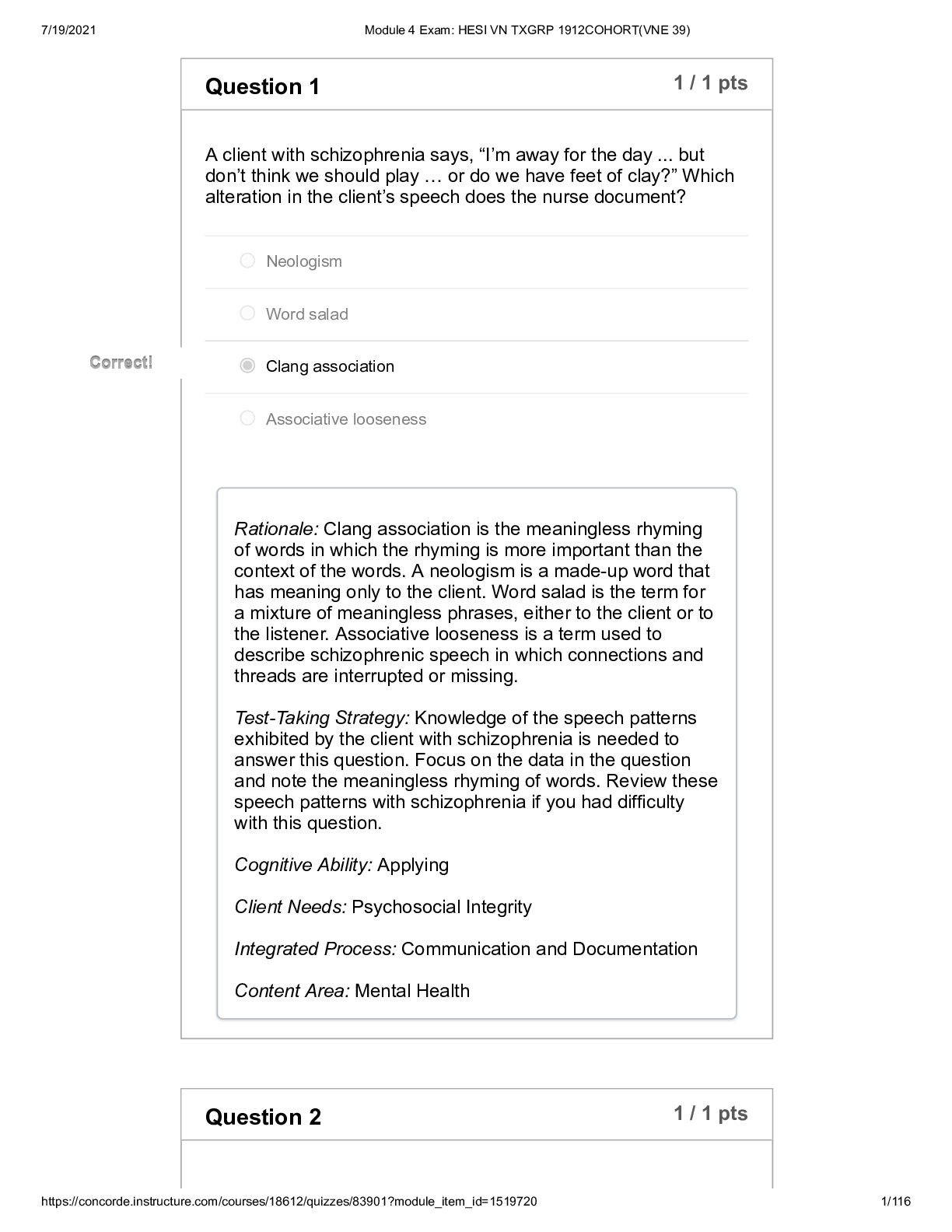

.png)
.png)
.png)
.png)


 Questions, Answers & Rationale, A+ Guide.png)
.png)