VSIM RED YODER part 1 Guided Reflection Sherman “Red” Yoder, Part 1 & 2 (answered)
Sherman “Red” Yoder, Part 1 & 2 (answered)
Guided Reflection Questions
Opening Questions
1. How did the simulated experience of Red Y
...
VSIM RED YODER part 1 Guided Reflection Sherman “Red” Yoder, Part 1 & 2 (answered)
Sherman “Red” Yoder, Part 1 & 2 (answered)
Guided Reflection Questions
Opening Questions
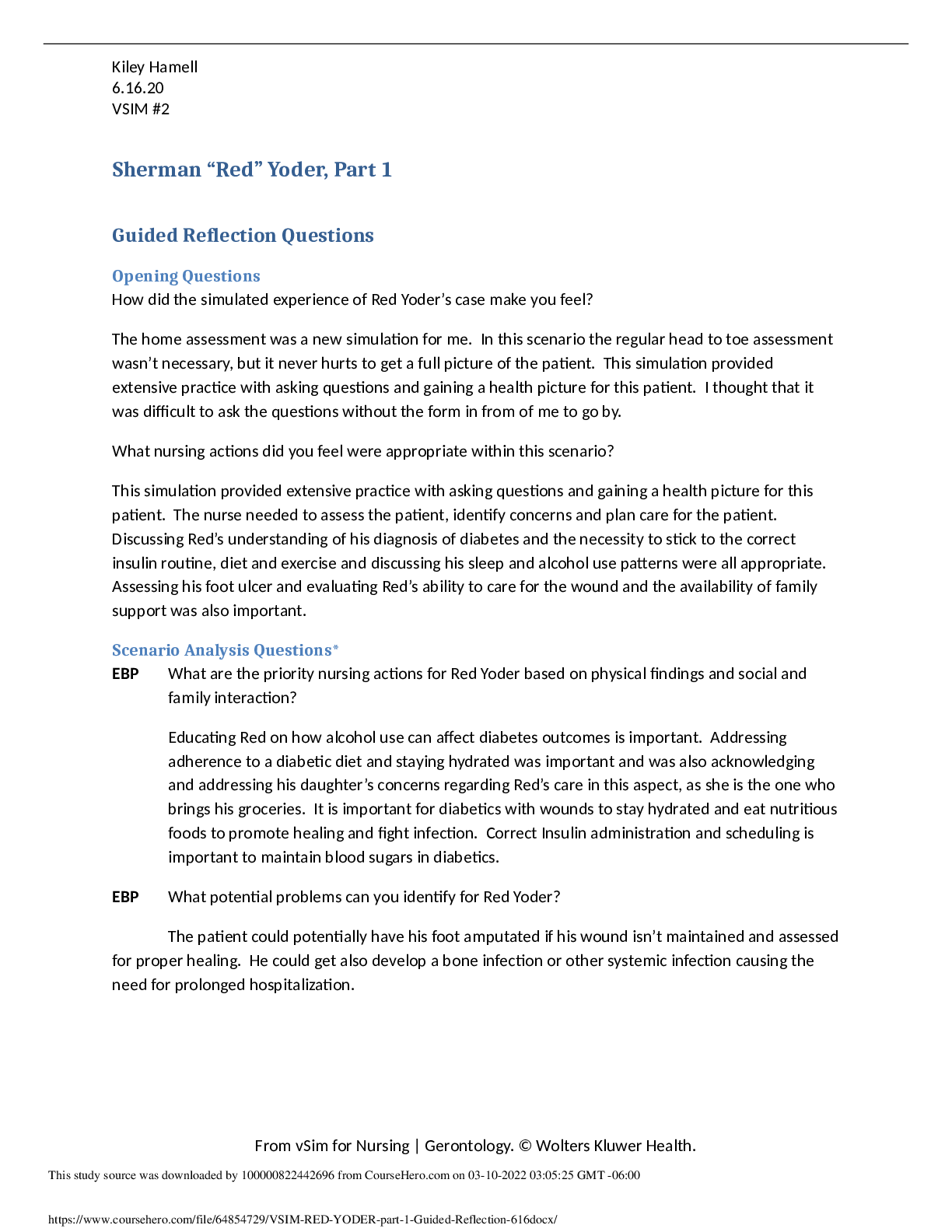
1. How did the simulated experience of Red Yoder’s case make you feel?
The home assessment was a new simulation for me. In this scenario the regular head to toe assessment
wasn’t necessary, but it never hurts to get a full picture of the patient. This simulation provided
extensive practice with asking questions and gaining a health picture for this patient. I thought that it
was difficult to ask the questions without the form in from of me to go by.
2. What nursing actions did you feel were appropriate within this scenario?
This simulation provided extensive practice with asking questions and gaining a health picture for this
patient. The nurse needed to assess the patient, identify concerns and plan care for the patient.
Discussing Red’s understanding of his diagnosis of diabetes and the necessity to stick to the correct
insulin routine, diet and exercise and discussing his sleep and alcohol use patterns were all
appropriate.Assessing his foot ulcer and evaluating Red’s ability to care for the wound and the
availability of family support was also important.
Scenario Analysis Questions*
3. EBP What are the priority nursing actions for Red Yoder based on physical findings and
social andfamily interaction?
Educating Red on how alcohol use can affect diabetes outcomes is important. Addressing
adherence to a diabetic diet and staying hydrated was important and was also acknowledging
and addressing his daughter’s concerns regarding Red’s care in this aspect, as she is the one who
brings his groceries. It is important for diabetics with wounds to stay hydrated and eat nutritious
foods to promote healing and fight infection. Correct Insulin administration and scheduling is
important to maintain blood sugars in diabetics.
4. EBP What potential problems can you identify for Red Yoder?
The patient could potentially have his foot amputated if his wound isn’t maintained and
assessedfor proper healing. He could get also develop a bone infection or other systemic infection
causing the need for prolonged hospitalization.5. S/QI For the following Safety/Quality Improvement measures, what nursing actions should be
takenduring Red Yoder’s case?
Safety/Quality Improvement Measures Nursing Actions
Assessment of patient’s ability to self-administer
his insulin
Teach and then have Red demonstrate proper
administration of insulin
Assessment of patient’s ability to monitor blood
glucose
Demonstrate the correct process and then have
Red re-teach back to the nurse.
Safety issues related to needle disposal Teach the patient about the importance and
possibly provide the patient with an appropriate
receptacle.
6. PCC/I What appropriate assessments were made to help you decide what
interventions Red Yoderneeded?
Skin assessment
Health and education assessment- Diet, wound care, diabetes knowledge
Sleep Routine
Alcohol Usage
Wound assessment
Vitals assessment
7. T&C Why is it important to include Red Yoder’s family as members of his health care team?
It is difficult for Red to assess the bottoms of his feet on his own, he is going to need some
support from his family. His family also provides support with groceries and getting to his doctor
appointments, so making sure they understand the plan of care with give Red more
accountability in his health routine.
Concluding Questions
1. Reflecting on Red Yoder’s case, were there any actions you would do differently? If so, what were
theseactions, and why would you do them differently?
I completed the simulation twice. During the first simulation I was confused as to where I find the
answers to the alcohol and sleep assessments, so I completed the questions based on what little
information I had of Red. I then realized there were options to have the conversation with the patient in
the communication controls. Secondly, I realized there were multiple ways to ask the same question,
and some were better than others. If I completed it again, I would pay closer attention to the way
questions were asked.2. How would you apply the knowledge and skills that you obtained in Red Yoder’s case to an actual
patientcare situation?
In real life, I would try to have a natural conversation with the patient. Asking questions directly from
some of the assessment tools available to nurses can be difficult and feel very unnatural. The
information is very personal and people tend to guard the truth when they think they are being judged
based on their answers. And questionnaires about alcohol use elicit a defensive response in people who
drink. Having an open conversation and remaining unbiased is important. Remembering the phrasing of
a question can make a huge difference when using these tools.Safety/Quality Improvement Measures Nursing Actions
Sherman “Red” Yoder, Part 2
Guided Reflection Questions
Opening Questions
1. How did the simulated experience of Red Yoder’s case make you feel?
- I think it was a great experience to assess a patient as an emergency triage nurse.
Assessing the same patient again but with different problem this time and evaluating his wound
care interventions was a good change. I also enjoyed asking questions regarding CAM
assessment.
2. What nursing actions did you feel were appropriate within this scenario?
- I feel all nursing actions were appropriate for this scenario. Administration of medication, taking
vitals, assessing the wound, completing CAM and SPICES assessment tools, communicating with
a family member, calling ICU and provider were all necessary actions.
Scenario Analysis Questions*
1. PCC What is the correlation between Red Yoder’s open foot wound, the diagnostic findings,
and treatment modalities including fluid bolus, insulin, and antibiotic therapy?
- A wound culture and sensitivity test was ordered for Red to identify the bacterial
microorganisms in the wound. His diagnostic findings also suggested high white blood
cells (12,000) which suggests an infection from a diabetic foot ulcer. Red was ordered to
start antibiotic therapy to treat Red’s foot wound and prevent further infection from
spreading. Red has type 2 diabetes which could cause nerve damage and numbness in
his foot. Insulin would help control the diabetes and fluid bolus would help red to stay
hydrated and promote wound healing. Fluid bolus will help to prevent the patient from
being hypovolemic and tachycardia.
2. PCC What potential problems can you identify for Red Yoder if his symptoms are not
managed in a timely manner?
- If the infection gets worse and his foot gets necrotic, his foot might need to be
amputated. If the systemic infection is not controlled, he could possibly go into septic
shock.
3. S/QI For the following Safety/Quality Improvement measures, what nursing actions should be
taken during Red Yoder’s case?Medication administration
- Prepare and administer medications,
using rights of medication
administration
- Assess IV site for infiltration or
extravasation
- Review pertinent data prior to
medication administration (e.g.,
contraindications, lab results, allergies,
potential interactions)
- Administer and document medications
given by parenteral routes
- Participate in medication reconciliation
process
- Assess pt’s response to the meds
Supportive care
- Educate pt about diabetes and its
complications
- Reposition pt to semi-fowler to promote
lung expansion to aid in breathing
- Using CAM method, assess his
confusion
- Educate judy and Red on delirium
- Provide education on foot sore, wound
care, medications, and sepsis
- Assess sensation in lower extremities
- Perform focused neurological exam
- Administer insulin as ordered
- Monitor vital signs
- Apply nasal cannula to bring o2 back up
to greater than 94
Safety issues related to infection control
- Pt is at fall risk due to delirium and
should be assess using morse fall risk
scale
- To control the infection, his lab values
should be monitored along with vitals
(sp02, BP)
- His blood sugar should be checked
frequently and administer insulin
accordingly
- Maintain contact isolation as pt is
positive for staph4. PCC/I What appropriate assessments were made to help you decide what interventions Red
Yoder needed?
- Completing the Confusion Assessment Method (CAM) was important to investigate Red’s
delirium
- SPICES was useful to identify red’s aging pattern
- Assessing Red’s wound to find that the wound is about 1 inch , and 5 millimeters deep
with white margins, foul odor, and opaque drainage.
- Assessing the sensation in the right foot.
- Assessing the vital signs.
- Assessing the pain level.
5. QI/EBP In your situation-background-assessment-recommendation (SBAR) report to the
provider, what would you request?
- In my SBAR report, I would request an immediate transfer to the intensive care unit. I
would also request MD to review his antibiotic. I would raise concern about his delirium.
6. T&C In addition to the health care team, who should be involved in discussions about Red
Yoder's treatment?
- It is important to communicate with the daughter-in-law Judy, as the primary source of
information. She is a caregiver for Red and with him being confused she can help the
nurse evaluate and assess Red’s situation better. Furthermore, the home health nurse
should be involved in the care at home for wound care, and focused assessments.
Concluding Questions
7. Reflecting on Red Yoder’s case, were there any actions you would do differently? If so, what were
theseactions, and why would you do them differently?
- The vsim stated that pt was lethargic, and he was confused. That puts the pt at high fall risk, i
would use Morse fall risk scale to assess his risk. There was no option for this. I would also try to
go in order by focusing on his ABC’s first, and then the rest.
8. How would you apply the knowledge and skills that you obtained in Red Yoder’s case to an actual
patientcare situation?
[Show More]





, 6e by Russell Hoye, Katie Misener, Michael Naraine, Catherine Ordway.png)
.png)