NU665B Week 6 iHuman Olive Chaney (solved) 2021.
NU665B_Week 6 iHuman Olive
Chaney. (solved) 2021.1
i-Human: Olive Chaney2
i-Human: Olive Chaney
Assessment
1. Exanthema Subitum (Roseola). Olive’s symptoms of cough,
...
NU665B Week 6 iHuman Olive Chaney (solved) 2021.
NU665B_Week 6 iHuman Olive
Chaney. (solved) 2021.1
i-Human: Olive Chaney2
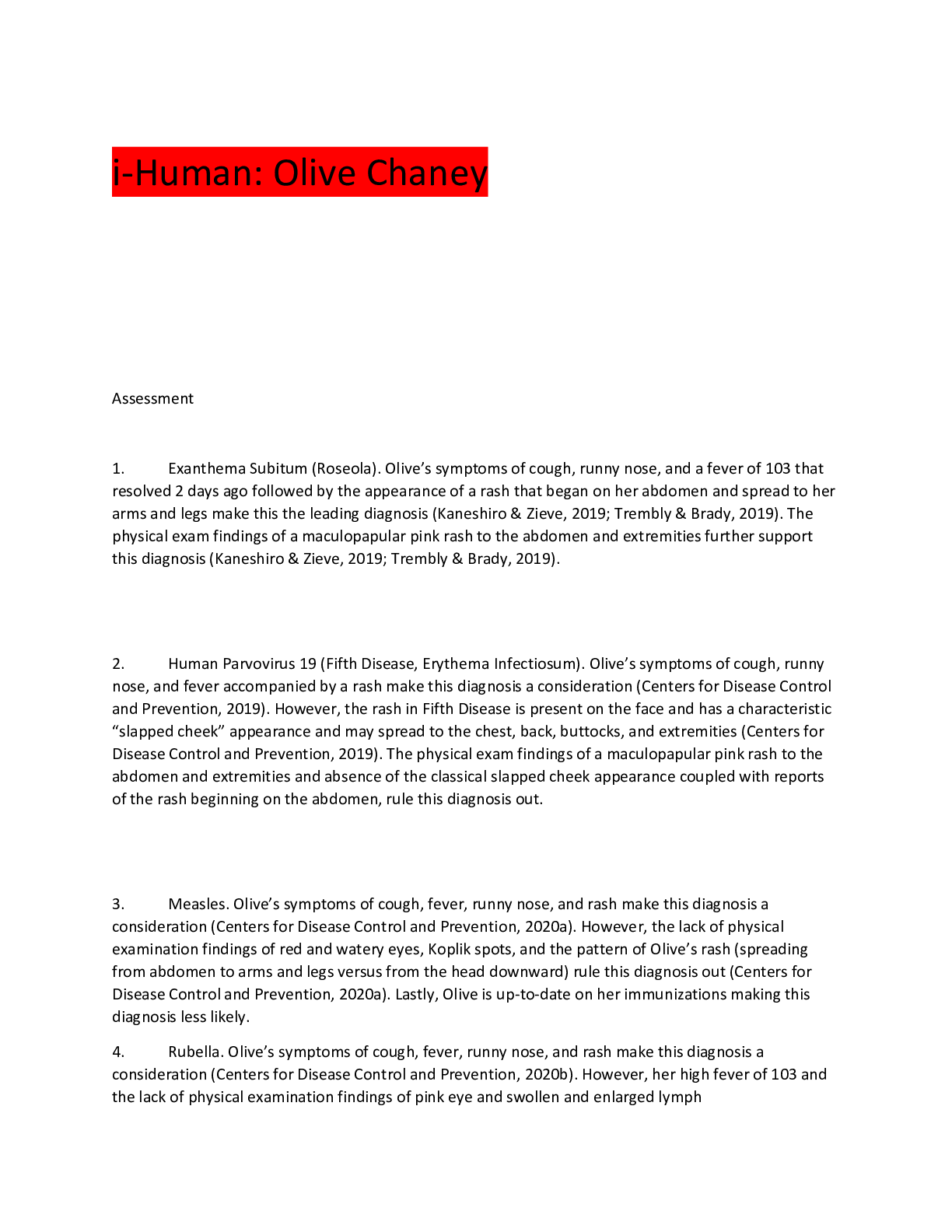
i-Human: Olive Chaney
Assessment
1. Exanthema Subitum (Roseola). Olive’s symptoms of cough, runny nose, and a fever of 103 that
resolved 2 days ago followed by the appearance of a rash that began on her abdomen and
spread to her arms and legs make this the leading diagnosis (Kaneshiro & Zieve, 2019; Trembly &
Brady, 2019). The physical exam findings of a maculopapular pink rash to the abdomen and
extremities further support this diagnosis (Kaneshiro & Zieve, 2019; Trembly & Brady, 2019).
2. Human Parvovirus 19 (Fifth Disease, Erythema Infectiosum). Olive’s symptoms of cough, runny
nose, and fever accompanied by a rash make this diagnosis a consideration (Centers for Disease
Control and Prevention, 2019). However, the rash in Fifth Disease is present on the face and has
a characteristic “slapped cheek” appearance and may spread to the chest, back, buttocks, and
extremities (Centers for Disease Control and Prevention, 2019). The physical exam findings of a
maculopapular pink rash to the abdomen and extremities and absence of the classical slapped
cheek appearance coupled with reports of the rash beginning on the abdomen, rule this
diagnosis out.
3. Measles. Olive’s symptoms of cough, fever, runny nose, and rash make this diagnosis a
consideration (Centers for Disease Control and Prevention, 2020a). However, the lack of physical
examination findings of red and watery eyes, Koplik spots, and the pattern of Olive’s rash
(spreading from abdomen to arms and legs versus from the head downward) rule this diagnosis
out (Centers for Disease Control and Prevention, 2020a). Lastly, Olive is up-to-date on her
immunizations making this diagnosis less likely.
4. Rubella. Olive’s symptoms of cough, fever, runny nose, and rash make this diagnosis a
consideration (Centers for Disease Control and Prevention, 2020b). However, her high fever of
103 and the lack of physical examination findings of pink eye and swollen and enlarged lymph3
nodes coupled with the pattern of Olive’s rash (spreading from abdomen to arms and legs versus
from the face to the rest of the body) rule this diagnosis out (Centers for Disease Control and
Prevention, 2020b). Lastly, Olive is up-to-date on her immunizations making this diagnosis less
likely.
5. Upper Respiratory Infection (URI). Olive’s symptoms of cough, fever, and runny nose make this
diagnosis a consideration. However, the presentation of a rash following resolution of Olive’s
fever is more characteristic of Roseola making this diagnosis less likely (Tesini, 2019).
Final Diagnosis: Exanthema Subitum (Roseola)
Plan
Pharmacology
• Children’s Tylenol (acetaminophen) 5 mL or 1 tablet (chewable) by mouth every 4 hours as
needed for fever of 100.4°F or higher. Do not give more than 5 times in 24 hours (Johnson &
Johnson Consumer Inc., 2019a; Johnson & Johnson Consumer Inc., 2019b).
Non-Pharmacology
• Maintain adequate hydration by encouraging clear liquids such as water, ginger ale or clear broth
(Mayo Clinic Staff, 2020).
• Pedialyte, Gatorade or Powerade may also be given for hydration (Mayo Clinic Staff, 2020).
• Apply cool washcloths to the forehead for fever, if present (Mayo Clinic Staff, 2020). A lukewarm
bath may also assist with fever, if present (Mayo Clinic Staff, 2020).
• Remove extra layers of clothing and use light cotton clothing and bedding when fever is present
(Harding, 2018).
• Encourage rest as needed.
• Apply moisturizing cream following a bath if the rash causes itching. If itching develops, avoid
soaps and bubble bath to prevent drying of the skin (Seattle Children’s, 2021).4
Diagnostics
• Not applicable, as a diagnosis of Roseola is made based on clinical symptoms (Tremblay
& Brady, 2019).
Consults/Referrals
• Not applicable.
Patient Education
• Roseola is a self-limiting virus with excellent prognosis. Treatment is supportive (Tremblay &
Brady, 2019).
• The virus may cause a high fever up to 105 degrees Fahrenheit, lasting 3 to 5 days. In rare cases,
a high fever may cause a febrile seizure which can lead to uncontrolled muscle spasms,
unresponsiveness lasting from 1 to 3 minutes, and loss of bladder or bowel control (Gardner,
2019; Healthwise Staff, 2019). You should seek emergency care immediately if a febrile seizure
occurs.
• Monitor Olive’s temperature using a rectal, forehead or ear thermometer and treat as needed
with Children’s Tylenol as prescribed.
• Monitor for signs of dehydration which may include dry mouth, absence of tears, sunken eyes,
drowsiness, and ill-appearance (Harding, 2018).
• Keep Olive home and away from other children until her fever resolves (Mayo Clinic Staff, 2020).
• The rash begins after the fever has resolved and may last for several hours or up to 2 to 3 days
(Kaneshiro & Zieve, 2019; Tremblay & Brady, 2019). The rash typically begins on the neck, chest,
and belly and spreads to the face, arms, and legs (Tremblay & Brady, 2019). It is usually not itchy
and does not require treatment (Kaneshiro & Zieve, 2019; Tremblay & Brady, 2019).
• Do not use Aspirin to treat a fever as this can cause a rare and serious condition known as Reye
syndrome (Healthwise Staff, 2019).5
• Do not use a cold bath or cold washcloths to alleviate fever, as this can lead to shivering and
increase temperature. Lukewarm bathwater or washcloths should only be used (Nationwide
Children’s Hospital, 2010).
• Handwashing can help prevent the spread of the virus (Tremblay & Brady, 2019).
• Olive may return to daycare/school and resume contact with other children after her fever has
been gone for 24 hours even if her rash is still present (American Academy of Pediatrics, 2015).
Follow Up
• Seek emergency care immediately if your child has a seizure caused by the fever.
• Contact the office for follow-up if:
o Your child’s rash becomes itchy and the itching is unrelieved by moisturizing cream;
o Your child is not maintaining adequate hydration and has signs of dehydration such as
lack of tear production, sunken eyes, dry mouth, drowsiness, has a decrease in wet
diapers or has not urinated in 8 hours;
o Your child’s fever persists or worsens;
o Your child’s rash worsens or persists for more than 7 days;
o Your child has other symptoms that worsen or do not improve (Marks, 2018; Healthwise
Staff, 2019; Mayo Clinic Staff, 2020; Doctors and Editors, 2021).6
References
American Academy of Pediatrics. (2015, November 21). Roseola infantum. Retrieved February 9, 2021
from https://www.healthychildren.org/English/health-issues/conditions/skin/Pages/RoseolaInfantum.aspx
Centers for Disease Control and Prevention. (2019, November 26). Fifth disease. U.S. Department of
Health & Human Services, National Center for Immunization and Respiratory Diseases, Division
of Viral Diseases. Retrieved February 14, 2021 from https://www.cdc.gov/parvovirusb19/fifthdisease.html
Centers for Disease Control and Prevention. (2020a, November 5). Measles (Rubeola). U.S. Department
of Health & Human Services, National Center for Immunization and Respiratory Diseases,
Division of Viral Diseases. Retrieved February 14, 2021 from
https://www.cdc.gov/measles/symptoms/signs-symptoms.html
Centers for Disease Control and Prevention. (2020b, December 31). Rubella (German measles, three-day
measles). U.S. Department of Health & Human Services, National Center for Immunization and
Respiratory Diseases, Division of Viral Diseases. Retrieved February 14, 2021 from
https://www.cdc.gov/rubella/about/symptoms.html
Doctors and Editors. (2021). Patient education: Roseola (The basics). UpToDate. Retrieved February 14,
2021 from https://www.uptodate.com/contents/roseola-the-basics
Gardner, S.S. (2019, March 8). What is roseola?. WebMD. Retrieved February 14, 2021 from
https://www.webmd.com/skin-problems-and-treatments/what-is-roseola
Harding, M. (2018, March 9). Roseola. Retrieved February 14, 2021 from https://patient.info/skinconditions/viral-rashes/roseola
[Show More]