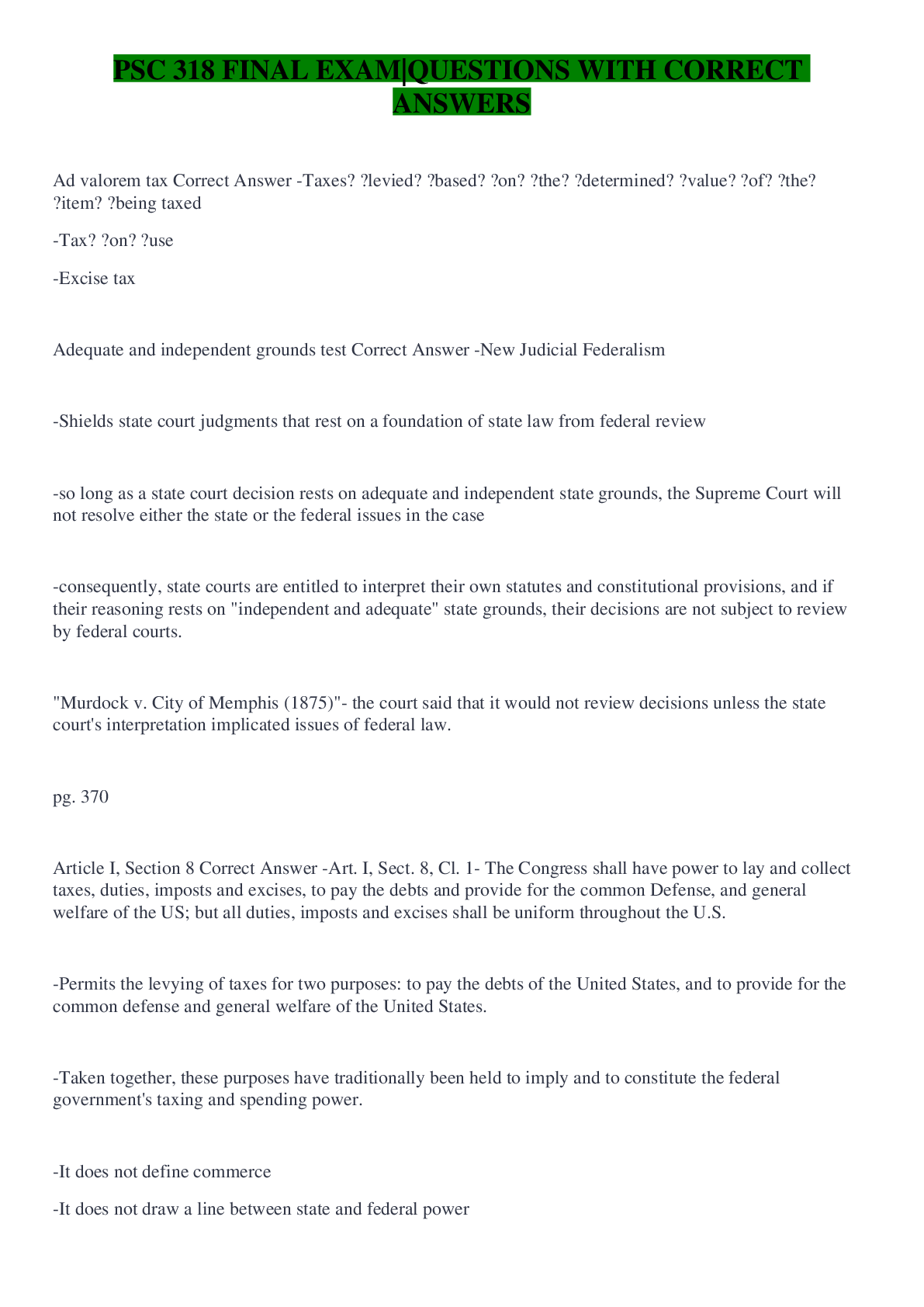
Ad valorem tax Correct Answer -Taxes levied based on the determined value of the item being taxed
-Tax on use
-Excise tax
Adequate and independent grounds test Correct Answer -New Judicial Federalism
-Shields s
...
Ad valorem tax Correct Answer -Taxes levied based on the determined value of the item being taxed
-Tax on use
-Excise tax
Adequate and independent grounds test Correct Answer -New Judicial Federalism
-Shields state court judgments that rest on a foundation of state law from federal review
-so long as a state court decision rests on adequate and independent state grounds, the Supreme Court will not resolve either the state or the federal issues in the case
-consequently, state courts are entitled to interpret their own statutes and constitutional provisions, and if their reasoning rests on "independent and adequate" state grounds, their decisions are not subject to review by federal courts.
"Murdock v. City of Memphis (1875)"- the court said that it would not review decisions unless the state court's interpretation implicated issues of federal law.
pg. 370
Article I, Section 8 Correct Answer -Art. I, Sect. 8, Cl. 1- The Congress shall have power to lay and collect taxes, duties, imposts and excises, to pay the debts and provide for the common Defense, and general welfare of the US; but all duties, imposts and excises shall be uniform throughout the U.S.
-Permits the levying of taxes for two purposes: to pay the debts of the United States, and to provide for the common defense and general welfare of the United States.
-Taken together, these purposes have traditionally been held to imply and to constitute the federal government's taxing and spending power.
-It does not define commerce
-It does not draw a line between state and federal power
-There is no other provision to flesh it out
Article I, Section 9 Correct Answer -Article I, section 9: "No capitation or other direct tax shall be laid unless in proportion to the census or enumeration herein before directed to be taken"
[Show More]