o A.L.A. Schechter Corp. v United States (1935) Correct Answer I-Under the National Industrial Recovery Act, Congress allowed the President to regulate certain industries by distributing authority to develop codes of con
...
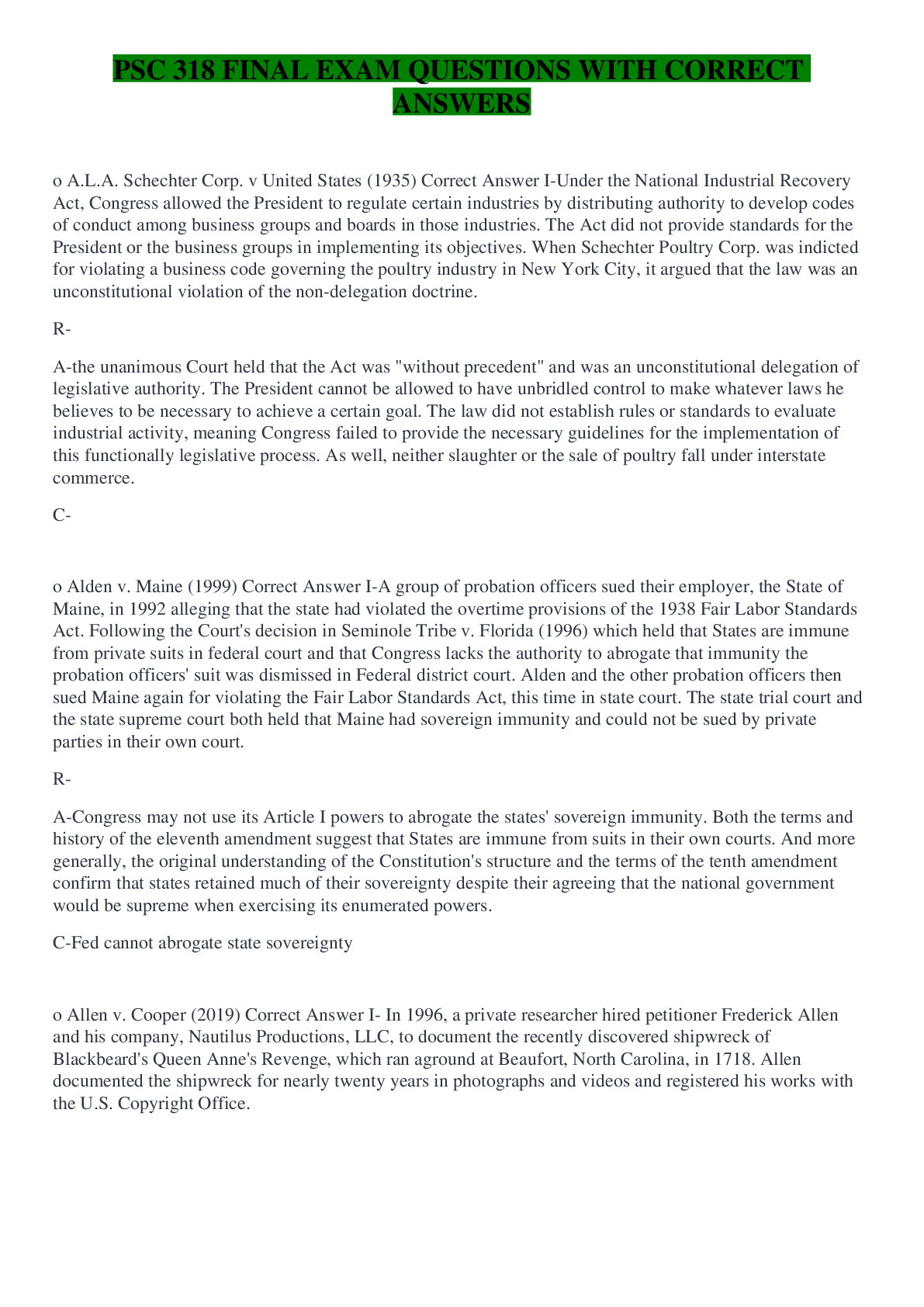
o A.L.A. Schechter Corp. v United States (1935) Correct Answer I-Under the National Industrial Recovery Act, Congress allowed the President to regulate certain industries by distributing authority to develop codes of conduct among business groups and boards in those industries. The Act did not provide standards for the President or the business groups in implementing its objectives. When Schechter Poultry Corp. was indicted for violating a business code governing the poultry industry in New York City, it argued that the law was an unconstitutional violation of the non-delegation doctrine.
R-
A-the unanimous Court held that the Act was "without precedent" and was an unconstitutional delegation of legislative authority. The President cannot be allowed to have unbridled control to make whatever laws he believes to be necessary to achieve a certain goal. The law did not establish rules or standards to evaluate industrial activity, meaning Congress failed to provide the necessary guidelines for the implementation of this functionally legislative process. As well, neither slaughter or the sale of poultry fall under interstate commerce.
C-
o Alden v. Maine (1999) Correct Answer I-A group of probation officers sued their employer, the State of Maine, in 1992 alleging that the state had violated the overtime provisions of the 1938 Fair Labor Standards Act. Following the Court's decision in Seminole Tribe v. Florida (1996) which held that States are immune from private suits in federal court and that Congress lacks the authority to abrogate that immunity the probation officers' suit was dismissed in Federal district court. Alden and the other probation officers then sued Maine again for violating the Fair Labor Standards Act, this time in state court. The state trial court and the state supreme court both held that Maine had sovereign immunity and could not be sued by private parties in their own court.
R-
A-Congress may not use its Article I powers to abrogate the states' sovereign immunity. Both the terms and history of the eleventh amendment suggest that States are immune from suits in their own courts. And more generally, the original understanding of the Constitution's structure and the terms of the tenth amendment confirm that states retained much of their sovereignty despite their agreeing that the national government would be supreme when exercising its enumerated powers.
C-Fed cannot abrogate state sovereignty
o Allen v. Cooper (2019) Correct Answer I- In 1996, a private researcher hired petitioner Frederick Allen and his company, Nautilus Productions, LLC, to document the recently discovered shipwreck of Blackbeard's Queen Anne's Revenge, which ran aground at Beaufort, North Carolina, in 1718. Allen documented the shipwreck for nearly twenty
[Show More]