MKT 100 Exam Review- December 2016
The 4 P’s of Marketing
● Product – A product can be either a tangible good or an intangible service that fulfills a need
or want of consumers. It’s imperative that you have a clear g
...
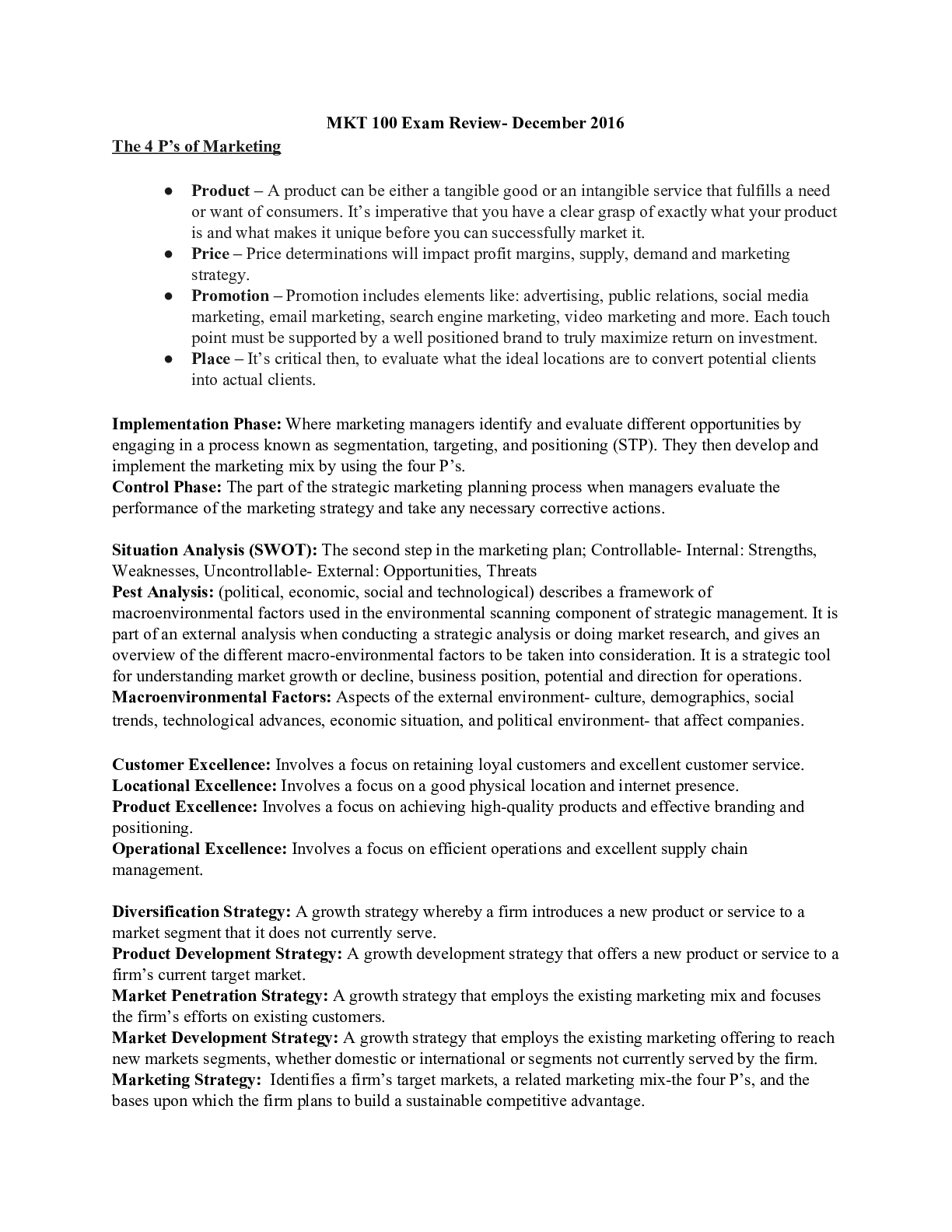
MKT 100 Exam Review- December 2016
The 4 P’s of Marketing
● Product – A product can be either a tangible good or an intangible service that fulfills a need
or want of consumers. It’s imperative that you have a clear grasp of exactly what your product
is and what makes it unique before you can successfully market it.
● Price – Price determinations will impact profit margins, supply, demand and marketing
strategy.
● Promotion – Promotion includes elements like: advertising, public relations, social media
marketing, email marketing, search engine marketing, video marketing and more. Each touch
point must be supported by a well positioned brand to truly maximize return on investment.
● Place – It’s critical then, to evaluate what the ideal locations are to convert potential clients
into actual clients.
Implementation Phase: Where marketing managers identify and evaluate different opportunities by
engaging in a process known as segmentation, targeting, and positioning (STP). They then develop and
implement the marketing mix by using the four P’s.
Control Phase: The part of the strategic marketing planning process when managers evaluate the
performance of the marketing strategy and take any necessary corrective actions.
Situation Analysis (SWOT): The second step in the marketing plan; Controllable- Internal: Strengths,
Weaknesses, Uncontrollable- External: Opportunities, Threats
Pest Analysis: (political, economic, social and technological) describes a framework of
macroenvironmental factors used in the environmental scanning component of strategic management. It is
part of an external analysis when conducting a strategic analysis or doing market research, and gives an
overview of the different macro-environmental factors to be taken into consideration. It is a strategic tool
for understanding market growth or decline, business position, potential and direction for operations.
Macroenvironmental Factors: Aspects of the external environment- culture, demographics, social
trends, technological advances, economic situation, and political environment- that affect companies.
Customer Excellence: Involves a focus on retaining loyal customers and excellent customer service.
Locational Excellence: Involves a focus on a good physical location and internet presence.
Product Excellence: Involves a focus on achieving high-quality products and effective branding and
positioning.
Operational Excellence: Involves a focus on efficient operations and excellent supply chain
management.
Diversification Strategy: A growth strategy whereby a firm introduces a new product or service to a
market segment that it does not currently serve.
Product Development Strategy: A growth development strategy that offers a new product or service to a
firm’s current target market.
Market Penetration Strategy: A growth strategy that employs the existing marketing mix and focuses
the firm’s efforts on existing customers.
Market Development Strategy: A growth strategy that employs the existing marketing offering to reach
new markets segments, whether domestic or international or segments not currently served by the firm.
Marketing Strategy: Identifies a firm’s target markets, a related marketing mix-the four P’s, and the
bases upon which the firm plans to build a sustainable competitive advantage.
[Show More]