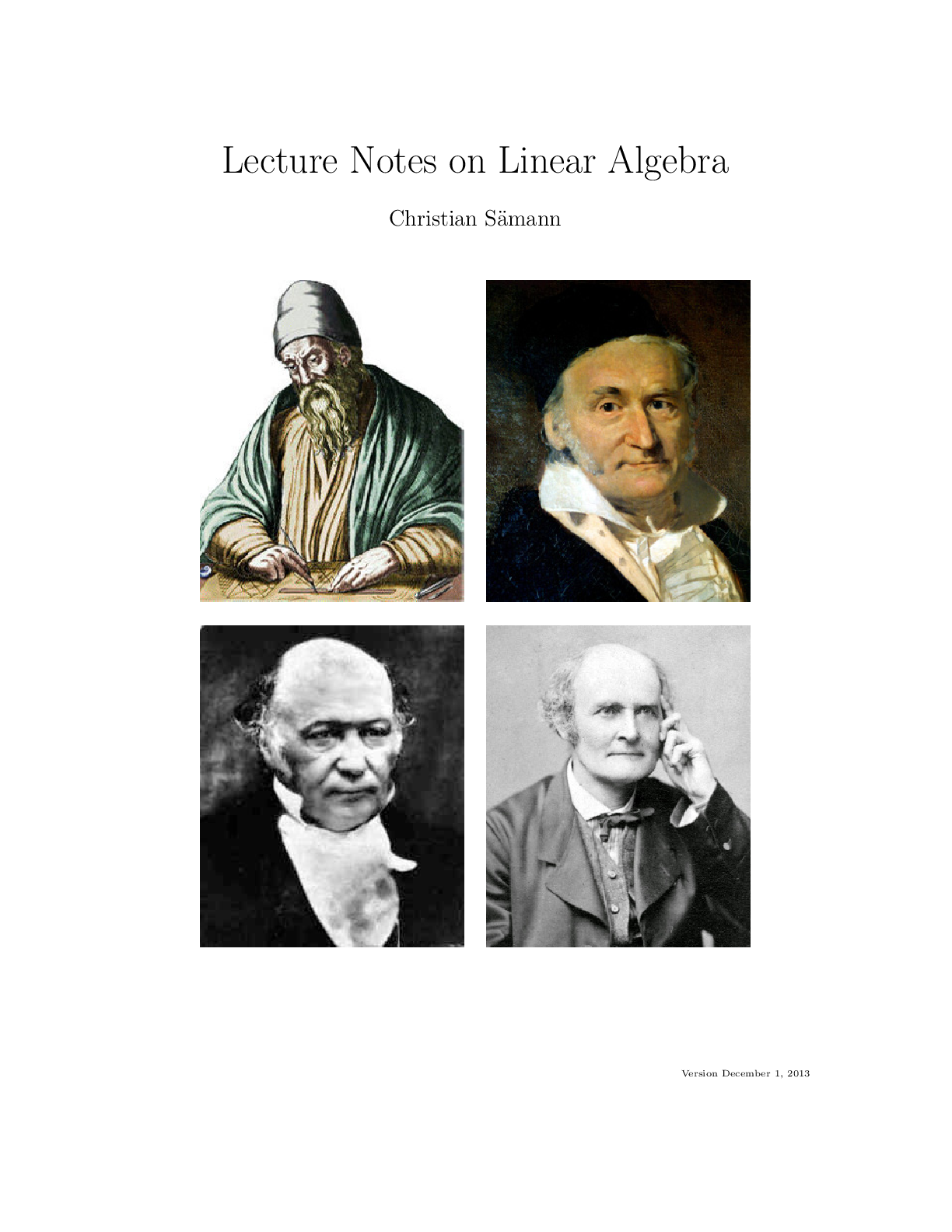
Mathematics > STUDY GUIDE > Study Guide > Lecture Notes on Linear Algebra Christian S¨amann (All)
Contents Preface 4 Course summary 5 I Euclidean space 7 I.1 The vector space R2 . . . . . . . . . . . . . . . . . . . . . . . . . . . . . 7 I.2 The vector spaces R3 and Rn . . . . . . . . . . . . ... . . . . . . . . . . . . 10 I.3 Matrices . . . . . . . . . . . . . . . . . . . . . . . . . . . . . . . . . . . 13 II Systems of linear equations 19 II.1 Motivation . . . . . . . . . . . . . . . . . . . . . . . . . . . . . . . . . . 19 II.2 Basic notions . . . . . . . . . . . . . . . . . . . . . . . . . . . . . . . . . 20 II.3 Gaußian elimination . . . . . . . . . . . . . . . . . . . . . . . . . . . . . 21 II.4 Homogeneous and inhomogeneous SLEs . . . . . . . . . . . . . . . . . . 25 II.5 Inverting matrices . . . . . . . . . . . . . . . . . . . . . . . . . . . . . . 25 III Vector spaces 27 III.1 Definition and examples . . . . . . . . . . . . . . . . . . . . . . . . . . . 27 III.2 Vector subspaces . . . . . . . . . . . . . . . . . . . . . . . . . . . . . . . 29 III.3 Linear combination and span . . . . . . . . . . . . . . . . . . . . . . . . 30 III.4 Linear dependence . . . . . . . . . . . . . . . . . . . . . . . . . . . . . . 31 III.5 Basis and dimensions . . . . . . . . . . . . . . . . . . . . . . . . . . . . 33 IV Inner product spaces 37 IV.1 Inner products . . . . . . . . . . . . . . . . . . . . . . . . . . . . . . . . 37 IV.2 Orthogonality of vectors . . . . . . . . . . . . . . . . . . . . . . . . . . . 39 IV.3 Gram-Schmidt algorithm . . . . . . . . . . . . . . . . . . . . . . . . . . 41 V Linear transformations 43 V.1 Examples and general properties . . . . . . . . . . . . . . . . . . . . . . 44 V.2 Row and column spaces of matrices . . . . . . . . . . . . . . . . . . . . 45 V.3 Range and kernel, rank and nullity . . . . . . . . . . . . . . . . . . . . . 48 V.4 Orthogonal linear transformations . . . . . . . . . . . . . . . . . . . . . 51 VI Eigenvalues and eigenvectors 52 VI.1 Characteristic polynomial . . . . . . . . . . . . . . . . . . . . . . . . . . 52 VI.2 Diagonalising matrices . . . . . . . . . . . . . . . . . . . . . . . . . . . . 56 VI.3 Applications . . . . . . . . . . . . . . . . . . . . . . . . . . . . . . . . . 59 VII Advanced topics 65 VII.1 Complex linear algebra . . . . . . . . . . . . . . . . . . . . . . . . . . . 65 VII.2 A little group theory . . . . . . . . . . . . . . . . . . . . . . . . . . . . . 69 VII.3 Special relativity . . . . . . . . . . . . . . . . . . . . . . . . . . . . . . . 75 Appendix 81 A Linear algebra with SAGE . . . . . . . . . . . . . . . . . . . . . . . . . 81 Index 84 3 Preface These are the lecture notes of the course Linear Algebra F18CF taught at Heriot-Watt University to second year students. While the material covered in this course is itself important for later courses, this course is mainly the first one to teach you how to prove theorems. Linear Algebra is in fact the ideal course to learn this, as the proofs are rather short, simple, and less technical than those in Analysis. Traditionally, switching from algorithmic work to problem solving and proving theorems is very difficult for students, and this course tries to ease the transition. To understand theorems and proofs it is necessary to try to construct examples and/or counterexamples to the statements. Playing and experimenting with definitions and theorems is one of the key activities for understanding mathematics. I therefore included an appendix giving an introduction to doing Linear Algebra with the computer algebra programme SAGE. SAGE can be a valuable help in playing and experimenting, as it does most of the tedious calculations for you. Please note that these notes may still contain typos and other mistakes. If you should find something that requires corrections (or if you have a good suggestion for improving these notes), please send an email to [email protected]. The lecture notes were created relying on material from many different sources and are certainly not meant to be original. Finally , I’d like to thank all students who spotted typos and took the time to let me know, in particular Simone Rea. Christian S¨amann Remarks on Nomenclature and Notation You should know what a Definition is. A Theorem is a mathematical (hopefully) profound and proved statement, and this is what we are most interested in. A Proposition is a less profound statement, also coming with a proof. A Lemma is a proved auxiliary statement1, usually used in the larger proof of a theorem. A Corollary is an interesting consequence that follows almost immediately from a theorem. A F marks additional reading material or questions to think about further. The end of a proof is marked by . We use the convention that a := b and b =: a mean a is defined as b. (In other sources, this is often written as a ≡ b.) Vectors are almost always labelled by underlined characters x, v, u, ... While our vectors in Rn are always column vectors, we also use row notation followed by a T for transpose to simplify typesetting. For example, x = (1; 2; 3)T 2 R3. N∗, R∗ etc. denote the sets Nnf0g, Rnf0g etc. We label the set of functions f : R ! R that are smooth, i.e. that can be differentiated infinitely many times, by C1(R). 1Although there are many very deep statements that are usually called Lemma, see Wikipedia’s list of Lemmata. Some people claim that a good lemma is worth a thousand theorems. 4 Course summary Outline Euclidean Space. Vector space Rn, Matrices, Basic matrix operations, Determinants Systems of Linear Equations. Gaußian elimination, Results on Homogeneous and Inhomogeneous Linear Systems, Matrix Inversion Vector Spaces. Definition and examples of Vector Spaces, Subspaces, Span, Linear Independence, Bases and Dimension Inner Product Spaces. Inner Products, Cauchy-Schwartz Inequality, Orthogonality, Orthogonal Projection, Orthonormal Bases, Gram-Schmidt Process, Vector Products Linear transformations. Row and Column Rank of a Matrix, Applications to Systems of Linear Equations, Range, Kernel, Rank and Nullity, Invertibility of Linear Transformations, Linear Transformations and Matrices Eigenvalues and Eigenvectors. Calculation of Eigenvalues and Eigenvectors, Symmetric Matrices, Diagonalisation of a Matrix, Cayley-Hamilton Theorem Assessment and feedback The final mark will be composed of 70% mark in final exam, 15% mark in midterm, 15% marks in multiple-choice tests during the tutorials. You can use electronic calculators in exams, however, the usual restrictions apply. The multiple-choice test will give you a good feeling of how well you are progressing. How to get the most out of this course It is expected that you participate in both lectures and tutorials. For each hour spent in a lecture, you should spend another hour at home to go through the material once more. Do not expect to understand all the material immediately when it is presented in class. Mathematics is difficult and requires considerable effort to learn. For this, it is also necessary to try to solve the exercises on the tutorial sheets before coming to the tutorials. The most effective and fun way to do this is to form small groups to work on the tutorials. Make sure that you are able to explain the solutions to each other. Try to work continuously throughout the term, this will make the preparation for the exam much easier for you. It is very important that you keep a tidy set of lecture notes for yourself. Understanding the material in class without lecture notes will be very difficult. As a backup, the lecture notes required for the current tutorial will be made available on VISION when the tutorial is handed out in class. Recommended textbooks This course is fairly self-contained and the material covered in the published lecture notes is certainly sufficient to pass the exam. To deepen your knowledge in Linear Algebra, you could use one of the following textbooks: 5 Linear Algebra - Concepts and Methods by Martin Anthony and Michele Harvey. Linear Algebra Done Right by Sheldon Axler, Springer. Introduction to Linear Algebra by Gilbert Strang, Cambridge University Press. Note that there is a wealth of lecture notes and other material freely available on the internet. The book Linear Algebra in Schaum’s outline series is available on VISION. By the end of the course, you should be able to... B Use the Gaußian elimination procedure to determine whether a given system of simultaneous linear equations is consistent and if so, to find the general solution. Invert a matrix by the Gaußian elimination method. B Understand the concepts of vector space and subspace, and apply the subspace test to determine whether a given subset of a vector space is a subspace. B Understand the concepts of linear combination of vectors, linear (in)dependence, spanning set, and basis. Determine if a set of vectors is linearly independent and spans a given vector space. B Find a basis for a subspace, defined either as the span of a given set of vectors, or as the solution space of a system of homogeneous equations. B Understand the concept of inner product in general, and calculate the inner products of two given vectors. B Understand the concept of orthogonal projection and how to explicitly calculate the projection of one vector onto another one. Use the Gram-Schmidt method to convert a given basis for a vector space to an orthonormal basis. Understand (geometrically) the concept of the vector product and calculate the vector product of two given vectors. B Find the coordinates of a given vector in terms of a given basis - especially in the case of an orthogonal or orthonormal basis. B Calculate the rank of a given matrix and, from that, the dimension of the solution space of the corresponding system of homogeneous linear equations. Calculate the determinant of 2 × 2 and 3 × 3 matrices. B Understand the concepts of linear transformation, range and kernel (nullspace). Understand the concept of invertibility of a linear transformation including injectivity and surjectivity. B Know and apply the Rank-Nullity Theorem. B Compute the characteristic polynomial of a square matrix and (in simple cases) factorise to find the eigenvalues. B Determine whether a given square matrix is diagonalisable, and if so find a diagonalising matrix. B Apply the Cayley-Hamilton Theorem to compute powers of a given square matrix. [Show More]
Last updated: 3 years ago
Preview 1 out of 85 pages
Buy this document to get the full access instantly
Instant Download Access after purchase
Buy NowInstant download
We Accept:
Can't find what you want? Try our AI powered Search
Connected school, study & course
About the document
Uploaded On
Jan 22, 2021
Number of pages
85
Written in
All
This document has been written for:
Uploaded
Jan 22, 2021
Downloads
0
Views
37
Scholarfriends.com Online Platform by Browsegrades Inc. 651N South Broad St, Middletown DE. United States.
We're available through e-mail, Twitter, and live chat.
FAQ
Questions? Leave a message!
Copyright © Scholarfriends · High quality services·