Question
Answered step-by-step
Asked by ChefCrow13252
Make two C programs a client and a server to implement a remote shell connection using sockets.
Server:
• Two copies of the server (serverA and serverB
...
Question
Answered step-by-step
Asked by ChefCrow13252
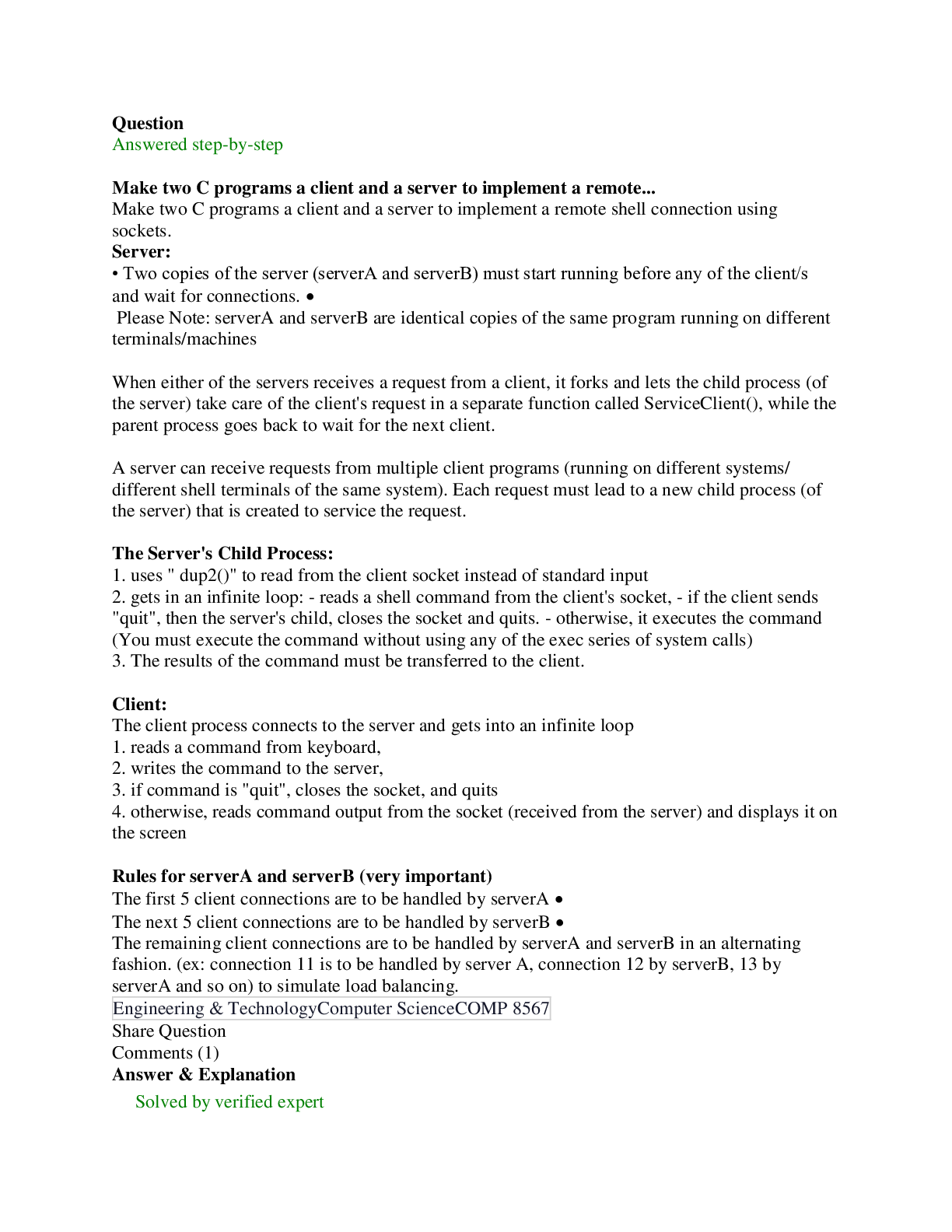
Make two C programs a client and a server to implement a remote shell connection using sockets.
Server:
• Two copies of the server (serverA and serverB) must start running before any of the client/s and wait for connections.
Please Note: serverA and serverB are identical copies of the same program running on different terminals/machines
When either of the servers receives a request from a client, it forks and lets the child process (of the server) take care of the client's request in a separate function called ServiceClient(), while the parent process goes back to wait for the next client.
A server can receive requests from multiple client programs (running on different systems/ different shell terminals of the same system). Each request must lead to a new child process (of the server) that is created to service the request.
The Server's Child Process:
1. uses " dup2()" to read from the client socket instead of standard input
2. gets in an infinite loop: - reads a shell command from the client's socket, - if the client sends "quit", then the server's child, closes the socket and quits. - otherwise, it executes the command (You must execute the command without using any of the exec series of system calls)
3. The results of the command must be transferred to the client.
Client:
The client process connects to the server and gets into an infinite loop
1. reads a command from keyboard,
2. writes the command to the server,
3. if command is "quit", closes the socket, and quits
4. otherwise, reads command output from the socket (received from the server) and displays it on the screen
Rules for serverA and serverB (very important)
The first 5 client connections are to be handled by serverA
The next 5 client connections are to be handled by serverB
The remaining client connections are to be handled by serverA and serverB in an alternating fashion. (ex: connection 11 is to be handled by server A, connection 12 by serverB, 13 by serverA and so on) to simulate load balancing.
[Show More]







.png)


.png)


