✓
1.
(01.01 LC)
How were the native peoples of the Americas living prior to European contact? (5 points)
They were organized into two large empires of the Incas and the Aztecs.
They had not developed into advanced f
...
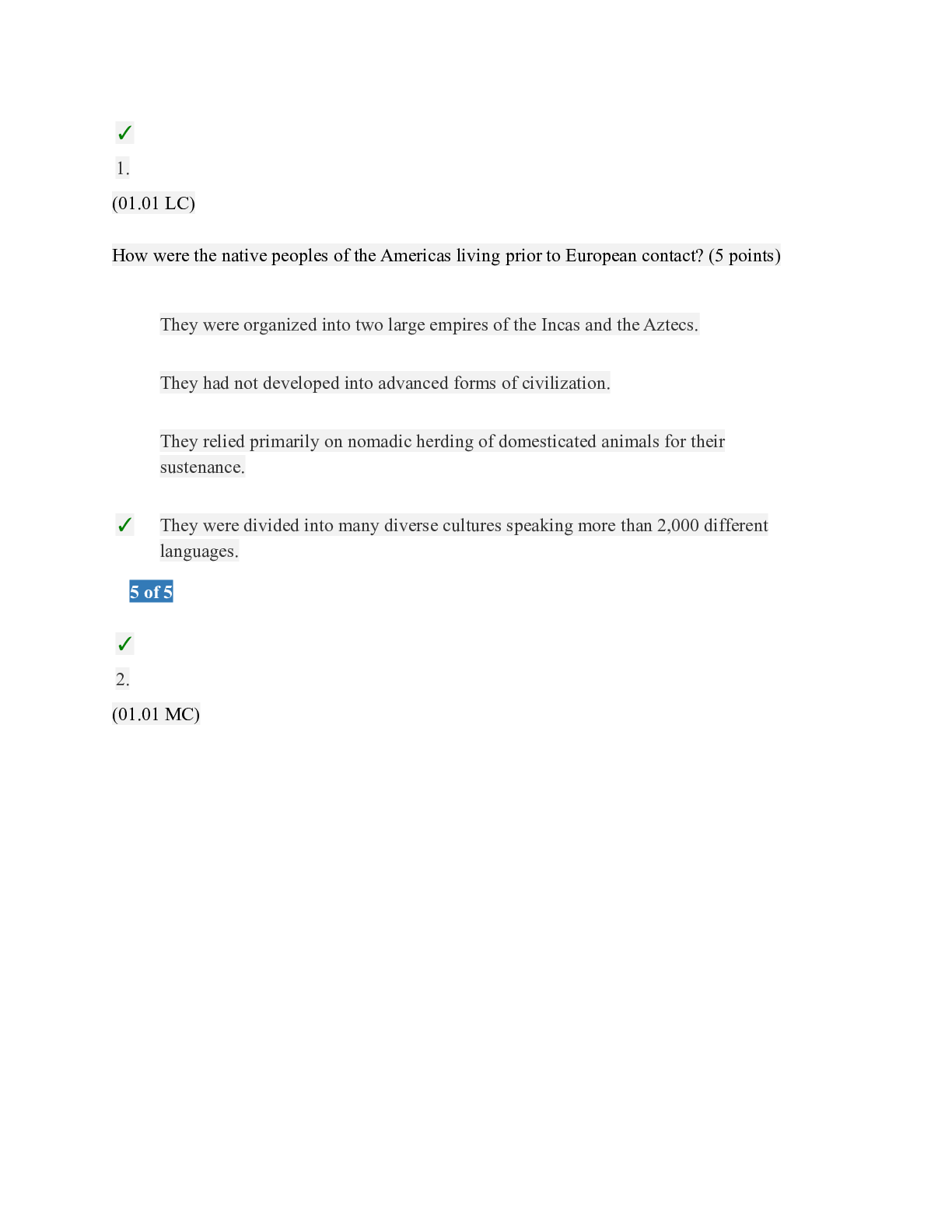
✓
1.
(01.01 LC)
How were the native peoples of the Americas living prior to European contact? (5 points)
They were organized into two large empires of the Incas and the Aztecs.
They had not developed into advanced forms of civilization.
They relied primarily on nomadic herding of domesticated animals for their
sustenance.
✓ They were divided into many diverse cultures speaking more than 2,000 different
languages.
5 of 5
✓
2.
(01.01 MC)
© Norton 2015
Which one of the following statements is true of the Aztec capital, Tenochtitlán? (5 points)
✓ It had a complex system of canals, bridges, and dams, with the Great Temple at the
center.
It was located in the dense jungle of the Yucatan Peninsula.
It had the New World's first mass transit system.
It was far behind European capitals, technologically and architecturally.
5 of 5
✓
3.
(01.01 MC)
Which of the following is true regarding the European belief about American Indians and their
cultures? (5 points)
All American Indians were gentle and friendly.
Native Americans worshipped the same God that Europeans did, although they
called him by different names.
✓ American Indians failed to make use of the land, so it was acceptable for Europeans
to take it and use it.
Because American Indian men engaged in masculine pursuits such as hunting and
fishing, Indian gender divisions were acceptable.
5 of 5
✓
4.
(01.01 MC)
What did both the Aztecs and the Incas have in common? (5 points)
Small in population but sophisticated in infrastructure
✓ Large, wealthy, and sophisticated in infrastructure
Large in geographic size but sparsely populated
Rural with few impressive buildings
5 of 5
✓
5.
(01.01 MC)
The Pueblo Indians encountered by the Spanish in the 16th century (5 points)
had been almost completely isolated from any other people before the Spanish
arrived
✓ used irrigation systems to aid their agricultural production
were called mound builders for the burial mounds they created
created a vast empire that included control of the Incas
5 of 5
✓
6.
(01.01 MC)
Prior to the arrival of Europeans, what did the natives of North America have in common? (5
points)
✓ They had elaborate trade networks.
They all lived in small family units.
Their lifestyles were entirely agricultural.
They lived only in coastal areas.
✓
1.
(01.04 LC)
Early French explorations of the New World (5 points)
brought great riches to France
✓ focused on the St. Lawrence, Mississippi, and Ohio rivers
were in response to an intense rivalry with the Netherlands
created no permanent settlements until the 18th century
5 of 5
✓
2.
(01.04 LC)
Which one of the following is true of agriculture in Spanish America? (5 points)
The main crops were vastly different than they had been before Spain's arrival.
Spain did not do any farming in its empire.
Catholic priests were forbidden to be involved in farming.
✓ American Indian slaves did the work on large-scale farms.
5 of 5
✓
3.
(01.04 LC)
Which European country dominated international commerce in the early 17th century? (5 points)
France
✓ The Netherlands
Spain
Britain
5 of 5
✓
4.
(01.04 MC)
On what did Europeans—particularly the English, French, and Dutch—base their claim to North
American Indian land? (5 points)
The Treaty of Tordesillas
Financial transactions between Indian peoples and themselves
✓ Their view that Indians did not use the land properly
Biblical stories such as Noah's division of the world among his sons
5 of 5
✓
5.
(01.04 MC)
Which of the following is a correct characteristic of New France? (5 points)
Constant severe conflicts between French settlers and the American Indians
A well-defined line between American Indian society and French society
✓ Maintained more peaceful European-American Indian relations than existed in New
Spain
Main focus was on the Protestant conversion of the American Indians
5 of 5
✓
6.
(01.04 MC)
The Spanish Empire in America (5 points)
included most of the populated part of the New World but few of its natural
resources, making the empire rich in people but poor economically
✓ was, unlike the French and English New World empires, a mostly urban civilization
society that would improve the settlers' chances of success, economic and otherwise
was centered around ports along the coast of Brazil
allowed religious freedom and therefore, attracted colonists from throughout Europe
5 of 5
✓
7.
(01.04 MC)
Question refers to the image below.
© Norton 2015
What does the seal of New Netherland, adopted by the Dutch West India Company in 1630,
suggest is central to the colony's economic prospects? (5 points)
Tobacco
Fish
✓ Fur
Timber
5 of 5
✓
8.
(01.04 MC)
Just as the Reconquista of Spain from the Moors established patterns that would be repeated in
Spanish New World colonization, the methods used in which one of the following countries
anticipated policies England would undertake in America? (5 points)
India
Scotland
✓ Ireland
Wales
5 of 5
✓
9.
(01.04 MC)
As a result of British landowners evicting peasants from their lands in the 16th and 17th
centuries (5 points)
there was an increase in the number of jobless peasants, whom the British
government aided with an early form of welfare.
✓ efforts were made to encourage those who had been evicted to settle in the New
World, thereby easing the British population crisis.
mass numbers of peasants converted from Protestantism to Catholicism, because the
Catholic Church took better care of the poor.
there was a sharp reduction in the number of sheep and other livestock.
5 of 5
✓
10.
(01.04 HC)
What do the demographics of the 104 English settlers who remained in Virginia in 1607 prove
about English colonial aims? (5 points)
✓ The settlers were all men, reflecting the Virginia Company's interest in searching for
gold as opposed to building a functioning society.
The settlers included women and children, because the Virginia Company realized
that a stable society would improve the settlers' chances of success, economic and
otherwise.
The settlers included representatives from several other countries, part of England's
effort to build a strong network of support in case of Spanish attack.
The settlers were all in their early twenties because the Virginia Company believed
younger people would be better able to handle the physical work of building and
maintaining the colony.
5
✓
1.
(01.05 MC)
How was Maryland similar to Virginia? (5 points)
Both offered settlers total religious freedom.
Strong leaders had taken over the colony and organized its settlers to work.
✓ Tobacco proved crucial to its economy and society.
[Show More]



















.png)



.png)


