Question 1
Laboratory testing has confirmed that a patient has chloroquine-resistant malaria and
the patient's physician has prescribed quinine along with an adjunctive drug. The nurse
should question the physician's
...
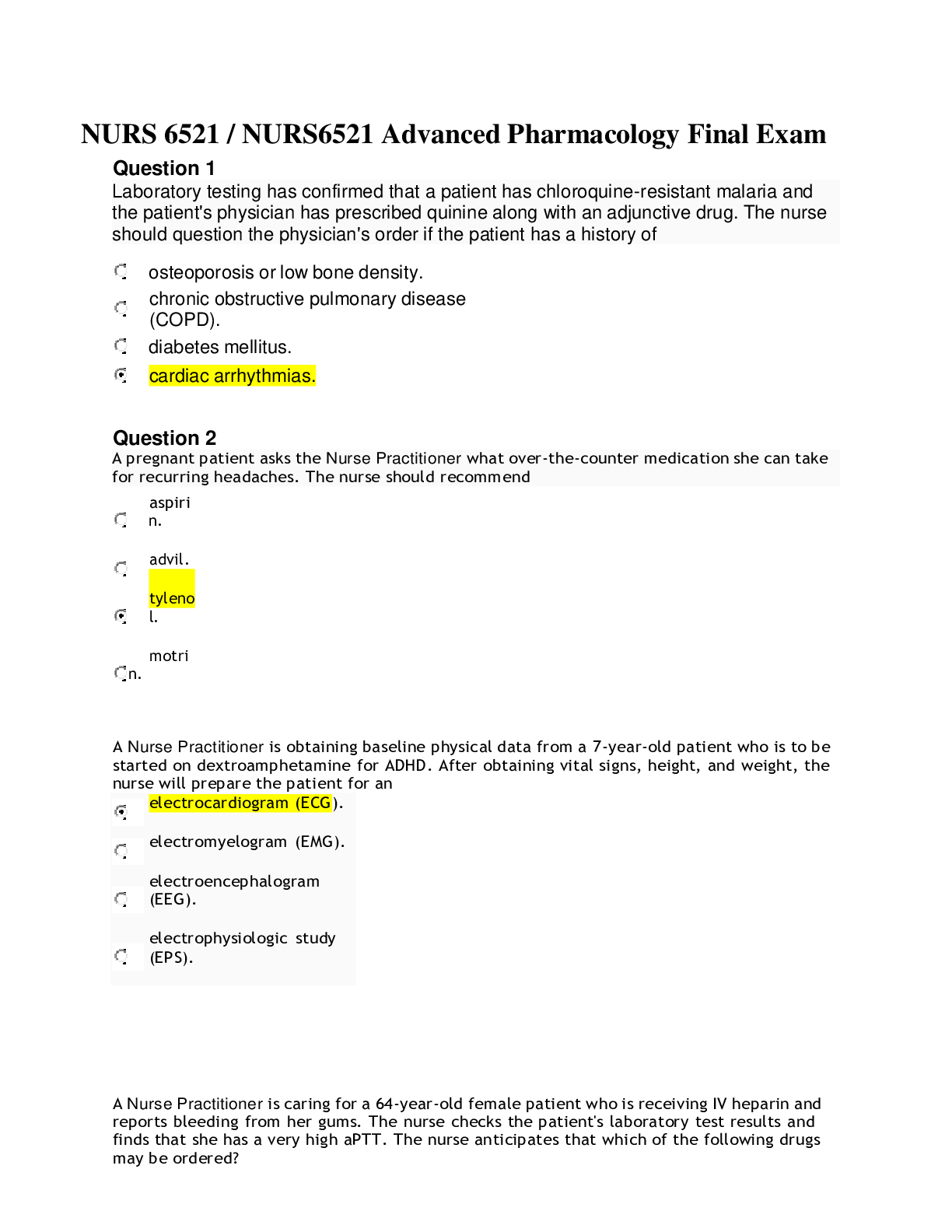
Question 1
Laboratory testing has confirmed that a patient has chloroquine-resistant malaria and
the patient's physician has prescribed quinine along with an adjunctive drug. The nurse
should question the physician's order if the patient has a history of
osteoporosis or low bone density.
chronic obstructive pulmonary disease
(COPD).
diabetes mellitus.
cardiac arrhythmias.
Question 2
A pregnant patient asks the Nurse Practitioner what over-the-counter medication she can take
for recurring headaches. The nurse should recommend
aspiri
n.
advil.
tyleno
l.
motri
n.
A Nurse Practitioner is obtaining baseline physical data from a 7-year-old patient who is to be
started on dextroamphetamine for ADHD. After obtaining vital signs, height, and weight, the
nurse will prepare the patient for an
electrocardiogram (ECG).
electromyelogram (EMG).
electroencephalogram
(EEG).
electrophysiologic study
(EPS).
A Nurse Practitioner is caring for a 64-year-old female patient who is receiving IV heparin and
reports bleeding from her gums. The nurse checks the patient's laboratory test results and
finds that she has a very high aPTT. The nurse anticipates that which of the following drugs
may be ordered?
Coumadin
NUR 6521 FINAL EXAM QUESTIONS AND ANSWERS 2021/2022
Alteplase
Ticlopidine
Protamine
sulfate
Question 5
A patient reports to a clinic with complaints of breast tenderness, a right lumpy breast,
and no breast discharge. The breast tenderness occurs primarily during her menstrual
cycle. The nurse practitioner probably suspects
breast cancer.
cancerous breast
tenderness.
pain in the heart.
PMS.
Question 6
A postmenopausal patient is prescribed bisphosphonates to treat osteoporosis. The
nurse will instruct the patient to take the drug
at bedtime.
after meals.
at any time of the day with tea or coffee.
first thing in the morning.
Question 7
Which test should the NP order for monitoring effectiveness of the patient receiving heparin?
Arterial blood gas
levels
PTT
Complete blood
count
Hemoglobin level
Question 8
Finasteride (Proscar) is prescribed for a 50-year-old man who is experiencing a problem with
urination secondary to an enlarged prostate. The practitioner would teach the patient that
while he is taking this medication, it is important to:
Increase his fluid intake.
Restrain from sexual activity
Take special precautions around women of childbearing age
Begin folic acid
Question 9
A 15-year-old patient has meningitis caused by Haemophilus influenzae. She is being
treated with chloramphenicol. The most important nursing action for this patient would
be to monitor
blood sugar levels daily.
liver enzymes monthly.
plasma concentrations regularly.
urine output daily.
Question 10
A patient has been taking doxazosin (Cardura) 2 mg PO daily for 3 weeks
for treatment of BPH. He returns to the clinic and is complaining of feeling
dizzy when he stands up. Which action would the family nurse practitioner
take?
Order urinalysis (UA) to determine hematuria and presence of bacteria.
Determine blood pressure (BP) with patient lying down, standing, and sitting.
Review with patient his symptoms over the past 3 weeks.
Perform digital rectal exam to determine if prostate is smaller than previously noted.
Question 11
A 5-year-old boy needs an IM injection. The least painful and most effective injection
site would be the
deltoid muscle.
rectus femoris muscle.
ventrogluteal muscle.
dorsogluteal muscle.
Question 12
A male patient has been on long-term bicalutamide (Casodex) therapy. In order to
assess adverse effects of the drug therapy, the nurse will closely monitor which of the
following?
Visual function
Blood counts
Pap test results
Liver function
Question 13
A 21-year-old has been placed on risperidone. Monitoring for risperidone includes
Bradykinesia, akathisia and
agitation
Excessive weight gain
Hypertension
Potentially fatal
agranulocytosis
Question 14
A patient who is at risk for DVT tells the NP she has just learned she is pregnant. The NP
should expect that this patient will use which of the following anticoagulant medications?
Aspirin
Heparin
Dabigatr
an
Warfarin
Question 15
When a NP chooses a benzodiazepine to treat anxiety the prescriber needs to be aware of
the possibility of dependence. The Benzodiazepine associated with the greatest likelihood of
causing rapid dependence is:
Chlordiazepoxide (Libri
um)
Clonazepam (Klonopin)
Alprazolam (Xanax)
Oxazepam (serax
[Show More]