Health Care  >  QUESTIONS & ANSWERS  >  NRNP 6566 Final Study Guide (All)

NRNP 6566 Final Study Guide

Document Content and Description Below

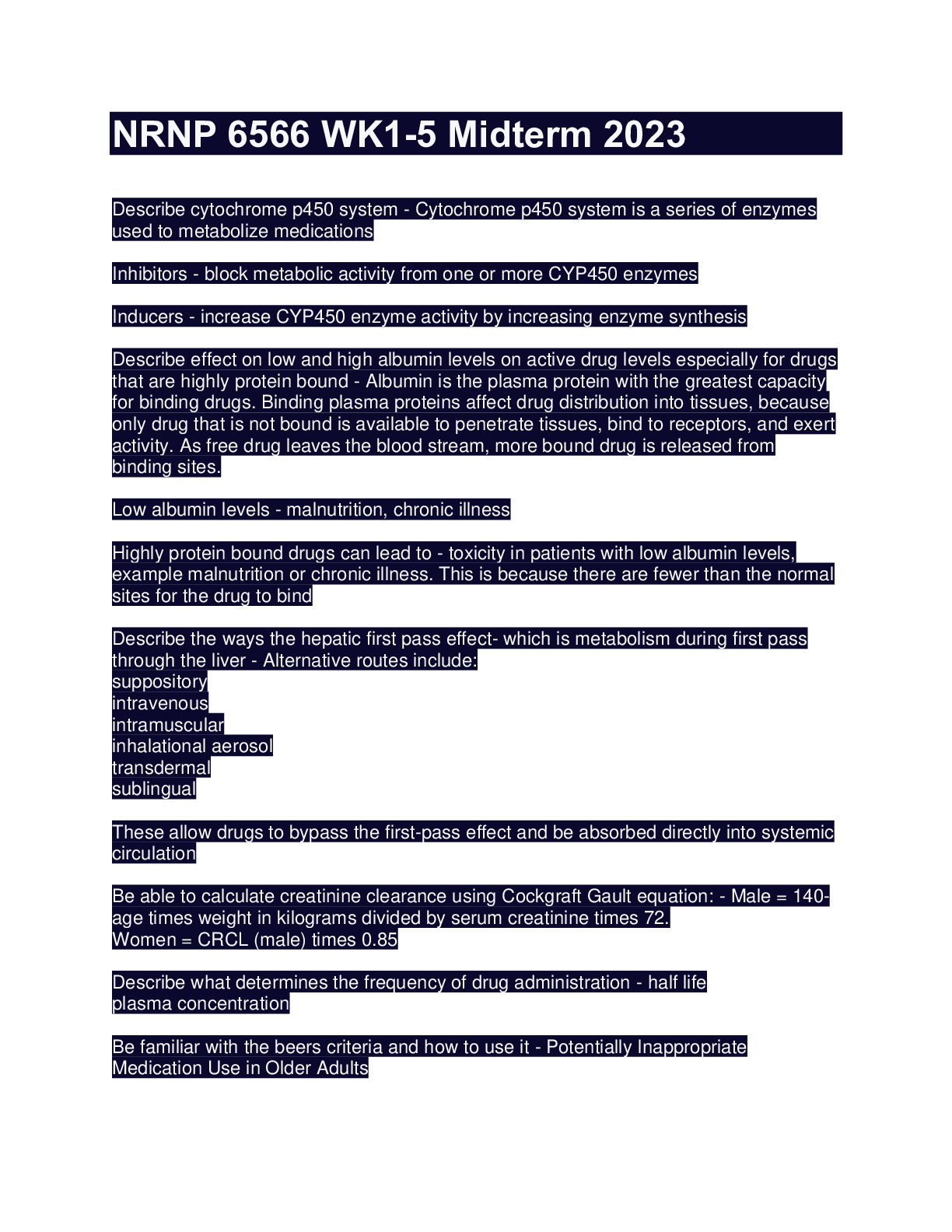
Week 6 and 7 Key Concepts 1. Interpret arterial blood gases (ABG). Differentiate alkalosis/ acidosis and respiratory / metabolic 2. Identify a ventilation – perfusion mismatch and how to treat it ... 3. Be able to calculate an Aa gradient. Be able to interpret an Aa gradient 4. Identify clinical symptoms or conditions indicating a need to intubate and ventilate a patient 5. Identify clinical signs and symptoms indicating a patient is ready for weaning and extubation 6. Prescribe ventilator settings for newly intubated patient. 7. Describe static and plateau pressures on a ventilator 8. Be able to adjust ventilator settings based on the patients condition and AGB results. 9. Diagnostic criteria and treatment for pulmonary embolism, hypovolemic shock, pneumonia 10. Treatment protocols for patients with ARDS 11. How to initiate BIPAP and write appropriate orders for it 12. Asthma management and treatment including PEF 13. Management of COPD 14. Ventilator adjustments for auto PEEP Help understanding Aa gradient Pulmonary Diffusion Explained Clearly by MedCram.com’ https://www.youtube.com/watch?v=47u3-GamoII Week 8 Key Concepts Pain and Sedation 1. Be able to describe and differentiate between the levels of sedation (minimal, moderate, deep, general anesthesia, and dissociation). 2. Be familiar with the recommendation for ICU sedation in the Society of Critical Care Medicine guideline. Apply that guideline to patients with trauma, on ventilation, with hypotension. 3. Discuss the diagnosis and treatment of delirium. Contrast that with dementia 4. Describe the step by step process for Rapid Sequence Intubation (RSI) 5. Identify medications used RSI 6. Know common doses of etomidate and succinylcholine. Be able to calculate those doses. This study source was downloaded by 100000852290574 from CourseHero.com on 01-08-2023 11:40:21 GMT -06:00 https://www.coursehero.com/file/106863582/NRNP-6566-Final-Study-Guide-docx/ 7. Describe the CDC guide for managing acute pain and opioid sensitive prescribing. 8. Differentiate the different types of pain and the best medications to treat them. 9. Discuss the use of lidocaine and lidocaine with epinephrine in blocks or local anesthesia. What is the maximum dose of lidocaine and lidocaine with epinephrine? Calculate those doses. 10. Be familiar with ketamine for procedure sedation, the appropriate dose, and required monitoring. 11. What medication could you use for a laceration repair if the patient is allergic to lidocaine? 12. Describe why a patient receiving IV opioids might develop chest wall rigidity and how to treat it. 13. What are antagonist drugs for benzodiazepines and opioids [Show More]

Last updated: 3 years ago

Preview 1 out of 3 pages

Buy Now

Instant download

We Accept:

Payment methods accepted on Scholarfriends (We Accept)
Preview image of NRNP 6566 Final Study Guide document

Buy this document to get the full access instantly

Instant Download Access after purchase

Buy Now

Instant download

We Accept:

Payment methods accepted on Scholarfriends (We Accept)

Reviews( 0 )

$6.00

Buy Now

We Accept:

Payment methods accepted on Scholarfriends (We Accept)

Instant download

Can't find what you want? Try our AI powered Search

47
0

Document information


Connected school, study & course


About the document


Uploaded On

Jan 08, 2023

Number of pages

3

Written in

All

Seller


Profile illustration for APLUSMASTER
APLUSMASTER

Member since 4 years

7 Documents Sold

Reviews Received
2
0
0
0
1
Additional information

This document has been written for:

Uploaded

Jan 08, 2023

Downloads

 0

Views

 47

Document Keyword Tags


$6.00
What is Scholarfriends

Scholarfriends.com Online Platform by Browsegrades Inc. 651N South Broad St, Middletown DE. United States.

We are here to help

We're available through e-mail, Twitter, and live chat.
 FAQ
 Questions? Leave a message!


Copyright © Scholarfriends · High quality services·