1. What ratio for compressions to breaths should be used for 1-rescuer infant CPR?
A. Give 5 compressions to 1 breath
B. Give 15 compressions to 2 breaths
C. Give 20 compressions to 2 breaths
D. Give 30 compression
...
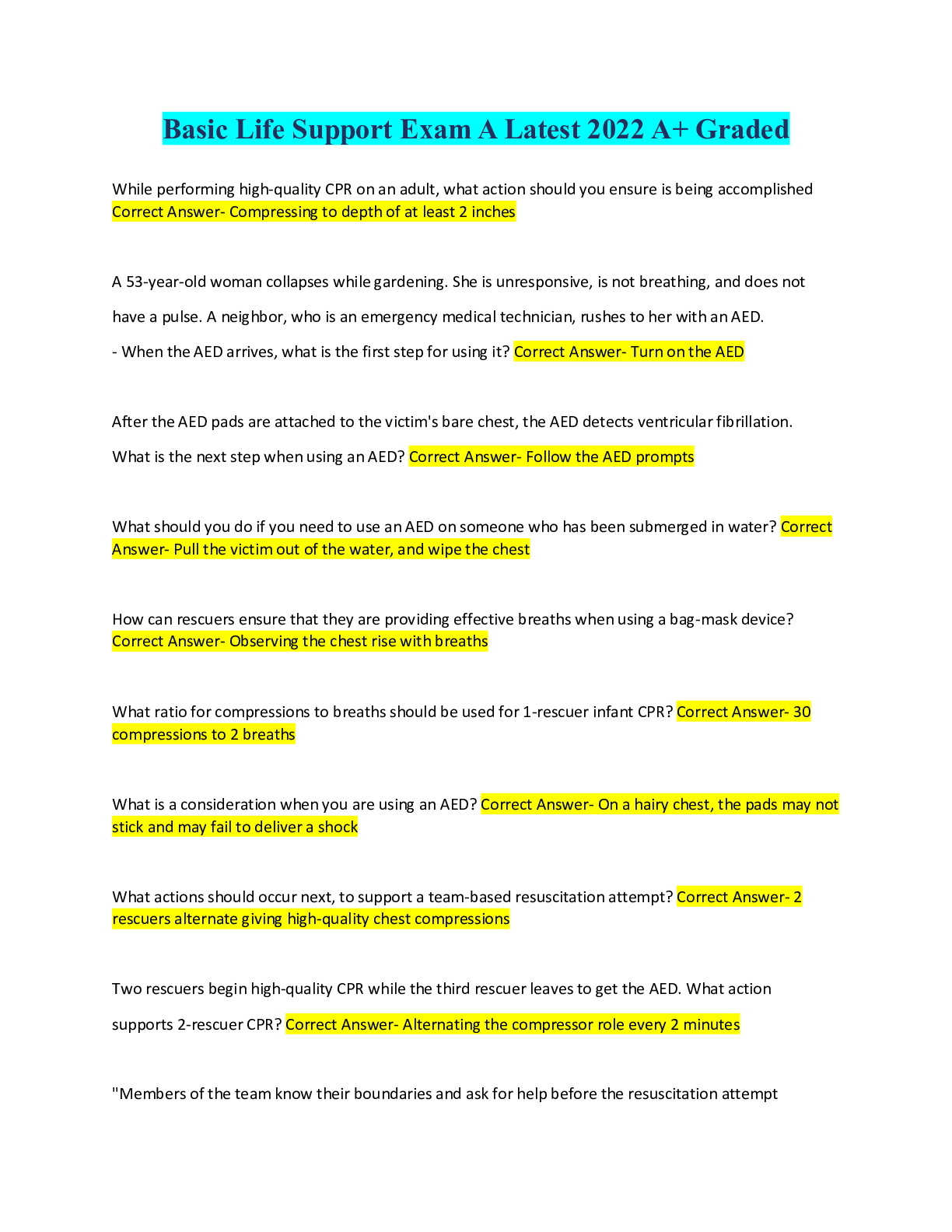
1. What ratio for compressions to breaths should be used for 1-rescuer infant CPR?
A. Give 5 compressions to 1 breath
B. Give 15 compressions to 2 breaths
C. Give 20 compressions to 2 breaths
D. Give 30 compressions to 2 breaths
2. What should you do if you need to use an AED on someone who has been submerged in water?
A. Pull the person out of the water, but do not use the AED
B. Do not pull the person out of the water, and wipe the chest
C. Pull the person out of the water, and wipe the chest
D. Do not move the person, and do not use the AED
5. You witness someone suddenly collapse. The person is unresponsive, you hear gasping sounds, and there is no pulse. You phone 9-1-1. What should you do next?
A. Begin CPR; the gasps are not normal breathing
B. Begin CPR even though gasping is normal breathing
C. Monitor the patient; the gasps are considered normal breathing
D. Give rescue breaths only; the gasps are not normal breathing
6. Why is defibrillation important?
A. There is a 100% success rate.
B. It is not important for cardiac arrest.
C. It prevents rearrest from occurring.
D. It can restore a regular cardiac rhythm.
9. “The team functions smoothly when all team members know their positions, functions, and tasks during a resuscitation attempt.” Match this statement with the most appropriate element of team dynamics listed.
A. Clear roles and responsibilities
B. Constructive intervention
C. Knowing your limitations
D. Mutual respect
10. “Members of the team know their boundaries and ask for help before the resuscitation attempt worsens.” Match this statement with the most appropriate element of team dynamics listed.
A. Summarizing and reevaluation
B. Constructive intervention
C. Knowledge sharing
D. Knowing your limitations
11. A victim with a foreign-body airway obstruction becomes unresponsive. What is your first course of action?
A. Start CPR, beginning with chest compressions
B. Perform abdominal thrusts
C. Roll the victim over and perform back blows
D. Perform blind finger sweeps
12. While performing high-quality CPR on an adult, what action should you ensure is being accomplished?
A. Allowing the chest to recoil to at least 1 inch
B. Maintaining a compression rate of 90 to 120/min
C. Placing hands on the upper third of the sternum
D. Compressing to a depth of at least 2 inches
15. Early defibrillation is a link in the adult Chain of Survival. Why is this important to survival?
A. It provides normal respiration.
B. It prevents respiratory arrest.
C. It prevents cardiac arrest.
D. It eliminates the abnormal heart rhythm
1. A B C ●
2. A B ● D
3. A B ● D
4. A ● C D
5. ● B C D
6. A B C ●
7. A B ● D
8. A ● C D
9. ● B C D
10. A B C ●
11. ● B C D
12. A B C ●
13. ● B C D
14. A B ● D
15. A B C ●
[Show More]