Abdominal Final Review WCUI 2022 with complete
solution
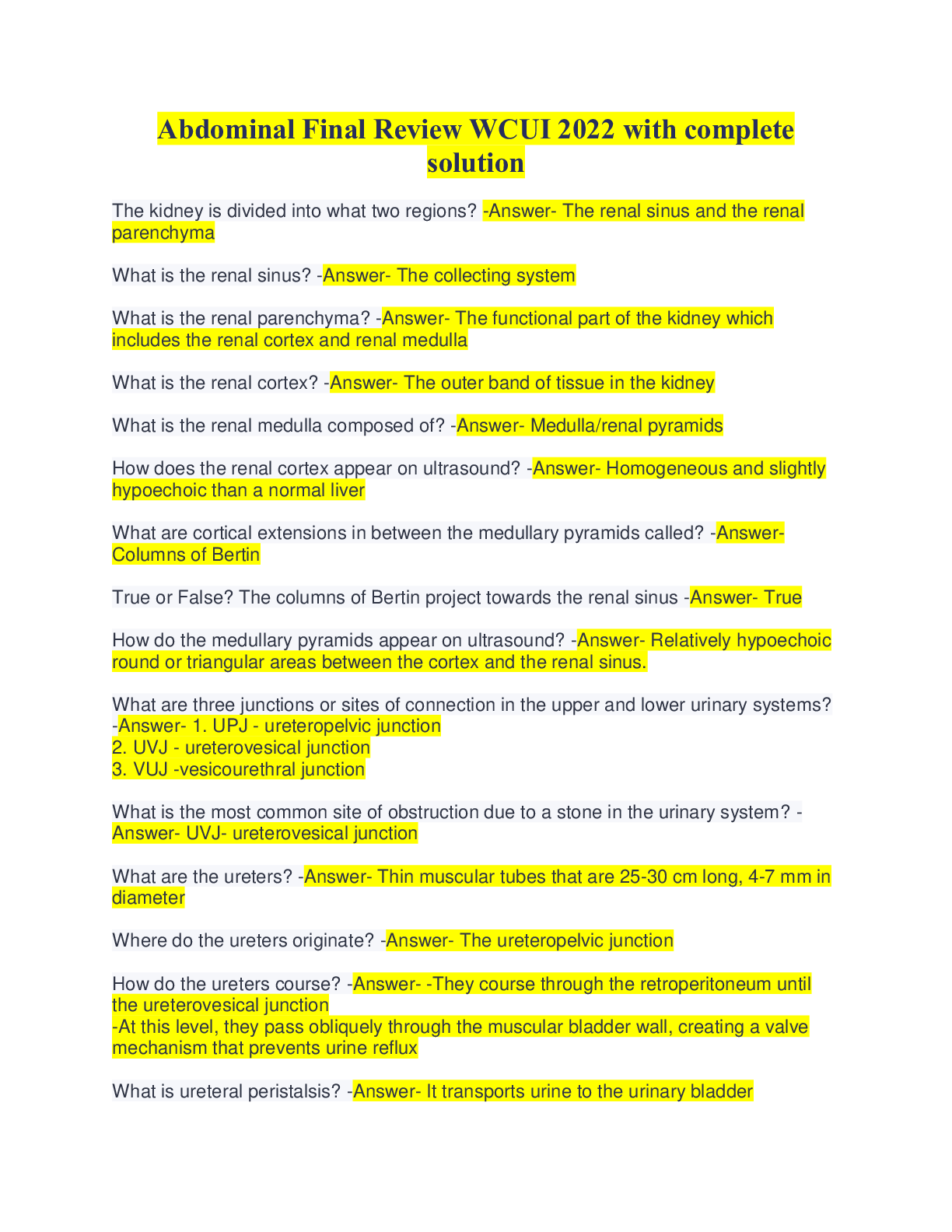
The kidney is divided into what two regions? -Answer- The renal sinus and the renal
parenchyma
What is the renal sinus? -Answer- The collecting system
What is
...
Abdominal Final Review WCUI 2022 with complete
solution
The kidney is divided into what two regions? -Answer- The renal sinus and the renal
parenchyma
What is the renal sinus? -Answer- The collecting system
What is the renal parenchyma? -Answer- The functional part of the kidney which
includes the renal cortex and renal medulla
What is the renal cortex? -Answer- The outer band of tissue in the kidney
What is the renal medulla composed of? -Answer- Medulla/renal pyramids
How does the renal cortex appear on ultrasound? -Answer- Homogeneous and slightly
hypoechoic than a normal liver
What are cortical extensions in between the medullary pyramids called? -AnswerColumns of Bertin
True or False? The columns of Bertin project towards the renal sinus -Answer- True
How do the medullary pyramids appear on ultrasound? -Answer- Relatively hypoechoic
round or triangular areas between the cortex and the renal sinus.
What are three junctions or sites of connection in the upper and lower urinary systems?
-Answer- 1. UPJ - ureteropelvic junction
2. UVJ - ureterovesical junction
3. VUJ -vesicourethral junction
What is the most common site of obstruction due to a stone in the urinary system? -
Answer- UVJ- ureterovesical junction
What are the ureters? -Answer- Thin muscular tubes that are 25-30 cm long, 4-7 mm in
diameter
Where do the ureters originate? -Answer- The ureteropelvic junction
How do the ureters course? -Answer- -They course through the retroperitoneum until
the ureterovesical junction
-At this level, they pass obliquely through the muscular bladder wall, creating a valve
mechanism that prevents urine reflux
What is ureteral peristalsis? -Answer- It transports urine to the urinary bladderWhat is associated with the bladder? -Answer- -Large muscular bag
-Has postero-lateral openings for the ureters
-Has an anterior opening for the urethra
Urine collects and contracts to expel urine through the ________, conveys urine from
the Urinary Bladder to the outside -Answer- Urethra
What is the urethra? -Answer- Membranous Hollow Canal, measure 4-6mm
What is associated with the junctional parenchyma defect? -Answer- -Seen in upper to
mid pole as an echogenic triangular, linear structure
-Better seen in the longitudinal plane
-May mimic an echogenic mass
A simple ectopia is more often seen where? -Answer- The pelvis
A horseshoe kidney is also called what? -Answer- Renal fusion
What is a horseshoe kidney? -Answer- When two kidneys are fused or joined together
What should be seen on ultrasound with a horseshoe kidney? -Answer- -Isthmus should
be imaged with ultrasound to confirm the diagnosis
-Isthmus is seen midline lower abdomen over the great vessels
-In some cases, loss of normal renal outline or reniform, instead they look with some
degree of rotation or malrotation
What type of horseshoe kidney is the most common? -Answer- The one where the
lower poles fuse together
How does a complete duplication of a collecting system appear on ultrasound? -
Answer- -Two echogenic regions separated by parenchymal tissue
-2 separate collecting systems in one kidney
The duplicated ureter commonly has a stenotic opening into the bladder and forms
what? -Answer- A ureterocele
How does a duplex collecting system appear on ultrasound in a transverse imaging
plane? -Answer- No echogenic renal pelvis seen on a transverse view at the level of the
mid pole
What is associated with a parapelvic cyst? -Answer- -Originates from renal parenchyma
and seen in the renal hilum
-May present with hypertensionWhat are the sonographic findings of a parapelvic cyst? -Answer- -Same criteria as for
simple cyst but located within the renal pelvis
-Solitary and large
-Does not communicate with collecting system
Where does a peripelvic cyst originate? -Answer- In the renal sinus from the lymphatic
system
What are the sonographic findings of a peripelvic cyst? -Answer- -Small, multiple, and
irregular in shape
-May appear as dilated pelvis
-Does not communicate with collecting system
What are posterior urethral valves (PUV)? -Answer- Obstructive membranes that
develop in the urethra (the tube that drains urine from the bladder) and are most
commonly seen in boys
What valve can obstruct or block the outflow of urine through the urethra? -AnswerPosterior urethra valve (PUV)
What is a copum? -Answer- Extra tissue in the distal urethra
What are the sonographic findings for posterior urethra valve (PUV)? -Answer- -The
bladder has a distinct "keyhole" appearance and massive bladder, hydroureters, and
hydronephrosis
-Bilateral hydronephrosis
What are the procedures to fix the condition of a posterior urethra valve? -AnswerAblation and vesicostomy
What are other names for adult polycystic kidney disease (APKD)? -Answer- Autosomal
dominant polycystic kidney disease (ADPKD) or Potter type III
What is adult polycystic kidney disease (APKD)? -Answer- -An autosomal dominant
disease and the most common disorder.
-The disease may be latent for many years and not manifest itself until the fourth
decade.
What are the clinical findings associated with adult polycystic kidney disease? -Answer-
-Patients present with decreasing renal function, and hypertension
-May have flank pain
-Associated findings include cysts in the liver, pancreas, and spleen.
What are the sonographic findings of adult polycystic kidney disease? -AnswerPresents as bilateral large kidneys with randomly distributed cortical cysts of various
sizes, and in the advanced stages, the kidneys lose the reniform shape.What is multicystic dysplastic kidney disease? -Answer- -The most common form of the
cystic disease in neonates
-It can be either dominant or recessive. Juvenile onset is autosomal recessive and
adult-onset is autosomal dominant.
-Clinically, patients present with renal failure.
What are the sonographic findings for multicystic dysplastic kidney disease? -Answer- -
There are small cysts in the medullary portion of both kidneys with a decreased
definition between the cortical/medulla junctions.
-May be uni- or bilateral
What are other names for infantile polycystic kidney disease (IPKD)? -AnswerAutosomal recessive polycystic disease (ARPKD) or (Potter type I)
What is the least common and most fatal of the three cystic diseases? -AnswerInfantile polycystic kidney disease
What is infantile polycystic kidney disease? -Answer- It is an autosomal recessive trait
and is more common in females (2:1).
With infantile polycystic kidney disease, if survival past infancy occurs what happens? -
Answer- Hepatic fibrosis becomes a complication, with death resulting from hepatic
failure and/or bleeding from esophageal varices
What are the sonographic findings for infantile polycystic kidney disease? -Answer- It
presents as bilateral echogenic, enlarged kidneys with cysts with a loss of
corticomedullary junction (the cysts classically are too small to be resolved).
What is pyonephrosis? -Answer- Pus in the dilated collecting system, a complication of
the hydronephrosis, urinary stasis, or infection
What are the clinical signs associated with pyonephrosis? -Answer- Similar to an
abscess, typically associated with elevated white blood cells count, fever, chills, and
flank pain, although some patients may be asymptomatic
What are the sonographic findings of pyonephrosis? -Answer- The collecting system is
seen as dilated with debris, and often shifting debris-urine level
What are the two major classifications of hydronephrosis? -Answer- Intrinsic and
extrinsic hydronephrosis
Intrinsic hydronephrosis is a result of what? -Answer- -Stricture
-Renal calculi (most common site ureterovesical junction)
-Bleeding or blood clot
-Ureterocele-Pyonephrosis
-Tuberculosis of the genitourinary system
Extrinsic hydronephrosis is a result of what? -Answer- -Pregnancy
-Pelvic masses
-Bladder neck obstruction
-Trauma
-Retroperitoneal fibrosis
-Prostatic hypertrophy
-Urethritis
-Inflammatory lesions
-Neurogenic bladder
What is a neurogenic bladder? -Answer- The loss of control of the bladder due to
damage to a neural network
What is a hydroureter? -Answer- It refers to abnormal dilation (>3 mm) of the ureter and
may occur in combination with hydronephrosis
How does nephrolithiasis appear on ultrasound? -Answer- Renal calculi appear as
highly reflective echogenic foci with shadowing.
The ________ is a color artifact that has been seen with urinary stones. -Answer-
"Twinkle sign"
What is a staghorn calculus? -Answer- A large stone located in the central portion of the
kidney, the collecting system, and takes the shape of the calyces and renal pelvis
What is a medullary sponge kidney (MSK)? -Answer- -A developmental anomaly that
occurs in the medullary pyramids and consists of cystic or fusiform dilation of the distal
collecting ducts (ducts of Bellini), causing stasis of urine and stone formation.
-Associated with hypercalcemia
What is tuberous sclerosis? -Answer- An autosomal dominant genetic disorder
characterized by mental retardation, seizures, and adenoma sebaceous
The renal pathologies most commonly seen in TSC are what? -AnswerAngiomyolipoma, renal cysts, and less commonly, oncocytomas
True or False? Tuberous sclerosis may be difficult to separate from adult polycystic
kidney disease -Answer- True
What is Emphysematous pyelonephritis? -Answer- It refers to a morbid infection with
gas formation within or around the kidneys.Emphysematous pyelonephritis commonly occurs in patients who are what? -Answer- In
diabetics (87-97% of patients), immunosuppressed patients, and patients with urinary
tract obstructions
What are the sonographic findings of emphysematous pyelonephritis? -AnswerAnaerobic bacteria produce intrarenal gas causing reverberation or comet tail, or dirty
shadowing artifact.
What is usually required to treat emphysematous pyelonephritis? -AnswerNephrectomy
What is associated with angiomyolipomas? -Answer- -More common benign tumor and
most common in women (2:1)
-Symptoms are flank pain, hematuria, and hypertension
What is the sonographic finding of an angiomyolipoma? -Answer- Discrete highly
echogenic mass found in the cortex
What is associated with Wilm's Tumor (Nephroblastoma)? -Answer- -Most common
primary renal malignancy in children
-Abdominal mass, hypertension, and nausea
-Hematuria
What is the sonographic appearance of Wilm's tumor? -Answer- -Early on -
encapsulated, later on, it may extend into the perirenal area
-Varied sonographic appearance depending upon the amount of necrosis and
hemorrhage
What are the clinical findings for Hypernephroma - Adenocarcinoma- Renal Cell
Carcinoma (RCC) and Grawitz tumor? -Answer- -Affect males more, after 50
-Hematuria
-Hyperperfusion seen on angiogram
-Metastases to bone, heart, and brain
What are the sonographic findings for Hypernephroma - Adenocarcinoma- Renal Cell
Carcinoma (RCC) and Grawitz tumor? -Answer- -Unilateral, solitary, encapsulated
-Varied echogenicity, from hypoechoic to hyperechoic
-Look for metastatic renal vein/vena cava invasion and thrombosis
-Look for the invasion to the contralateral side, ureter, peritoneum, spleen
What is associated with acute pyelonephritis? -Answer- -Infection is the most common
disease of the urinary tract, and the combination of parenchymal, caliceal, and pelvic
inflammation constitutes pyelonephritis. ---Bacteria ascending from the urinary bladder
or adjacent lymph nodes to the kidney usually cause infection of the kidney.
What is one of the clinical symptoms of acute pyelonephritis? -Answer- BacteriuriaWhat is cystitis? -Answer- Infection or inflammation of the bladder of the lower urinary
tract
What is the sonographic appearance for cystitis? -Answer- Bladder wall thickening and
debris
True or False? With primary malignant tumors, 95% are transitional cell carcinoma
(TCC) and 5% are squamous cell carcinoma -Answer- True
What is associated with primary malignant bladder tumors? -Answer- -Invasive tumor
-40% will metastasize into the prostate and pelvic organs
-Usually detected late in the stage
-Hematuria, dysuria, anuria, urinary frequency
What are bladder/ureteral stones? -Answer- They can develop in the bladder or form in
the kidney and travel down through the ureters
What is the sonographic appearance of bladder/ureteral stones? -Answer- Echogenic
focus with posterior acoustic shadowing.
What is a urinary bladder diverticulum? -Answer- -An outpouching from the bladder wall.
-It may be solitary or multiple in nature and can vary considerably in size.
-It can be congenital or acquired.
What is renal failure? -Answer- -It is the kidneys' inability to filter metabolites from the
blood resulting in decreased renal function
-It may be either acute or chronic
What laboratory findings are associated with renal failure? -Answer- Increased serum
BUN and serum creatinine levels
What are the sonographic findings of acute renal failure? -Answer- -The kidney may be
normal-sized or enlarged
-There may be decreased definition between the medullary/cortical junctions
What are the sonographic findings of chronic renal failure? -Answer- -The echogenicity
will increase
-Patients in end-stage renal failure will have small echogenic kidneys that are difficult to
image Sonographically.
What is the location of the adrenal glands? -Answer- Suprarenal space
What are the adrenal glands and kidneys enclosed by? -Answer- Gerota's fasciaThe adrenal cortex produces steroid hormones which are? -Answer- Aldosterone,
cortisol, and gonadocorticoids
What is aldosterone? -Answer- Used to regulate electrolyte metabolism
What is cortisol? -Answer- An antistress and anti-inflammatory hormone
What is gonadocorticoids? -Answer- Used for regulation of the secretion of androgens
and estrogens, which are the sex hormones of an individual
The adrenal medulla produces what? -Answer- Epinephrine and norepinephrine
What is epinephrine? -Answer- -It dilates the coronary vessels and constricts the skin
and kidney vessels.
-It increases coronary output, raises oxygen consumption, and causes hyperglycemia.
What is nonepinephrine? -Answer- -It constricts all arterial vessels except the coronary
arteries (which dilate).
-It is the essential regulator of blood pressure.
What are the clinical findings for Adrenocortical Hyperfunction (Cushing's Syndrome)? -
Answer- Cortisol ↑ and adrenal androgens- diabetes, large abdomen, loss of tissue's
elasticity, cardiomegaly, edema, hirsutism, amenorrhea
What are the clinical findings for Conn's syndrome? -Answer- Aldosterone ↑ -
associated with sodium retention, hence hypertension, increased thirst, and urination
What are the clinical findings for Adrenocortical Hypofunction - Addison's disease? -
Answer- -Hormonal production ↓ - causing hypotension weight loss, skin pigmentation,
loss of hair, menstrual dysfunction
-Autoimmune predominantly (80%)
What is the most common benign tumor of the adrenal glands? -Answer- Adenomas
What are the clinical findings of adenomas? -Answer- -Benign tumors associated with
Cushing's and Conn's syndromes (hyperproduction of hormones)
-In most of the cases - asymptomatic
What are the sonographic findings of adenomas? -Answer- Round or oval in shape
mass, usually larger than 1 cm, hypoechoic lesion
[Show More]