Abdominal Final Review WCUI 2022 with complete
solution
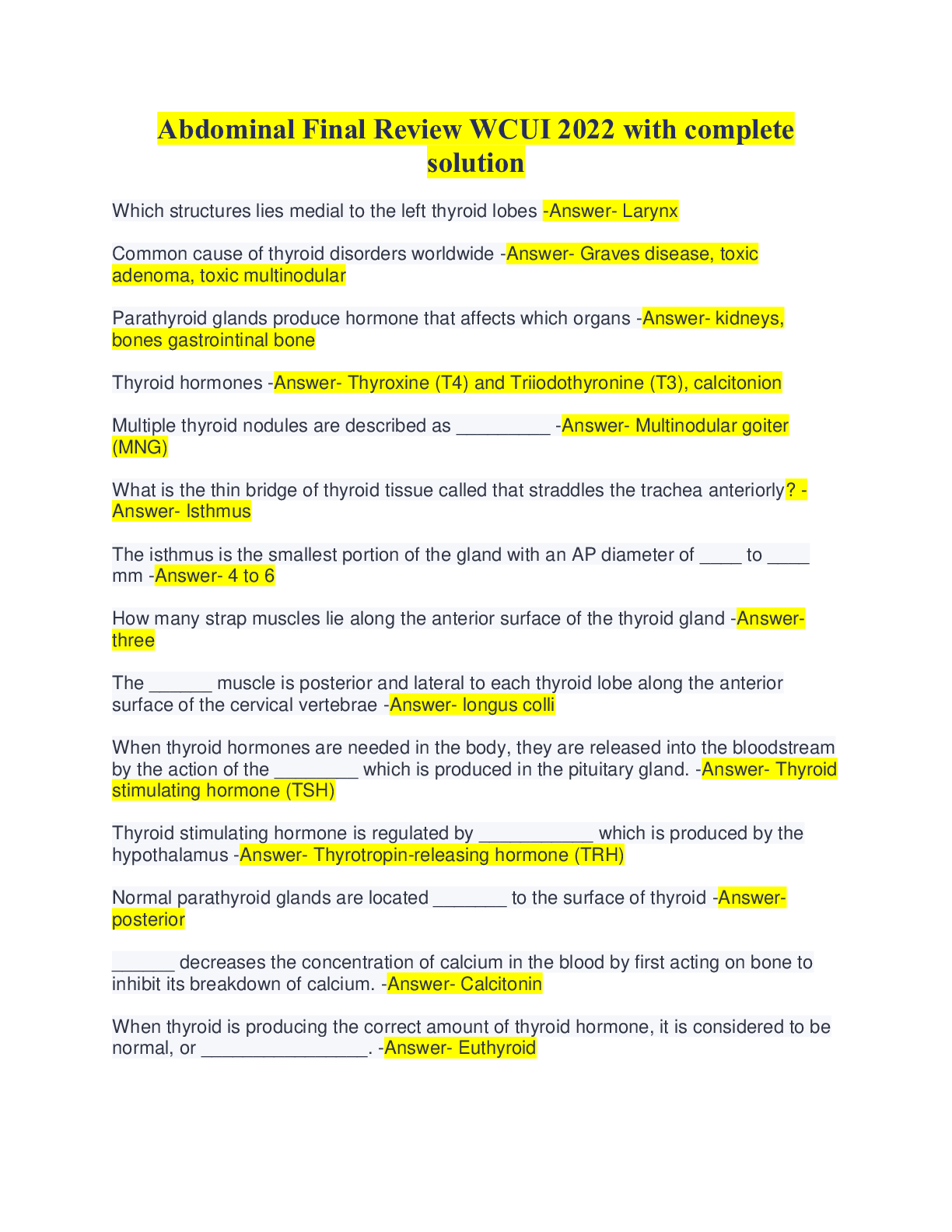
Which structures lies medial to the left thyroid lobes -Answer- Larynx
Common cause of thyroid disorders worldwide -Answer- Graves disease, toxic
adenoma, toxic
...
Abdominal Final Review WCUI 2022 with complete
solution
Which structures lies medial to the left thyroid lobes -Answer- Larynx
Common cause of thyroid disorders worldwide -Answer- Graves disease, toxic
adenoma, toxic multinodular
Parathyroid glands produce hormone that affects which organs -Answer- kidneys,
bones gastrointinal bone
Thyroid hormones -Answer- Thyroxine (T4) and Triiodothyronine (T3), calcitonion
Multiple thyroid nodules are described as _________ -Answer- Multinodular goiter
(MNG)
What is the thin bridge of thyroid tissue called that straddles the trachea anteriorly? -
Answer- Isthmus
The isthmus is the smallest portion of the gland with an AP diameter of ____ to ____
mm -Answer- 4 to 6
How many strap muscles lie along the anterior surface of the thyroid gland -Answerthree
The ______ muscle is posterior and lateral to each thyroid lobe along the anterior
surface of the cervical vertebrae -Answer- longus colli
When thyroid hormones are needed in the body, they are released into the bloodstream
by the action of the ________ which is produced in the pituitary gland. -Answer- Thyroid
stimulating hormone (TSH)
Thyroid stimulating hormone is regulated by ___________ which is produced by the
hypothalamus -Answer- Thyrotropin-releasing hormone (TRH)
Normal parathyroid glands are located _______ to the surface of thyroid -Answerposterior
______ decreases the concentration of calcium in the blood by first acting on bone to
inhibit its breakdown of calcium. -Answer- Calcitonin
When thyroid is producing the correct amount of thyroid hormone, it is considered to be
normal, or ________________. -Answer- EuthyroidUnder secretion of thyroid hormones is called _________ and is the most commo
thyroid disorder. -Answer- Hypothyroidism
What are the clinical signs and symptoms of hypothyroidism? -Answer- weight gain, hair
loss, increased subcutaneous tissue around the eyes, lethargy, slowing motor, cold
intolerance, constipation
Oversecretion of thyroid hormone results in _______. -Answer- Hyperthyroidism
_______ occurs when the entire thyroid gland is not functioning properly usually from
diffuse enlargement or localized nodule or adenoma causing an over-production of
thyroid hormones. -Answer- Grave's Disease
Clinical signs and symptoms of hyperthyroidism -Answer- weight loss, increased
appetite, irritable, tremor, excessive sweating, heat intolerance, palpitations, protruding
eyes (exophthalmos)
The most common laboratory test to evaluate thyroid function is ___________ -Answerserum thyroxine
______ is a thyroid test that can determine its function by combining iodine uptake scan
and thyroid scan -Answer- Scintigraphy
The _________ thyroid scan will detect the amount of radioactive tracer to image the
thyroid glad and demonstrate the thyroid size, shape & position -Answer- nuclear
medicine
A concentrated amount of radioactivity in the thyroid will be imaged as a ______
(hyperfunction) nodule and an lower concentration of radioactive tracer will
demonstrated absence of uptake as _______ (nonfunctioning) nodule -Answer- hot,
cold
Hot nodules are typically ______ and cold nodules have the potential to be ______ -
Answer- benign, malignant
Normal sonographic appearance of the thyroid gland is fine _______ echotexture that is
slightly more echogenic that the surrounding musculature -Answer- homogeneous
Approximately 80% of nodular thyroid disease is due to _________ or compensatory
______ forming micronodules and micronodules of the gland -Answer- hyperplasia,
hypertrophy
The most common cause of thyroid disorders worldwide is ______ deficiency, which
leads to nodule and goiter formation -Answer- iodineAn _______ goiter may affect large groups of people in a specific geographic area
where iodine levels in the soil, food and water are low -Answer- endemic
A _______ goiter is condition where nodular enlargement causes hyperactivity of the
thyroid gland and hyperthyroidism. -Answer- toxic
________ goiter occurs when nodular enlargement is not associated with thyroid
dysfunction. -Answer- nontoxic
A __________ is a benign thyrid neoplasm that represents 5% to 10% of all nodular
diseases of the thyroid. -Answer- follicular adenoma
The _______ is often solitary and slow growing unless hemorrhage occurs that could
cause sudden and painful enlargement. -Answer- adenoma
A presence of a thin _______ ______ or halo due to compressed tissue surrounding the
adenoma is consistent finding with a benign adenoma. -Answer- hypoechoic rim
________ of the thyroid is rare -Answer- carcinoma
A solitary markedly hypoechoic thyroid nodule with the presence of cervical
lymphadenopathy on the same side suggest ________ -Answer- malignancy
The most common of thyroid malignancies is __________, which comprises
approximately 70% of all thyroid cancers. affects females 3 times more often at ages 20
to 40 years of age -Answer- papillary carcinoma
________ is the second most common type of malignancy, affects females between the
ages of 40 to 60 -Answer- Follicular carcinoma
Follicular carcinoma usually presents as a ______ thyroid mass and may not be
differentiated pathologically with FNA biopsy and may require surgical removal of the
entire nodule to confirm diagnosis. -Answer- solitary
Several diseases of the thyroid are characterized by _____________ of the gland
causing enlargement without palpable nodule. -Answer- diffuse involvement
_______ disease is an autoimmune disorder and the most common (85%) causes of
hyperthyroidism. Lab test will demonstrate elevated T3 & T4 -Answer- Graves
Uncontrolled acute hyperthyroidism may cause a severe complication of Grave's
disease call _______, thyrotoxic crisis or thyroid storm. It usually occurs after infection
and may be life threatening due to resulting hypothermia, tachycardia or heart failure -
Answer- throtoxicosisThe overactivity of Grave's disease often demonstrates increased vascularity on color
Doppler imaging, leading to term ___________ -Answer- thyroid inferno
__________ is "a group disorders" that include inflammation of the thyroid gland with
several causes such as bacteria or viral infections, postpartum, drug induced or related
autoimmune abnormalities -Answer- Thyroiditis
With acute thyroiditis the thyroid is _____, enlarged and may have increased color flow
visualized -Answer- hypoechoic
________ thyroiditis is the most common form of thyroiditis, it is associated with a
destructive autoimmune disorder, which leads to chronic inflammation of the thyroid. -
Answer- Hashimoto's
Parathyroid glands have 2 that lie _____ to the superior pole of the thyroid and the other
2 lie _____ to the inferior pole. -Answer- superior, posterior
The normal parathyroid glands measure less than _____ millimeters (mm). -Answer-
5x3x1
The parathyroid glands produce _______ to control the serum calcium concentration
using a feedback mechanism. -Answer- parathyroid hormone (PTH)
When the serum calcium level __________, the parathyroid glands are stimulated to
release PTH. -Answer- decrease
A __________ is a benign, solid mass and the most common cause of primary
hyperparathyroidism (80% to 85%) -Answer- parathyroid adenoma (PTA)
________ is an endocrine disorder caused by the increased function of the parathyroid
glands affecting women 2 to 3 times more than men. -Answer- Primary
Hyperparathyroidism
Breast cancer screening -Answer- Age > 20 --> self breast exams
Age 20 - 39 --> breast exam every 3 years
Age > 40 --> breast exam annually
Age 50-79 --> mammogram every year
Clinical sign and symptoms of breast cancer -Answer- dominant, discrete, breast lump,
unilateral single-duct nipple discharge, surface nipple lesions, nipple retraction, focal
skin dimpling, red hot breast
Common Primary Signs of breast cancer mammography -Answer- Irregular (Spiculated)
high density mass, clustered pleomorphic, focal distortionBI-RADS Breast Imaging Reporting and Data System was implemented by which
organization -Answer- American College of Radiology
BI-RADS assessment for Mammographic masses -Answer- 1 - Negative
2 - Calcified fibroadenomas, multiple secretory calcification
3 -Noncalcified circumscribed solid mas
4 - Finding do not have classic appearance of malignancy
5. Classic breast cancers
Ductal elements hypertrophy -Answer- gynecomastia
Lymphatic glands drain to the ______ -Answer- axillary
Breast extends deep towards lateral upper margin -Answer- axilla
The terminal ends of the duct and acini form small lobular units referred to as
___________ -Answer- terminal ductal lobular units (TDULS)
_____ connective septa within the breasts form a fibrous skeleton which is responsible
for maintaining the shape and structure of breast -Answer- Coopers ligaments
__________ generally appears hypoechoic, whereas Cooper's ligaments and other
connective tissue appear echogenic and are dispersed in a linear pattern -AnswerSubcutaneous fat
Generally, young woman have _________ tissue elements predominate and as a
woman ages have a ______ tissue. -Answer- Fibrous, fatty
Breast implants create _______ appearance, sometimes termed ________ -Answerechogenic, stapladder sign
Malignant tumors are aggressive and tend to grow finger like extension sometimes
termed ________ -Answer- spiculation
Benign lessions typically are round oval, grow within tissue planes or _________ -
Answer- wider than tall
Malignancy lessions typically are sharp, angular margins and invade other tissue or
_________ -Answer- taller than wide
___________ within a solid mass are associated with a malignancy -AnswerMicrocalcification
Most common benign breast tumor and growth is stimulated by estrogen -AnswerFibroadenoma__________ causes an enlarged, reddened tender breast and is often confined to one
area of the breast -Answer- Acute mastitis
_________ is an inflammation of glandular tissue, typically in older women -AnswerChronic Mastitis
________ is small, benign tumor that grows within acini of breast, frequently in women
35 to 55 years of age -Answer- Intraductal papilloma
Cancer of the breast has two types _____ and ______ -Answer- sarcoma & carcinoma
________ breast cancer has a tumor that arise from supportive or connective tissue;
grows rapidly -Answer- Sarcoma
______ breast cancer has a tumor that arise from epithelium; in ductal & glandular
tissue -Answer- Carcinoma
_________ accounts for nearly 80% of breast cancer begin in ducts but spread to fatty
tissue -Answer- Invasive ductal carcinoma
_______ is an intraductal solid carcinoma that has duct filled with yellow paste like
material -Answer- Comedocarcinoma
_______ arises in the retroareolar ducts & grows in direction of nipple; spreading into
intraepidermal region of nipple & areola -Answer- Paget's disease
_______ intraductual tumor with extensive fibrous tissue, most common form of breast
cancer & often no histologic pattern -Answer- Scirrhous carcinoma
_________ is a densely cellular tumor that contains large, round tumor -Answermedullary carcinoma
Normal size of testes -Answer- 4cm length x 2 diam x 3 wide
Epidiymis is divided into what three parts -Answer- head, body & tail
Testis is completely covered by dense, fibrous tissue called ________ -Answer- tunica
albuginea
The _________ lines the inner walls of the scrotum, covering each testis and
epididymis. -Answer- tunica vaginals
Common spot for fluid to collect in testis -Answer- Between partietal & visceral layer or
the tunica vaginalsThyroglossal duct cyst is a palpable mass _______ midlines between hyoid bone -
Answer- anterior
Hyperfunction of all parathyroid glands with no apparent occurs with which one of the
following -Answer- primary hyperplasia of parathyroid gland
Which disease is marked with increased vascularity with color Doppler and is termed
thyroid inferno -Answer- Graves disease
Abnormal lymph nodes demonstrate __________ -Answer- round contour
Sonographic appearance of normal testis -Answer- homogenous with medium level
echoes
Epididymis courses _______ & _______ to testis -Answer- superior & posterolartally
Which one of the following may transpire 2nd to epididymites in testis -Answer- orchitis
Intratesticular cysts have association with _________ -Answer- spermatoceles
Microlithiasis of testis is associated with _______ -Answer- malignant neoplasm
_______ is by the superior pole of testis between epididymis and testis -AnswerAppendix testis
_______ is "not considered a cancer" -Answer- lobular carcinoma in situ
Microlithiasis is not considered to be abnormal unless more than ___ appear on single
image -Answer- 5
The ______ is a fibrous band that stretches from the xiphoid to the symphysis pubis -
Answer- linea alba
The retroperitoneal cavity contains the _______, ______, ureters, _______, aorta, IVC,
bladder, uterus & prostate gland -Answer- pancreases, kidneys, adrenal glands
The ________ pararenal space is located between the anterior surface of the renal
fascia (Gerota's fascia) and the posterior area of the peritoneum. -Answer- Anterior
The most common renal neoplasm affecting the IVC is ________ usually from the right
kidney -Answer- renal cell carcinoma
The ______ is formed posterior to the pancrease by the union of the SMV and splenic
veins. -Answer- portal veinThe liver receives a dual blood supply from the ____ and _____ -Answer- portal vein &
hepatic artery
Peritoneal Cavity -Answer- Liver is in what cavity?
Posterior Superior surface of the medial left lobe, bordered by IVC psteriorly -AnswerWhere is caudate lobe located?
Falciform Ligament -Answer- Divides liver into Rt and Lt lobes.
Ligamentum Teres/Round Ligament -Answer- Divides the left lobe into medial and
lateral segments.
Ligamentum Teres -Answer- Remnant of the umbilical vein extending from umbilicus to
the left portal vein.
Ligamentum Venosum -Answer- Remnant of the ductus venosum. (fetal circulation
shunt)
Subpherenic Space -Answer- What is the space between the diaphragm and the liver
called?
Portal Triad -Answer- Group of structures is surrounded by Glisson's Capsule, w/c
accounts for echogenecity of this region.
CBD,Hepatic Artery and Portal Vein -Answer- What are the vessels in Portal Triad?
Splenic Vein and SMV -Answer- Portal vein is confluence of ________________ and
_____________________.
Portal Vein -Answer- Echogenic walls, hepatopedal, low velocity, low resistance,
continous flow, horizontal positioning and intra segmental.
Hepatic Vein -Answer- Thin walls, hepatofugal, high resistance, pulsatile and tri-phasic,
vertical positioning, and intersegmental
Kupffer Cells -Answer- Excretory function, detoxification, Phagocytosis
Lab Values for liver -Answer- AST, ALT, ALP, AFP, Bilirubin, Hematocrit, Leukocytosis,
Prothrombin Time and Serum Proteins
Alanine Amino Transferase -Answer- High levels of _______________________ in the
blood can indicate a liver problem, even before you have signs of liver disease, such as
jaundice, a condition that causes your skin and eyes to turn yellow.Liver Disease -Answer- An ALT blood test may be helpful in early detection of
_________________________..
Alkaline Phosphatase -Answer- High _____________________________ usually
means that either the liver has been damaged or a condition causing increased bone
cell activity is present.
Hematocrit Level -Answer- test measures the proportion of red blood cells in your blood.
Red blood cells carry oxygen throughout your body. Having too few or too many red
blood cells can be a sign of certain diseases.
Leukocytosis -Answer- refers to an increase in the total number of WBCs due to any
cause.
Prothrombonin Time -Answer- Your doctor might order this test to check for a bleeding
disorder.
Serum Protein Electrophoresis -Answer- test measures specific proteins in the blood to
help identify some diseases.
Chronic Cellular Damage -Answer- What do elevation of AST indicate?
Enzyme release from the liver damage disease -Answer- What do elevation of ALT
indicate?
Hepatoma/Hepatoblastoma -Answer- What do elevation of alkaline phosphatase
(ALP)indicate?
Jaundice -Answer- What does the elevated total bilirubin indicate?
Biliary Tract Obstruction and Hepatocellular Disease -Answer- What does the elevated
direct bilirubin indicate?
Hemolytic Disease -Answer- What does the elevated indirect bilirubin indicate?
Hepatoblastoma -Answer- A rare malignant germ-cell tumor. The most common
malignant liver tumor that occurs in infancy and childhood.
Portal Hypertension -Answer- Increased pressure in the PV as a result of obstruction of
the flow of blood through the liver.
Stage1-Necrosis, Stage2-Regeneration and Stage3-Fibrosis -Answer- Stages of
Cirrhosis.
Cirrhosis -Answer- Progressive/irreversible disease of the liver.Hydatid/Echinoco Cyst -Answer- Parasite most often causing disease in humans
Fundus, Neck and Body -Answer- What are the parts of GB?
Inside the cystic duct -Answer- Where are the 2 normal variants?
<5 mm -Answer- What are the normal measurement of CBD?
Concentrates, Stores and Transport -Answer- What are the functions of the GB?
Acute Cholecystitis -Answer- Inflammation of the GB wall
Adenoma -Answer- Benign epithelial cell tumor representing localized overgrowth of the
lining epithelium.
Polyps -Answer- Adenoma AKA _____________. Most common benign neoplasm.
Klatskin Tumor -Answer- A rare carcinoma of the intrahepatic bile duct specially at
hepatic hilum.
Pancreatic Duct > Prox CBD. Cystic Duct >GB Dilation (Hydrophic Mucocele, CBD
Dilation Intrahepatic Duct -Answer- List the structures that will be associated (dilated)
with the obstruction of CBD.
Retroperitoneal -Answer- Whereis the pancreas located?
Wirsung Duct -Answer- What is the another name of the pancreatic duct?
Head, Body Tail -Answer- Define the pancreatic subdivision.
GDA, SMA and Splenic Artery -Answer- Which vessels provide blood flow to the
pancreas?
GDA and CBD -Answer- Vessels are present in the head of the pancreas.
Exocrine and Endocrine -Answer- Pancreas performs both ______________ and
____________ functions.
Exocrine -Answer- secretes hormones
Lipase, Trypsin, and Amylase -Answer- What are the exocrine products of the
pancreas?
Amylase -Answer- Breakdown complex carbs.
Islets of Langerhans -Answer- Which cells perform the endocrine functions?Alpha Cells, Beta Cells and Delta Cells -Answer- What are the endocrine products of
the pancreas?
Alpha Cells -Answer- Secretes glucagon stimulates the liver, convert glycogen to
glucose.
Beta Cells -Answer- Stimulates cell receptors to open and receive glucose.
Cholecystokinin -Answer- Stimulates secretion of pancreatic enzymes relaxation of
intestinal sphincters and GB contraction.
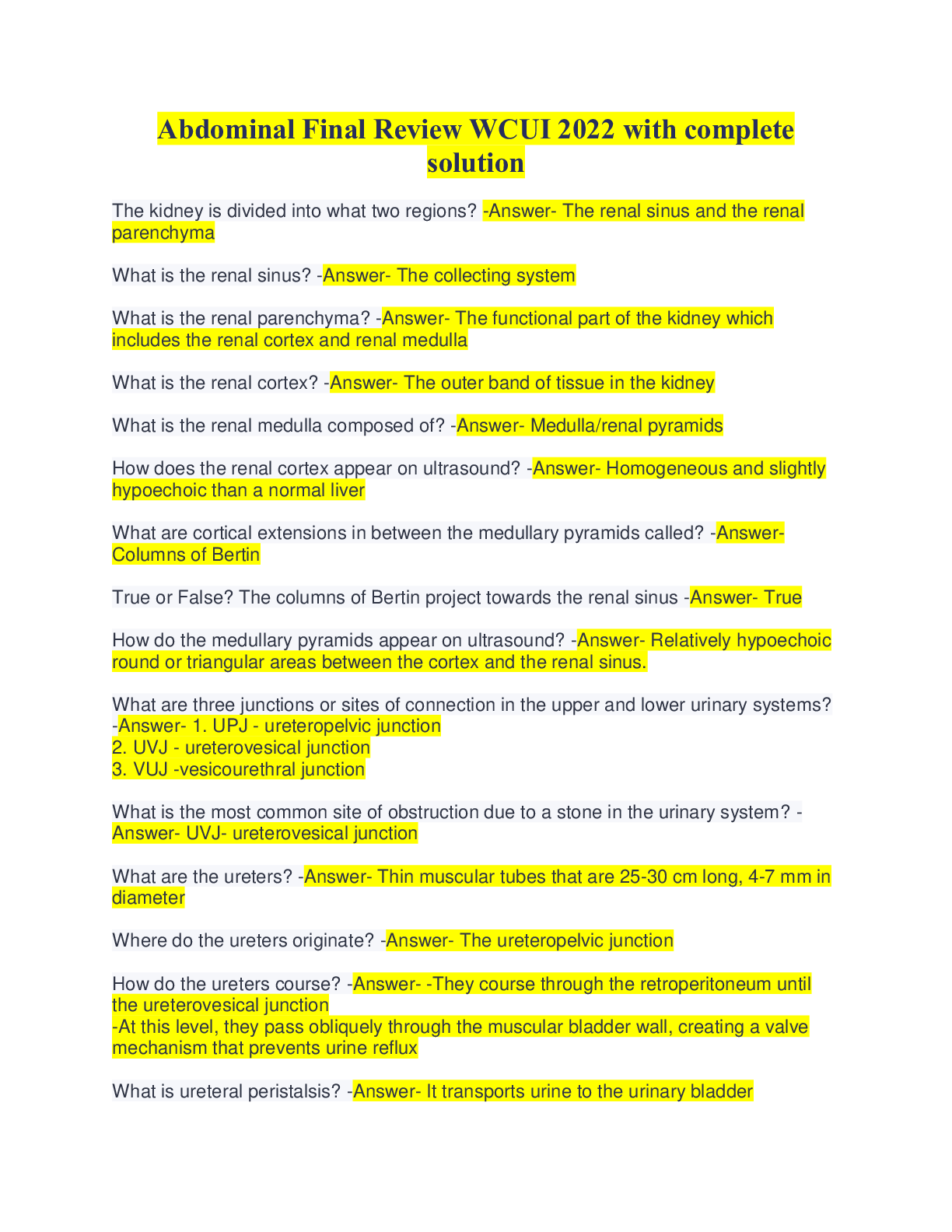
Renal Cortex, Medulla and Renal Pelvis -Answer- What are the 3 subdivisions of the
kidney?
Renal Pelvis -Answer- Which is the most echogenic portion of the kidney?
Medulla -Answer- Which is the darkest part of the kidney?
Gerota's Fascia, Fibrous Capsule and Pararenal Fat -Answer- What are 3 surrounding
layers of the kidney?
Blood Vessels, Peripelvic Fat, Nerves, and Lymphatics -Answer- What are the contents
of renal sinus?
What is the normal size of the kidney -Answer- 9-13 cm length, 4-5 wide, 2-3 thick
Urine Test, Pyuria, Proteinia, PH level of the urine, BUN and Serum Creatinine -
Answer- What are the lab values for abnormal renal functioning/failure?
Excretion of waste, Urine Production, it influence blood pressure, regulation of acid
base/electrolytes ions, and control blood concentration -Answer- What are the functions
of kidney's?
<0.5 to 0.7 -Answer- What is the normal resistive index?
Adult Polycystic Kidney Disease -Answer- A genetic disorder. Associated with Burry's
aneurysm
Multicystic Dysplastic Kidney -Answer- Most common childhood renal cystic disease.
Multiple renal cysts of variable size are typical w/ largest ones usually peripheral.
Hydronephrosis -Answer- Dilation of renal collecting system caused by obstructive
outflow of the urine.
Hypernephroma -Answer- RCC AKAAngiomyolipoma -Answer- Common benign neoplasm composed of angiolipotoma
composed of fat, blood, vessel and smooth muscle fibers.
Lymphatic Systems and IVC -Answer- Define the ways cancer can mestatisize from
kidney.
Perinephric fat, Gerota's Fascia, Renal Vein, IVC, Heart, Lymph Nodes, and Adjacent
structures (Adrenal gland, spleen, liver contralateral kidneys) -Answer- Name the
various locations of invasion of the metastasize from the kidneys.
24-72 hrs to define texture, size, blood flow and fluid collection -Answer- What does the
baseline examination include for transplanted kidney?
Anterior Superior and medial to the Kidney bilateral -Answer- Where is the location of
adreanl glands?
RetroPeri -Answer- Is adrenal glands retro or peritoneal?
Aldestrone, Cortisol and Estrogen/Androgen -Answer- Which are the hormones
produced by the cortex of adrenal gland?
Epinephrine and Non Epinephrine -Answer- Which are the hormones produced by the
medulla of adrenal gland?
Addison's Disease -Answer- List the diseases caused by the hypoadrenalism.
Atrophy -Answer- Addison's disease is due to __________ of the gland.
Cushing's Syndrome, Conn's Syndrome, and Pheochromacytoma -Answer- List the
diseases caused by hyperadrenalism.
Cushing's Disease -Answer- Caused by the pituitary tumor or adrenal corticol tumor.
Conn's Disease -Answer- Caused by too much aldesterone-benign tumor
Pheochromacytoma -Answer- Tumor arises from medulla and causes sustained
hypertension, headaches, sweating, tachycardia, anxiety nausea, and vomiting.
Phagocytosis -Answer- Filters blood damage cells and amino organism
Tunica Intima, Media and Externa -Answer- List the 3 layers of an artery/
Bi-Phasic Flow -Answer- What are type of blood flow is present in aorta?Celiac Axis, SMA, Renal Artery, Gonadal Artery and IMA -Answer- What are the
branches of abdominal AO (cephalad to caudal) and which structures receive blood
form them?
Celiac Axis -Answer- The artery supplies blood to liver, stomach, spleen and pancreas.
SMA -Answer- The artery supplies blood to small intestine, cecum, asc. colon, pancreas
and hepatic flexure.
Renal Artery -Answer- The artery supplies blood kidney, ureters, adrenal glands.
Gonadal Artery -Answer- The artery supplies blood to ovaries/testicles.
common hepatic artery -Answer- Liver get the blood supply from what artery?
Lt. Gastric Artery -Answer- Stomach get the blood supply from what artery?
Splenic Artery -Answer- Spleen and pancreas get the blood supply from what artery?
SMA and IMA -Answer- Which artery has dual resistance in our body and when does it
changes its resistance of blood flow?
Low Resistance -Answer- SMA/IMA resistance after eating?
Distal IVC -Answer- What vessel is anterior to to spine and ascends in the abdomen to
the right of the abdominal AO.
Does the distal IVC has pulsatile or phasic flow? -Answer- phasic
IVC -Answer- The following veins drains to ___________________.
CIV, Rt GV, Rt and Lt Renal V, Hepatic V and Rt Adrenal V
Fusiform -Answer- A true aneurysm. Uniform dilation of all 3 layers of an artery.
Saccular -Answer- Focal outpouching on one side of the vessel wall.
Lt. CIA -Answer- What is the most common location of Saccular Aneurysm?
Intrarenal -Answer- What is the most common location of Fusiform Aneurysm?
Dissecting Aneurysm -Answer- occurs when intimal lining of the arterial wall tears and
allow the blood to flow between intima and media causing inflammation.
Thoracic Region -Answer- What is the most common location of Dissecting aneurysm?Pseudoaneurysm -Answer- Fasle aneurysm. These aneurysm do not have a wall.
Surrounded by clot.
T3, T4 and Calcitonin -Answer- Which hormones are produced by thyroid gland?
T3 and T4 -Answer- Stimulation growth of the body
Calcitonin -Answer- Balances calcium/blood level
Parathormone -Answer- Which hormone is produced by parathyroid gland?
CCA and IJV -Answer- The lateral borders of the thyroid glands?
Strap Muscle -Answer- The anterior border of the thyroid glands?
Longus Colli -Answer- The posterior borders of the thyroid glands?
Multinodular and Hashimoto Thyroiditis -Answer- List the diseases caused by
hypothyroidism.
Grave's Disease, Thyroid Cysts, and Follicular Adenoma -Answer- List the diseae
caused by the hyperthyroidism.
Mucosal, Submucosal, Muscularis, Serosal, and Mesothelium -Answer- What are the
layers of the GI tract?(from innermost to outermost)
Head, Body and Tail -Answer- What are the portions of epididymis?
Hydrocele -Answer- Abnormal accumulation of fluid in the tunica vaginalis.
Varicocele -Answer- Enlargment of the veins of the seromatic cord that will cause
infertility.
Hematocele -Answer- Blood in serotal sac because of injury or surgery.
Spermatic Cord Tosion -Answer- The spermatic cord w/c is composed of arteries, veins,
vas deferens, nerves and lymphatic ducts is twisted and cut off the blood supply to the
testicle.
Subcutaneous, Mammary, and Retromammary -Answer- What are the layers of breast?
Fibradenomas -Answer- What is the most common benign breast mass?
Infiltrating Ductal Carcinoma, Medullary Carcinoma and Infiltrating lobular Carcinoma -
Answer- List the malignant masses of the breast.A Stone -Answer- Intraluminal echogenic structure casting a distal acoustic shadow.
gravity dependent and moves or float. Posterior shadowing
Hemorrhage, Urinoma, Lymphocele and Abscess -Answer- List the fluid collections in
the retro peritoneal cavity.
Hepatopedal -Answer- Flow toward the liver
Hepatofugal -Answer- Flow away the liver
Hyperglycemia -Answer- Uncontrolled increase in glucose
Porcelain GB -Answer- Calcification of the GB wall
Hydropic GB -Answer- Hydrops occurs with distention of the GB
Santorini Duct -Answer- A variant or accessory pancreatic duct
Ampulla of Vater -Answer- Small opening in the duodenum in which the pancreatic and
CBD enter to release secretions
retroperitoneum -Answer- space behind the peritoneal lining of the abdominal cavity
vas deferens -Answer- tube that connects the epididymis to the seminal vesicle
rete testis -Answer- network of tubules between the seminiferous tubules and the
epididymis
ureterocele -Answer- a dilated distal portiob of ureter seen in the bladder. maybe
unilateral or bilateral
Courvoisier's sign -Answer- it's enlarged non diseased GB associated w/ an extrinsic
obstruction of the distal CBD
McBurneys point -Answer- site of maximal tenderness in the RLQ; usually appendicitis
located by drawing a line from the right anterosuperior iliac spine to the umbilicus at
approximately the midpoint of thisbline lies the rootof the appendix.
Positive Murphy's sign -Answer- focal tenderness over the GB
Exopthalmus -Answer- bulging eyes, often from thyroid disease due to Graves disease
tunica vaginalis -Answer- The delicate layer of serous membrane that covers the testis
is called thepampiniform plexus -Answer- a network of testicular veins that drain the testes and
absorb body heat from the testes and scrotum
cyptoorchidism -Answer- undescend testicles risk for cancer
Valsalva maneuver -Answer- forcible exhalation against a closed glottis, resulting in
increased intrathoracic pressure
[Show More]