ACSM Personal Trainer Certification Exam 2022 with
complete solution
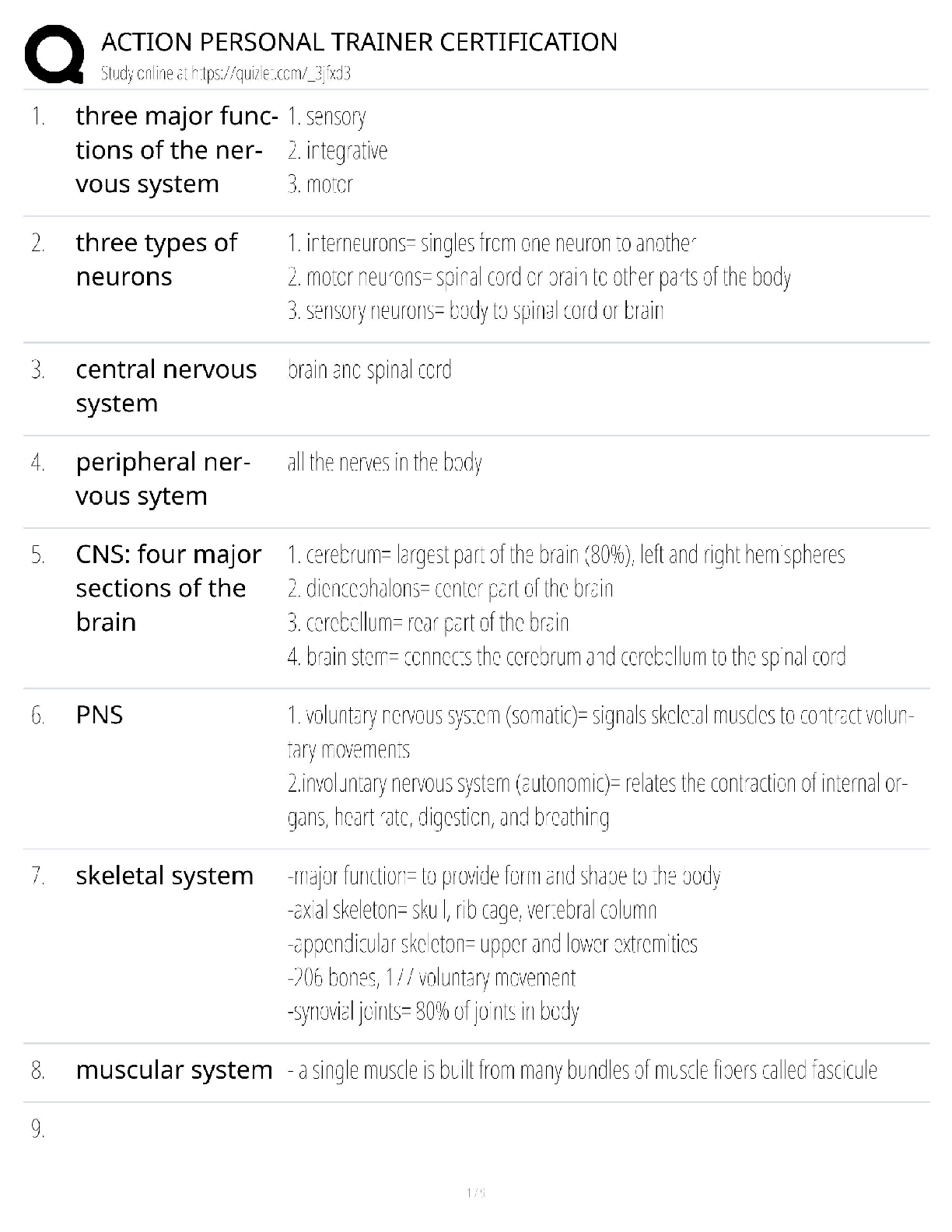
ADL -Answer- One's ability to perform daily tasks such as self care and chores.
Acroymn
Physical Activity -Answer- Transition from rest to active m
...
ACSM Personal Trainer Certification Exam 2022 with
complete solution
ADL -Answer- One's ability to perform daily tasks such as self care and chores.
Acroymn
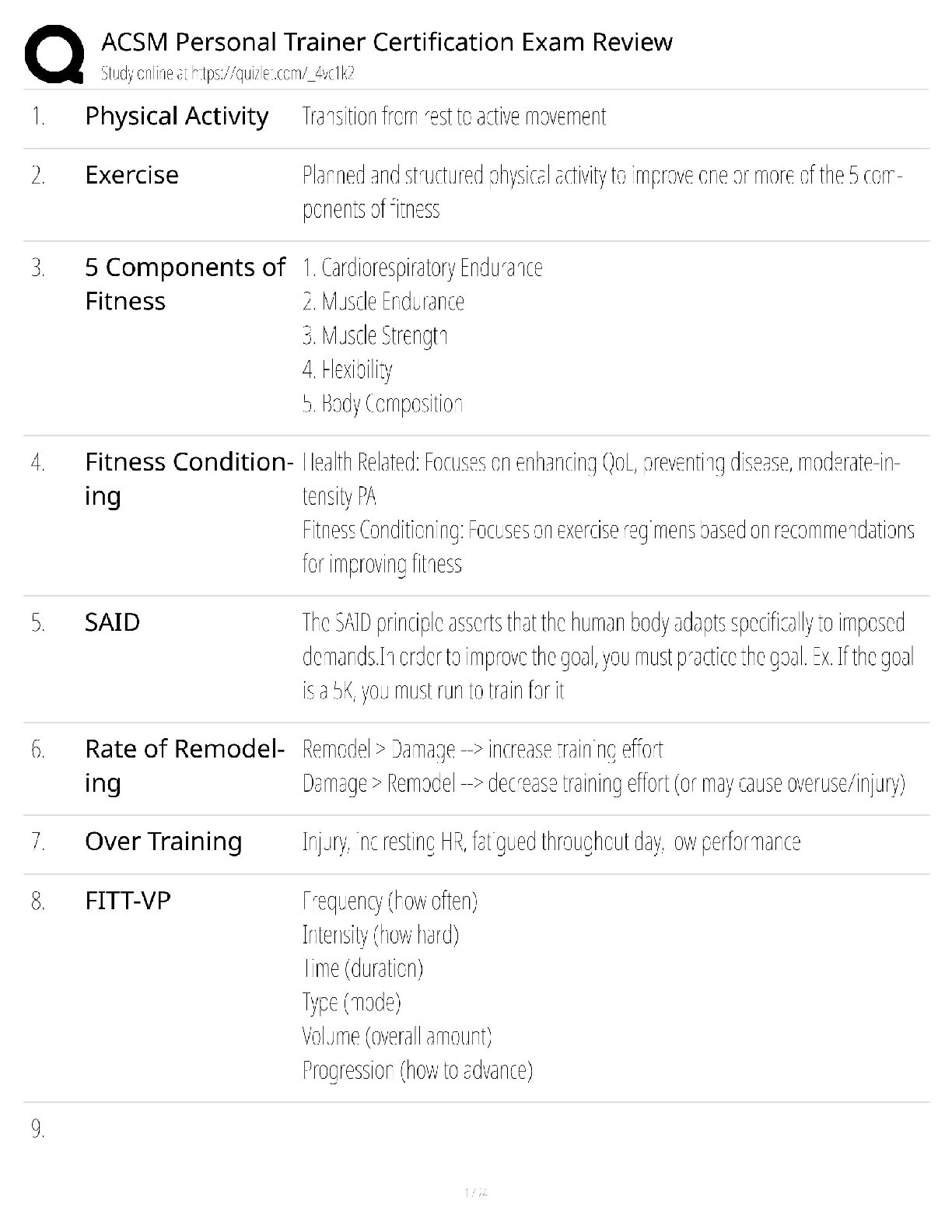
Physical Activity -Answer- Transition from rest to active movement
Exercise -Answer- Planned and structured physical activity to improve one or more of
the 5 components of fitness
5 Components of Fitness -Answer- 1. Cardiorespiratory Endurance
2. Muscle Endurance
3. Muscle Strength
4. Flexibility
5. Body Composition
Fitness Conditioning -Answer- Health Related: Focuses on enhancing QoL, preventing
disease, moderate-intensity PA
Fitness Conditioning: Focuses on exercise regimens based on recommendations for
improving fitness
SAID -Answer- In order to improve the goal, you must practice the goal. Ex. If the goal
is a 5K, you must run to train for it
Rate of Remodeling -Answer- Remodel > Damage --> increase training effort
Damage > Remodel --> decrease training effort (or may cause overuse/injury)
Over Training -Answer- Injury, inc resting HR, fatigued throughout day, low performance
FITT-VP -Answer- Frequency (how often)
Intensity (how hard)
Time (duration)
Type (mode)
Volume (overall amount)
Progression (how to advance)
ATP-CP (Phosphagen) System -Answer- Transfers high energy phosphate from
Creatine Phosphate to rephyosphorylate ATP from ADP using the enzyme creatine
kinase.
Anaerobic
0-30 sec high intensity work
sprints, weight lifting
ADP+CP --Creatine kinase--> ATP+CAnaerobic Glycolysis (Lactic Acid) -Answer- The rapid breakdown of carbohydrate
molecules,either glycogen or glucose, occuring without the presence of oxygen.
Anaerobic
Glucose & lactic acid
:30-3 mins high intensity work
400-800m sprint, 100m swim
Oxidation System -Answer- Metabolic pathway that can use fat, protien, and
carbohydrate as substrates to produce ATP.
Fat oxidation
3+ minutes
important for endurance
capacity limited by O2 and Cals available
*Unfit client has decreased ability to deliver O2 from dec capillary density preventing
delivery
O2 Physiological Adaptations -Answer- 1. Oxygen Deficit - initial stages of CV training
bout referred to as lag in O2 consumption, relying on anaerobic metabolism
2. Steady State - achieved w/ sustained CV once O2 supplied equals O2 demanded.
Inc fit, reach SS faster and endurance depends how long you stay here.
3. EPOC - O2 debt, uptake remained elevated post exercise for several minutes (or
house if longer bout); EPOC effect is to restore CP/ATP in muscles and O2 in blood;
"after burn" effect
Oxygen Deficit -Answer- Initial stages of CV training bout referred to as lag in O2
consumption, relying on anaerobic metabolism
Steady state -Answer- Achieved w/ sustained CV once O2 supplied equals O2
demanded. Inc fit, reach faster and endurance depends how long you stay here.
EPOC (Excess Postexercise Oxygen Consumption) -Answer- O2 debt, uptake
remained elevated post exercise for several minutes (or house if longer bout); Effect is
to restore CP/ATP in muscles and O2 in blood; "after burn" effect
Sino Atrial Node -Answer- Pacemaker of the heart, in RA, initiates contraction
Atrioventricular Node -Answer- Slows down the heart contracting
Right Chambers -Answer- RA receives deoxy blood from vena cava. Blood travels to
RV through tricuspid valve. Leaves RV via pulmonary semilunar valve to pulmonary
system.
Left Chambers -Answer- LA receives oxy blood from veins. Travels to LV through
bicuspid valve then to aorta through the aortic semilunar valve where it then travels
through the body's arteries to deliver oxygen.Pulse Sights -Answer- Carotid (not recommended to perform on someone)
Brachial
Femoral
Radial (most recommended)
Heart Rate -Answer- Avg is 72bpm resting (normal is 60-100bpm)
Good gauge for clients to see how fit they are becoming
Tachycardia/Bradychardia -Answer- Faster than normal heart rate, >100 bpm
Slower than normal heart rate, < 60 bpm
Stroke Volume (SV) -Answer- The amount of blood pumped from the left ventricle in
one beat
Cardiac Output (CO) -Answer- The amount of blood pumped from the heart in one
minute
Arteriovenous Oxygen Difference -Answer- Difference between oxygen content of
arterial and venous blood
Pulmonary Ventilation -Answer- Volume of air exchanged per minute
VO2 Max -Answer- Highest rate and amount of O2 achieved at maximal physical
exertion
Acute CR Response (to Aerobic Exercise) -Answer- Increase: HR, SV, CO, AOD, BF,
systolic BP, pulmonary ventilation, O2 consumption
Chronic CR Adaptations (to Aerobic Exercise) -Answer- Decrease: RHR, BP, blood
lactate
Increase: SV, Cardiac Output, maximal oxygen consumption
Synovial Joints -Answer- Freely movable allowing for variety of angular, circular, and
specialized movements; most common type in human body
Cardiac Muscle -Answer- involuntary muscle tissue
Smooth Muscle -Answer- involuntary muscle tissue of arterial walls and organs of the
body
Skeletal Muscle -Answer- Voluntary muscle tissue made of striated fibers
Type I Fibers -Answer- Aerobic, slow twitch, slow oxidative, red twitch
Type IIA Fibers -Answer- Aerobic and anaerobic capabilities, intermediate fibers, fast
oxidative glycolitic fibersType IIB Fibers -Answer- Anaerobic fibers, fast glycolitic, white twitch fibers
Acute Responses to Training -Answer- Increase HR and BP, SV (eccentric). short term
Chronic Responses to Training -Answer- Hypertrophy, hyperplasia, muscle fiber
transformation, increase in connective tissue.
Hypertrophy -Answer- Increase in muscle size
Hyperplasia -Answer- Increase in number of cells
Acute Muscle Injuries -Answer- Contusions/bruises, muscle strains, AOMS, DOMS, joint
subluxation/dislocation, ligament sprains
Overuse Muscle Injuries -Answer- tonditis, fasciitis, bursitis, osteoarthritis, shin splints,
patello-femoral pain
RICE -Answer- Rest, Ice, Compression, Elevation, (Stabilization)
Angina (symtoms) -Answer- Chest pain and pressure, radiating jaw pain, shortness of
breath, subscapular pain
Heat Exhaustion -Answer- Cool, moist, pale or flushed skin, dizziness, weakness, heavy
sweating, body temperature near normal
Heat Stroke -Answer- Red, hot, dry skin, rapid weak pulse, changes in level of
consciousness, vomiting, body temperature as high as 105F
Hydration Recommendation -Answer- 16 fl. oz water for every lb lost during exercise
Antihypertensive Medication -Answer- Reduces high BP, can cause reduced BP in
exercise
Psychotropic Medication -Answer- Medication that can slow down metabolism
Beta-Blocker Medication -Answer- Reduces resting and exercise HR and BP
Caffeine as Erg. Aid -Answer- May extend endurance in moderate aerobic exercises,
mobilizes FFA into blood stream
1st Class Lever -Answer- Primarily for balance, see saw
Ex. Head on cervical vertebrae
2nd Class Lever -Answer- Primarily for power
Wheel barrowEx. Plantar flexion while walking
3rd Class Lever -Answer- Primarily for ROM, always physiological disadvantaging
movement, distance between lever and fulcrum is smallest; 75% of skeletal system
Ex. Shoveling motion
Elbow flexion
Lever-Pulley-Fulcrum -Answer- Bones-Muscles-Joints
Sagittal Plane -Answer- Divides body into left and right segments
Flexion/extension movements
Frontal Plane -Answer- Divides body into anterior and posterior segments
Abduction/adduction movements, some fl/ex
Transverse Plane -Answer- Divides body into superior and inferior segments
Ab/adduction along horizon
Chest, traps, upper back, obliques
Also known as the horizontal plane
Supine/prone -Answer- Face up/face down
Anterior/posterior -Answer- Front/back
Proximal/distal -Answer- Closer to trunk/further from trunk (anatomical position)
Superior/inferior -Answer- Above/below
Valgus/varus -Answer- Distal segment of joint deviates laterally/medially
Abduction/adduction -Answer- Movement away from/into the midline
Flexion/extension -Answer- Decrease/increase in joint angle
Lateral flexion -Answer- Decrease in joint angle (spine and side bend)
Hyperextension -Answer- Extension beyond normal degree of extension
Supination/pronation -Answer- Lateral/medial rotation of forearm
Plantar flexion/dorsiflexion -Answer- Extension/flexion of the ankle
Retraction/protraction -Answer- Scapula toward (adduction) or away from midline
(abduction)
Inversion/eversion -Answer- Movement of foot medially and laterally (intertarsal)Internal/external rotation -Answer- Transverse plane rotation toward/away from midline
Elevation/depression -Answer- Shoulder girdle movement upward/downward
Circumduction -Answer- Moving in a 360 degree arc/multiplanar
Isometric Contraction -Answer- Static tension is created within the muscle fiber but it
does not change in length so no joint angle change, NO WORK is done, F=R
Ex. Wall sit, plank, lunge hold
Isotonic Contraction -Answer- Dynamic, muscle fibers change in length and joint angle
changes, WORK is done (W=f*d); may be concentric or eccentric
Concentric -Answer- Muscle fibers creating cross bridges while shortening in length
against the pull of gravity so F>R
Positive movements, prime movers
Eccentric -Answer- Muscle fibers creating cross bridges while lengthening to resting
length while going with direction of gravity (F6 months
Social Cognitive Theory -Answer- Based on individual emotions and personality, past
and present; behaviors; environment physically and socially
Self Efficacy: belief in their capability to successfully complete a course of action such
as exercise (task self vs barrier self, able to do the task vs overcoming barriers like time
and fatigue)
Theory of Planned Behavior -Answer- Intentions to perform a behavior are the primary
determinant, intentions are determined by an individual's attitudes, subjective norms,
and perceived control of the outcomes
Learning Process Phases -Answer- Cognitive Phase: Learning general skills and
concepts
Associative Phase: Practice and refine
Automatic Phase: Skill is developed and consistent
Adult Learning Strategies -Answer- Self directed focus
Involvement in decision making
Use past experience as a basis of decision making
Learn by problem solving
Learn best when emotionally and physically stable
Intrinsic (from within) or extrinsic (outside) reward system
FITT-VP -Answer- Frequency, Intensity, Time, Type, Volume, Pattern, Progression
(FITT-VP for) CR Fitness Programming -Answer- F: 3-5 days/wk
I: Vigorous/moderate or combination
Time: 150min/wk moderate or 75 min/wk vigorous
Type: whatever individual enjoys
Volume: >500-1000 MET*min/wk or 1000 Cals/wk
Pattern: Perform in continuous session per day or multiple sessions to accumulate
volume; utilize interval training
Progression: Initial 4-6 wks add 5-10 mins every 1-2 wks; after improvement 4-8
months, avoid large increases in FITT components but one may be toleratedHR max equation -Answer- HRmax = (220-age) +/- 10
Intensity of CR Programming -Answer- Deconditioned: 30-40% HRR/VO2 or 57-64%
HRmax
Fit: 70-90% HRR/VO2 or 84-94%
ACSM recommends 64-94% HRmax or 40-90% HRR/VO2 for most people, it is
recommended to manipulate time before manipulating intensities
Vigorous > 70% HRmax or > 60% HRR
Time of CR Programming -Answer- Moderate: 30-60 min/day or 150 min/wk
Vigorous: 20-60 min/day or 75 min/wk
Or a combination
< 20 min/day can be beneficial to sedentary adults
Health Benefits of CR Training (ACSM & CDC) -Answer- All adults should accumulate
30+ min of physical activity (moderate intensity) preferably all days of the week
ACSM & AHA CR Training -Answer- <65 should engage in moderate intensity aerobic
exercises 30 min/day, 5 days/wk or high intensity 20 min/day, 3 days/wk
HRrest -Answer- Bpm taken first thing in the morning, averaged over the course of 3
days
HRmax -Answer- HR of all out effort, estimated as (220-age)+/- 10
Target Heart Rate -Answer- HR within intensity range during training
VO2 Reserve -Answer- O2 Uptake reserve, difference between max and resting O2
uptake
Heart Rate Reserve -Answer- Difference between HRrest and HRmax
Resting Heart Rate -Answer- Rate the heart recovers from exercise
RPE -Answer- Perceived exhaustion scale, 6-20 scale; 12-16 for general public during
exercise; adding a 0 estimates HR
Karvonen Formula -Answer- HRR = HRmax - HRrest
THR = [HRR * training%] + HRrest
*Important for HR training, safety, vig vs moderate control
METs -Answer- Metebolic Equivalence
O2 consumption and caloric expenditure relative to resting values
MET (equation) -Answer- 1 MET = [VO2mL(kg*min)^-1]/3.5 --> MET of restEx. 8 METS = metabolic requirements of activity for O2 and energy are 8x that
compared to rest
Mod ex -Answer- 40% to <60% VO2R; <6 METs
"An intensity that causes noticeable increases in HR and breathing"
Vig ex -Answer- >60% VO2R; >6 METs
"An intensity that causes substantial increases in HR and breathing."
Client Physical Readiness -Answer- Poor: Sedentary, no habitual activity, extremely
deconditioned
Poor-fair: Minimal PA, no exercise, moderately to highly deconditioned
Fair-average: Sporadic PA, no/suboptimal exercise, moderately to mildly deconditioned
Average-good: Habitual PA, regular moderate/vig exercise
Good-excellent: High habitual PA, regular vigorous intensity exercise
Aerobic Training for Beginners -Answer- No activity: focus on light to moderate activity
for 20-30 mins/day, accumulating 10 min bouts is okay; totaling 60-150 min/week
Minimal prior PA: focus 30-60 min/day (accumulating 10 min bouts okay); totaling 150-
200 min/wk
Aerobic Training for Intermediate -Answer- Fair-average readiness: moderate 30-90
min/day, accumulating 200-300 min/wk
>60 min at a time can increase dropout rate
Aerobic Training for Established -Answer- Moderate to vigorous exercise 30-90
min/day, targeting 200-300 min/wk for moderate or 100-1
[Show More]