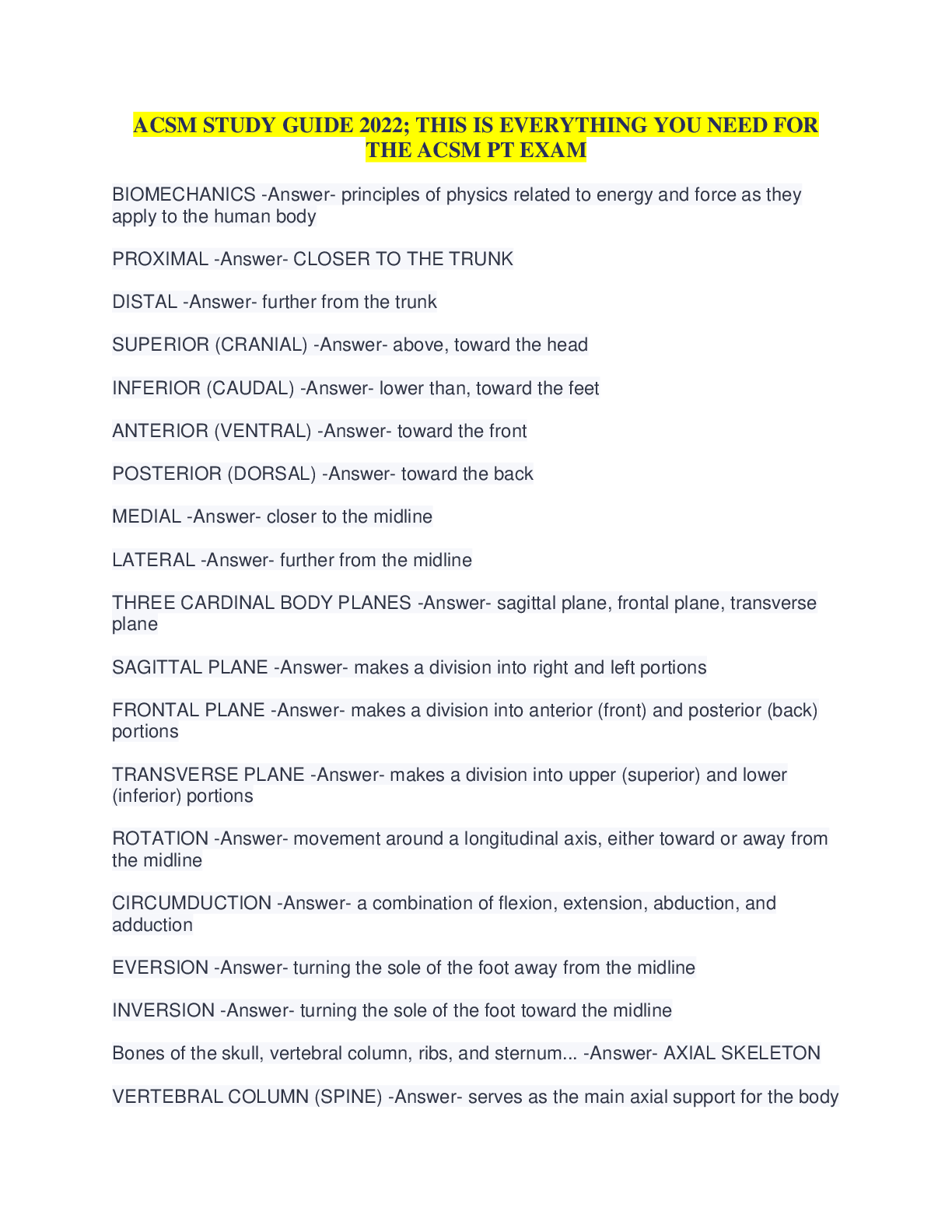
ACSM STUDY GUIDE 2022; THIS IS EVERYTHING YOU NEED FOR
THE ACSM PT EXAM
BIOMECHANICS -Answer- principles of physics related to energy and force as they
apply to the human body
PROXIMAL -Answer- CLOSER TO THE TRUNK
D
...
ACSM STUDY GUIDE 2022; THIS IS EVERYTHING YOU NEED FOR
THE ACSM PT EXAM
BIOMECHANICS -Answer- principles of physics related to energy and force as they
apply to the human body
PROXIMAL -Answer- CLOSER TO THE TRUNK
DISTAL -Answer- further from the trunk
SUPERIOR (CRANIAL) -Answer- above, toward the head
INFERIOR (CAUDAL) -Answer- lower than, toward the feet
ANTERIOR (VENTRAL) -Answer- toward the front
POSTERIOR (DORSAL) -Answer- toward the back
MEDIAL -Answer- closer to the midline
LATERAL -Answer- further from the midline
THREE CARDINAL BODY PLANES -Answer- sagittal plane, frontal plane, transverse
plane
SAGITTAL PLANE -Answer- makes a division into right and left portions
FRONTAL PLANE -Answer- makes a division into anterior (front) and posterior (back)
portions
TRANSVERSE PLANE -Answer- makes a division into upper (superior) and lower
(inferior) portions
ROTATION -Answer- movement around a longitudinal axis, either toward or away from
the midline
CIRCUMDUCTION -Answer- a combination of flexion, extension, abduction, and
adduction
EVERSION -Answer- turning the sole of the foot away from the midline
INVERSION -Answer- turning the sole of the foot toward the midline
Bones of the skull, vertebral column, ribs, and sternum... -Answer- AXIAL SKELETON
VERTEBRAL COLUMN (SPINE) -Answer- serves as the main axial support for the body4 Major curvatures of the adult vertebral column -Answer- cervical curve, thoracic curve,
lumbar curve,
sacral curve
KYPHOSIS "primary curves" -Answer- curves of the thoracic and sacral regions
LORDOSIS "secondary curves" -Answer- curves of the cervical and lumbar region
Commonly found abnormal curves in the sagittal plane -Answer- hyperkyphosis and
hyperlordosis
HYPERKYPHOSIS -Answer- exaggerated posterior thoracic curvature
HYPERLORDOSIS -Answer- exaggerated anterior lumbar curvature
Commonly found abnormal curve in the frontal plane -Answer- scoliosis
STERNUM -Answer- midline of the chest
What are the 3 parts of the sternum? -Answer- manubrium, body, xiphoid process
RF for family history -Answer- myocardial infarction, coronary revascularization or
sudden death to a 1st degree family member when >55 male, >65 female
RF for cigarette smoking -Answer- within 6 months
Risk factor for Dyslipidemia LDL -Answer- Lgreater than 130 mg/dL
RF Dyslipidemia Total Cholesterol -Answer- greater than 200 mg/dL
RF Dyslipidemia low HDL -Answer- less than 40 mg/dL
RF Sedentary minutes of activity, days of week, past # of months -Answer- less than 30
min/day, 3 days/week, for at least 3 months
RF Prediabetes fasting blood glucose -Answer- greater than or equal to 100 mg/dL up
to 126
greater than or equal to 126 mg/dL -Answer- Fasting Blood Glucose for Diabetes
diagnosis
RF for Obesity -Answer- body mass of greater then or equal to 30kg/m2; waist
girthgreater than 102 cm for men and 88 cm for women
RF Age men, women -Answer- 45 men, 55 womenNegative Risk Factor -Answer- HDL greater than 60 mg/dL
RF for hypertensive -Answer- systolic greater than or equal to 140; diastolic greater
then or equal to 90; confirmed by 2 separate occasions or on hypertension meds
obesity -Answer- excessivly high amounts of body fat or adipose tissue in relation to
lean body mass
overweight -Answer- increased body weight, in relation to height when compared to
some standard of acceptable or desirable weight
percent fat -Answer- the total amount of weight that is measured as fat tissue
body mass index BMI -Answer- the height to weight ratio can be misleading because it
does not consider body type
lean body mass -Answer- not fat tissue: muscle, bone, skin etc
anorexia nervosa -Answer- the disorder of self-induced starvation
bulimia nervosa -Answer- the psychologically addictive cycle of binging/purging
USRDA food pyramid -Answer- 1. fat, oils & sweets: use sparingly
2. milk, yogurt &cheese 2-3 servings;
3. meat, poultry, fish, dry beans, nuts, eggs: 2-3 servings;
4. fruits: 3-5 serv;
5. veggies: 3-5 serv.
6. bread, cereal, rice, & pasta: 6-11 serv
female athlete triad -Answer- amenorrhea, osteoporosis, and eating disorders; when left
untreated they damage the musculoskeletal and reproductive systems
# of kilocalories in one gram -Answer- Carbo= 4; fats=9; protein=4; alcohol=7
guidelines for losing weight -Answer- 500-1000 cal daily to lose 1-2 lbs. per wk; same to
increase
kilocalaries -Answer- equivalent to losing 1 lb of fat 3500cal
waist-hip ratio -Answer- Hips/Waist (ex. 45" waist and 36" hips... 36/45=.8)
ratios above .86 for women and .95 for men indicate abdominal adiposity
Heart Rate (HR) -Answer- total # of times the heart contracts in one minute, increases
with work-rate during exerciseStroke Volume -Answer- amount of blood pumped from the left ventricle in one beat
Cardiac Output -Answer- the amount of blood pumped from the heart in one minute
Blood Pressure -Answer- arterial pressure providing force for blood flow (systolic and
diastolic pressure)
Arteriovenous Oxygen Difference -Answer- difference between oxygen content of
arterial and venous blood
Blood Flow -Answer- distribution of the cardiac output
Maximum Oxygen Consumption -Answer- highest rate and amount of oxygen achieved
at maximal physical exertion
Types of muscle tissue -Answer- cardiac, smooth, and skeletal
Cardiac muscle -Answer- cardiac muscle tissue is involuntary, it is the tissue of the
heart
smooth muscle -Answer- involuntary muscle tissue that lines the arterial walls and
organs of the body
skeletal muscle -Answer- voluntary and made up of striated fibers
Kinesiology -Answer- the study of human movement
Bones -Answer- mineral reservior, internal skeleton (levers)
joints -Answer- where two bones meet (fulcrum and axis)
muscle tissue -Answer- elastic tissue with contractile properties (pulley)
tendons -Answer- connective tissue that connects muscles to bone
ligaments -Answer- connective tissue that connects bone to bone
cartilage -Answer- white fibrous tissue that cushions surfaces and prevents friction
(cushions bones)
anterior/posterior -Answer- front/ back
inferior/superior -Answer- below/ above
medial/lateral -Answer- closer to midline/further from midlineproximal/distal -Answer- closer to trunk/further from trunk
abduction/adduction -Answer- movement away/into from midline
horizontal abduction -Answer- the row
horizontal adduction -Answer- chest press
supination/ pronation -Answer- rotational movement, results in the palm facing
upward/downward
flexion -Answer- decrease joint angle (elbow curl)
extension -Answer- increase in joint angle
lateral flexion -Answer- decrease in joint angle (spine side bend, love handles)
Physical Activity -Answer- bodily (musculoskeletal movement leading to caloric
expenditure
Exercise -Answer- movement done for improvement in one or more components of
fitness
5 components of Physical Fitness -Answer- a group of characteristics a person
achieves/possesses related to physical activity and cardiorepiratory, muscle endurance,
muscle strength, flexibility, body composition
cardiorespiratory -Answer- increases the capacity of the heart, lungs, and blood carrying
vessels to deliver oxygen; also called aerobic fitness
muscle endurance -Answer- refers to a muscle's ability to perform repeated contractions
or hold static contractions
muscle strength -Answer- the amount of force a muscle can exert in a single all-out
effort (1 Rep Mas/1RM)
flexibility -Answer- refers to a joint's range of mobility (ROM)
Body Composition -Answer- refers to th ratio of lean body mass compared to fat mass
Principle of Adaptation/Overload Training and Progression -Answer- -greater then
normal demand is placed upon muscles,
-to enhance the muscular fitness, the system must be progressively overloaded
-tension required for strength gain is about 60% - 80% of 1RM
-fleck and kraemer recommend 75 - 90%Progression involves increasing/changing one or more of the exercise training
components to promote adaptations
Principle of Specificity of Training -Answer- The body adapts to specific exercise
training stimulus with specific physical and physiological adaptations.
Cardio adaptations -Answer- -resting heart rate decreases by approx 10 - 15 bpm
-SV increases both at rest and during exercise
-Resting SBP/DBP may decrease (if prev elevated)
Exercise Program Components -Answer- (FITTE) Frequency, Intensity, Time/Duration,
Type/Mode, Enjoyment
Warm up Considerations -Answer- Should include appropriate cardiorespiratory and
musculoskeletal activity
Cool Down Considerations -Answer- Appropriate cardiorespiratory and musculoskeletal
activity serving to enhance venous return and decrease the chance of postexercise
hypotension during recovery
Initial treatment for Musculoskeletal injury for the first 24-72 hrs -Answer- (RICES) rest
(prevents further injury, ice (reduces pain, swelling, and initiates inflammatory response)
compression (reduces swelling and bleeding) elevation (controls edema and decreases
blood flow) stabilization (assists in muscle relaxation, diminishing spasm
Symptoms of Angina (chest pain) and myocardial infaction (heart attack) -Answer- a.
chest pain, b. pressure discomfort in the chest, c.left jaw, neck or shoulder-may radiate
distally, d. shortness of breath and lightheadedness, e. back pain, which may be
experienced by some women
Treatment for chest pain and heart attack symptoms -Answer- a. stop exercise
immediately and place person ina comfortable sitting or lying position, b. 911, monitor
HR, and be prepared to begin CPR, c. Automated External Defibrillator AED may be
used if cardiac arrest
Signals of heat exhaustion -Answer- a. cool, moist pale, ashen, or flushed skin b.
headache, nausea, dizziness, c. weakness, exhaustion d. heavy sweating e. body temp
will be near normal
Signals of heat stroke -Answer- 1. red, hot dry skin 2. rapid weak pulse, shallow
breathing 3. changes in the level of consciousness 4. vomiting 5. body temp will be very
high as high as 105
Hydration recommendations according to ACSM -Answer- approx. 3-6 ounces of water
every 1-2 miles of the raceATP-PC phosphagen system (anaerobic) -Answer- 25-30 seconds of high intesity work
(spints, weight lifting)
Anaerobic Glycolysis/Lactic Acid System (anaerobic) -Answer- 1-2 min of high intensity
work 400-800m distance sprint
Oxygen System (aerobic) -Answer- fuels activities lasting more than 2-3 min. Capacity
is limited only by oxygen and fuel avail. to the cell
Ipsilateral -Answer- same Side
Contralateral -Answer- opposite side
unilateral -Answer- one side
bilateral -Answer- both sides
supine -Answer- lying face up
prone -Answer- lying face down
upper respiratory system -Answer- nose, sinuses, pharynx, larynx ...filters air
lower respiratory system -Answer- trachea, bronchi, bronchiloes, alveoli...puts oxygen
into blood
anatomical sites of pulse -Answer- carotid, brachial, radial, femoral
type 1 fibers -Answer- slow twitch, slow oxidative and red twitch fibers (aerobic)
type IIA fibers -Answer- have aerobic and anaerobic capabilities and refered to as
intermediate fibers, continuum fibers, fast oxidative glycolitic fibers
type IIB -Answer- anaerobic in nature. refered as fast glycolitic fibers
sliding filament theory -Answer- the events that occur b/w actin and myosin during
muscle contraction and relaxation
-when nerve impulse is received, the cross bridges of myosin will put the actin filaments
towards the center of the sarcomere and tension is created
neuromuscular activation -Answer- stimulus for vol. physical activity initiates in the brain
and is then transformed into a movement pattern
antihypertensive meds -Answer- reduces high blood pressureanti-anginal -Answer- reduces angina/chest pain
brochodilator -Answer- relaxes bronchial passageways
hypoglycemic -Answer- reduces blood sugar
anti-arrhythmic -Answer- prevents/controls abnormal heart rhythms
psychotropic -Answer- affects behavior
antihistamine -Answer- prevents system of allergic response
vasodilator -Answer- widens blood vessal
beta-blocker -Answer- reduces resting and exercise heart rate and blood pressure
caffine -Answer- may extend endurance in moderate aerobic exercise
alcohol -Answer- dehydrating-may impair exercise tolerance and increase risk of heart
injury
nicotine -Answer- may elevate HR,BP and respiratory response
A.O.M.S -Answer- Acute-onset muscle soreness; muscle fatigue and discomfort
dimininishes when exercise stops
D.O.M.S -Answer- delayed onset muscle soreness;muscle discomfort 24-36 hr after
exercise
overuse/chronic muscle and joint injury -Answer- tendonitis, fasciitis, bursitis,
osteoarthritis
tendonitis -Answer- inflammation of a tendon
fasciitis -Answer- inflammation of the fascia; fascia is a connective tissue that surrounds
muscles, groups of muscles, blood vessels, and nerves, binding those structures
together in much the same manner as plastic wrap can be used to hold the contents of
sandwiches together
bursitis -Answer- Bursitis is inflammation of the fluid-filled sac (bursa) that lies between
a tendon and skin, or between a tendon and bone
osteoarthritis -Answer- chronic breakdown of cartilage in the jointsnormal acute cardiorespiratory response to aerobic exercise -Answer- elevated HR, SV,
Cardiac output, BP, Blood Flow, Arteriovenous oxygen difference, pulmonary ventilation
and oxygen consumption
pulmonary ventilation -Answer- vol of air exchanged per minute
Force -Answer- any interaction b/w 2 objects producing a change in magnitude or
direction of motion
torque -Answer- rotary force
1st class lever -Answer- primarly for balance;see saw, head on cervical vertebrea
2nd class lever -Answer- primarly for power; wheel borrw, plater flexion during walking
3rd class lever -Answer- range of motion; shovel, exbow flexion; we use this the most
isometric/static contraction -Answer- tension is created within the muscle fiber, but the
fiber change length and there is no change in joint angle F=R
Isotonic/dynamic contraction -Answer- muscle fibers change length and joint angles;
Work= force x distance; can concentric or eccentric
concentric -Answer- muscle fibers creating cross bridges while shortening in length
against the pull of gravity F>R
eccentric -Answer- muscle fibers creating cross bridges while returning to resting length
while going with gravity R>F
Isokinetic -Answer- variable force w. accommodating speed
agonist -Answer- muscle responsible for producing joint movement
ex. bicep during curl
antagonist -Answer- opposing muscle to the prime mover
synergists -Answer- muscles involved in stabilizing, fixating or assisting at the joint
SPIES -Answer- Social: support systems
Physical: physical/phyiological well-being
Intellectual: Open to Learn
Emotional:Coping Skills
Spiritual:living in harmony
Transtheoretical Model stages of change -Answer- Pre-contemplation: not ready to
exerciseContemplation: thinking about behavior change
Preparation:doing something related to exercise, but not meeting the guidelines
Action: meeting set criteria of at least 6 months
Maintenance: met criteria of 6 months, and continuing
internal/external rotation -Answer- transverse plane rotation towards/away from midline
retraction/protraction -Answer- scapula toward (add) and away from midline (abd)
hyperextension -Answer- extension beyond normal degree of extension
Work = -Answer- Force x distance = work
dose response -Answer- sedentary individuals will demonstrate significicant
improvements in fitness early in training program
regular physical activity can improve health and reduce health risks by... -Answerreduces...
-cardiovascular disease
-risk of stroke
-reduces high blood pressure
-risk of colon cancer, lowers
-cholesterol/triglycerides,
-depression/anxiety/stress
Increases...
-lipoproteins
-self-esteem
-healthy body
benefits of flexibility training -Answer- -reduces muscle tension
-promotes relaxation
-muscle contractions become easier/smoother
-improves ease of movement
benefits of resistance training -Answer- -stress management
-MET capacity
-increased resting metabolism
-osteoporosis prevention/management
-injury prevention/rehab
consequences of physical inactivity -Answer- -heart disease
-stroke
-diabetes
-hypertension
-obesity-depression/anxiety
-certain cancers
Direction of blood flow -Answer- The Right Atrium, receives "used blood" from the body.
Blood will be pushed through the tricuspid valve to the
Right Ventricle, the chamber which will pump to the lungs through the pulmonic valve to
the
Pulmonary Arteries, providing blood to both lungs. Blood is circulated through the lungs
where carbon dioxide is removed and oxygen added. It returns through the
Pulmonary Veins, which empty into the
Left Atrium, a chamber which will push the Mitral Valve open. Blood then passes into
the
Left Ventricle. As it pumps, the pressure will close the mitral valve and open the aortic
valve, with blood passing through to the
Aorta, where it will be delivered to the rest of the body.
Mitral valve prolapse -Answer- heart problem resulting from the mitral valve not
regulating the flow of blood between the left atrium and left ventricle of the heart
Arrhythmias -Answer- An arrhythmia is a disorder of the heart rate (pulse) or heart
rhythm, such as beating too fast (tachycardia), too slow (bradycardia), or irregularly.
atrophy -Answer- decrease in the mass of the muscle;Muscle atrophy results from a comorbidity of several common diseases, including cancer, AIDS, congestive heart failure,
COPD (chronic obstructive pulmonary disease), renal failure, starvation
hypertrophy -Answer- Enlargement of muscle
2 types of hypertrophy -Answer- sarcoplasmic and myofibrillar
sarcoplasmic -Answer- volume of sarcoplasmic fluid in the muscle cell increases with no
accompanying increase in muscular strength
myofibrillar -Answer- actin and myosin contractile proteins increase in number and add
to muscular strength as well as a small increase in the size of the muscle
Par-Q -Answer- Physical Activity Readiness identifies people who should not be tested
in a field setting. Proceed with caution if a client answers yes to one or more questions.
May require physician clearance
informed consent -Answer- lets person know there is a risk to exercise
order of exercise assessments -Answer- 1.resting mesurements (BP/HR/Body
Fat/height/weight)
2.cardio test
3.muscular endurance4.flex
Heart rate reserve -Answer- HRR = HRmax − HRrest
Karvonen formula -Answer- aka max heart rate reserve method;
training HR = (max HR - resting HR) X target intensity (40/50-85%) + resting HR
FITTE (resistance training) -Answer- Frequency(2-3x a week),
Intensity (2 to 4 sets of 8-12 reps w/ 2-3 mins b/w sets)
Time no longer then 60 mins,
Type (various resistance equipment),
Enjoyment
Risk stratifications (low) -Answer- men/women w/ 1 or less CVD; can participate in
moderate(40%-60%) and vigorous (>60% VO2R) exercise w/o prior medical testing
Risk stratifications (med) -Answer- Men 45 or older
Women 55 or older
and Those who meet the threshold for two or more positive risk factor are considered
moderate risk; can participate in moderate(40%-60%) but need prior medical testing for
vigorous (>60% VO2R) exercise
Risk stratifications (high) -Answer- Cardiac, peripheral vascular, or cerebrovascular
disease
Chronic OPD, asthma, interstitial lung disease, or cystic fibrosis
Diabetes type 1 or 2, thyroid disorders, renal, or liver disease
VAK -Answer- visual learner:
Auditory Learner
Kinesthetic Learner
the learning process -Answer- cognitive phase:learn general skill concepts
associative phase: practice and refine
automatic phase: skill is developed and consistent
social learning theory -Answer- the theory th
[Show More]