Question 1.
1. Your patient has been using chewing tobacco for 10 years. On physical examination, you
observe a white ulceration surrounded by
erythematous base on the side of his tongue. The clinician should recogniz
...
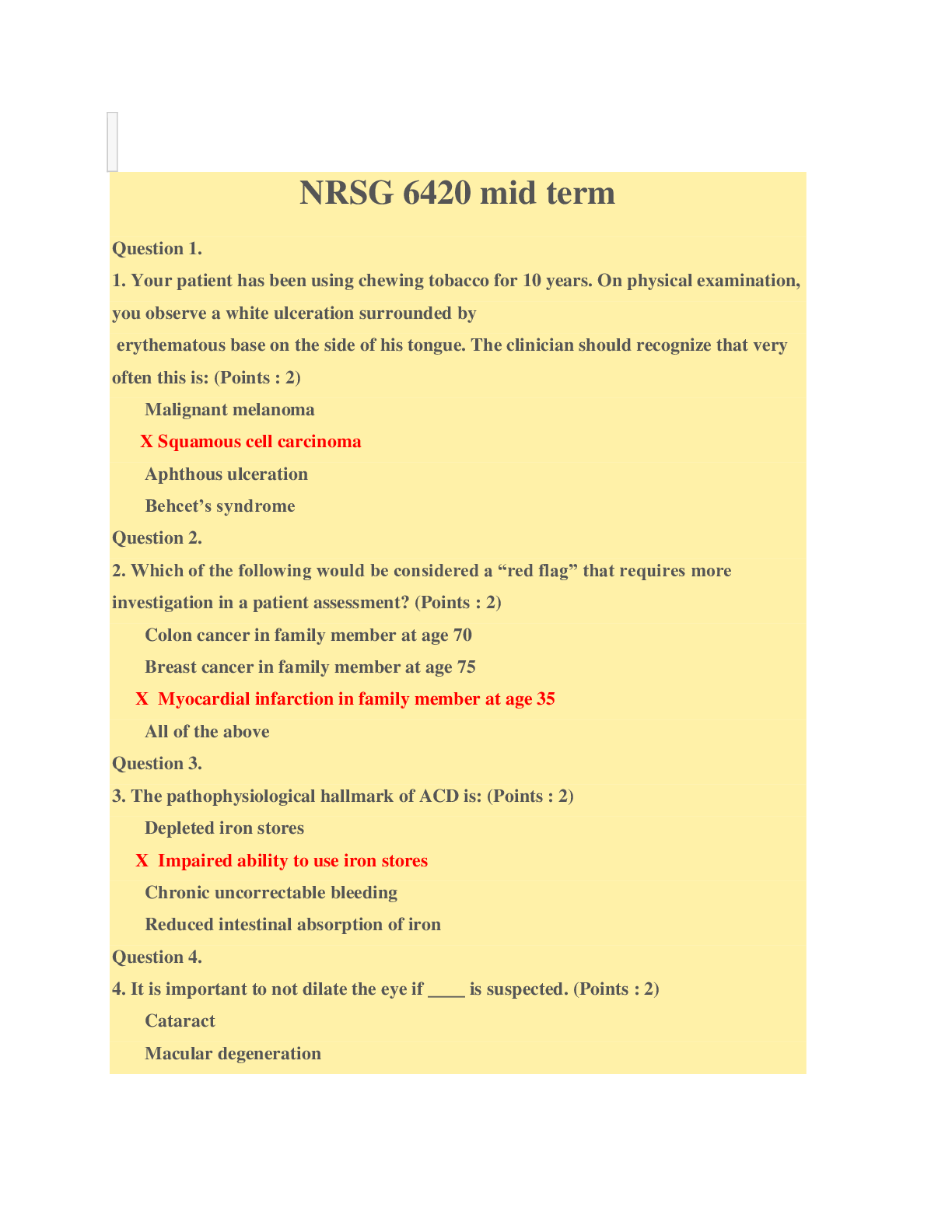
Question 1.
1. Your patient has been using chewing tobacco for 10 years. On physical examination, you
observe a white ulceration surrounded by
erythematous base on the side of his tongue. The clinician should recognize that very often this
is: (Points : 2)
Malignant melanoma
X Squamous cell carcinoma
Aphthous ulceration
Behcet’s syndrome
Question 2.
2. Which of the following would be considered a “red flag” that requires more investigation in a
patient assessment? (Points : 2)
Colon cancer in family member at age 70
Breast cancer in family member at age 75
X Myocardial infarction in family member at age 35
All of the above
Question 3.
3. The pathophysiological hallmark of ACD is: (Points : 2)
Depleted iron stores
X Impaired ability to use iron stores
Chronic uncorrectable bleeding
Reduced intestinal absorption of iron
Question 4.
4. It is important to not dilate the eye if ____ is suspected. (Points : 2)
Cataract
Macular degeneration
X Acute closed-angle glaucoma
Chronic open-angle glaucoma
Question 5.
5. A 66-year-old patient presents to the clinic complaining of dyspnea and wheezing. The patient
reports a smoking history of 2 packs of
cigarettes per day since age 16. This would be recorded in the chart as: (Points : 2)
50 x 2-pack years
X 100-pack years
50-year, 2-pack history
100-pack history
Question 6.
6. When teaching a group of older adults regarding prevention of gastroesophageal reflux disease
symptoms, the nurse practitioner will include
which of the following instructions? (Points : 2)
Raise the head of the bed with pillows at night and chew peppermints when symptoms of
heartburn begins.
Raise the head of the bed on blocks and take the proton pump inhibitor medication at
bedtime.
Sit up for an hour after taking any medication and restrict fluid intake.
X Avoid food intolerances, raise head of bed on blocks, and take a proton pump inhibitor
before a meal.
Question 7.
7. A 56-year-old male complains of anorexia, changes in bowel habits, extreme fatigue, and
unintentional weight loss. At times he is constipated
and other times he has episodes of diarrhea. His physical examination is unremarkable. It is
important for the clinician to recognize the
importance of: (Points : 2)
CBC with differential
Stool culture and sensitivity
This study source was downloaded by 100000852290574 from CourseHero.com on 01-18-2023 14:58:52 GMT -06:00
https://www.coursehero.com/file/24241962/South-University-NRSG-6420-mid-termdocx/
Abdominal X-ray
X Colonoscopy
Question 8.
8. Dan G., a 65-year-old man, presents to your primary care office for the evaluation of chest pain
and left-sided shoulder pain. Pain begins
after strenuous activity, including walking. Pain is characterized as dull, aching; 8/10 during
activity, otherwise 0/10. Began a few months ago,
intermittent, aggravated by exercise, and relieved by rest. Has occasional nausea. Pain is
retrosternal, radiating to left shoulder, definitely
affects quality of life by limiting activity. Pain is worse today; did not go away after he stopped
walking. BP 120/80. Pulse 72 and regular. Normal
heart sounds, S1 and S2, no murmurs. Which of the following differential diagnoses would be
most likely? (Points : 2)
Musculoskeletal chest wall syndrome with radiation
Esophageal motor disorder with radiation
Acute cholecystitis with cholelithiasis
X Coronary artery disease with angina pectoris
Question 9.
9. A common auscultatory finding in advanced CHF is: (Points : 2)
Systolic ejection murmur
X S3 gallop rhythm
Friction rub
Bradycardia
Question 10.
10. Which of the following symptoms is common with acute otitis media? (Points : 2)
X Bulging tympanic membrane
Bright light reflex of tympanic membrane
Increased tympanic membrane mobility
All of the above
[Show More]
 (1).png)

 (1).png)
.png)