Active Physics Full Solutions to Textbook Exercises
Chapter 8
Work, Energy and Power
Checkpoint
Checkpoint 1 (p.194)
1. (a) Yes
(b) No. The displacement of the bag is perpendicular to the force exerted on it.
(c)
...
Active Physics Full Solutions to Textbook Exercises
Chapter 8
Work, Energy and Power
Checkpoint
Checkpoint 1 (p.194)
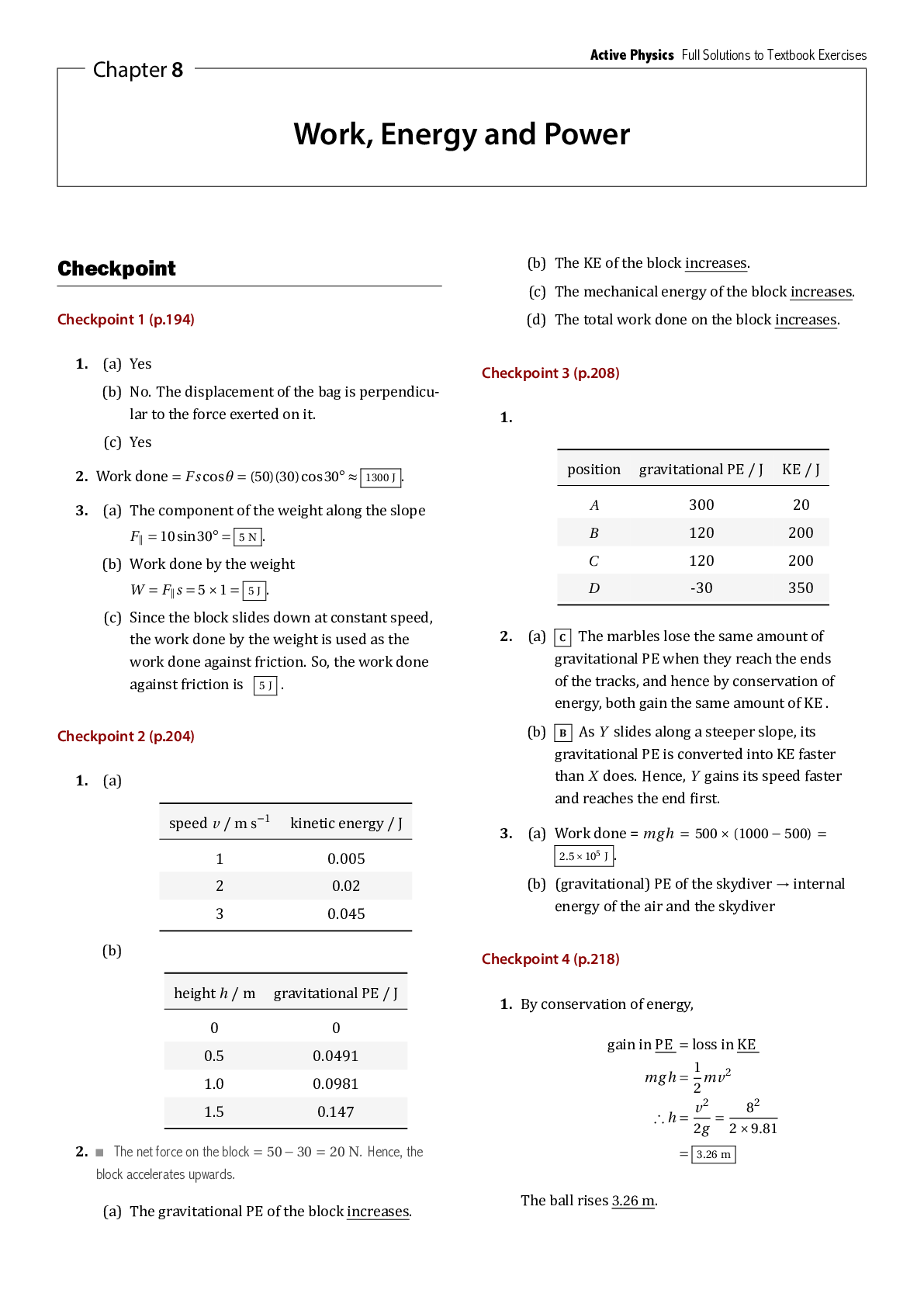
1. (a) Yes
(b) No. The displacement of the bag is perpendicular to the force exerted on it.
(c) Yes
2. Work done ˘ F s cosθ ˘ (50)(30)cos30° … 1300 J .
3. (a) The component of the weight along the slope
F∥ ˘ 10sin30° ˘ 5 N .
(b) Work done by the weight
W ˘ F∥s ˘ 5£1 ˘ 5 J .
(c) Since the block slides down at constant speed,
the work done by the weight is used as the
work done against friction. So, the work done
against friction is 5 J .
Checkpoint 2 (p.204)
1. (a) dummy
speed v / m s¡1 kinetic energy / J
1 0.005
2 0.02
3 0.045
(b) dummy
height h / m gravitational PE / J
0 0
0.5 0.0491
1.0 0.0981
1.5 0.147
2. The net force on the block ˘ 50 ¡ 30 ˘ 20 N. Hence, the
block accelerates upwards.
(a) The gravitational PE of the block increases.
(b) The KE of the block increases.
(c) The mechanical energy of the block increases.
(d) The total work done on the block increases.
Checkpoint 3 (p.208)
1. dummy
position gravitational PE / J KE / J
A 300 20
B 120 200
C 120 200
D -30 350
2. (a) C The marbles lose the same amount of
gravitational PE when they reach the ends
of the tracks, and hence by conservation of
energy, both gain the same amount of KE .
(b) B As Y slides along a steeper slope, its
gravitational PE is converted into KE faster
than X does. Hence, Y gains its speed faster
and reaches the end ϐirst.
3. (a) Work done = mgh ˘ 500 £ (1000 ¡ 500) ˘
2.5£105 J .
(b) (gravitational) PE of the skydiver ! internal
energy of the air and the skydiver
Checkpoint 4 (p.218)
1. By conservation of energy,
gain in PE ˘ loss in KE
mgh ˘ 1
2
mv2
) h ˘ v2
2g
˘
82
2£9.81
˘ 3.26 m
The ball rises 3.26 m.2 | Chapter 8 Work, Energy and Power Exercise Active Physics Full Solutions to Textbook Exercises
2. By conservation of energy,
the work done by the resistive force
˘ loss in (gravitational) PE
˘ mgh ˘ 5000£(20¯2) ˘ 1.1£105 J
Average resistive force
F ˘
W s
˘
1.1£105
2
˘ 55000 N
Checkpoint 5 (p.224)
1. Work done by the crane
W ˘ F∥s ˘ 20000£20 ˘ 4£105 J
Power of the crane
P ˘
W t
˘
4£105
50
˘ 8000 W
Alternative Solution:
Speed of the load
v ˘
s t
˘
20
50
˘ 0.4 m s¡1
Power of the crane
P ˘ F v ˘ 20000£0.4 ˘ 8000 W
2. B Let a be the acceleration of the car.
Power of the car
P ˘
F∥s
t
˘
mas
t
˘
m ( v22 )
t
˘
mv2
2t
Exercise
Exercise 8.1 (p.194)
1. B W ˘ F s ˘ mas
) [J] ˘ [kg][m s¡2][m] ˘ [kg][m2 s¡2]
2. B If the length of the barrel is longer, the cannonball is acted on by the force for a longer distance (i.e.
larger s). By W ˘ F s, a larger s leads to a larger work
W to be done on the cannonball, which hence gains
a larger KE .
3. B
4. A The normal reaction exerted by the ground is
perpendicular to the direction of motion of the crate.
5. The net work done ˘ Fnets ˘ (5¡2)£3 ˘ 9 J .
6. (a) The work done by the pulling force
˘ F∥s ˘ (20cos45°)(50) ˘ 707.1 … 707 J .
(b) The work done against friction
˘ f s ˘ (8)(50) ˘ 400 J .
(c) The energy gained by the suitcase
˘ 707.1¡400 … 307 J .
7. By W ˘ F s, we have
energy gained ˘ area under the F–s graph
˘
5£2
2
˘ 5 J
So the energy gained by the block is 5 J .
8. (a) Since the dumbbell is lifted at a constant
speed, the force exerted by Carol is equal to
the weight of the dumbbell.
The work done by Carol is
W ˘ F s ˘ mg s ˘ (10)(9.81)(0.3) … 29.4 J
(b) When the dumbbell falls, the only force acting
on the dumbbell is the gravitational force
exerted by the Earth.
The work done by the Earth is
W ˘ F s ˘ mg s ˘ (10)(9.81)(0.8) … 78.5 J
9. (a) The work done against friction is
W ˘ f s ˘ (0.3)(2…£0.2£ 14) … 0.0942 J
(b) The work done by the gravitational force is
W ˘ mg s ˘ (0.1£9.81)(0.2) … 0.196 J
Exercise 8.2 (p.204)
1. (a) The gain in PE ˘ mgh ˘ (120)(9.81)(2) … 2350 J .
(b) The KE ˘ 1 2mv2 ˘ 1 2(0.43)(82) … 13.8 J .
2. C By KE ˘ 1 2mv2, we have KE / v2. If v is doubled,
then the KE is 4 times of the original value.
3. A Since KE ˘ 1
2mv2, the slope of the graph is m2 . If
the mass m is doubled, then the slope is doubled.
4. C The change in the height of the marble is the
same no matter it slides down rails A or B.Active Physics Full Solutions to Textbook Exercises Chapter 8 Work, Energy and Power Exercise | 3
5. D Note that work has to be done to stretch the
spring. The spring does not gain any gravitational
PE since it (more precisely, its c.g.) does not have
any vertical motion.
6. (a) The KE of the car is
KE ˘
1 2
mv2 ˘ 1
2
(2000)(122) ˘ 1.44£105 J
(b) When the car comes to a stop, the KE of the
car must have been transformed into the work
done against friction. Given that the braking
force is 3500 N, we have
KE ˘ F s
1.44£105 ˘ 3500s
) s … 41.1 m ˙ 50 m
Yes. The car can stop before the ϐlock of sheep.
7. The gravitational PE of John is given by
gravitational PE ˘ mgh
˘ (70)(9.81)(6sin38°)
… 2540 J
8. (a) If the cannonball is ϐired horizontally, the work
done on the cannonball is equal to the gain in
its KE , and hence
F s ˘
1 2
mv2
(20000)(1) ˘
1 2
(15)v2
) v … 51.6 m s¡1
The speed of the cannonball is 51.6 m s¡1 .
(b) Free body diagram of the cannonball when it
reaches the end of the barrel:
Since the net work done on the cannonball is
equal to the gain in its KE , we have
(F ¡mg)s ˘
1 2
mv2
(20000¡15£9.81)(1) ˘
1 2
(15)v2
) v … 51.4 m s¡1
The speed of the cannonball is 51.4 m s¡1 .
OR: The work done on the cannonball is equal to
the sum of its KE and gravitational PE , and so
F s ˘
1 2
mv2 ¯mgh
(20000)(1) ˘
1 2
(15)v2 ¯(15)(9.81)(1)
) v … 51.4 m s¡1
9. The y-intercept of the graph represents the initial
gravitational PE of the block. Thus
grav. PE ˘ mgh
1000 ˘ (10)(9.81)h
) h ˘ 10.19 … 10.2 m
The vertical distance travelled by the block is
10.2 m .
Consider the ϐigure below.
Therefore, we have
sinθ ˘ 10.19
50
) θ … 11.8°
10. (a) Take the initial gravitational PE of the box as
zero. The work done on the box is
W ˘ F s ˘ (8)(20) ˘ 160 J
(b) The gain in KE is
KE ˘ 1
2
mv2 ˘ 1
2
m(22) ˘ 2m
The gain in gravitational PE is
PE ˘ mgh ˘ m(9.81)(20sin30°) ˘ 98.1m
Combining the equations, we have
work done ˘ KE gain¯PE gain
160 ˘ 2m ¯98.1m
) m ˘
160
100.1
… 1.60 kg
[Show More]


.png)