where to find federal laws - United States Code
where to find federal regulations - Code of Federal Regulations (CFR)
where to find Indiana Code - Indiana Code
Indiana Administrative Code (AIC)
adulteration -
...
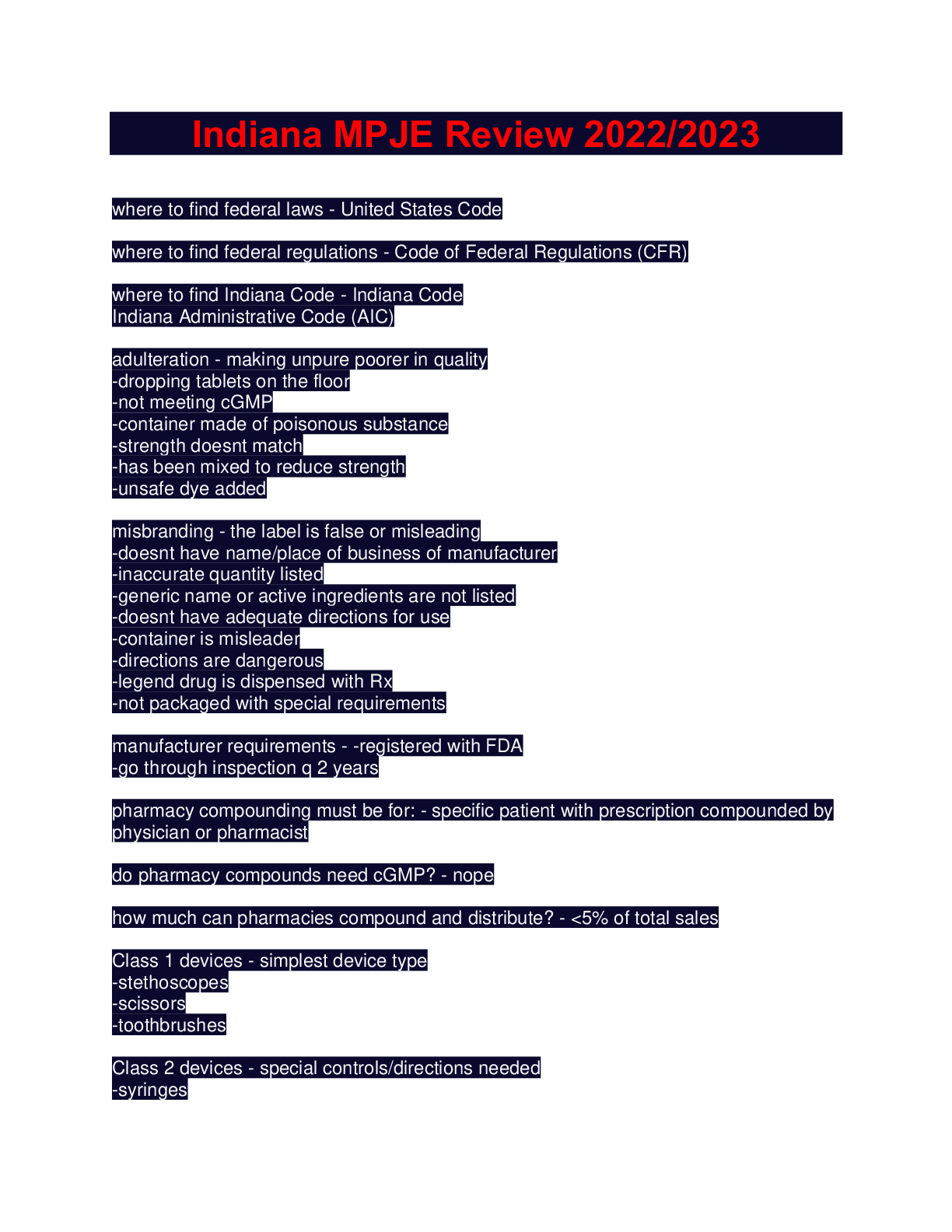
where to find federal laws - United States Code
where to find federal regulations - Code of Federal Regulations (CFR)
where to find Indiana Code - Indiana Code
Indiana Administrative Code (AIC)
adulteration - making unpure poorer in quality
-dropping tablets on the floor
-not meeting cGMP
-container made of poisonous substance
-strength doesnt match
-has been mixed to reduce strength
-unsafe dye added
misbranding - the label is false or misleading
-doesnt have name/place of business of manufacturer
-inaccurate quantity listed
-generic name or active ingredients are not listed
-doesnt have adequate directions for use
-container is misleader
-directions are dangerous
-legend drug is dispensed with Rx
-not packaged with special requirements
manufacturer requirements - -registered with FDA
-go through inspection q 2 years
pharmacy compounding must be for: - specific patient with prescription compounded by physician or pharmacist
do pharmacy compounds need cGMP? - nope
how much can pharmacies compound and distribute? - <5% of total sales
Class 1 devices - simplest device type
-stethoscopes
-scissors
-toothbrushes
Class 2 devices - special controls/directions needed
-syringes
-tampons
-condoms
-A1C test kits
Class 3 devices - need premarket approval
-pacemakers
-replacement valves
-soft contact lenses
restricted devices - need prescription for measures
-contact lenses
-diaphragms
custom devices - ordered to fit the needs of a single patient
-orthotics
-braces
-canes
banned devices - banned from the use in the united states
ONLY one is prosthetic hair fibers
Class 1 Recall - where there is a strong likelihood that the product will cause serious adverse effects or death
Class 2 recall - the product may cause temporary but reversible adverse effects, or in which there is little likelihood of serious adverse effects
Class 3 recalls - Are for products that are unlikely to cause adverse health effects
who decides on recall - voluntarily issued by manufacturer
Poison Prevention Packaging Act of 1970 - • Also known as the PPPA
• Designed to reduce the risk of children ingesting dangerous substances.
• Required locking caps on most prescriptions
-gives CPSC authority to require special packaging
-for ORAL drugs
PPPA Requirements - 90% of adults can open
85% of children <5 who havent been shown cannot open it within 5 mins
80% still cannot open after adult shows them
Prescribers can give waivers for prescriptions ______ - one by one (includes refills on that Rx
patients can give ___ for PPPA - blanket waivers
Exempt from PPPA - -SL NTG
-SL ISDN
-birth control
-unit dose forms of KCl
-prednisone <105mg
-Medrol dose paks
-Colestipol powder
-estrogens <32mg
-sevelamer <2.4g/package
-iron animal feeds
-iron dietary supplements
package insert - manufacturer's printed guidelines for the use and dosing of a drug
-for HCP but you can give to patient if you want
patient package insert - -Community or outpatient pharmacies must give with every dispensing for the drugs that require one (ex: estrogen products)
-Institutional law: must be given before the first administration and every 30 days
-Physician canNOT opt out for a patient
-It is considered misbranded if not given
-only one is estrogens and birth controls right now
medication guide - -Required by FDA on certain products that cause "a serious and significant public health concern"
-Required in the community setting with EVERY dispensing (misbranded if not given)
-Physician CAN request the patient does not receive one but patient can override this request
-Institutional setting: it's unnecessary to dispense b/c there's a professional available at all times to answer questions.
Prescription Drug Marketing Act of 1987 - Prevents re-importation of a drug into US
Prohibited hospital and healthcare entities from reselling their pharamaceuticals
how to get whistleblower reward if you help a conviction
Federal Anti-Tampering Act of 1982 - Federal crime to tamper with OTC. Required tamper-resistant packaging on selected OTC drug products and cosmetics accessible to the public while held for sale. Barrier that provides visible evidence of entry if disturbed and directions to consumer on how to determine if tampering has occurred.
-must be a statement saying all tamper evident features of drug
Dietary Supplement Health and Education Act of 1994 - can say supplement benefits classical nutrient deficiency and US prevalence, describes role intended to affect metabolism, documented mechanism, describes general wellbeing
-doesnt need to provide safety/efficacy data to FDA
Pregnancy Category A - no risk to fetus
[Show More]