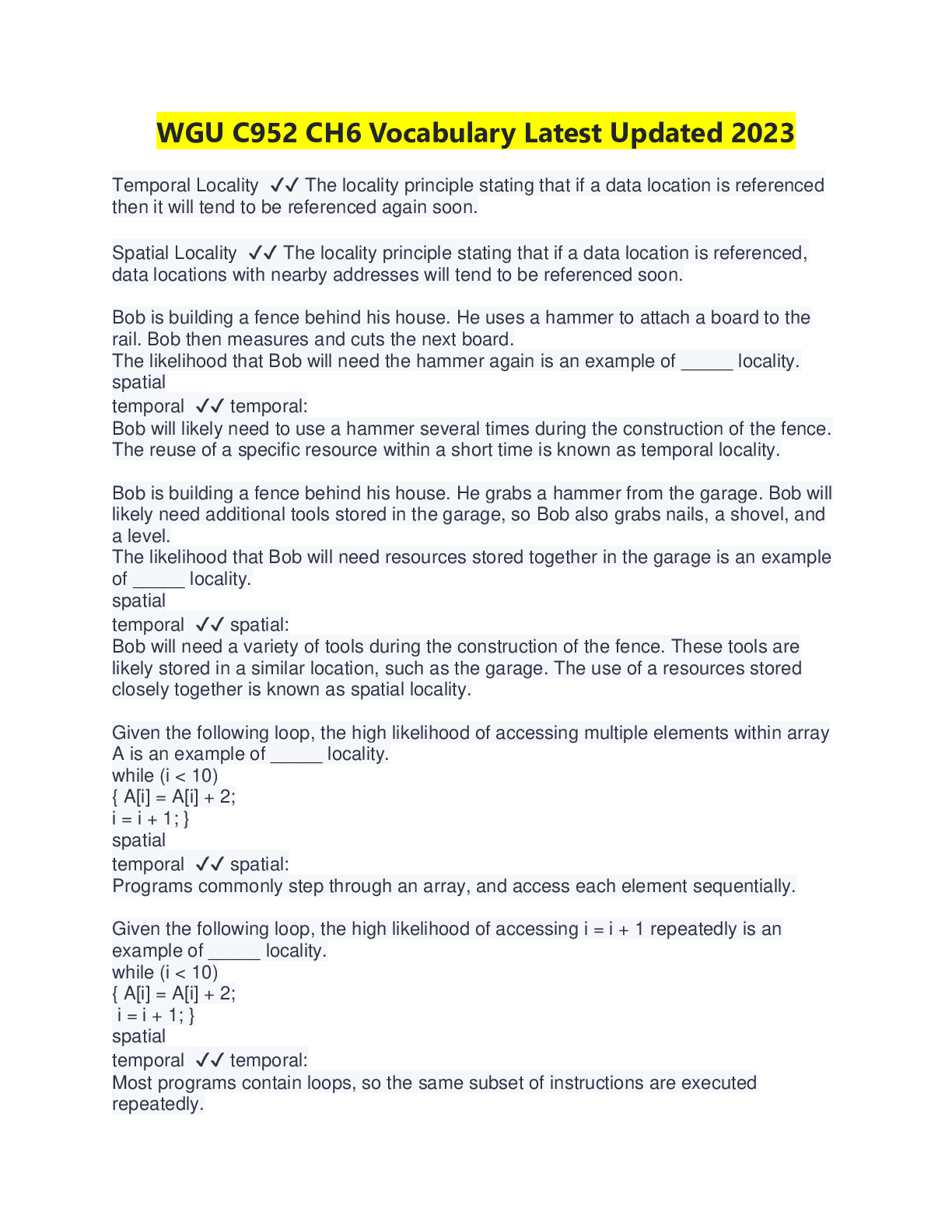
WGU C952 CH6 Vocabulary Latest Updated 2023
Temporal Locality ✔✔ The locality principle stating that if a data location is referenced then it will tend to be referenced again soon.
Spatial Locality ✔✔ The locality
...
WGU C952 CH6 Vocabulary Latest Updated 2023
Temporal Locality ✔✔ The locality principle stating that if a data location is referenced then it will tend to be referenced again soon.
Spatial Locality ✔✔ The locality principle stating that if a data location is referenced, data locations with nearby addresses will tend to be referenced soon.
Bob is building a fence behind his house. He uses a hammer to attach a board to the rail. Bob then measures and cuts the next board.
The likelihood that Bob will need the hammer again is an example of _____ locality.
spatial
temporal ✔✔ temporal:
Bob will likely need to use a hammer several times during the construction of the fence. The reuse of a specific resource within a short time is known as temporal locality.
Bob is building a fence behind his house. He grabs a hammer from the garage. Bob will likely need additional tools stored in the garage, so Bob also grabs nails, a shovel, and a level.
The likelihood that Bob will need resources stored together in the garage is an example of _____ locality.
spatial
temporal ✔✔ spatial:
Bob will need a variety of tools during the construction of the fence. These tools are likely stored in a similar location, such as the garage. The use of a resources stored closely together is known as spatial locality.
Given the following loop, the high likelihood of accessing multiple elements within array A is an example of _____ locality.
while (i < 10)
{ A[i] = A[i] + 2;
i = i + 1; }
spatial
temporal ✔✔ spatial:
Programs commonly step through an array, and access each element sequentially.
Given the following loop, the high likelihood of accessing i = i + 1 repeatedly is an example of _____ locality.
while (i < 10)
{ A[i] = A[i] + 2;
i = i + 1; }
spatial
temporal ✔✔ temporal:
Most programs contain loops, so the same subset of instructions are executed repeatedly.
Instructions may exhibit temporal locality, but not spatial locality. ✔✔ False:
Instructions may exhibit both temporal and spatial locality. Instructions are accessed sequentially in the absence of a jump, thus showing spatial locality. Instructions within a loop are executed repeatedly, thus showing temporal locality.
Data may exhibit spatial locality, but not temporal locality. ✔✔ False
Data may exhibit both spatial and temporal locality. Sequential access to arrays or strings show spatial locality. Data within a loop are accessed repeatedly, thus showing temporal locality.
Memory Heirarchy ✔✔ A structure that uses multiple levels of memories; as the distance from the processor increases, the size of the memories and the access time both increase.
Block (or line) ✔✔ The minimum unit of information that can be either present or not present in a cache.
Hit rate ✔✔ The fraction of memory accesses found in a level of the memory hierarchy.
Miss rate ✔✔ The fraction of memory accesses not found in a level of the memory hierarchy.
Hit time ✔✔ The time required to access a level of the memory hierarchy, including the time needed to determine whether the access is a hit or a miss.
Miss penalty ✔✔ The time required to fetch a block into a level of the memory hierarchy from the lower level, including the time to access the block, transmit it from one level to the other, insert it in the level that experienced the miss, and then pass the block to the requestor.
memory accesses found in the upper level /
total number of memory accesses = ✔✔ hit rate
1-hit rate= ✔✔ miss rate
Memory hierarchies take advantage of temporal locality. ✔✔ True
More recently accessed data items are kept closer to the processor.
On a read, the value returned depends on which blocks are in the cache. ✔✔ False:
The value returned by a read remains the same. The time required to read the data varies given the data's location in the memory hierarchy. If the data is not present in the higher levels, then additional time is needed to copy data from a lower level of the memory hierarchy.
[Show More]