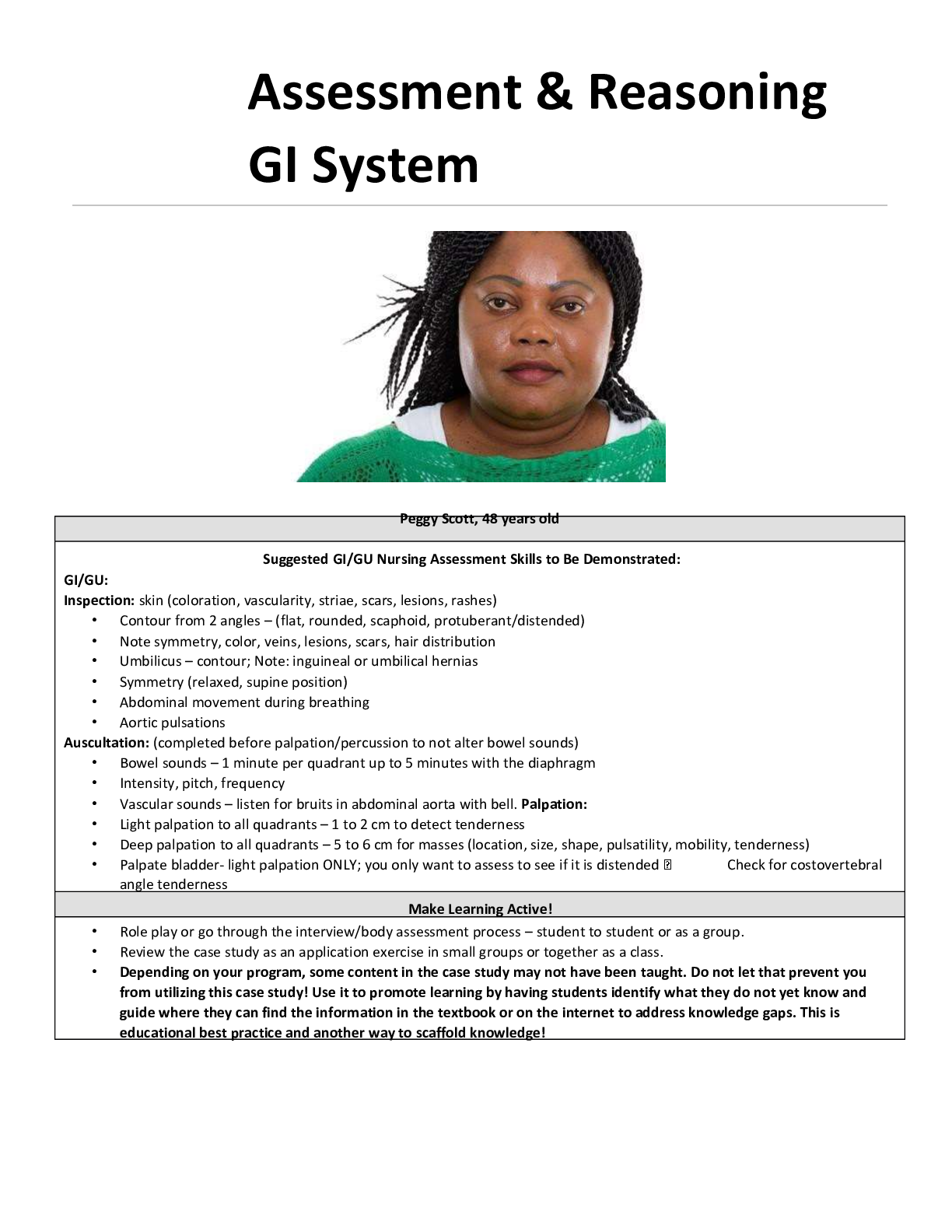
Assessment & Reasoning GI System Peggy Scott, 48 years old- Best
study Guide(Latest)
Present Problem:
Peggy Scott is a 48-year old African American woman who came to the emergency department because she is having seve
...
Assessment & Reasoning GI System Peggy Scott, 48 years old- Best
study Guide(Latest)
Present Problem:
Peggy Scott is a 48-year old African American woman who came to the emergency department because she is having severe
abdominal pain radiating to the back that started 24 hours ago but has become progressively worse in the last couple of hours. She is
now nauseated and states that she has “puked small amounts of green liquid” five times in the last four hours. She had two loose
stools today that were dark brown or black in color.
Peggy has struggled with ETOH use/abuse most of her adult life but has been sober the past six months. She begins to cry and
tells the nurse that this week was the one-year anniversary of her only son’s death in an automobile accident. She reports that she
has been drinking one liter of vodka daily the past week.
What data from the present problem are RELEVANT and must be interpreted as clinically significant by the nurse?
(Reduction of Risk Potential)
RELEVANT Data from Present Problem: Clinical Significance:
Severe abdominal pain radiating to the back.
Began 24 hours ago and is worsening.
Nauseous
Puked green liquid 5x.
2 loose stool dark brown/black
Crying about sons death
- Constant pain in your upper belly that radiates to your back. This is a
symptom of pancreatitis.
-Nausea from alcohol intake which increases the production of stomach acids and
delays the stomach from emptying. Also signs of pancreatitis.
-Green/yellow vomit could indicate bile produced by the gallbladder.
-Brown stool is normal but black would indicate bleeding in the GI tract iron/
something she ate
What is the RELATIONSHIP of your patient’s past medical history (PMH) and current meds?
(Which medication treats which condition? Draw lines to connect.)
PMH: Home Meds: Pharm. Class: Mechanism of Action (own words):
• Depression
• Low back pain
• Ibuprofen 600
mg PO three
times
daily PRN
• Citalopram 40
mg PO daily
NSAID nonsteroidal
anti-inflammatory
drugs
SSRI serotonin-
reuptake inhibitors
IBUPROFEN- reduces pain and inflammation in the
body.
• Pancreatitis Citalopram- used for depression
(no current meds)
• ETOH abuse
(no current meds)
Patient Care Begins:
Current VS: P-Q-R-S-T Pain Assessment:
T: 100.6 F/38.1 C (oral) Provoking/Palliative: Movement provokes, nothing relieves pain
P: 98 (regular) Quality: Sharp
R: 20 (regular) Region/Radiation: Epigastric area/LUQ
BP: 146/94 Severity: 10/10
O2 sat: 95% room air Timing: Continuous since onset 24 hours ago
What vital signs are abnormal? What is the reason (pathophysiology) for these findings?
(Reduction of Risk Potential/Health Promotion and Maintenance)
Abnormal VS: Clinical Significance:
T: 100.6 oral temp -High fever likely caused due to pancreatitis
P: 98 -Although this is within normal limits it is borderline to tachycardia likely caused by pain level
R: 20 hypovolemia
BP: 146/94 -Although this is technically normal it is borderline Tachypnea likely caused by current sitation, pain
level
-High bp could be a result of pain level and alcohol intake
Assessment & Reasoning GI System Peggy Scott, 48 years old- Best
study Guide(Latest)
Current Assessment:
GENERAL SURVEY: Alert, oriented, pleasant, in no acute distress, Is unkept in appearance with soiled clothing,
body tense, grimacing
NEUROLOGICAL: Alert & oriented to person, place, time, and situation (x4)
HEENT: Head normocephalic with symmetry of all facial features. PERRLA, sclera white bilaterally,
conjunctival sac pink bilaterally. Lips, tongue, and oral mucosa pink and tacky
dry in appearance.
RESPIRATORY: Breath sounds clear with equal aeration on inspiration and expiration in all lobes
anteriorly, posteriorly, and laterally, nonlabored respiratory effort on room air.
CARDIAC: Pink, warm & dry, no edema, heart sounds regular, pulses strong, equal with palpation at
radial/pedal/post-tibial landmarks, brisk cap refill. Heart tones audible and regular, S1 and S2,
noted over A-P-T-M cardiac landmarks with no abnormal beats or murmurs. No JVD
noted at 30-45 degrees.
ABDOMEN: Abdomen round, soft, and tender in epigastric area and LUQ to gentle palpation.
Nauseated with small light bile green emesis, BS + in all four quadrants
GU: Voiding without difficulty, urine dark amber
INTEGUMENTARY: Skin warm, dry, intact, normal color for ethnicity. No clubbing of nails, cap refill <3
seconds, Hair soft-distribution normal for age and gender. Skin integrity intact, skin turgor elastic,
no tenting present.
What assessment findings are abnormal? What is the reason (pathophysiology) for these findings?
(Reduction of Risk Potential/Health Promotion & Maintenance)
RELEVANT Assessment Data: Clinical Significance:
General survey
HEENT
Abdomen
Soiled clothing is seen with depression and or pain for face/intoxicated
Dry mouth is a side effect of depression medication.
Tenderness due to pancreatitis likely due to inflammation.
Radiology Reports:
What diagnostic results are RELEVANT and must be interpreted as clinically significant by the nurse?
(Reduction of Risk Potential/Physiologic Adaptation)
CT: Abdomen
Results: Clinical Significance:
Gallbladder normal in size and
appearance with no stones present in
the gallbladder or common bile duct.
Pancreas is moderately enlarged.
Alcohol is a common cause of pancreatitis.
Normal gallbladder size and appearance so this can be ruled out.
Lab Results:
Complete Blood Count (CBC)
WBC HGB PLTs % Neuts Bands
Current: 14.8 10.2 98 88 0
RELEVANT Lab(s): Clinical Significance:
WBC count is high (5-10) Indicating infection
HBG is low (F-12-16) Indicates blood loss- anemia which is found with pancreatitis.
PLT 98 (100-400) Indicates thrombocytopenia which is found in pts with alcoholic pancreatitis.
%Neuts 88 (40-60) Indicates neutropenia caused by
Bands normal
Assessment & Reasoning GI System Peggy Scott, 48 years old- Best
study Guide(Latest)
Basic Metabolic Panel (BMP)
Na K Gluc. Creat.
Current: 139 3.4 195 1.1
RELEVANT Lab(s): Clinical Significance:
-Sodium normal (135-145)
-K low (3.5-5 normal)
-Gluc high (normal 70-110)
-Creatinine (normal 0.8-1.2)
normal
Low K+ due to vomiting and diarrhea
Hyperglycemia caused by chronic drinking
GI Labs:
Amylase Lipase Albumin ALT AST
Current: 288 224 2.8 204 166
What lab results are RELEVANT and must be recognized as clinically significant by the nurse?
(Reduction of Risk Potential/Physiologic Adaptation)
RELEVANT Lab(s): Clinical Significance:
-Amylase high 288 (30-125)
-Lipase high 224 (10-150)
-Albumin low 2.8 (4-6)
-ALT high 204 (10-30)
AST high 166 (below 50)
-Caused due to pancreatitis or even alcohol. (enzyme)
-Due to pancreatitis. Lipase and amylase levels are drawn to diagnose pancreatitis.
-Low albumin can be seen in inflammation, malnutrition etc. alcohol also impairs albumin levels.
- could indicate liver damage due to alcohol abuse.
-also indicates liver damage caused by alcohol abuse. High AST can also indicate pancreatitis which the
patient has already been diagnosed with.
Put it All Together and Think Like a Nurse!
1. Interpreting relevant clinical data, what is the primary problem? What body system(s) will you assess
most thoroughly based on the primary/priority concern?
What’s the
Problem?
What’s Causing the Problem?
(explain pathophysiology in OWN words)
PRIORITY Body
System to Assess:
pancreatitis All pt symptoms align with pancreatitis which is irritated due to alcohol use. Pt
PMH shows diagnosis of pancreatitis and ETOH abuse.
Digestive system and
Endocrine system.
2. State the rationale and expected outcomes for the medical plan of care.
Medical Management: Rationale: Expected Outcome:
Establish peripheral IV
0.9% NS 1000 mL IV bolus
Hydromorphone 1 mg IV
every 2 hours PRN pain
Establishing a peripheral IV gives access to peripheral
circulation to administer medications, fluids as well as blood
labs
NS IV is a solution administered to treat dehydration
Hydromorphone is a narcotic and is used to treat pain.
Ondansetron is administered to treat her nausea and vomiting.
Used to administered medications
via peripheral intravenous.
Within a few hours or less we want
the pt nausea to decrease and go
away entirely.
We will reassess pt and expect pain
level to go down within 120
minutes.
NPO to decrease vomiting.
Ondansetron 4 mg IV every 6
hours PRN pain Nothing by mouth due to nausea.
NPO
Assessment & Reasoning GI System Peggy Scott, 48 years old- Best
study Guide(Latest)
3. Which specific nursing assessments for this body system are most important? Validate successful completion of
each nursing assessment on a manikin (if available) identified with peer or faculty initials.
PRIORITY Nursing Assessments: Rationale: Validate Student
Performance:
Digestive system and Endocrine system. Most importantly we need to focus on Ms.Scott’s
abdominal and back pain due to her pancreatitis flare
up.
N/a
4. What is the current nursing priority and plan of care?
Nursing PRIORITY: Acute pain
PRIORITY Nursing Interventions: Rationale: Expected
Outcome:
During assessment document pt pain levels,
location, when it occurs, etc. PQRST
Pain management
Determining location, pain intensity, characteristics etc are
critical in determining proper treatment and underlying cause
but in this case we already know that.
Pain level will go down and
within 1-2 weeks
pancreatitis will heal.
Evaluation: Thirty Minutes Later...
Current VS: Most Recent: Current PQRST:
T: 99.5 T: 100.6 F/38.1 C (oral) Provoking/Palliative: Movement provokes
P: 88 P: 98 (regular) Quality: Sharp
R: 15 R: 20 (regular) Region/Radiation: Epigastric area/LUQ
BP: 130/90 BP: 146/94 Severity: 4/10
O2 sat:95% O2 sat: 95% room air Timing: Continuous since onset 24 hours ago, now
decreased
Current Assessment:
Evaluate the response to nursing and medical interventions.
All orders have been implemented.
What would be the EXPECTED response in clinical data collected if her pain is
decreased and she is no longer nauseated?
Assessment & Reasoning GI System Peggy Scott, 48 years old- Best
study Guide(Latest)
GENERAL
APPEARANCE:
Alert, oriented, pleasant, in no acute distress, Is unkept in appearance with soiled clothing,
body tense, grimacing
RESP: Breath sounds clear with equal aeration on inspiration and expiration in all
lobes anteriorly, posteriorly, and laterally, nonlabored respiratory effort on room
air.
CARDIAC: Pink, warm & dry, no edema, heart sounds regular, pulses strong, equal with palpation at
radial/pedal/post-tibial landmarks, brisk cap refill. Heart tones audible and regular, S1 and S2, noted over
A-P-T-M cardiac landmarks with no abnormal beats or murmurs. No JVD
noted at 30-45 degrees.
NEURO: Drowsiness as a side effect of pain medication. oriented to person, place, time, and situation (x4)
GI: Abdomen round, soft, and tender in epigastric area and LUQ to gentle palpation.
GU: Deceased urine output due to morphine.
SKIN: Skin warm, dry, intact, normal color for ethnicity. No clubbing of nails, cap refill <3
seconds, Hair soft-distribution normal for age and gender. Skin integrity intact, skin turgor elastic, no tenting
present.
1. What data is RELEVANT and must be interpreted as clinically significant by the nurse?
(Reduction of Risk Potential/Health Promotion and Maintenance)
RELEVANT VS Data: Clinical Significance: TREND:
Improve/Worsening/Stable:
Temp: 99.5
BP: 130/90
Pt temp has decreased but still monitoring since this
is still a low grade fever.
Bp still high due to current situational stress, as well
as pain level.
Improving
Improving.
RELEVANT Assessment Data: Clinical Significance: TREND:
Improve/Worsening/Stable:
General survey
Abdomen
Soiled clothing is seen with depression
Tenderness due to pancreatitis likely due to
inflammation. With morphine we see an
improvement in pain level.
improving
Assessment & Reasoning GI System Peggy Scott, 48 years old- Best
study Guide(Latest)
2. Has the status improved or not as expected to this point? Does your nursing priority or plan of care need to be
modified after this evaluation assessment? (Management of Care, Physiological Adaptation)
Evaluation of Current Status: Modifications to Current Plan of Care:
The the pt has improved. I would not change the
nursing priority but I will add that pt needs education
of risks of pancreatitis as well as causes.
n/a at this time we are monitoring her acute pancreatitis and will further educate
pt during discharge
3. What did you learn that you can apply to future patients you care for? Reflect on your current strengths
and weaknesses this case study identified. What is your plan to make any weakness a future strength?
What Did You Learn? What did you do well in this case study?
I learned a lot of what blood work levels can show signs of
pancreatitis. I also learned what causes inflammation of
the pancreas as well as the function.
I felt I did well in the lab values portion. I thought it was fun looking up
normal values and what the highs and lows can mean.
What could have been done better? What is your plan to make any weakness a future strength?
The 30/60 min evaluation. I feel I am being to “close”
minded with them. Since I can still unfamiliar in some areas
I ask myself “what could have really changed within 30
minutes aside from pain levels after morphine medication.
I also hard a very hard time with my care plans/interventions
and rationales.
I will speak with my instructors to ask for help and what I can do
better next time.
Assessment & Reasoning GI System Peggy Scott, 48 years old- Best study Guide(Latest)
Patient Initials:
Subject Cluster Data (for this problem) objective Cluster Data (for this problem)
Severe abdominal pain
Nauseous
Puking small amounts of green lquid.
Loose stool
Facial tension
Elevated bp, RR, P
Elevated fever
VISIBILY SOILED CLOTHING
Nursing Problem (Diagnosis) #1: ineffective coping rt use of alcohol to cope with life events as evidence by drinking 1 L of alcohol each day.
Goals (List one short term and one long term goal)
STG: use behaviors to decrease stress
STG Interventions (List 3, with rationales & citation)
1.collaborate with client to identify strengths such as ability to relate the facts and recognize the source of stressors. – this is strength based nursing.
2. provide information regarding care before care is given. Most important needs is R/T information about the client. And the care provided.
3. provide mental activities within the pt ability- television, radios, crafts rtc this will help pt
LTG: use effective coping strategies.
LTG Interventions (List 3, with rationales & citation)
1. offer introduction regarding alternative coping strategies- motivational interviewing is a a supportive strategy that helps pt elicit pt perspectice and
promotoes coping.
2. encourage use of spiritual resources as desired- researching found that in coping mothers are more likely to use spiritual resources.
3. refer for additional and more intensive therapies as needed. More complex interventions are available to help with
coping. Evaluation: (State if goals were met/not met and why; If goal should continue/discontinue or be revised)
STG: pt has used behaviors to decrease stress.
LTG: pt has been educated and seems ready to begin therapy and try more long term coping mechanisms.
Assessment & Reasoning GI System Peggy Scott, 48 years old- Best study Guide(Latest)
[Show More]