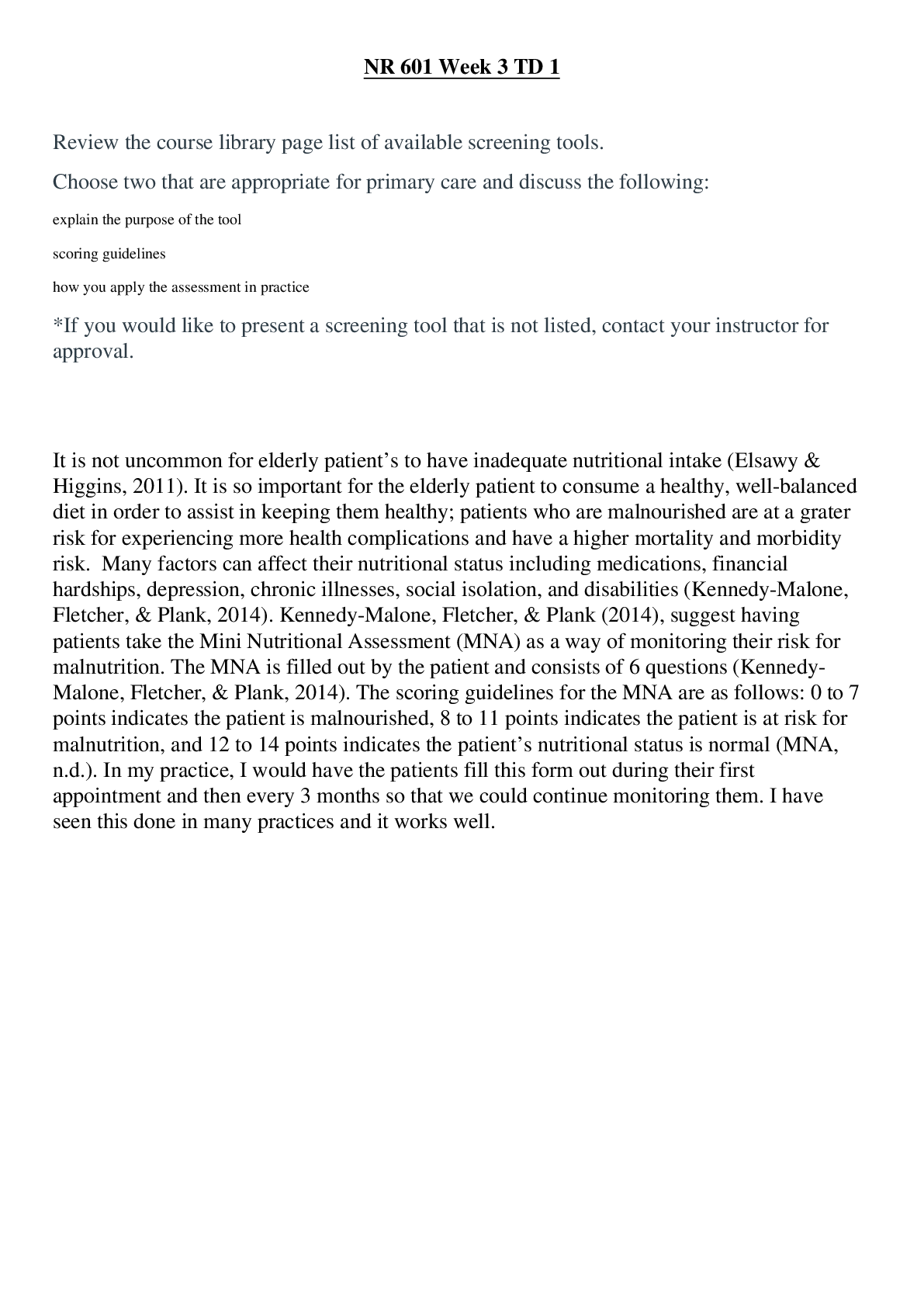
NR 601 Week 3 TD 1 Review the course library page list of available screening tools. Choose two that are appropriate for primary care and discuss the following: • explain the purpose of the too ... l • scoring guidelines • how you apply the assessment in practice *If you would like to present a screening tool that is not listed, contact your instructor for approval. It is not uncommon for elderly patient’s to have inadequate nutritional intake (Elsawy & Higgins, 2011). It is so important for the elderly patient to consume a healthy, well-balanced diet in order to assist in keeping them healthy; patients who are malnourished are at a grater risk for experiencing more health complications and have a higher mortality and morbidity risk. Many factors can affect their nutritional status including medications, financial hardships, depression, chronic illnesses, social isolation, and disabilities (Kennedy-Malone, Fletcher, & Plank, 2014). Kennedy-Malone, Fletcher, & Plank (2014), suggest having patients take the Mini Nutritional Assessment (MNA) as a way of monitoring their risk for malnutrition. The MNA is filled out by the patient and consists of 6 questions (Kennedy-Malone, Fletcher, & Plank, 2014). The scoring guidelines for the MNA are as follows: 0 to 7 points indicates the patient is malnourished, 8 to 11 points indicates the patient is at risk for malnutrition, and 12 to 14 points indicates the patient’s nutritional status is normal (MNA, n.d.). In my practice, I would have the patients fill this form out during their first appointment and then every 3 months so that we could continue monitoring them. I have seen this done in many practices and it works well. Affective disorders and cognitive disorders become more common as one ages, especially delirium, dementia, and depression (Kennedy-Malone, Fletcher, & Plank, 2014). Depression is under diagnosed, especially in older patients (Kennedy-Malone, Fletcher, & Plank, 2014). There are a number of screening tools that providers can use in the office setting to screen for depression, such as the Patient Health Questionnaire (PHQ) and the Geriatric Depression Scale: Short Form (GDS:SF) (Kennedy-Malone, Fletcher, & Plank, 2014). My clinical site last session and my clinical site this session [Show More]
Last updated: 3 years ago
Preview 1 out of 5 pages
Buy this document to get the full access instantly
Instant Download Access after purchase
Buy NowInstant download
We Accept:
Can't find what you want? Try our AI powered Search
Connected school, study & course
About the document
Uploaded On
Jan 26, 2021
Number of pages
5
Written in
All
This document has been written for:
Uploaded
Jan 26, 2021
Downloads
0
Views
58
Scholarfriends.com Online Platform by Browsegrades Inc. 651N South Broad St, Middletown DE. United States.
We're available through e-mail, Twitter, and live chat.
FAQ
Questions? Leave a message!
Copyright © Scholarfriends · High quality services·