NFDN 2005 SLOS PEDIATRICS
UNIT 1: GROWTH AND DEVELOPMENT IN CHILDREN
Growth: a quantitative change that can be measured. IE: Weight and height, head circumference, body proportion, and body systems.
Development:
...
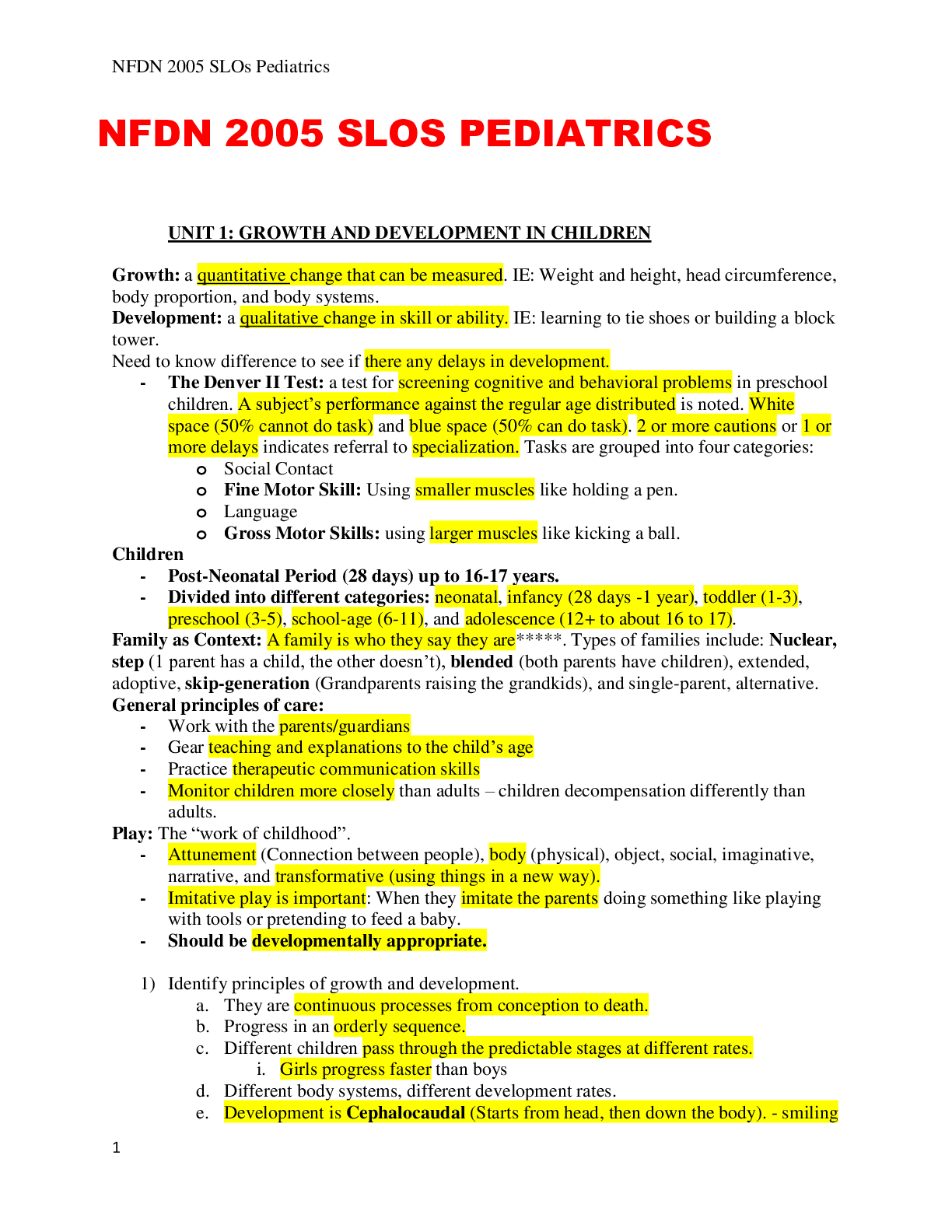
NFDN 2005 SLOS PEDIATRICS
UNIT 1: GROWTH AND DEVELOPMENT IN CHILDREN
Growth: a quantitative change that can be measured. IE: Weight and height, head circumference, body proportion, and body systems.
Development: a qualitative change in skill or ability. IE: learning to tie shoes or building a block tower.
Need to know difference to see if there any delays in development.
- The Denver II Test: a test for screening cognitive and behavioral problems in preschool children. A subject’s performance against the regular age distributed is noted. White space (50% cannot do task) and blue space (50% can do task). 2 or more cautions or 1 or more delays indicates referral to specialization. Tasks are grouped into four categories:
o Social Contact
o Fine Motor Skill: Using smaller muscles like holding a pen.
o Language
o Gross Motor Skills: using larger muscles like kicking a ball.
Children
- Post-Neonatal Period (28 days) up to 16-17 years.
- Divided into different categories: neonatal, infancy (28 days -1 year), toddler (1-3), preschool (3-5), school-age (6-11), and adolescence (12+ to about 16 to 17).
Family as Context: A family is who they say they are*****. Types of families include: Nuclear, step (1 parent has a child, the other doesn’t), blended (both parents have children), extended, adoptive, skip-generation (Grandparents raising the grandkids), and single-parent, alternative.
General principles of care:
- Work with the parents/guardians
- Gear teaching and explanations to the child’s age
- Practice therapeutic communication skills
- Monitor children more closely than adults – children decompensation differently than adults.
Play: The “work of childhood”.
- Attunement (Connection between people), body (physical), object, social, imaginative, narrative, and transformative (using things in a new way).
- Imitative play is important: When they imitate the parents doing something like playing with tools or pretending to feed a baby.
- Should be developmentally appropriate.
1) Identify principles of growth and development.
a. They are continuous processes from conception to death.
b. Progress in an orderly sequence.
c. Different children pass through the predictable stages at different rates.
i. Girls progress faster than boys
d. Different body systems, different development rates.
e. Development is Cephalocaudal (Starts from head, then down the body). - smiling f. Developme
[Show More]