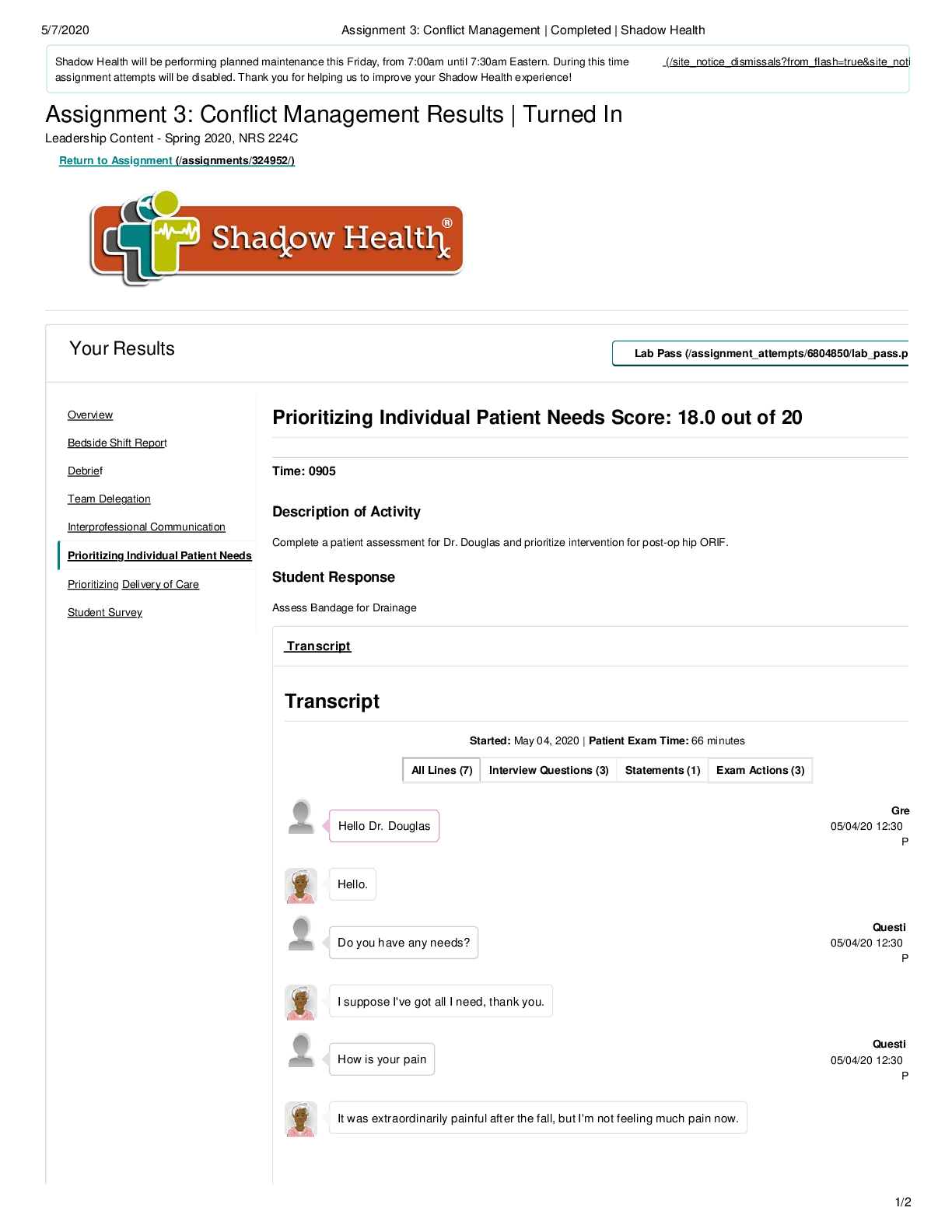
Assignment 3: Conflict Management
Results | Turned In
Return to Assignment
Your Results
Lab Pass
Overview
Bedside Shift Report
Debrief
Team Delegation
Interprofessional Communication
Prioritizing I
...
Assignment 3: Conflict Management
Results | Turned In
Return to Assignment
Your Results
Lab Pass
Overview
Bedside Shift Report
Debrief
Team Delegation
Interprofessional Communication
Prioritizing Individual Patient Needs
Prioritizing Delivery of Care
Experience Overview
Assignment 3: Conflict Management
Digital Clinical Experience Score
Total Time
103 minutes
103 minutes interacting with patients
0 minutes spent in post-exam activities
96.0%
The DCE score represents a weighted score based on all learning activities in this assignment.
Some learning activities have been assigned greater value than others. This score may not be your
final grade if your instructor chooses to include additional components, such as rationales or time
spent.
Activity Scores 96.0/100 points
Bedside Shift Report 19.0/20 points
Team Delegation 15.0/15 points
Interprofessional Communication 17.0/20 points
Prioritizing Individual Patient Needs 20.0/20 points
Prioritizing Delivery of Care 25.0/25 points
Bedside Shift Report Score: 19.0 out of 20
Time: 0600
Ben: Hey there, Dr. Douglas, I'm heading out now. This is the nurse who'll be
taking over for me.
Anita: Nice to meet you.
Nice to meet you too, Dr. Douglas.
Anita: Shame it couldn't be under better circumstances. But when bodies get old
enough, I guess they just have a habit of breaking.
Ben: Anybody can break a bone, Dr. Douglas, but it's true that we'd like you to be
careful. All right, I know hospital stays aren't any fun, but I'm leaving you in
excellent hands, here.
Anita: I sure hope so. [AUDIO COMING SOON]
I'll be checking in with you about once an hour today.
Ben: Here we go. Dr. Douglas is a 72-year-old woman with a displaced
You scored
1.0 out of 1
The correct answer I don't need to ask annow. Dr. Douglas camthe left femur, was gbeen receiving PT for
intertrochanteric fracture of the left femur. She had an open reduction and internal
fixation two days ago, and now she's receiving physical therapy to help with her
mobility. The orthopaedic surgeon on her case is Dr. Mayleen Zhang, and her
physical therapist is Dr. Virgil Kline. Her hospitalist is Dr. Mateo Martinez.
What else do you need to ask Ben about Anita Douglas's Situation?
I don't need to ask any questions right now. Dr. Douglas came in with a
fracture of the left femur, was given an ORIF, and has been receiving PT for
mobility. Got it.
I don't need to ask any questions right now. Dr. Douglas came in
with a fracture of the left femur, was given an ORIF, and is now
receiving PT for mobility. Got it.
Ben: Great! Let's move on to the Background of Dr. Douglas's
case . . .
Why is this the best question to ask Ben about Anita Douglas's
Situation?
For review, here are the selections that were available in the
previous problem:
I don't need to ask any questions right now. Dr. Douglas came in
with a fracture of the left femur, was given an ORIF, and has been
receiving PT for mobility. Got it. (correct)
Will Dr. Kline be visiting Dr. Douglas this afternoon?
Does Dr. Douglas have any medical allergies?
It is important to practice listening during a Bedside Shift
report. Your response shows your understanding and does not
cause any unnecessary interruptions to Ben's report.
You scored
1.0 out of 1
The correct answer is:
It is important to practice listening durireport. Your response shows your undenot cause any unnecessary interruptionBen: So, three days ago, at around 0630 hours, Dr. Douglas slipped and fell while she was alone at
home. She felt a sharp pain and knew something was wrong. She couldn't get to her phone, so she held
still and waited for her husband to come home. At 0800 hours, Dr. Douglas reported at our Emergency
Department with pain in her groin and inability to support weight. She had an open reduction and
internal fixation at 1200 hours. At 1700 hours that day, she was moved here to Med-Surg for postoperative care.
Ben: The physician has prescribed her 1 hydrocodone/acetaminophen tablet (5 mg hydrocodone and
325 mg acetaminophen) every 4-6 hours for post-operative pain, to be increased as needed up to 2 tabs
every 4-6 hours. Physician also prescribed her apixaban for anticoagulation, at 2.5 mg twice a day, and
she's been given thromboembolic deterrent hose (known as a TED hose). Dr. Douglas has been
receiving regular physical therapy.
Ben: Her vital signs are all within normal limits. Her respirations are 15 per minute and her oxygen
saturation is 98%.
Ben: And now for the provider's orders. Administer the hydrocodone as scheduled. Every four hours,
monitor fluid input and output. Perform peripheral neurovascular checks every 8 hours until discharge.
Provide ice as needed. Incentive spirometer 10 times per hour while awake. Check SpO2 every 8 hours
and as needed to keep oxygen saturation over 92%. Notify the MD if there's a significant increase in O2
needs. Keep dressing dry and notify MD if there's significant drainage. Dr. Douglas will need to
perform weight-bearing exercises with physical therapy, and go from bed to chair at least 2 times per
day.
What else do you need to ask Ben about Anita Douglas's Background?
Does Dr. Douglas take any home medications?
Ben: Dr. Douglas takes a trandolapril and verapamil combination pill and
chlorothiazide for hypertension, along with calcium and vitamin D
supplements. She doesn't have any allergies to medicine or food.
Why is this the best question to ask Ben about Anita Douglas's Background?
Learning what home medications a patient takes can help you to gain a
full picture of your patient's circumstances.
You scored
1.0 out of 1
The correct answer is:
Learning what home medtakes can help you to gainpatient's circumstances.
Ben: The dressing is clean and Dr. Douglas's skin shows no sign of infection. Dr. Douglas is
stable, alert and oriented x4. Color, pulse, warmth, pain, sensation, and movement in
extremities are all within normal limits. No disproportionate swelling. Strength of active
movement against moderate resistance was last rated as 4 out of 5.
What else do you need to ask Ben about his Assessment of Anita Douglas's condition?
What is Dr. Douglas's pain rating, and how well is her pain being controlled by
medication?
You score1.0 out ofThe correWhat is Drating, anbeing conBen: Good catch! Dr. Douglas's pain is under control with
medication. Her pain was last reported as 2 out of 10. Pain at the
worst was reported as an 8 out of 10.
Why is this the best question to ask Ben about Anita Douglas's
Assessment?
Assessing a patient's response to medication is an important
nursing duty, and you need to understand how well Dr.
Douglas's pain medication is working.
You scored
1.0 out of 1
The correct answer is:
Assessing a patient's response to medicnursing duty, and you need to understaDouglas's pain medication is working.
Ben: Dr. Douglas is going to need help with her physical therapy exercises. She's at risk for falls,
so you'll be helping with ambulation and self-care, too. Depending on her pain, you may also
need to help with positioning throughout the day. Dr. Douglas has a PT session this morning at
0630 hours, and the MD will change her dressing at 0800 hours. Her husband, Jeffrey, is
You sc1.0 ou
scheduled to visit at 1400 hours today.
What else do you need to ask Ben about his Recommendation for Anita Douglas's care?
Do you have any recommendations for patient assessment?
The coDo yourecompatienBen: Thanks for reminding me! When you do your hourly check-in, I
recommend that you perform musculoskeletal, strength, and skin checks, and
monitor respiratory status. Monitor fluid input and output and perform
neurovascular checks as ordered. You'll want to perform mental status checks
every 4 hours with orientation x4. Since Dr. Douglas is on pain medication, I
recommend that you assess her pain before and after her physical therapy.
Why is this the best question to ask Ben about his Recommendation for Anita
Douglas's care?
Patient assessment is an important part of the nursing process and
therefore something Ben should take into consideration when making his
recommendations.
You scored
1.0 out of 1
The correct answer is:
Patient assessment is annursing process and thershould take into considehis recommendations.
What else would you like to ask Ben about Anita Douglas's case?
Does Dr. Douglas have any cultural or dietary considerations
I should be aware of?
You scored
1.0 out of 1
The correct answer is:
Does Dr. Douglas have any cultural or dshould be aware of?
Ben: Actually, Dr. Douglas here is a vegetarian. I think we've got
a few of those on the floor right now.
Anita: I can't bring myself to eat animals; I worked with them too
long. Eggs and dairy are all fine, though.
Why was this the best question to ask Ben as a follow-up to his
Bedside Shift Report for Anita Douglas?
Learning about a patient's unique needs will help you to
effectively and respectfully provide for their care.
You scored
1.0 out of 1
The correct answer is:
Learning about a patient's unique needeffectively and respectfully provide for tBen: And that should be it. I am transferring Dr. Douglas into your care. You can call me if you have any quesIt was nice to meet you, Dr. Douglas.
Anita: You too, I suppose.
Time: 0605
Ben: Hi, Mrs. O'Connor. This is the nurse who will be replacing me for the day.
Debbie: Hey, there.
Hello, Mrs. O'Connor. I'll be checking in with you regularly throughout the day.
Debbie: Glad to hear it.
Ben: Mrs. O'Connor, I'm going to be transferring your care to your replacement here using a Bedside Shift
Report. We do patient handoffs at the patient's bedside so that you can be involved and so that you can hear
what's going on when it comes to your care.
Debbie: Honey, it's not my first rodeo.
Ben: Fair enough. Let's begin.
Ben: Here's the Situation. Debbie O'Connor is a woman with COPD exacerbation. Her hospitalist is Dr.
Mateo Martinez and her pulmonologist is Dr. Gina Tremblay.
What else do you need to ask Ben about Debbie O'Connor's Situation?
What is Mrs. O'Connor's age?
Ben: Mrs. O'Connor is 55.
Why is this the best question to ask Ben about Debbie O'Connor's
Situation?
Knowing a patient's age can help you to gain a broad
understanding of their condition. You may need to consider
their age when performing interventions.
[Show More]

 Exam_ANSWERED Questions.png)