A manager wants to see if it is worth going back for an MBA degree. They randomly sample 18
managers' salaries before and after undertaking a MBA degree and record their salaries in
thousands of dollars. Assume Salarie
...
A manager wants to see if it is worth going back for an MBA degree. They randomly sample 18
managers' salaries before and after undertaking a MBA degree and record their salaries in
thousands of dollars. Assume Salaries are normally distributed. Test the claim that the MBA
degree, on average, increases a manager’s salary. Use a 10% level of significance.
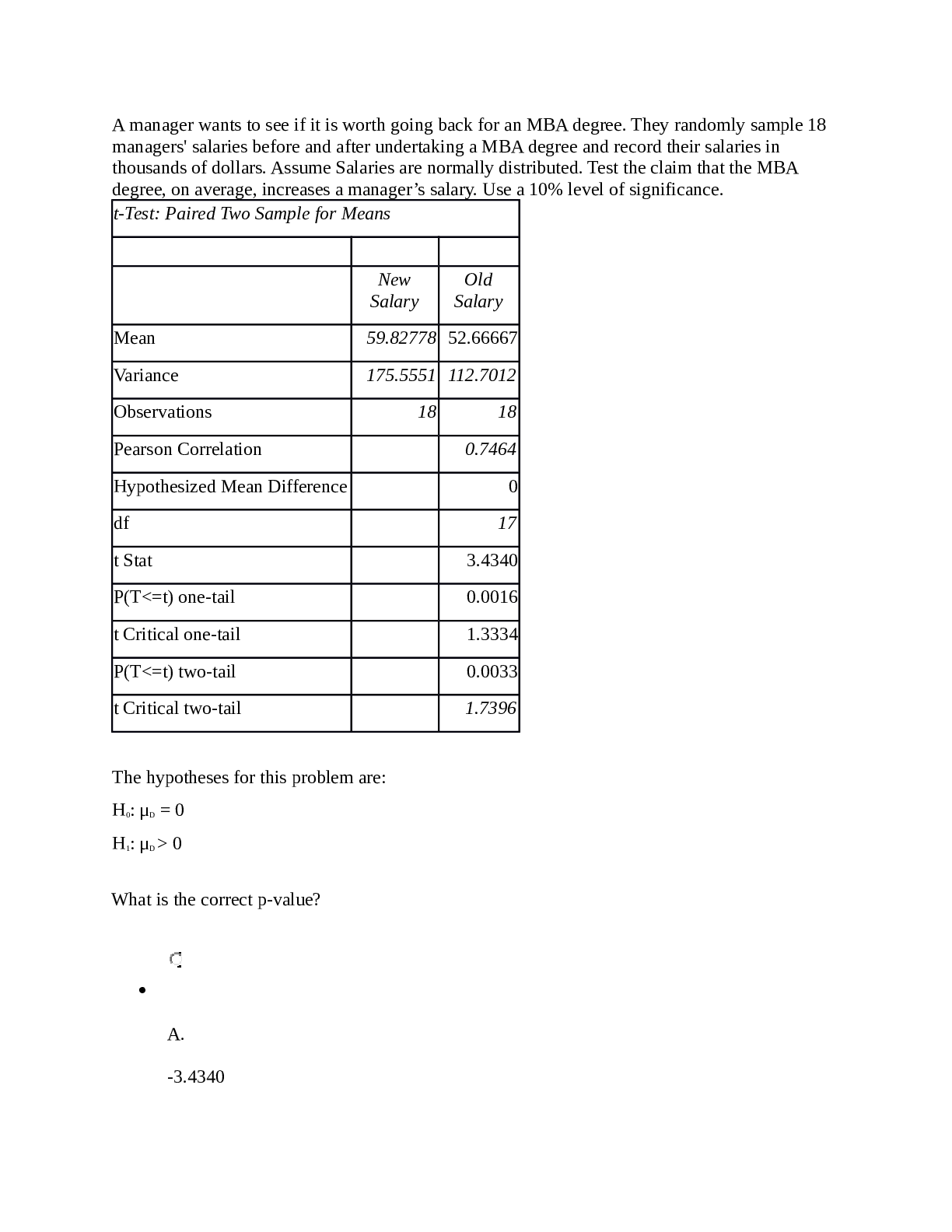
t-Test: Paired Two Sample for Means
New
Salary
Old
Salary
Mean 59.82778 52.66667
Variance 175.5551 112.7012
Observations 18 18
Pearson Correlation 0.7464
Hypothesized Mean Difference 0
df 17
t Stat 3.4340
P(T<=t) one-tail 0.0016
t Critical one-tail 1.3334
P(T<=t) two-tail 0.0033
t Critical two-tail 1.7396
The hypotheses for this problem are:
H0: μD = 0
H1: μD > 0
What is the correct p-value?
A.
-3.4340
B.
-1.3334
C.
0.0033
D.
0.0016
E.
0.7464
Answer Key:D
Feedback:
No calculations are needed. The answer is given to you in the output.
P(T<=t) one-tail 0.0016
Question 2 of 20
0.0/ 1.0 Points
An adviser is testing out a new online learning module for a placement test. They wish to test the
claim that on average the new online learning module increased placement scores at a
significance level of α = 0.05. For the context of this problem, μD=μnew–μold where the first data set
represents the new test scores and the second data set represents old test scores. Assume the
population is normally distributed.
H0: μD = 0
H1: μD < 0
You obtain the following paired sample of 19 students that took the placement test before and
after the learning module:
Choose the correct decision and summary and state the p-value.
New
LM Old LM
58.1 55.8
58.3 53.7
83.6 76.6
49.5 47.5
51.8 48.9
20.6 11.4
35.2 30.6
46.7 54
22.5 21
47.7 58.5
51.5 42.6
76.6 61.2
29.6 26.8
14.5 12.5
43.7 56.3
57 43.1
66.1 72.8
38.1 42.2
42.4 51.3
A.
Reject H0, there is not enough evidence to support the claim that on average the new
online learning module increased placement scores, the p-value = 0.2266.
B.
Do not reject H0, there is not enough evidence to support the claim that on average the
new online learning module increased placement scores, the p-value = 0.4533.
C.
Reject H0, there is enough evidence to support the claim that on average the new online
learning module increased placement scores, the p-value = 0.4533.
D.
Do not reject H0, there is not enough evidence to support the claim that on average the
new online learning module increased placement scores, the p-value = 0.2266
Answer Key:D
Feedback:
Copy and paste the data into Excel. Use the Data Analysis Toolpak in Excel.
Data - > Data Analysis -> scroll to where is says t:Test: Paired Two Samples for Means -> OK
Variable 1 Range: is New LM
Variable 2 Range: is Old LM
The Hypothesized Mean Difference is 0 and make sure you click Labels in the first row and click
OK. You will get an output and this is the p-value you are looking for.
P(T<=t) one-tail 0.2266
Part 2 of 7 - Week 6: Comparing Two Independent Population Proportions 2.0/ 3.0 Points
Question 3 of 20
0.0/ 1.0 Points
Two competing toothpaste brands both claim to produce the best toothpaste for whitening. A
dentist randomly samples 48 patients that use Brand A (Group 1) and finds 30 of them are
satisfied with the whitening results of the toothpaste. She then randomly samples 45 patients that
use Brand B (Group 2) and finds 33 of them are satisfied with the whitening results of the
toothpaste. Construct a 99% confidence interval for the difference in proportions and use it to
decide if there is a significant difference in the satisfaction level of patients.
Enter the confidence interval - round to 3 decimal places.
0.356 < p1 - p2 < 0.319
Answer Key:-0.356|-.356, 0.139|.139
Feedback:
Z-Critical Value =NORM.S.INV(.995) = 2.575
LL = (.625-.7333) - 2.575*
UL = (.625-.7333) + 2.575*
Question 4 of 20
1.0/ 1.0 Points
A researcher took a random sample of 200 new mothers in the United States (Group 1) and found
that 16% of them experienced some form of postpartum depression. Another random sample of
200 new mothers in France (Group 2), where mothers receive 16 weeks of paid maternity leave,
found that 11% experienced some form of postpartum depression. Can it be concluded that the
percent of women in the United States experience more postpartum depression than the percent
of women in France? Use α=0.05.
Select the correct alternative hypothesis and decision .
A.
H1: p1 ≠ p2; Do not reject the null hypothesis.
B.
H1: p1 ≠ p2; Reject the null hypothesis.
C.
H1: p1 > p2; D
[Show More]


, 3e by Steven Krantz.png)






.png)


.png)


