NURS 6541 final may 2020
Question 1
1 out of 1 points
A small-for-gestational-age, dysmorphic newborn infant has microcephaly and sloping forehead, cutis aplasia (missing portion
of the skin and hair) of the scalp, p
...
NURS 6541 final may 2020
Question 1
1 out of 1 points
A small-for-gestational-age, dysmorphic newborn infant has microcephaly and sloping forehead, cutis aplasia (missing portion
of the skin and hair) of the scalp, polydactyly, microphthalmia, and omphalocele. Which of these is the most likely diagnosis?
Selected Answer: a.
Patau syndrome (trisomy 13)
• Question 2
• 1 out of 1 points
A 16-year-old girl has enuresis, frequent urination, a white vaginal discharge, and a dark rash around
her neck. Her serum glucose level is 250 mg/dL, and her urinalysis is positive for 2+ glucose but is
otherwise negative. Which of the following is the most likely diagnosis?
Selected Answer: c.
Type II diabetes
• Question 3
• 1 out of 1 points
Mark, age 15, is 5 feet tall andn weighs 85 pounds. You suspect anorexia and know that the best initial approach is to
Selected Answer: d.
Confront Mark with the fact that you suspect an eating disorder.
• Question 4
• 1 out of 1 points
Which of the following is not a sign or symptom of congenital hypothyroidism?
Selected Answer: d.
Frequent stooling
• Question 5
• 0 out of 1 points
While doing a 5-year-old well child exam, you notice two small patches of hair loss. Broken hair is present, as is erythema and
scaling. On the basis of this information, which of these is the likely diagnosis?
Selected Answer: c.
Alopecia areata
• Question 6
• 1 out of 1 points
Hope is a 7-month-old who presents in January with a 1-day history of cough, yellow nasal discharge,and low-grade temp (T max 100°F). She was previously healthy. She does have 2+ edema of the nasal
turbinates and cloudy rhinorrhea. She is afebrile in the office. Her chest, mouth, and ears are clear.
You prescribe:
Selected Answer: d.
Saline drops, bulb suction, humidified air, and increased PO fluids
• Question 7
• 1 out of 1 points
The parents of an 8-year-old Down Syndrome boy arrive for his annual well-child visit. He wants to participate in sports,
including the Special Olympics. Until further examination can be completed, which of the following sports would you suggest
as being safe?
Selected Answer: a.
Tennis
• Question 8
• 1 out of 1 points
Jason, age 14, appears with tender discoid breast tissue enlargement (2-3 cm in diameter) beneath the areola. Your next action
would be to
Selected Answer: a.
Perform watchful waiting for 1 year.
• Question 9
• 1 out of 1 points
You see a 7-year-old boy a day after he was bitten by his pet dog. According to the mother, the dog
bit the child after he snuck up on the dog and grabbed his tail. The dog has had all its vaccinations,
including rabies. The child has had no fever, has full movement of the injured limb, and has no sign
of neurologic or vascular injury. The wound is on the child’s forearm, is not deep, and is not bleeding,
but has developed about 2 cm of erythema surrounding the site. Which of the following is the most
appropriate treatment?
Selected Answer: c.
Oral amoxicillin-clavulanate for 7-14 days
• Question 10
• 1 out of 1 points
A head injury in which bruising or tearing of the cerebral structures occurs is a
Selected Answer: d.
Contusion
• Question 11
• 1 out of 1 pointsA 14-year-old has a 3-week history of fever, anorexia, and abdominal pain. What additional symptom would cause the NP to
suspect Crohn's disease?
Selected Answer: b.
Blood, mucous diarrhea
• Question 12
• 1 out of 1 points
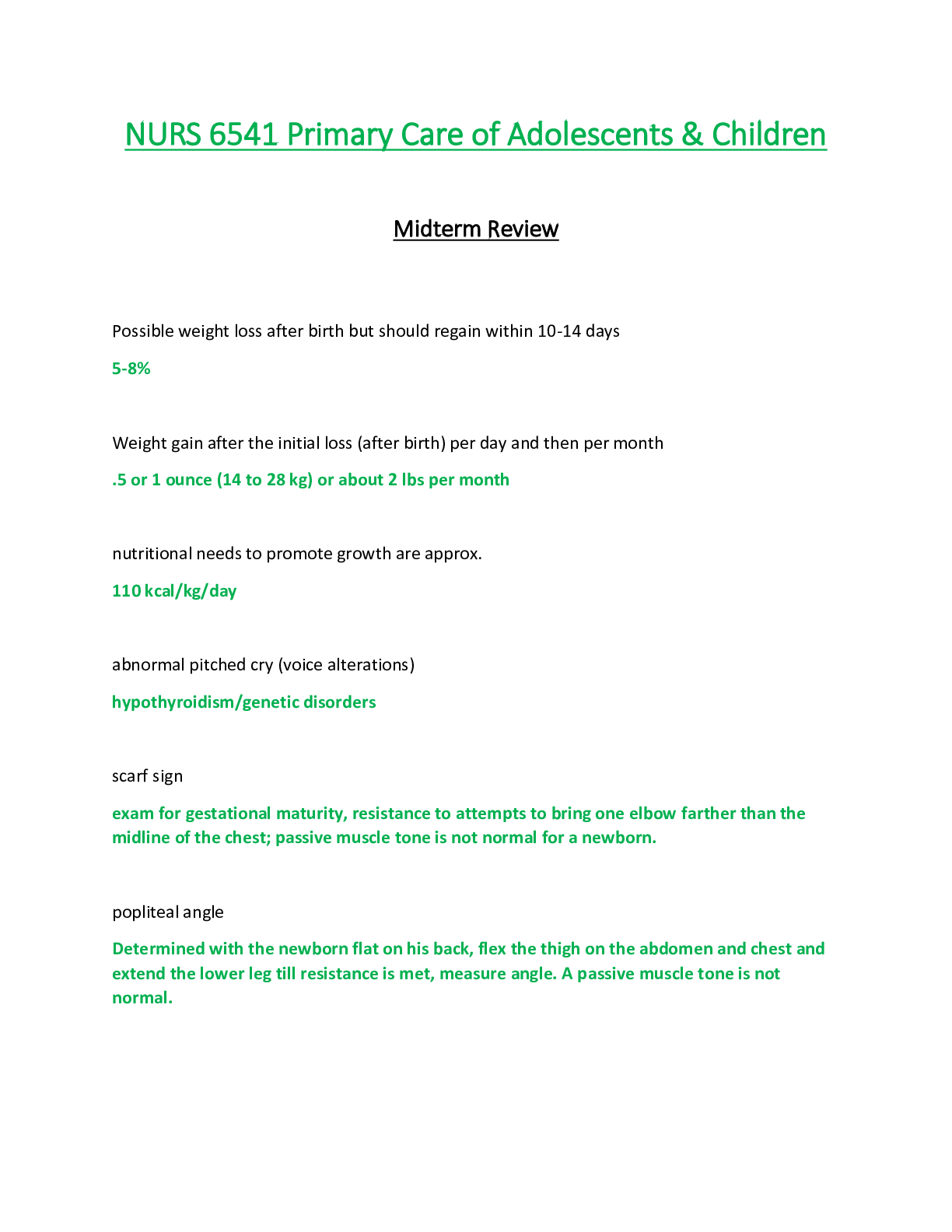
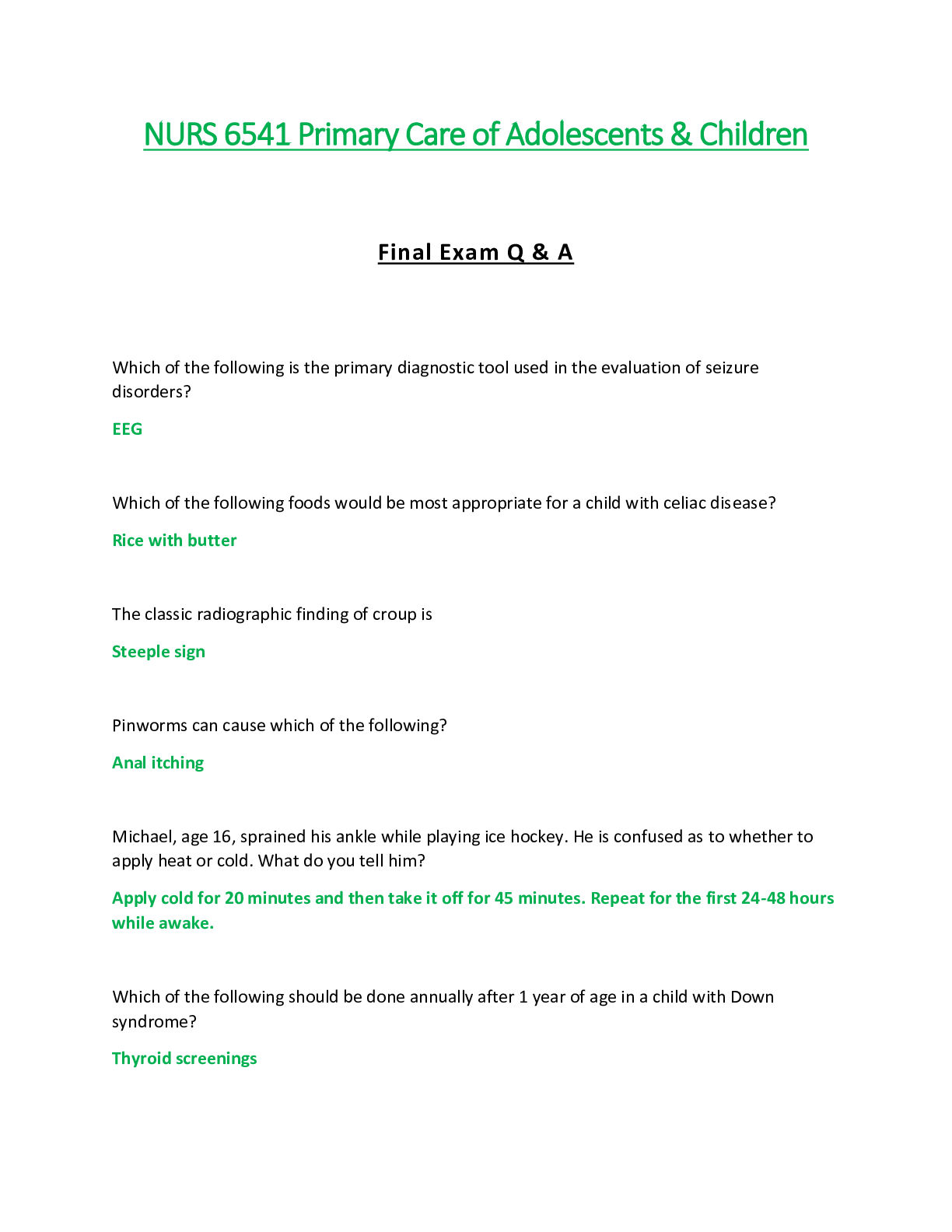
Which of the following should be done annually after 1 year of age in a child with Down syndrome?
Selected Answer: a.
Thyroid screenings
• Question 13
• 1 out of 1 points
A previously healthy male has a 3-month history of increasing headaches, blurred vision, and
personality changes. Previously he admitted to marijuana experimentation more than 1 year ago. On
examination he is a healthy, athletic-appearing 17-year-old with decreased extraocular range of
motion and left eye visual acuity. Which of the following is the best next step in his management?
Selected Answer: c.
Neuroimaging
• Question 14
• 1 out of 1 points
Kelly, your 11-year-old well visit patient, presents to the office with weight loss, polyuria, and polydipsia. Which of the
following do you need to rule out?
Selected Answer: d.
Diabetes mellitus
• Question 15
• 1 out of 1 points
A 3-week old presents to the office in January with a 1-week history of nasal congestion and occastional cough. On the night
prior to the visit in infant developed a fever 102ºF rectally, was difficult to breastfeed, and had paroxysmal coughing and noisy,
labored breathing. On exam, you note an ill-appearing infant who is lethergic with wheezing, tachypnea, and intercostal
retractions. The infant is home with the mom at this time; however, has a sibling who is 4-years-old and is in daycare and
recently had cold symptoms. If the patient has been diagnosed with RSV bronchiolitis, which of the following would be the
treatment of choice?
Selected Answer: a.
Fluids and nutritional support and close monitoring
• Question 16
• 1 out of 1 points
Chest pain in young children is usuallySelected Answer: a.
Noncardiac in origin
• Question 17
• 1 out of 1 points
Maddie, age 2, had a complete blood count (CBC) drawn at her last visit. It indicates that she has a microcytic hypochromic
anemia. What should you do now at this visit?
Selected Answer: a.
Obtain a lead level.
• Question 18
• 1 out of 1 points
Most children with Duchenne muscular dystrophy become wheelchair dependent by what age?
Selected Answer: b.
4 to 6 years of age
• Question 19
• 1 out of 1 points
The following clinical description best matches which genetic disorder? A tall, thin 14-year-old boy
has no signs of puberty. He was delayed in his speech development and always has done less well in
school than his siblings. He is shy, and teachers report his activity is immature. Physical examination
reveals breast development, and long limbs with a decreased upper segment/lower segment ration. He
has small testes and phallus.
Selected Answer: e.
Klinefelter syndrome (XXY)
• Question 20
• 1 out of 1 points
Of the following patients, which child should not receive a tuberculin skin test?
Selected Answer: d.
A 2-year-old who was infected with RSV 2 months ago and is currently asymptomatic.
• Question 21
• 1 out of 1 points
A 10-year-old male presents with a fever of 102ºF and complaints of leg pains. His mother reports
that he had an upper respiratory infecion with a sore throat about 2 weeks ago. No treatment was
needed. On examination, he has tender and swollen knees bilaterally. His heart rate is 125 bpm and a
blowing systolic murmur is heard at the apex. No murmur was noted at in the chart. The mostly
diagnosis is:Selected Answer: a.
Rheumatic fever
• Question 22
• 1 out of 1 points
When a neonate is initially protected against measles, mumps, and rubella because the mother is immune, this is an example of
which type of immunity?
Selected Answer: b.
Natural passive
• Question 23
• 1 out of 1 points
Sarah, age 13, is markedly obese and has a poor self-image. How do you differentiate between compulsive eating and bulemia?
Selected Answer: a.
A compulsive eater does not induce vomiting.
• Question 24
• 1 out of 1 points
Seborrhea dermatitis is common for both infants and adolescents. Which is not correct for this condition?
Selected Answer: b.
The condition in adolescents is known as acne with comedones and popular and pustular lesions.
• Question 25
• 1 out of 1 points
Which chromosomal abnormality is associated with short stature in girls?
Selected Answer: b.
Turner syndrome
• Question 26
• 1 out of 1 points
You see a patient you believe has folliculitis. What medication would be the best to treat this patient? The patient has no
allergies.
Selected Answer: c.
Dicloxacillin
• Question 27
• 1 out of 1 points
Antibiotic therapy is one of the mainstays of treatment for which of the following causes of wheezing?Selected Answer: b.
Epiglottitis
• Question 28
• 1 out of 1 points
Which of the following symptoms are most suggestive of pneumonia in a young child?
Selected Answer: a.
Fever, tachypnea, coryza, cough, scattered rales
• Question 29
• 1 out of 1 points
An 11-year-old has been diagnosed with mild intermittent asthma. Which of the following is not a routine part of the clinical
management?
Selected Answer: a.
School excuse to not participate in recess and/or physical education activities
• Question 30
• 0 out of 1 points
Generalized absence seizures usually occur in which age group?
Selected Answer: a.
Middle-aged adults
• Question 31
• 1 out of 1 points
Which test is routinely recommended for a preparticipation sports physical?
Selected Answer: c.
A Snellen test
• Question 32
• 0 out of 1 points
A healthy, thriving 4-year-old male has had sudden episodes of drawing his knees to his chest and crying like he is in acute pain
for the last 5 hours. These episodes are separated by quiet times when he appears normal and comfortable. He is not vomiting
and has not had a bowel movement today. What is the most likely diagnosis.
Selected Answer: d.
Hirschprung disease
• Question 33
• 1 out of 1 pointsA 15-day-old infant has respiratory distress. A quick observation suggests she has slight cyanosis,
hepatosplenomegaly, and features consistent with Down Syndrome. The cardiac examination
demonstrates a loud first heart sound, a low-pitched, mid-diastolic murmur at the lower left sternal
border, and a harsh apical holosystolic murmur in the mitral area. Which of the following cardiac
conditions most likely explains her heart findings?
Selected Answer: b.
Complete atrioventricular canal (endocardial cushion defect)
• Question 34
• 0 out of 1 points
An ex-preemie with bronchopulmonary dysplasia has been discharged to home from the NICU. One potential problem area that
requires close monitoring is
Selected Answer: a.
Temperature control.
• Question 35
• 1 out of 1 points
A 16-year-old presents with pharyngitis, cough, and high fever. Her chest x-ray reveals bilateral pulmonary infiltrates. Her white
blood cell count is normal and the neutrophil count is normal. The most likely etiology is
Selected Answer: b.
Chlamydia pneumonia
• Question 36
• 1 out of 1 points
Which of the following vaccines provides protection against a common type of sepsis/meningitis?
Selected Answer: b.
Haemophius influenzae vaccine
• Question 37
• 1 out of 1 points
A mother brings a 2-year-old to your office with the complaint that she passes 5 to 10 watery stools per day that often contain
undigested food. The child appears healthy and has no other GI symptoms. She is acting, eating, and voiding normally. Weight
gain is normal and the mother states she often drinks (her favorite drink is Kool-Aid) instead of eating. The best management for
this condition is:
Selected Answer: c.
Counsel to decrease fluid intake, increase dietary fiber, and increase fats to 40% of calories.
• Question 38
• 1 out of 1 points
Six months after being diagnosed with what appears to be insulin-dependent diabetes, the 5-year-old in the case presentation has
a significant decrease in his insulin requirement. Which of the following is the most likely explanation?Selected Answer: b.
He has entered the "honeymoon phase" of his diabetes.
• Question 39
• 1 out of 1 points
Grace, age 15, has been diagnosed with acne. Which of the following is not true with this condition?
Selected Answer: a.
Poor hygiene is the primary cause of acne.
• Question 40
• 1 out of 1 points
All of the following is treatment for a child with phimosis except
Selected Answer: a.
Ice packs
• Question 41
• 1 out of 1 points
Primary dysmenorrhea is due to
Selected Answer: b.
Elevated prostaglandin level
• Question 42
• 1 out of 1 points
Children in child care facilities are at greater risk of being exposed to which of the following infections?
Selected Answer: d.
HAV
• Question 43
• 1 out of 1 points
A 14-month-old child has lower extremity bowing, a waddling gait, genu varum, and is at the
5th percentile for height. Laboratory data include low-normal serum calcium, moderately low serum
phosphate, and elevated serum alkaline phosphatase levels, hyperphosphaturia, and normal
parathyroid levels. Which of the following is the most likely diagnosis?
Selected Answer: a.
Genetic primary hypophosphatemia
• Question 44
• 1 out of 1 pointsA child has developed her second perirectal abscess in 6 months. She should be evaluated for which of the following conditions?
Selected Answer: d.
Crohn's disease
• Question 45
• 1 out of 1 points
The classic radiographic finding of croup is
Selected Answer: b.
Steeple sign
• Question 46
• 1 out of 1 points
What is the primary treatment for testicular torsion?
Selected Answer: a.
Immediate surgical referral
• Question 47
• 1 out of 1 points
You see a 7-year-old with a positive stool culture for Salmonella enteriditis. The appropriate therapy for a non-dehydrated child
is
Selected Answer: d.
Bland diet with focus on maintaining hydration
• Question 48
• 1 out of 1 points
Riley, a 12-year-old girl, has scaly, hyperpigmented lesions in a "Christmas tree" distribution. It is predominantly on her trunk.
One lesion is on her buttock that is larger than the other, at about 4 cm in diameter. What is your diagnosis?
Selected Answer: a.
Pityriasis rosea
• Question 49
• 1 out of 1 points
You are on call and receive a phone call from the parents of a 13-year-old known asthmatic. She has been having chest tightness
and a worsening cough for 48 hours. She has significant nasal discharge that began 14 days ago and intermittent complaint of
headache. She is now running a low-grade fever. Her peak flow the last 48 hours is 70–80% of personal best. Her temperature
right now is 101.7°F. She is on salmeterol with corticosteroid (Advair) and PRN albuterol. Which of the following is most
appropriate?
Selected
Answer:
d.
See her in the office in the morning and prescribe a 14-day course of amoxicillin plus the addition of a
short course of oral steroids.• Question 50
• 1 out of 1 points
Which of the following therapeutic options is common for the treatment of both bee stings and bite wounds?
Selected Answer: b.
Tetanus vaccination
• Question 51
• 1 out of 1 points
A common presenting symptom of inflammatory bowel disease is
Selected Answer: d.
Unexplained fever
• Question 52
• 1 out of 1 points
Newborn R.T. has a vascular lesion that will not fade as she gets older. What is your diagnosis?
Selected Answer: a.
Port-wine stain (nervus flammeus)
• Question 53
• 0 out of 1 points
Ana is a 14-year-old female and has not yet started her menstrual cycle. The history is noncontributory and the physical is
normal. Mom started her menstrual cycle at 14-years of age. Ana's breast development and pubic hair began about a year ago.
Mom is very concerned. The most appropriate initial step would be to
Selected Answer: a.
Do a pregnancy test
• Question 54
• 1 out of 1 points
The diet of a 3-year-old with cystic fibrosis should be supplemented with which of the following?
Selected Answer: e.
Vitamin D
• Question 55
• 1 out of 1 points
Which of the following objective data are associated with significantly better long-term outcomes in children born with open
spina bifida?
Selected Answer: c.
Perineal sensation• Question 56
• 1 out of 1 points
Individuals with chronic adrenal insufficiency often have
Selected Answer: b.
A craving for salt
• Question 57
• 1 out of 1 points
A healthy 8-month-old infant presents with diarrhea but no dehydration. What is the best advice to give to the parents?
Selected Answer: b.
Give bananas, cereal, vegetables, and full-strength formula as tolerated.
• Question 58
• 1 out of 1 points
An essential test in the evaluation of a 2-year-old being managed for Kawasaki disease is
Selected Answer: b.
an echocardiogram
• Question 59
• 1 out of 1 points
In mild to moderate attacks of acute asthma, Albuterol should be given every 4-6 hours prn and routine medication should be
Selected Answer: c.
Continued as usual
• Question 60
• 1 out of 1 points
Which fo the following foods would be most appropriate for a child with celiac disease?
Selected Answer: a.
Rice with butter
• Question 61
• 1 out of 1 points
John is 4 years old and in today for a well child visit. He is due for his 4-year-old immunizations. He was recently diagnosed
with ALL and is being treated with chemotherapy and radiation. Which statement is true about immunizations during treatments
during childhood cancer?
Selected Answer: d.
Immunizations are not given during active chemotherapy.• Question 62
• 1 out of 1 points
The most useful test for evaluation of suspected acute rheumatic fever is
Selected Answer: c.
Antistreptolysin-O (ASO) titer
• Question 63
• 1 out of 1 points
A 15-year-old girl has a 1-month history of urinary frequency without dysuria and recent onset of an
itchy rash beneath both breasts. She has been gaining weight over the past year and regularly
complains of fatigue. She is afebrile, with a weight greater than the 99th percentile and has an
erythematous, macular rash beneath both breasts characterized by satellite lesions. Urinalysis is
significant for 2+ glucosuria but no pyuria. Which of the following is the most likely diagnosis?
Selected Answer: a.
Diabetes mellitus
• Question 64
• 1 out of 1 points
Tommy has bloody diarrhea. His family eats fast-food four to five times each week. Which organism may have caused the
diarrhea?
Selected Answer: a.
E. Coli
• Question 65
• 1 out of 1 points
A 6-year-old male is brought in for evaluation of a painful hip. He has been limping and not wanting to walk for the past 2 days.
He has no obvious injury. He feels a little better if he is given ibuprofen. He has not had a fever and does not have any other
current symptoms, although he had "the flu" last week. On examination, his vital signs are normal. His right hip has some pain
with internal rotation. He walks with a pronounced limp. Which of the following statements is most accurate?
Selected Answer: a.
He should have a complete blood count (CBC) and ESR.
• Question 66
• 1 out of 1 points
Which of the following conditions is most responsible for developmental delays in children?
Selected Answer: c.
Fetal Alcohol Syndrome
• Question 67• 1 out of 1 points
Which of the following is not a feature of DiGeorge syndrome?
Selected Answer: c.
Frontal bossing
• Question 68
• 1 out of 1 points
The peak incidence for adolescent gynecomastia occurs at age
Selected Answer: a.
13 to 14 years of age
• Question 69
• 1 out of 1 points
The most common trigger for an acute asthma episode in the very young child is
Selected Answer: d.
Respiratory infections
• Question 70
• 1 out of 1 points
The following clinical description best matches which genetic disorder? A 15-year-old girl with
primary amenorrhea is noted to be well below the 5th percentile for height. She has hypertension, a
low posterior hairline, prominent and low-set ears, and excessive nuchal skin.
Selected Answer: e.
Turner syndrome (XO)
• Question 71
• 1 out of 1 points
Kawasaki disease is most common in
Selected Answer: c.
Children younger than 5 years of age
• Question 72
• 1 out of 1 points
What does a low level of thyroid stimulating hormone (TSH) indicate?
Selected Answer: a.
Hyperthyroidism
• Question 73• 1 out of 1 points
John, age 12, injured his spinal cord by diving into a shallow lake. He is in a wheelchair but can self-transfer. He can use his
shoulder and extend his wrist, but has no finger control. At what level of the spinal cord was the damage?
Selected Answer: a.
C6
• Question 74
• 1 out of 1 points
Drew is a 6-month-old with newly diagnosed sickle cell disease. His mother brings him to the office for a well-baby visit. Which
of the following should you do on this visit?
Selected
Answer:
a.
Immunize Drew with diphtheria, tetanus, and pertussis: Haemophilus influenzae type B (HIB),
hepatitis B (HBV), and polio vaccines.
• Question 75
• 1 out of 1 points
The most common central nervous system side effect of mumps in children is
Selected Answer: c.
Ataxia
• Question 76
• 1 out of 1 points
Whitney is a 2-year-old female with dysuria. She has a fever of 102.4 and is nontoxic. She has no prior history of UTI. Urine
dipstick reveals 1+ leukocyte esterase, 2+ nitrates, 1+ non-hemolyzed blood, pH of 6.0, and specific gravity 1.025. Her
vulvovaginal area is slightly red with no discharge. Which of the following treatments is recommended.
Selected Answer: a.
Start sulfamethoxazole/trimethoprim (Bactrim) for 10 days and send culture and sensitivity
• Question 77
• 1 out of 1 points
One of the most appropriate agents used to treat influenza A is
Selected Answer: d.
Oseltamivir
• Question 78
• 1 out of 1 points
Robert, your 15-year-old male patient, is here today for a well visit. He is tall in stature and has increased arm span, laxity of
joints, pectus excavatum, and an abnormal echocardiogram. Which of the following diagnosis would you suspect Robert as
having?
Selected Answer: b.Marfan syndrome
• Question 79
• 0 out of 1 points
A 7-week-old male with three episodes of severe abdominal pain and vomiting in the last month, previously diagnosed with
failure to thrive. Which of the following is the most likely etiology?
Selected Answer: b.
Volvulus
• Question 80
• 1 out of 1 points
Which of the following is a characteristic physical sign of fragile X syndrome in adolescent males?
Selected Answer: c.
Macro-orchidism
• Question 81
• 0 out of 1 points
A small-for-gestational-age infant is born to a 35-year-old woman. He has low-set and malformed ears, microcephaly, rockerbottom feet, inguinal hernias, cleft lip/palate, and micrognathia. Chromosomal analysis is likely to reveal which of the
following?
Selected Answer: d.
Patau syndrome (trisomy 13)
• Question 82
• 0 out of 1 points
Sam is a healthy 17-year-old student. He is thinking about having sex and asks for more information about condoms. You give
him all of the following information except
Selected Answer: a.
It is only safe to use water-based lubricant with latex condoms.
• Question 83
• 1 out of 1 points
During the 2-year-old well-child visit, the child's mother shows you a picture from the birthday party. You notice only one eye
has a red reflex on the picture. When you do the exam, in the right eye, you notice leukocoria. What is your diagnosis?
Selected Answer: c.
Retinoblastoma
• Question 84
• 0 out of 1 pointsWhich of the following is true regarding the diagnosis of epiglottitis?
Selected Answer: d.
Diagnosis is decreasing in incidence.
• Question 85
• 1 out of 1 points
Dave, age 17, has gynecomastia. You should also assess him for
Selected Answer: b.
Testicular cancer
• Question 86
• 0 out of 1 points
In children who have not received antibiotics in the past month, which antibiotic is recommended by
the Centers for Disease Control and Prevention for the management of acute bacterial respiratory
infection?
Selected Answer: d.
Amoxicillin plus clavulanic acid (Augmentin)
• Question 87
• 1 out of 1 points
A 6-week-old boy, born by vaginal delivery after an uncomplicated term gestation, has experienced
cough and “fast breathing” for 2 days. His mother relates that he has a 1-week history of nasal
congestion and watery eye discharge, but no fever or change in appetite. He has a temperature of
99.4°F and a respiratory rate of 44 breaths/min. He has nasal congestion, clear rhinorrhea,
erythematous conjunctivae bilaterally, and watery, right eye discharge. His lungs demonstrate
scattered crackles without wheezes. Which of the following is the most likely pathogen?
Selected Answer: a.
Chlamydia trachomatis
• Question 88
• 1 out of 1 points
Screening infants for anemia should occur at what age?
Selected Answer: a.
9 months
• Question 89
• 0 out of 1 points
Tracy, the mother of a 2-year-old, is concerned because her daughter walks on her toes all the time. What do you tell her?
Selected Answer: a.Don't worry, she will outgrow it.
• Question 90
• 1 out of 1 points
Pinworms can cause which of the following?
Selected Answer: b.
Anal itching
• Question 91
• 1 out of 1 points
Which of the following is important to determine in the recent history of a child with suspected Clostridium difficile infection?
Selected Answer: d.
Antibiotic use
• Question 92
• 1 out of 1 points
The following clinical description best matches which genetic disorder? An institutionalized male
juvenile delinquent upon close examination has severe nodulocystic acne, mild pectus excavatum,
large teeth, prominent glabella, and relatively long face and fingers. His family says he has poor fine
motor skills (such as penmanship), an explosive temper, and a low-normal IQ.
Selected Answer: d.
XYY male
• Question 93
• 0 out of 1 points
You are seeing a patient you think may have IBD. Which of the following tests would not be helpful?
Selected Answer: c.
Serum total protein and albumin
• Question 94
• 1 out of 1 points
What does shift to the left mean in a white blood count?
Selected Answer: c.
A rise in neutrophils
• Question 95
• 1 out of 1 points
A 6-year-old boy is left alone for 10 hours, now with hematemesis and pneumomediastinum on chest x-ray. Which of thefollowing is the most likely etiology?
Selected Answer: a.
Esophageal foreign body
• Question 96
• 1 out of 1 points
During a track and field meet, a 16-year-old male pole-vaulter falls to the ground screaming in pain. He complains of intense
pain in his right scrotum. He vomits twice while waiting for the ambulance. He most likely has
Selected Answer: d.
Testicular torsion
• Question 97
• 1 out of 1 points
A 12-year-old girl was brought to the emergency department because of severe sore throat, muffled
voice, drooling, and fatigue. She had been sick for the past 3 days and is unable to eat because of
painful swallowing. The parents deny any history of recurrent pharyngitis. The patient still managed
to open her mouth and you were able to see an abscess at the upper pole of the right tonsil with
deviation of the uvula toward the midline. Examination of the neck reveals enlarged and tender
lymph nodes. Which of the following is the most appropriate management?
Selected Answer: d.
Incision and drainage of the abscess
• Question 98
• 1 out of 1 points
Prophylactic penicillin should be started in children with sickle cell anemia by
Selected Answer: d.
2 to 3 months of age
• Question 99
• 1 out of 1 points
An 18-month-old African American girl is brought to your office because she has been crying and
stopped walking today. She will crawl, however. Her mom denies any injury to the child. On
examination, she is crying but consolable in her mother’s arms. She has bruising and swelling just
proximal to the left ankle. An x-ray reveals a spiral fracture of the tibia. At this time, you advise the
mother that:
Selected Answer: c.
This is a common fracture resulting from twisting on a planted foot.
• Question 100
• 1 out of 1 pointsMrs. Bay is upset. She is convinced something is seriously wrong with her son. He is a 2-month-old and frequently vomits after
feeding. Which of the following is most suggestive of GERD (gastroesophageal reflux disease)?
Selected Answer: a.
He drinks 7 to 8 ounces every 3 hours.
• Question 101
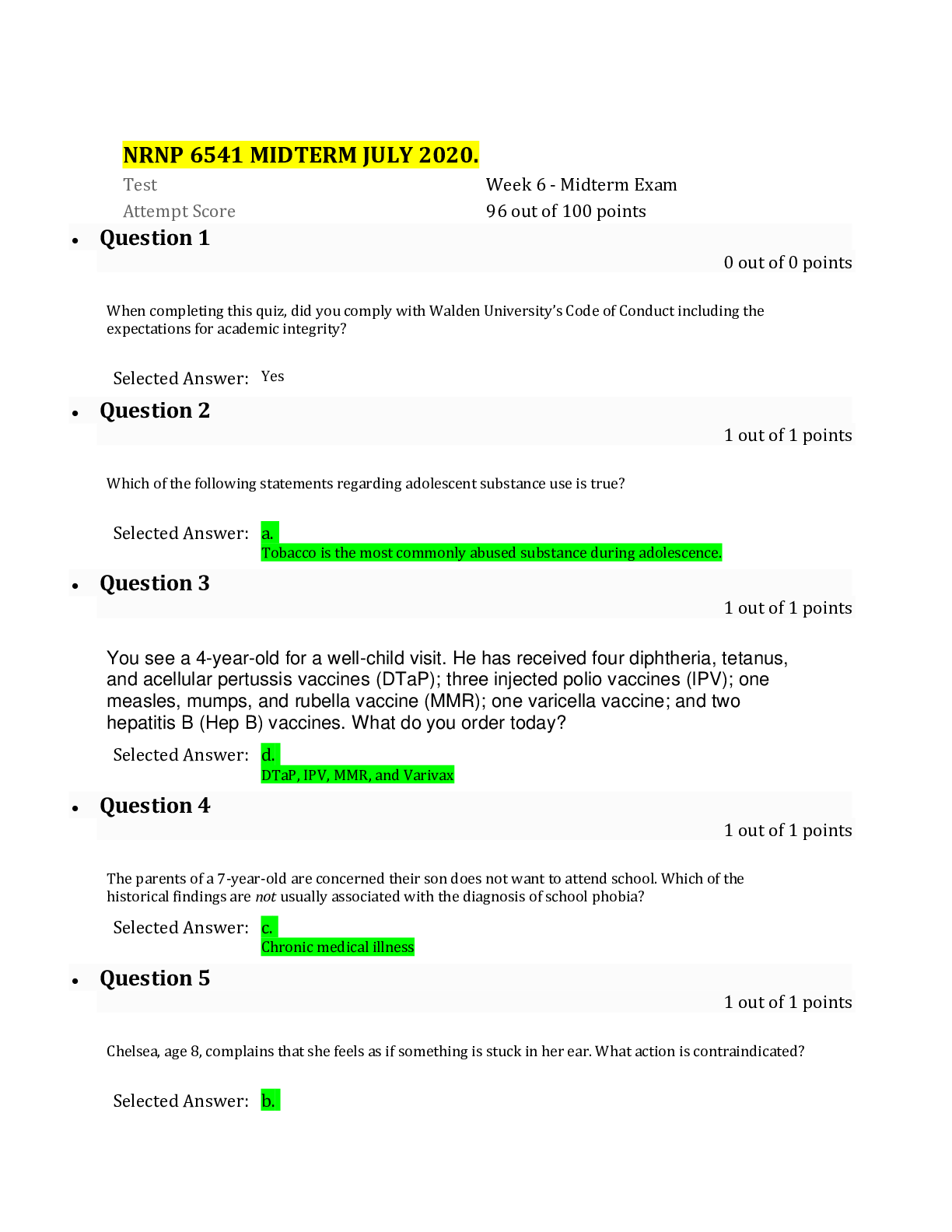
• 0 out of 0 points
When completing this quiz, did you comply with Walden University’s Code of Conduct including the expectations for academic
integrity?
Selected Answer: Yes
Friday, May 8, 2020 12:41:41 AM EDT
[Show More]

 Final Exam Study Guide Review A21.png)









.png)

![Preview of Walden University - NURS 6660/NURS 6660 final COMPLETED A [Completed for 2022/2023]](https://scholarfriends.com/storage/Walden UniversityWalden University - NURS 6660NURS 6660 final.png)