Micro Biology  >  EXAMs  >  Micro Exam 6 Portage Learning (All)

Micro Exam 6 Portage Learning

Document Content and Description Below

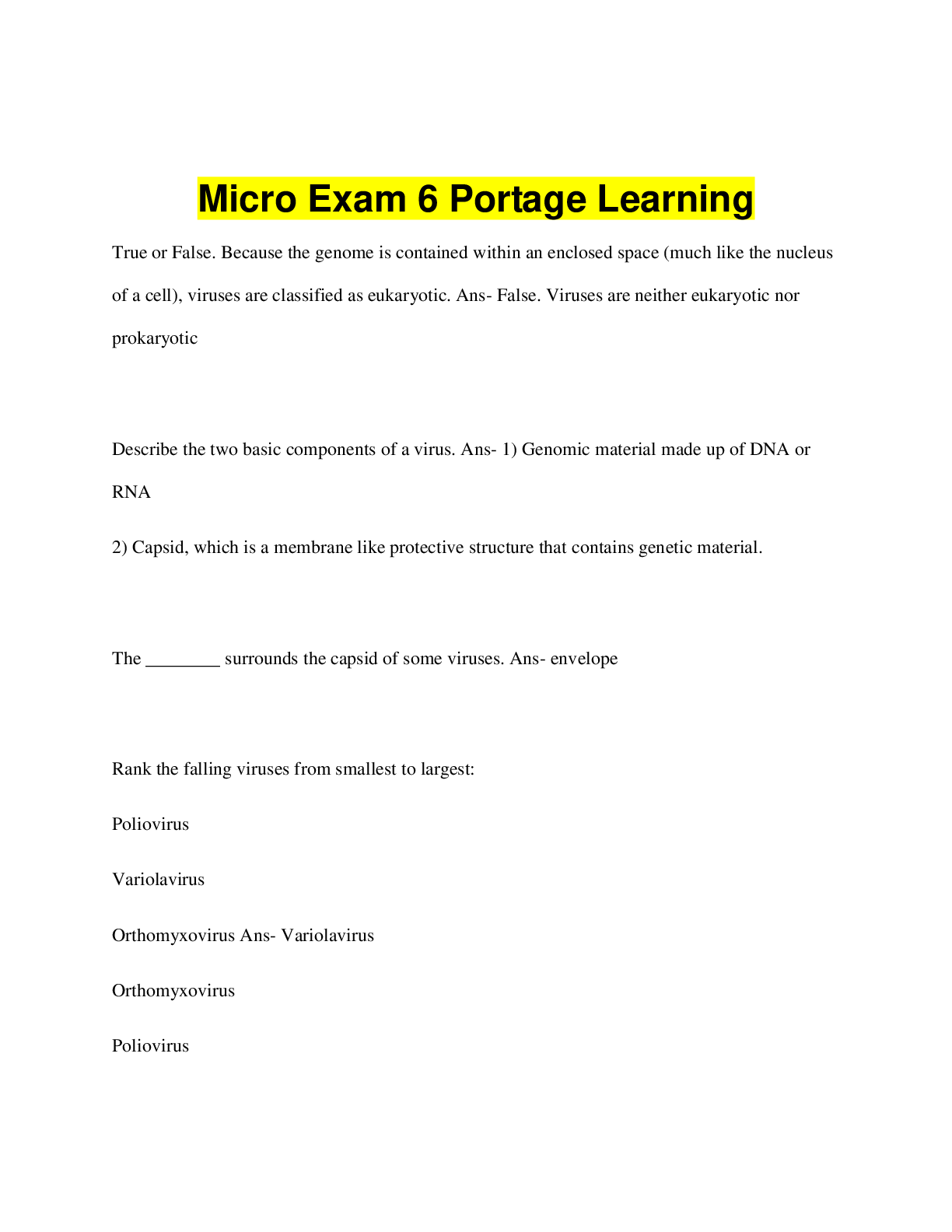
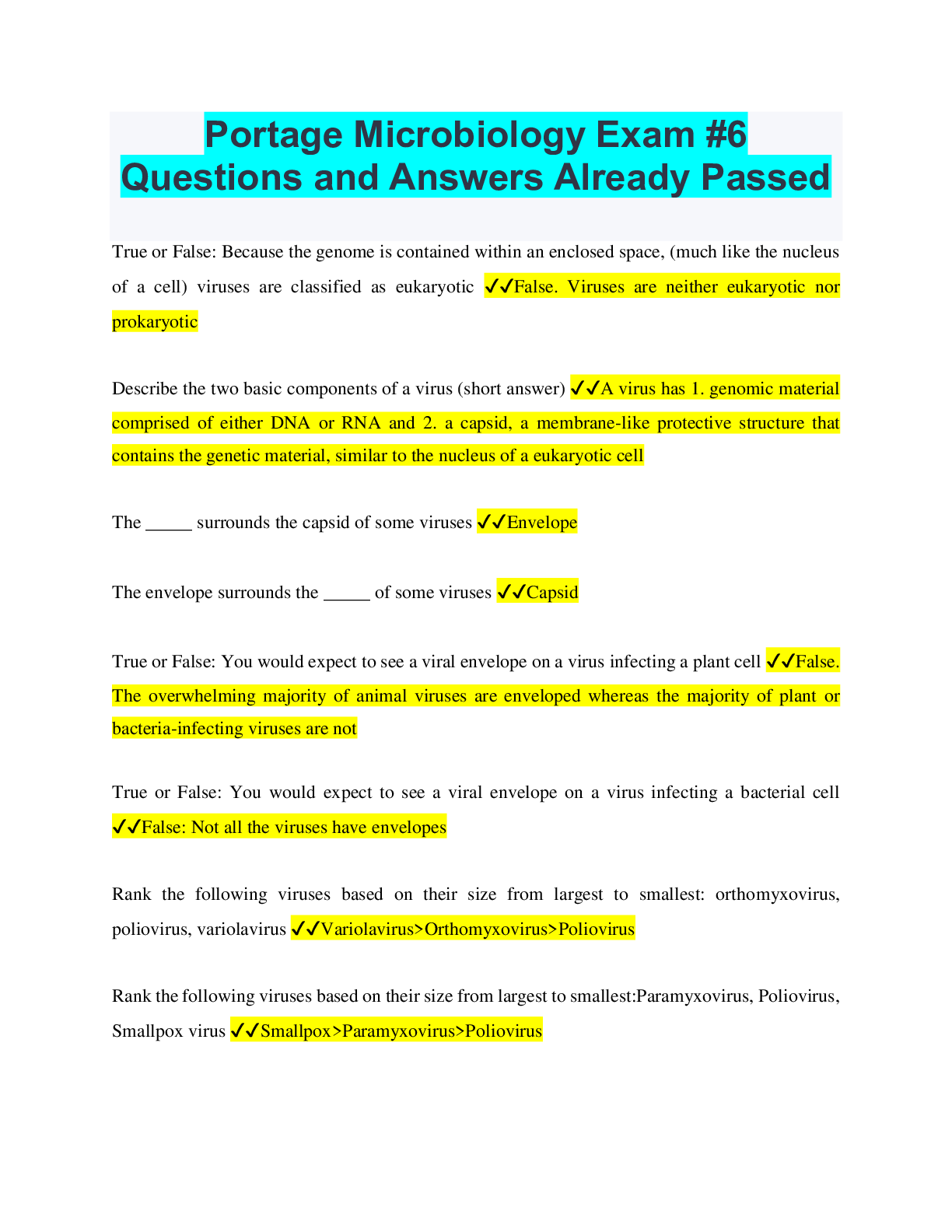
True or False. Because the genome is contained within an enclosed space (much like the nucleus of a cell), viruses are classified as eukaryotic. Ans- False. Viruses are neither eukaryotic nor prok ... aryotic Describe the two basic components of a virus. Ans- 1) Genomic material made up of DNA or RNA 2) Capsid, which is a membrane like protective structure that contains genetic material. The ________ surrounds the capsid of some viruses. Ans- envelope Rank the falling viruses from smallest to largest: Poliovirus Variolavirus Orthomyxovirus Ans- Variolavirus Orthomyxovirus Poliovirus True or False: Viral replication occurs after it attaches and enters the host cell. Ans- True True or False. You would expect to see a viral envelope on a virus infecting a bacterial cell. AnsFalse. The majority of animal viruses are enveloped whereas the majority of plant or bacteria infecting viruses are not Rank the following viruses based on their size from largest to smallest: Paramyxovirus Polivirus Smallpox virus Ans- 1 (Largest): Smallpox 2: Paramyxovirus 3 (Smallest): Poliovirus True or False: Highly infectious viruses undergo genome replication prior to viral attachment and entry. Ans- False. The viral genome is never replicated before attachment and entry regardless of its level of infectivity Place the following viral life cycle steps in order beginning with viral attachment and provide a description of each step. Uncoating: Release: Replication: Attachment: Entry: New infection: Ans- 1) Viral Attachment: Virus particle attaches to surface of host's cell 2) Entry: Virus fuses with host membrane and enters cell 3) Uncoating: once viral genetic material is inside host's cell, envelope will shed releasing genetic material (disessembles) 4) Replication: Viral genetic material replicates and new viral proteins are made 5) Release: New viruses produced & leave host cell 6) New Infection: Newly released virus particles find a new host cell to infect (continuing process) A virus that infects bacteria is called a [answer1] and contains a [answer2] -sided polygon capsid. Ans- Bacteriophages 20 True or False. Structurally, bacteriophages are distinct from viruses that infect plant or animal cells. Ans- True. Bacteriophages are structurally distinct from viruses that infect plant and animal cells True or False: Structurally, bacteriophages are similar to viruses that infect animals Ans- False Identify the following components of a bacteriophage. Ans- 1) Capsid 2) Collar 3) Sheath 4) Base plat [Show More]

Last updated: 2 years ago

Preview 1 out of 10 pages

Buy Now

Instant download

We Accept:

Payment methods accepted on Scholarfriends (We Accept)
Preview image of Micro Exam 6 Portage Learning document

Buy this document to get the full access instantly

Instant Download Access after purchase

Buy Now

Instant download

We Accept:

Payment methods accepted on Scholarfriends (We Accept)

Reviews( 0 )

$9.50

Buy Now

We Accept:

Payment methods accepted on Scholarfriends (We Accept)

Instant download

Can't find what you want? Try our AI powered Search

91
0

Document information


Connected school, study & course


About the document


Uploaded On

Feb 11, 2023

Number of pages

10

Written in

All

Seller


Profile illustration for Native
Native

Member since 3 years

7 Documents Sold

Reviews Received
0
0
0
0
1
Additional information

This document has been written for:

Uploaded

Feb 11, 2023

Downloads

 0

Views

 91

Document Keyword Tags

Recommended For You

Get more on EXAMs »

$9.50
What is Scholarfriends

Scholarfriends.com Online Platform by Browsegrades Inc. 651N South Broad St, Middletown DE. United States.

We are here to help

We're available through e-mail, Twitter, Facebook, and live chat.
 FAQ
 Questions? Leave a message!

Follow us on
 Twitter

Copyright © Scholarfriends · High quality services·