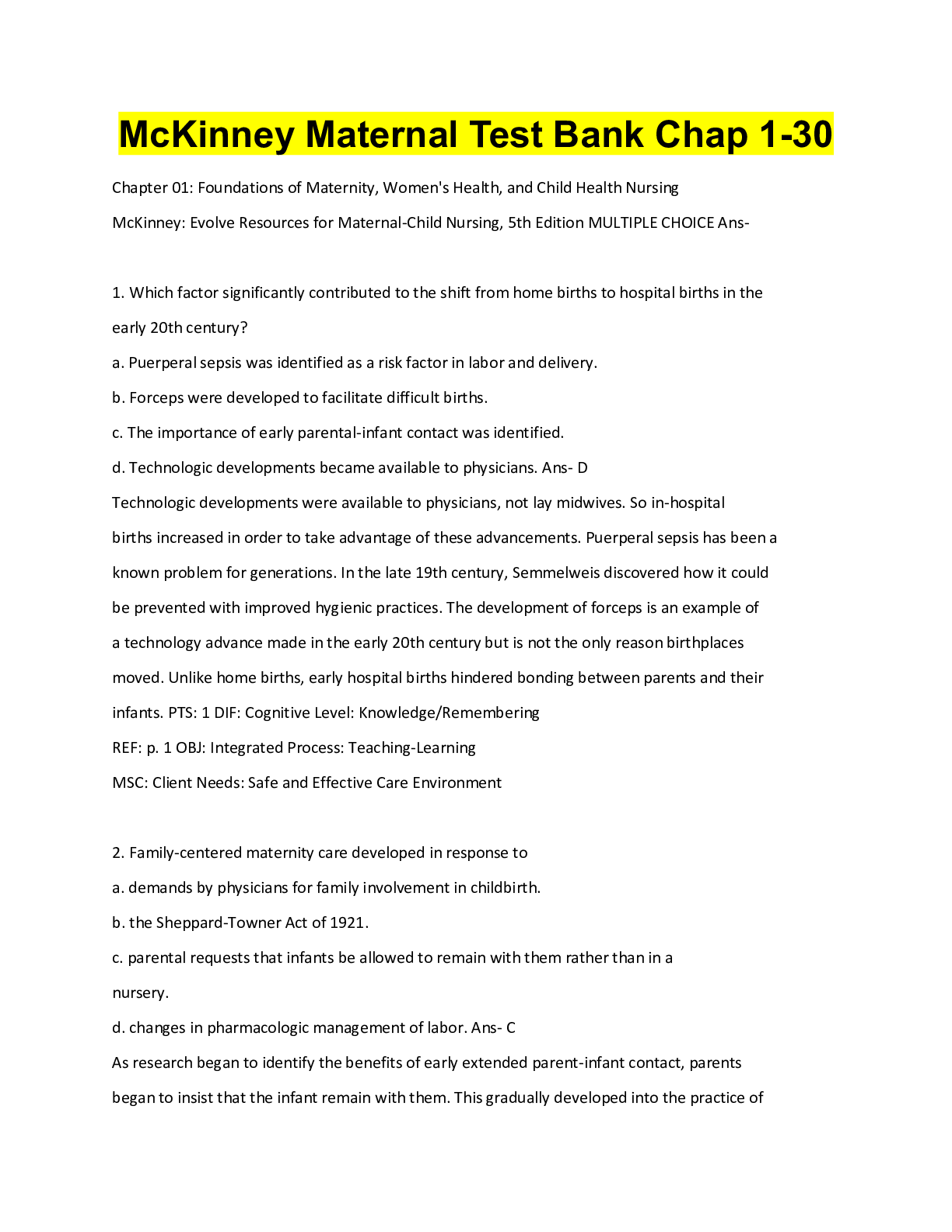
EMT Chapter 6: The Human Body - Multiple Choice Questions Rated A+
Document Content and Description Below
The part of the brain that controls the left side of the body is the:
A. Left-side cerebrum
B. Left parietal lobe
C. Right-side cerebrum
D. Right temporal lobe Ans- C. Right-side cerebrum
Activities such as walking,
...
[Show More]
Last updated: 3 years ago
Preview 1 out of 34 pages
Instant download
.png)
Buy this Document to get the Full Access Instantly
Provided by Students Who Aced it
We Verify Document Content to Gurantee Accuracy
Reviews( 0 )
Document information
Connected school, study & course
About the document
Uploaded On
Feb 12, 2023
Number of pages
34
Written in
All

Additional information
This document has been written for:
Uploaded
Feb 12, 2023
Downloads
0
Views
143
Topic Tags
Recommended For You
Get more on EXAM »
$80
29 Pages
NR565 Week 8 Final Exam Complete with 100 Questions and 100% C...

$9
3 Pages
NR 661 Week 3 APEA Module: Endocrine / Disorders – APEA Practi...
$16
20 Pages
Galen College of Nursing Foundations Of Nursing: NUR 155 Exam...



More related documents below


.png)
.png)