Cardio output (CO)
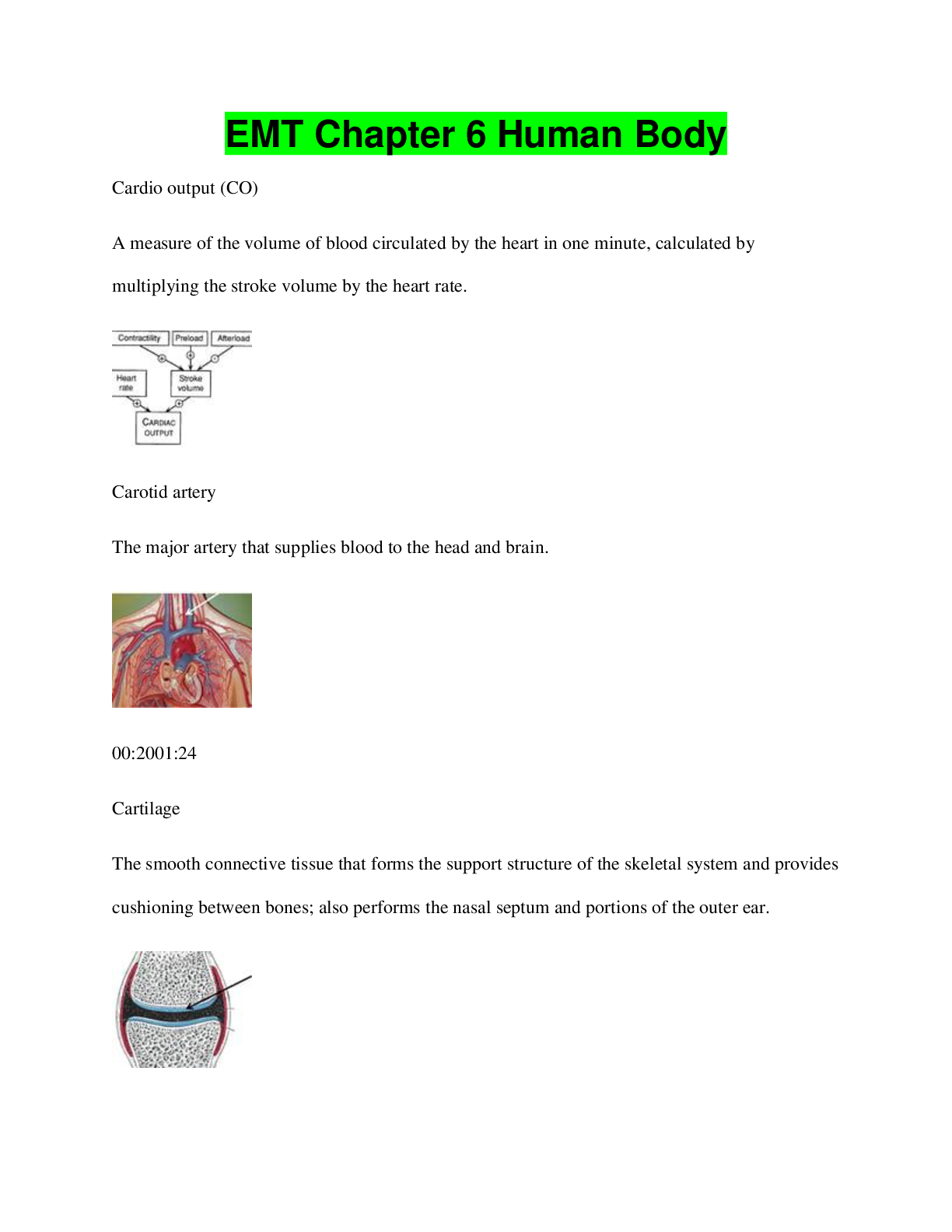
A measure of the volume of blood circulated by the heart in one minute, calculated by
multiplying the stroke volume by the heart rate.
Carotid artery
The major artery that supplies blood to the he
...
Cardio output (CO)
A measure of the volume of blood circulated by the heart in one minute, calculated by
multiplying the stroke volume by the heart rate.
Carotid artery
The major artery that supplies blood to the head and brain.
00:2001:24
Cartilage
The smooth connective tissue that forms the support structure of the skeletal system and provides
cushioning between bones; also performs the nasal septum and portions of the outer ear.
Cecum
The first part of the large intestine into which the Ileum opens.
Central nervous system (CNS)
The brain and spinal cord.
Cerebellum
13 major subdivisions of the brain, sometimes called the little brain; coordinate the various
activities of the brain particularly fine body movements.
Cerebrospinal fluid (CSF)
The fluid produced in the ventricles of the brain that flows in the subarachnoid Space and bathes
the meninges
Cerebrum
The largest part of the three subdivisions of the brain, sometimes called the gray matter; made up
of several lobes that control movement, hearing, balance, speech, Visual perception, emotions,
and personality.
Cervical spine
The portion of the spinal column consisting of the first seven vertebrae that lie in the neck.
Chordae tendineae
Thin bands of fibrous tissue that attached to the valves in the heart and prevent them from
inverting.
Chyme
The substance that leaves the stomach. It is a combination of all all of the eaten foods with added
stomach acids.
Circulatory system
The complex arrangement of connected tubes, including the arteries, arterioles, capillaries,
venules and the veins, that moves blood, oxygen, nutrients, carbon dioxide, and cellular waste
throughout the body.
00:0201:2
[Show More]