Characteristics of preferred stock includes Ans- -dividends in arrears
-dividends are cumulative
-higher payoff claim in a BK (has first dibs in a BK)
-considered "hybrid" (part stock/part bond)
-no fixed maturity da
...
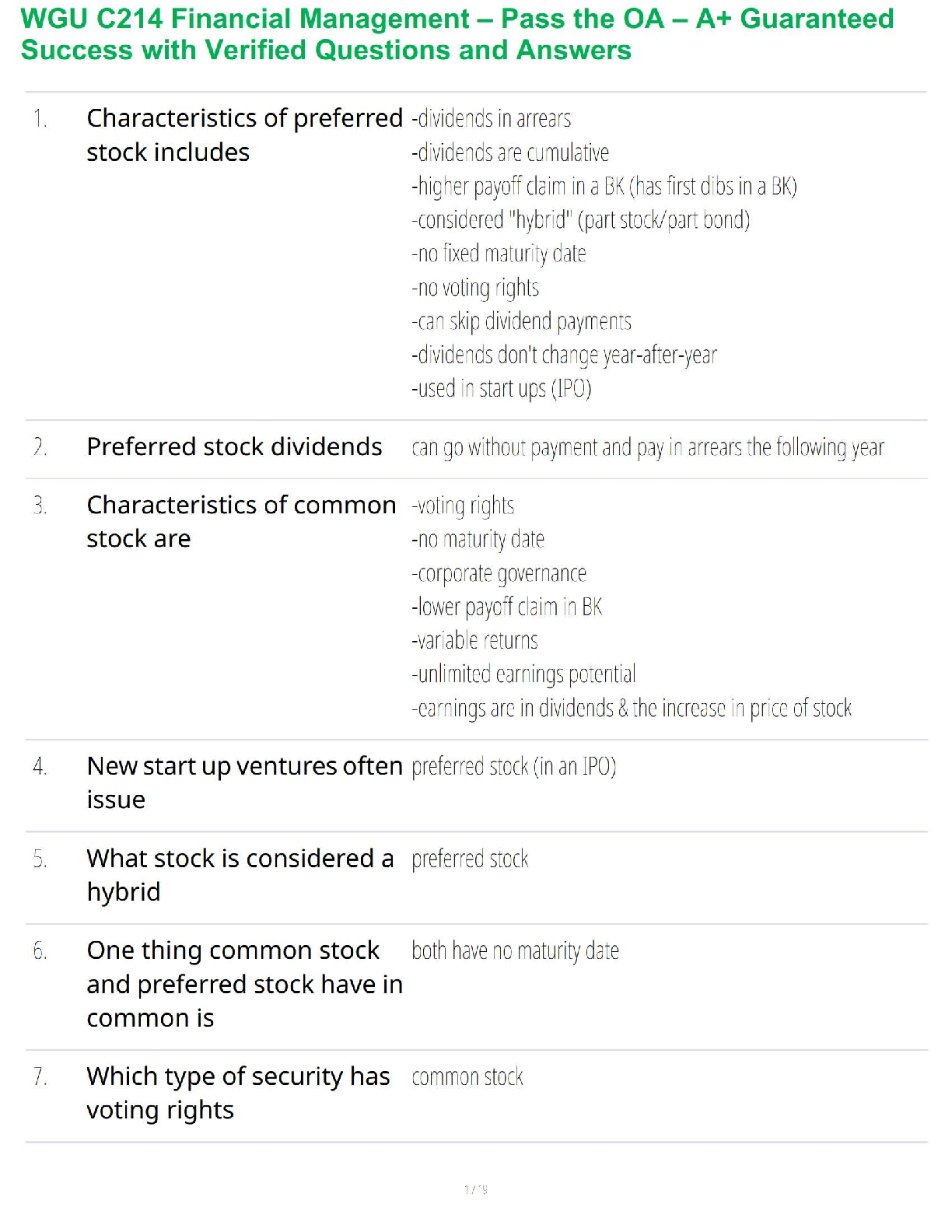
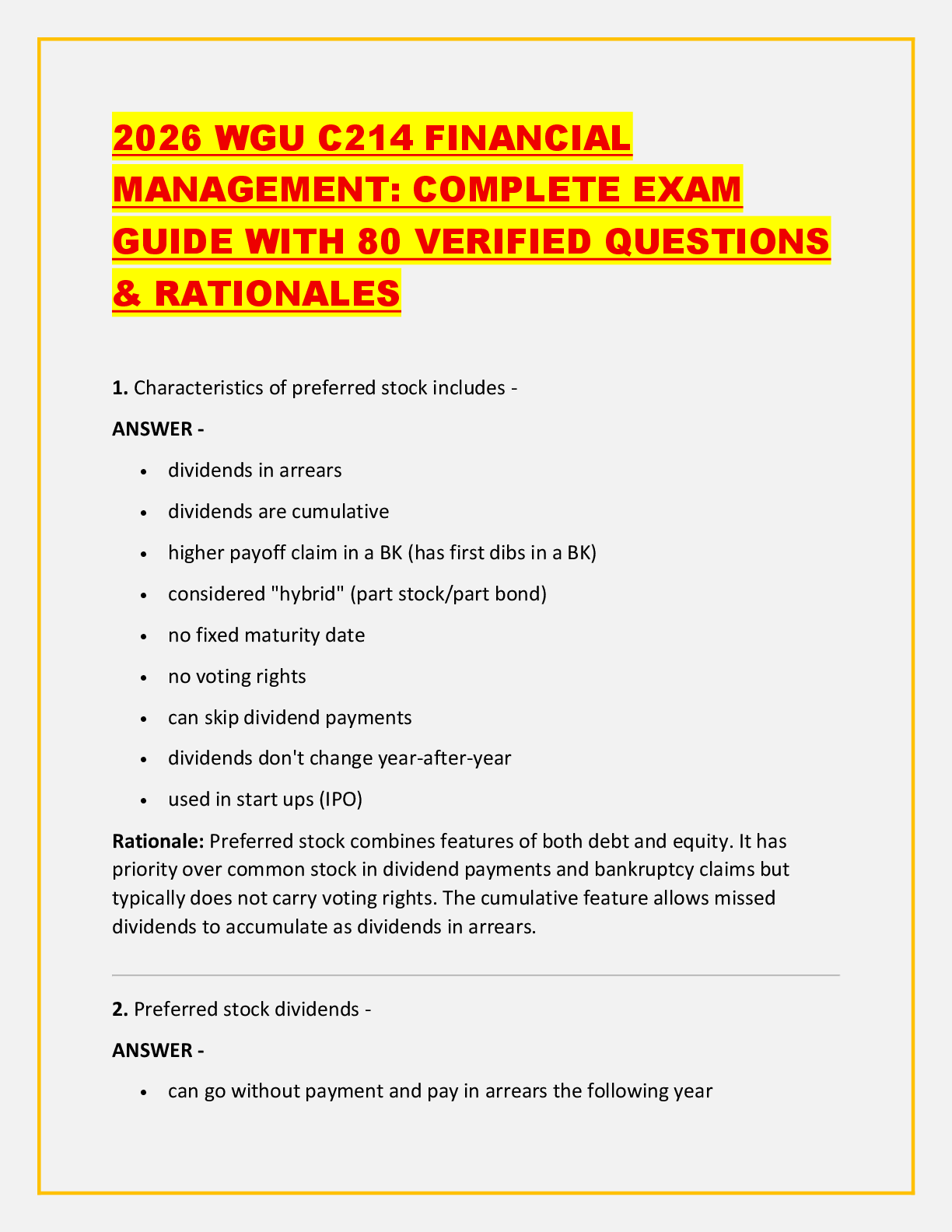
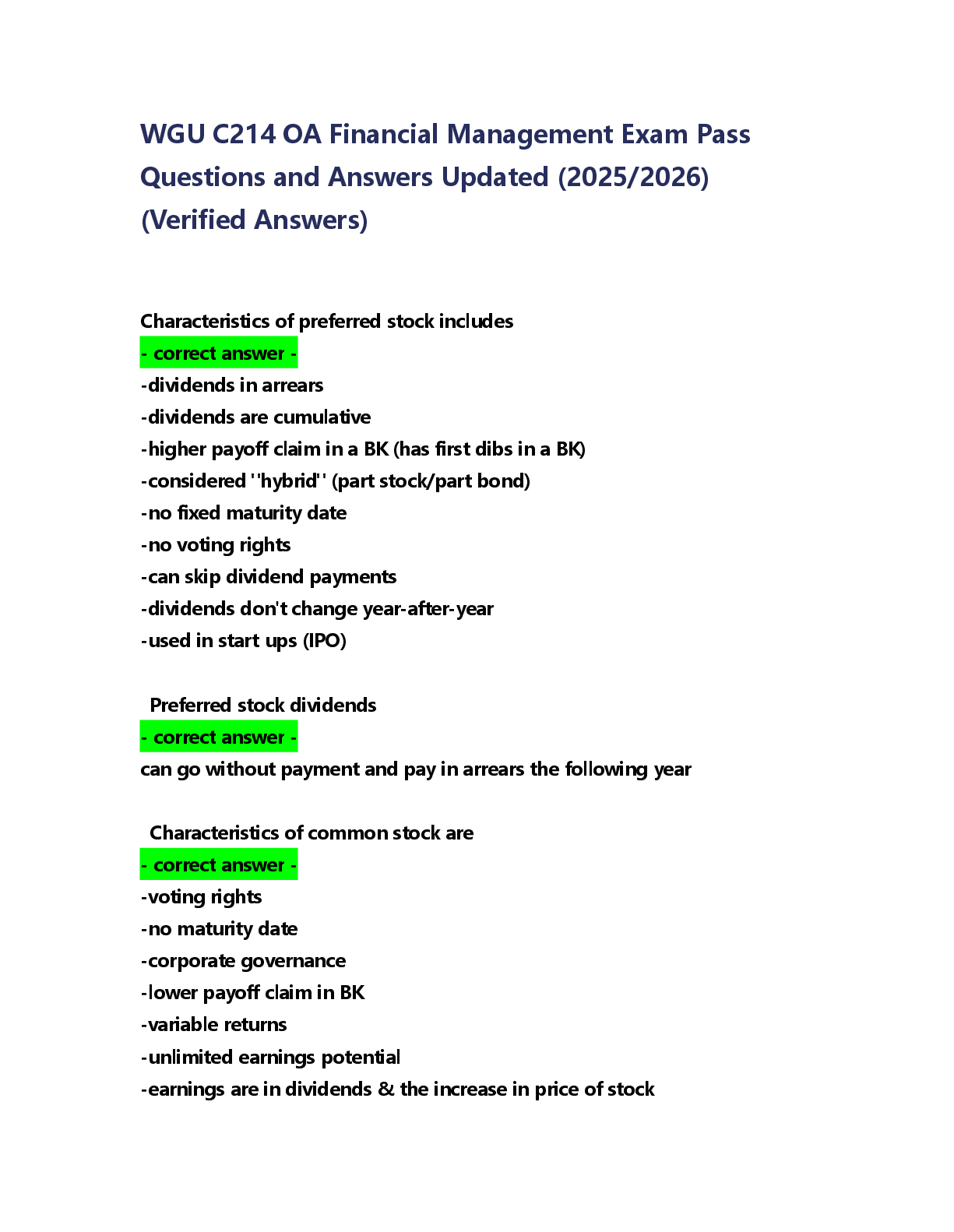
Characteristics of preferred stock includes Ans- -dividends in arrears
-dividends are cumulative
-higher payoff claim in a BK (has first dibs in a BK)
-considered "hybrid" (part stock/part bond)
-no fixed maturity date
-no voting rights
-can skip dividend payments
-dividends don't change year-after-year
-used in start ups (IPO)
Preferred stock dividends Ans- can go without payment and pay in arrears the following year
Characteristics of common stock are Ans- -voting rights
-no maturity date
-corporate governance
-lower payoff claim in BK
-variable returns
-unlimited earnings potential
-earnings are in dividends & the increase in price of stock
New start up ventures often issue Ans- preferred stock (in an IPO)
What stock is considered a hybrid Ans- preferred stock
One thing common stock and preferred stock have in common is Ans- both have no maturity date
Which type of security has voting rights Ans- common stock
Debt covenants and restrictions help to ensure that Ans- management is meeting bond and shareholder
expectations
NOTE: covenants are promises meant to be kept
What is true regarding bonds Ans- -when bond matures, bondholder gets lump sum back
-coupon rate doesn't change
-maturity is in years
-PAR value is typically $1000
-Future value (same as PAR) is typically $1000
Bond sells at face value when Ans- required rate of return is equal to the coupon rate
Why are bonds the primary method for raising capital Ans- because bonds remove the intermediary
costs
NOTE: IPO's require an intermediary known as a syndicate - a group of banks underwriting the security
issue
What type of bond can be traded for stock Ans- convertible bonds
What is the interest rate for annual payments of a bond known as Ans- the coupon rate
NOTE: coupon rate is the established interest rate for the life of the bond and will remain unchanged
Coupon rate is the established rate of the bond and should Ans- never change
Debentures are Ans- secured bonds
NOTE: debentures are a debt instrument (bond) issued to raise cash, secured against a company's assets
and backed by credit, transferable by the holder, and may also be unsecured
Secured loan Ans- has collateral like a mortgage
The amount repaid at the expiration date of a bond is Ans- PAR value
NOTE: expiration date is also known as maturity date PAR (or Face Value) is typically $1000
Duration measures Ans- the market risk of a bond and is the percentage drop in price caused by a 1%
increase in yield (rate)
NOTE: measurement of the drop in price after a rate increase
Maturity of bonds is calculated in Ans- years
A bond premium occurs when Ans- bonds are issued for an amount greater than their face or maturity
amount; caused by the bonds having a stated interest rate that is higher than the market interest rate
for similar bonds
Junk Bonds are Ans- high yield bonds without any stability
"Leveraged" results in Ans- having more debt (bonds) than equity (stock) and lower stock prices
NOTE: recall that debt is safer and levels out risk in a portfolio
In current assets, inventory is the Ans- LEAST liquid of current assets
NOTE: current assets take less than 12 months to make liquid
Net fixed assets are Ans- long term assets such as buildings, land, equipment, machinery
NOTE: assets that are not current
A/P represents money paid to Ans- suppliers for what is bought on credit and amount owed by a
business to suppliers by agreement
NOTE: A/P is supplies, inventory, or PP&E
Notes payable involves Ans- an explicit interest bearing arrangement with the lender at interest cost
NOTE: notes payable is a long-term liability
Current liabilities are listed in order of Ans- maturity
NOTE: current liabilities are to be paid within 12 months
Two things you can do with net income Ans- pay out as dividends or retain (plow back into the firm)
On the Statement of Cash Flows, CFO's include Ans- -cash receipts from customers (inflow)
-cash paid for inventory (outflow)
-cash paid for wages (outflow)
NOTE: receipts of cash is inflow & what is paid out is outflow
Which is NOT considered an operating expense Ans- interest expense is NOT considered an operating
expense
On the Statement of Cash Flows, CFI includes Ans- cash receipts from sale of property and equipment
(inflow), cash paid for purchase of equipment (outflow)
NOTE: receipts of cash is inflow & what is paid out is outflow
Which of the following is true with respect to CFO Ans- an increase in inventory indicates a reduction in
CFO
NOTE: there is a cost (reduction) to purchasing (increasing) inventory
The Statement of Cash Flows is not useful when addressing the financial health of a firm due to the
impact of accrual accounting Ans- FALSE - the impact of accrual accounting is seen as MOST useful in
relation to net income
Which is true with respect to CFF Ans- an increase in notes payable indicates an increase in CFF
Which is not a part of the Statement of Cash Flows Ans- cash flows from liquidating activities
NOTE: cash flows are operating, investing, and financing
The sum of CFO + CFI + CFF is equal to Ans- the change in cash during the period
Depreciation expense is a significant source of difference between net income and CFO because Ans�depreciation is a non-cash expense on the Income Statement associated with the acquisition of long�term assets
Subordinated bonds Ans- are bonds not backed by collateral
For visualization purposes, CFI accounts are generally non-current assets on the bottom of the asset side
of the Balance Sheet Ans- TRUE
NOTE: CFI is investing in PP&E and is considered long-term assets shown as assets on the Balance Sheet
Increases in operating assets and decreases in operating liabilities will Ans- decrease CFO
NOTE: an increase in PP&E (assets) consumes operating cash; decreases in equipment (liabilities) also
consumes operating cash (CFO)
Unsecured loan Ans- has no collateral
NOTE: a credit card is an example
Assuming no asset disposals, CFI is Ans- the change in Gross PP&E -or- CFI is the change in NET PP&E
plus depreciation expense
Assuming no asset disposals, depreciation expense is equal to Ans- the change in ACCUMULATED
depreciation
Assets are financed by Ans- other people's money or equity
Dividends are considered Ans- CFF (financing section)
A firm with positive CFO should be considered healthy Ans- FALSE
NOTE: a positive CFO can still be detrimental to the firm depending on other factor
[Show More]






.png)